
1. Background
The cardiac autonomic nervous system is central to the regulation of cardiovascular homeostasis and orchestrates the balance between sympathetic and parasympathetic activity (1). This dynamic equilibrium modulates heart rate, blood pressure, and cardiac responses to internal and external stimuli. Disruptions in autonomic balance, as assessed by heart rate variability (HRV), are associated with increased cardiovascular risk, including arrhythmias, hypertension, and ischemic heart disease (2, 3).
Heart rate variability has emerged as a noninvasive, reliable, and sensitive biomarker for evaluating cardiac autonomic function (4). It reflects the heart’s capacity to adapt to physiological and environmental demands and provides insight into sympathovagal balance. Time-domain indices, such as the standard deviation of normal-to-normal intervals (SDNN), the root mean square of successive differences (RMSSD), and the percentage of successive NN intervals differing by more than 50 ms (PNN50%), quantify the magnitude of beat-to-beat variability. Frequency-domain analysis distinguishes contributions from low-frequency (LF) and high-frequency (HF) components, which correspond primarily to sympathetic and parasympathetic activity, respectively (5). The LF/HF ratio is widely used as an indicator of cardiac sympathovagal balance, and alterations in these parameters may reveal shifts in autonomic tone even in otherwise healthy individuals (6).
Pharmacological agents can substantially affect autonomic regulation (7). Dimenhydrinate, a first-generation H1 histamine receptor antagonist, is commonly administered to alleviate motion sickness, nausea, and vomiting (8). Its primary mechanisms involve central vestibular suppression and modulation of histaminergic pathways; however, its anticholinergic and mild sedative properties may also influence cardiovascular autonomic control (9). Although dimenhydrinate is generally regarded as safe in healthy adults, its acute effects on HRV and cardiac autonomic function remain poorly characterized, particularly in young, healthy populations (10).
Previous research has shown that antihistamines and other agents acting on the central nervous system can modify autonomic indices, including HRV, blood pressure, and baroreflex sensitivity (11). Most studies, however, have focused on patient populations or chronic drug administration, leaving a notable gap regarding the immediate impact of a single oral dose of dimenhydrinate on cardiac autonomic regulation in healthy young adults (10, 12). Investigating this effect is important because even transient alterations in autonomic balance may provide valuable insights into drug safety, physiological adaptation, and potential implications for susceptible individuals (4, 10).
Advances in HRV analysis, including time-domain and frequency-domain metrics, enable precise quantification of autonomic responses following pharmacological challenges (5). Short-term 5-minute ECG recordings provide reliable estimates of LF, HF, and the LF/HF ratio, allowing high-resolution temporal monitoring of autonomic dynamics (6). These methods are particularly useful in crossover clinical trial designs, in which participants serve as their own controls, thereby minimizing interindividual variability and enhancing statistical power (12).
2. Objectives
Given the widespread use of dimenhydrinate, its well-characterized pharmacokinetics, and the limited number of controlled studies evaluating its autonomic effects in healthy volunteers, this randomized, double-blind, placebo-controlled crossover study was designed to assess the acute effects of 50 mg oral dimenhydrinate on cardiac autonomic responses in healthy young adults, as measured using time-domain and frequency-domain HRV indices.
3. Methods
3.1. Study Design
This randomized, double-blind, placebo-controlled, crossover phase I clinical trial was designed to investigate the acute effects of a single oral dose of dimenhydrinate on cardiac autonomic function in healthy young adults. Each participant served as their own control and received both interventions (50 mg dimenhydrinate and a visually identical placebo) in 2 separate sessions in randomized order. A 2-week washout period separated the sessions to minimize potential carryover effects.
3.2. Participants
Fifteen healthy volunteers aged 19 to 26 years (mean body mass index [BMI], 22.75 ± 1.62 kg/m²) were recruited from Babol University of Medical Sciences. Inclusion criteria were normal health status, absence of chronic or acute disease, and no use of medications, alcohol, or tobacco. Exclusion criteria included cardiovascular disorders, contraindications to dimenhydrinate, substance abuse, and abnormal ECG findings. Dimenhydrinate tablets and matching placebo were manufactured by Darou Pakhsh Pharmaceutical Manufacturing Co., a major Iranian pharmaceutical company headquartered in Tehran, Iran. Written informed consent was obtained from all participants before the study procedures. The study protocol was approved by the Ethics Committee of Babol University of Medical Sciences (IR.MUBABOL.REC.1402.018) and registered in the Iranian Clinical Trial Registry (IRCT20230606058390N1).
3.3. Experimental Procedure
Participants attended 2 experimental sessions conducted between 8:00 and 12:00 AM after receiving standardized pretest instructions, including abstinence from caffeine, alcohol, strenuous exercise, and heavy meals. Each session began with a 15-minute rest period in the supine position. Baseline 5-minute ECG recordings were obtained in lead II using a 3-electrode configuration (right wrist × 2 and left wrist × 1) connected to an eWave bioamplifier (ScienceBeam, Iran), with a 1 kHz sampling frequency and 24-bit resolution. Participants then ingested either 50 mg dimenhydrinate or placebo. ECG recordings were acquired at 30-minute intervals over a 4-hour period after ingestion. Raw ECG signals were digitized, stored, and processed using eProbe software to extract R-R intervals. The resulting NN interval series were visually inspected to remove artifacts, ectopic beats, and noise.
3.4. Heart Rate Variability Analysis
Heart rate variability was analyzed in both the time and frequency domains. Time-domain indices included SDNN, RMSSD, PNN50%, and the mean NN interval. Frequency-domain analysis was performed using fast Fourier transform to calculate HF power (0.15 - 0.40 Hz) and LF power (0.04 - 0.15 Hz). High-frequency power was interpreted as a marker of parasympathetic activity, LF power reflected combined sympathetic and parasympathetic influences mediated by baroreflex mechanisms, and the LF/HF ratio served as an index of sympathovagal balance. LF and HF powers were calculated in both absolute and normalized units (LFnu and HFnu) for comprehensive assessment.
3.5. Statistical Analysis
Data normality was assessed using the Kolmogorov-Smirnov test. Parametric data were analyzed using repeated-measures analysis of variance to compare HRV indices across time points and conditions. Nonparametric data were evaluated using the Kruskal-Wallis test, followed by post hoc Mann-Whitney comparisons. Statistical significance was set at P ≤ 0.05. All results are presented as mean ± standard deviation. Statistical analyses were conducted using SPSS version 26 (IBM Corp., Armonk, NY, USA).
4. Results
A total of 15 healthy young adults participated in this study. The mean age of the participants was 23.87 ± 2.16 years (range, 19 - 26 years), and the mean BMI was 22.75 ± 1.62 kg/m² (range, 19.9 - 24.5 kg/m²). The study population included 8 males (53.3%) and 7 females (46.7%). Baseline comparisons of all study variables were performed at time zero on day 1 and day 14 (repeat session) to assess potential carryover effects. No statistically significant differences were observed between baseline measurements across the 2 sessions (all P > 0.05), indicating comparability between the 2 study periods.
Repeated-measures analysis of variance showed that the mean RR interval (MRR) did not differ significantly across measurement time points in either the placebo group or the dimenhydrinate group (P = 0.307 and P = 0.921, respectively). Similarly, comparisons of MRR values between baseline and postadministration time points showed no significant interaction between time and treatment condition (P = 0.265), indicating that oral administration of dimenhydrinate did not induce statistically significant alterations in MRR compared with placebo. The mean ± SD of MRR values for both the dimenhydrinate and placebo conditions at all time points are presented in Table 1. Pairwise comparisons using paired t tests showed no statistically significant differences between the 2 groups at any individual time point (P > 0.05 for all comparisons). Notably, at 1 hour after administration, a trend toward a greater increase in MRR was observed in the dimenhydrinate group than in the placebo group (P = 0.068). Although this difference did not reach statistical significance, the magnitude of change may be clinically relevant. As illustrated in Figure 1, mean MRR values decreased in the dimenhydrinate group at 1.5, 2, and 3 hours after administration, a pattern not evident in the placebo group. However, these changes did not reach statistical significance.
Table 1.
Comparison of Mean ± SD SDNN Before and for 4 Hours After Oral Administration of Drug and Placebo a
| Time Points and Groups | SDNN (ms) | Standard Deviation | P-Value |
|---|---|---|---|
| Baseline | 0.284 | ||
| Dimenhydrinate | 74.66 | 23.33 | |
| Placebo | 65.09 | 24.66 | |
| 30 min | 0.861 | ||
| Dimenhydrinate | 73.31 | 28.68 | |
| Placebo | 71.06 | 40.34 | |
| 60 min | 0.218 | ||
| Dimenhydrinate | 108.50 | 135.84 | |
| Placebo | 63.98 | 17.34 | |
| 90 min | 0.038 | ||
| Dimenhydrinate | 73.81 | 28.39 | |
| Placebo | 51.57 | 27.46 | |
| 120 min | 0.882 | ||
| Dimenhydrinate | 74.02 | 33.87 | |
| Placebo | 76.20 | 45.55 | |
| 150 min | 0.330 | ||
| Dimenhydrinate | 86.72 | 55.46 | |
| Placebo | 71.67 | 19.57 | |
| 180 min | 0.216 | ||
| Dimenhydrinate | 75.75 | 25.53 | |
| Placebo | 63.78 | 26.21 | |
| 210 min | 0.672 | ||
| Dimenhydrinate | 79.54 | 32.80 | |
| Placebo | 74.99 | 24.91 | |
| 240 min | 0.135 | ||
| Dimenhydrinate | 78.90 | 29.18 | |
| Placebo | 63.86 | 24.10 |
a P-value was calculated using the paired t-test. A P-value < 0.05 was considered statistically significant.
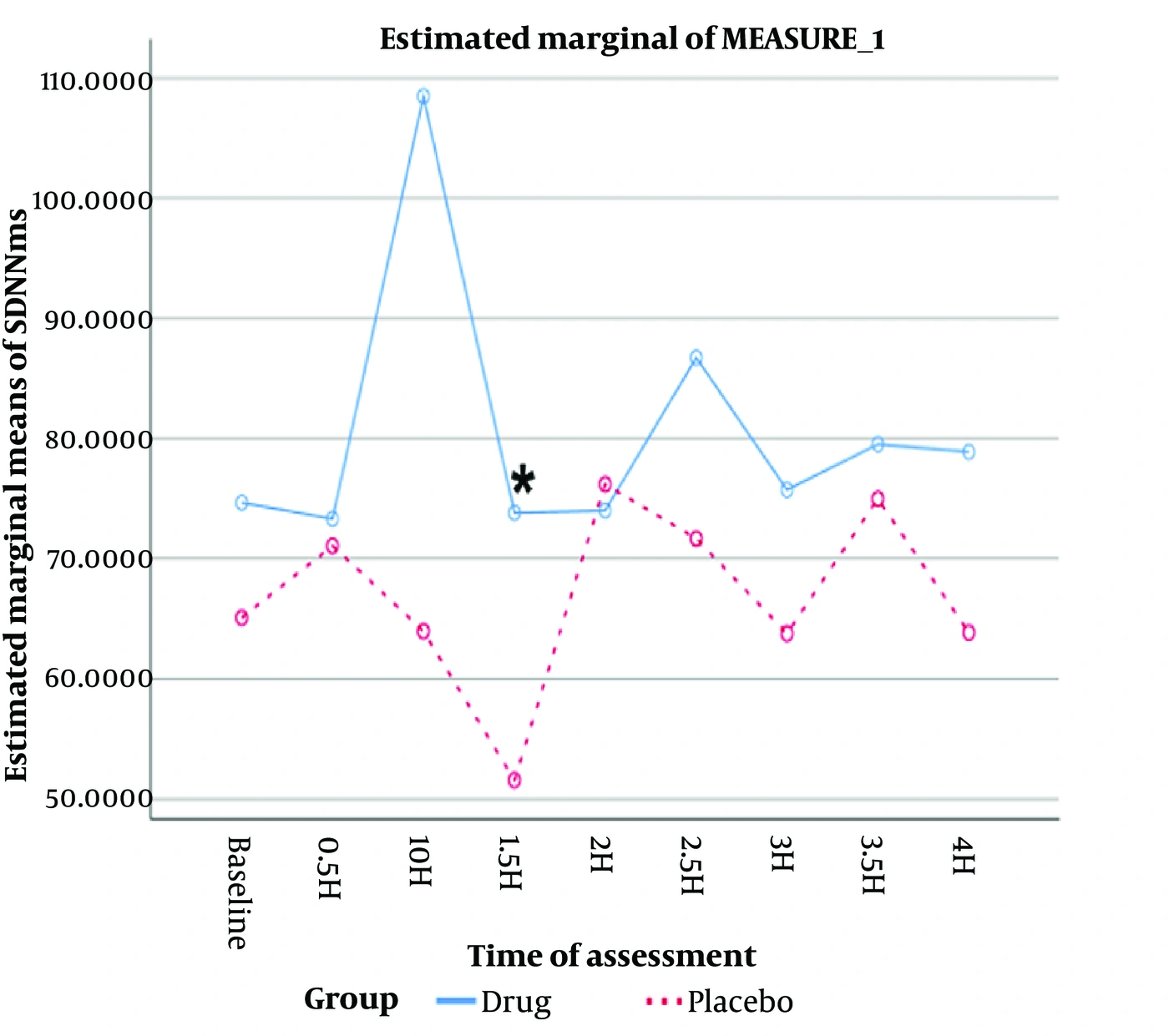
Figure 1.
Mean ± SD of SDNN before and for 4 hours after oral administration of drug and placebo (values presented as mean; P ≤ 0.05)
Analysis of variance within the drug and placebo groups showed no statistically significant differences in mean RMSSD across measurement times (P = 0.716 and P = 0.865, respectively). Repeated-measures analysis of variance comparing preadministration and postadministration time points showed no significant changes in RMSSD between the 2 groups (P = 0.236). The mean ± SD of RMSSD values in the drug and placebo groups are presented in Table 2. Pairwise comparisons at each time point using the paired t test indicated that, at 4 hours, the mean RMSSD in the drug group was significantly higher than that in the placebo group (P = 0.042). As illustrated in Figure 2, although differences in RMSSD trends were observed at 1, 2, 3, and 4 hours, the 4-hour measurement corresponded to a statistically significant difference between the 2 groups, as also shown in Table 2.
Table 2.
Comparison of Mean ± SD RMSSD Before and for 4 Hours After Oral Administration of Drug and Placebo
| RMSSD (ms) and Groups | Mean ± SD | P-value |
|---|---|---|
| Baseline | 0.324 | |
| Drug | 18.89 ± 38.20 | |
| Placebo | 75.77 ± 34.84 | |
| 30 min | 0.792 | |
| Drug | 85.92 ± 44.12 | |
| Placebo | 91.02 ± 59.57 | |
| 60 min | 0.227 | |
| Drug | 124.87 ± 157.13 | |
| Placebo | 73.90 ± 28.28 | |
| 90 min | 0.261 | |
| Drug | 88.27 ± 49.98 | |
| Placebo | 68.62 ± 43.61 | |
| 120 min | 0.660 | |
| Drug | 86.31 ± 51.32 | |
| Placebo | 97.03 ± 77.83 | |
| 150 min | 0.696 | |
| Drug | 89.50 ± 38.48 | |
| Placebo | 83.85 ± 39.88 | |
| 180 min | 0.163 | |
| Drug | 96.43 ± 44.34 | |
| Placebo | 75.31 ± 36.00 | |
| 210 min | 0.581 | |
| Drug | 95.75 ± 55.12 | |
| Placebo | 85.99 ± 39.26 | |
| 240 min | 0.042 a | |
| Drug | 102.42 ± 48.70 | |
| Placebo | 70.87 ± 30.45 |
a P value < 0.05 was considered statistically significant. P-value was calculated using the paired t test.
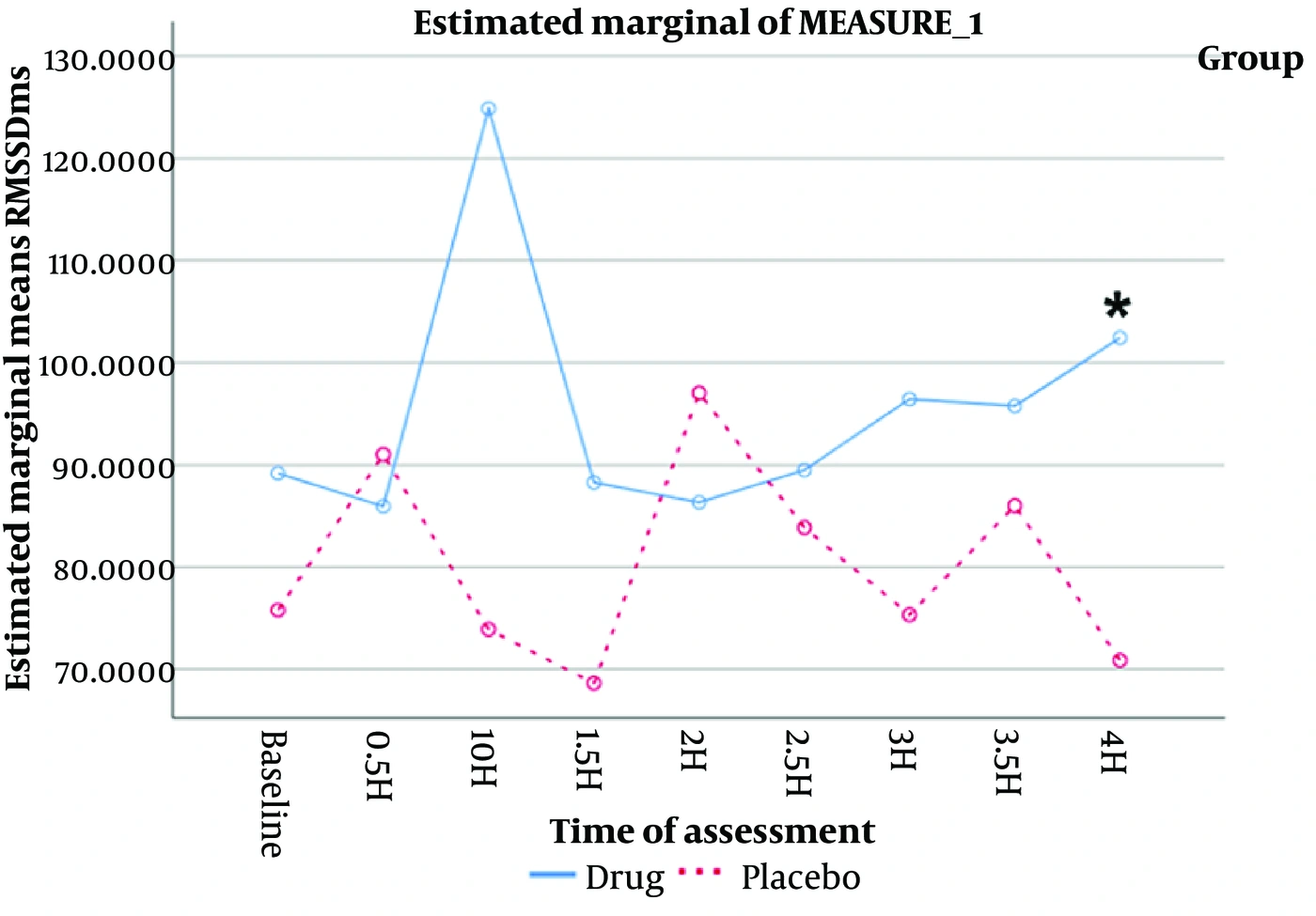
Figure 2.
Root mean square of RMSSD before and for 4 hours after oral administration of drug and placebo (values presented as mean; P ≤ 0.05)
Analysis of variance within the placebo and drug groups showed no statistically significant differences in mean PNN50% across measurement times (P = 0.957 and P = 0.818, respectively). Repeated-measures analysis of variance comparing preadministration and postadministration time points showed no significant changes in PNN50% between the 2 groups (P = 0.228). The mean ± SD of PNN50% values in the drug and placebo groups are presented in Table 3. Pairwise comparisons at each time point using the paired t test indicated that, at the 4-hour measurement, the mean PNN50% in the drug group was significantly higher than that in the placebo group (P = 0.027). As illustrated in Figure 3, a marked decline in PNN50% was observed in the placebo group at 4 hours, whereas the drug group exhibited an increasing trend.
Table 3.
Comparison of Mean Percentage of Successive R-R Intervals Differing by PNN50% Before and for 4 Hours After Oral Administration of Drug and Placebo
| PNN50% and Groups | Mean ± SD | P-Value |
|---|---|---|
| Baseline | 0.171 | |
| Drug | 27.01 ± 20.54 | |
| Placebo | 17.94 ± 14.18 | |
| 30 min | 0.538 | |
| Drug | 22.84 ± 20.43 | |
| Placebo | 18.58 ± 16.86 | |
| 60 min | 0.607 | |
| Drug | 24.13 ± 21.64 | |
| Placebo | 20.17 ± 20.02 | |
| 90 min | 0.979 | |
| Drug | 24.19 ± 21.05 | |
| Placebo | 23.95 ± 28.20 | |
| 120 min | 0.459 | |
| Drug | 30.03 ± 24.80 | |
| Placebo | 23.68 ± 21.42 | |
| 150 min | 0.360 | |
| Drug | 29.33 ± 21.67 | |
| Placebo | 21.82 ± 22.53 | |
| 180 min | 0.268 | |
| Drug | 33.55 ± 18.91 | |
| Placebo | 24.80 ± 23.28 | |
| 210 min | 0.328 | |
| Drug | 28.78 ± 21.75 | |
| Placebo | 20.61 ± 17.46 | |
| 240 min | 0.027 a | |
| Drug | 34.96 ± 26.34 | |
| Placebo | 16.00 ± 16.98 |
a P value < 0.05 was considered statistically significant. P value was calculated using the paired t test.
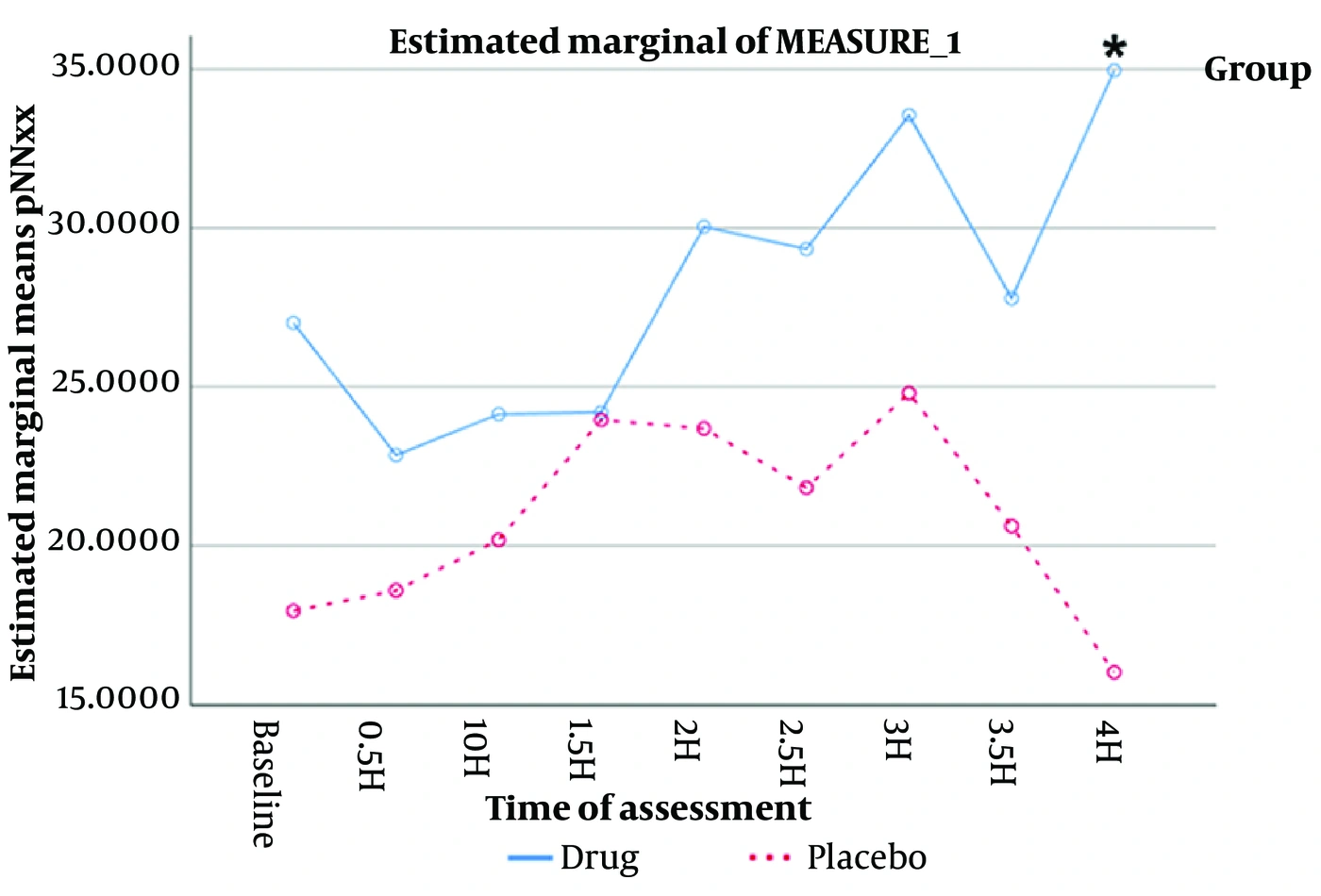
Figure 3.
PNN50% before and for 4 hours after oral administration of drug and placebo (values are presented as mean) (P ≥ 0.05)
For LFnu, both analysis of variance and repeated-measures analyses showed no significant differences between groups (P ≈ 0.99 and P ≈ 0.68, respectively). Overall trends were similar, with only minor variations at 4 hours, when the placebo group showed a slight increase and the dimenhydrinate group showed a slight decrease.
High-frequency normalized units similarly showed no significant between-group differences (P ≈ 0.99 and P ≈ 0.69). Overall trends were comparable, with small deviations at 0.5 hours, including a slight decrease in the drug group and stable values in the placebo group, and at 4 hours, including an increase in the drug group and a decrease in the placebo group.
The LF/HF ratio also remained unaffected, with no significant differences between groups (P ≈ 0.71 and P ≈ 0.72) and only minor fluctuations over time that did not reach statistical significance.
Within-group analysis of SDNN indicated no significant changes across time points in either the placebo group (P = 0.431) or the dimenhydrinate group (P = 0.753). Between-group repeated-measures analysis revealed no significant overall group-time interaction (P = 0.106), indicating that the temporal pattern of SDNN changes did not differ meaningfully between interventions. Pairwise comparisons showed no significant differences at most time points. Although SDNN in the placebo group showed a slight decrease at 60 minutes and SDNN in the dimenhydrinate group showed a transient increase, these variations were not statistically significant.
5. Discussion
In this double-blind crossover study, the effects of a single oral 50 mg dose of dimenhydrinate versus placebo on cardiac autonomic nervous system activity were evaluated (13). Heart rate variability, a widely accepted, noninvasive, and reliable method for estimating autonomic function, was analyzed using time-domain and frequency-domain indices (14). Overall, the findings can be summarized as follows. First, placebo administration had no significant effect on any time-domain or frequency-domain HRV indices during 5-minute short-term ECG recordings over the 4-hour postadministration period (15). Second, repeated-measures analysis of variance showed that, across all time points, 50 mg dimenhydrinate did not induce statistically significant changes in most HRV indices compared with placebo (16). Third, time-specific analyses showed modest but statistically significant increases in SDNN at 90 minutes and in RMSSD and PNN50% at 240 minutes after dimenhydrinate administration, indicating a transient enhancement of parasympathetic activity (17).
Inspection of the line plots comparing dimenhydrinate and placebo revealed a notable reduction in LFnu after dimenhydrinate intake (18). Low-frequency power, which primarily reflects sympathetic modulation within the 0.04 - 0.15 Hz frequency range, has been variably interpreted in previous studies; some reports suggest contributions from both sympathetic and vagal activity (19), whereas others emphasize a predominantly sympathetic origin, particularly when expressed in normalized units. SDNN, which represents overall HRV influenced by both sympathetic and parasympathetic activity, remained largely unchanged except at 90 minutes (4). The similarity of SDNN trends between groups supports the notion that the observed reduction in LFnu primarily reflects decreased sympathetic activity (20). This sympatholytic effect of dimenhydrinate is consistent with its H1 receptor antagonism and the known interactions between the histaminergic and sympathetic systems, likely mediated at both ganglionic and central levels (21). These findings are consistent with Rezaeyanzade et al., who reported sympatholytic effects of oral hydroxyzine (13), and with studies of promethazine, another first-generation H1 antihistamine, which showed reductions in LFnu after oral administration (23). Notably, in the present study, the sympatholytic effect of dimenhydrinate became apparent 4 hours after administration, whereas the effects of hydroxyzine in prior studies emerged earlier, peaked at 30 to 120 minutes, and returned to baseline by 180 to 240 minutes (22, 23).
In addition, dimenhydrinate increased indices associated with cardiac vagal activity (24). RMSSD increased at 1, 3, and 4 hours, HFnu increased at 4 hours, and PNN50% was elevated at 4 hours after administration, indicating enhanced parasympathetic modulation (25). These changes coincide with the expected time to peak plasma concentration (3 - 6 hours) (26), supporting a temporal correlation between pharmacokinetics and vagomimetic effects. Similar effects have been reported by Rezaeyanzade et al. for hydroxyzine (13) and for promethazine (23), although the timing of maximal vagal effects differed because of differences in pharmacokinetic profiles (26). Mechanistically, these findings align with animal and in vitro studies showing that H1 receptor blockade can modulate vagal output centrally through depolarization of neurons in the dorsal motor nucleus and nucleus tractus solitarius (27) and peripherally through effects on parasympathetic ganglia. Interestingly, despite the known anticholinergic properties of first-generation H1 antihistamines, dimenhydrinate enhanced vagal indices in the present study, potentially because of its central penetration and interaction with muscarinic receptors in vagal motor nuclei (28).
Finally, the LF/HF ratio, reflecting sympathovagal balance, decreased at 4 hours after dimenhydrinate administration, indicating a shift toward reduced sympathetic dominance and enhanced parasympathetic dominance (29). In summary, although repeated-measures analysis of variance did not reveal statistically significant overall effects of dimenhydrinate across all time points, analyses of temporal trends showed that H1 receptor-mediated histaminergic modulation exerts a measurable, albeit transient, influence on cardiac autonomic regulation (30). This modulatory effect is likely counterbalanced by other homeostatic mechanisms, which may explain why overall statistical significance was limited (31). Collectively, these findings highlight the nuanced role of histaminergic signaling in the autonomic control of heart rate and provide evidence that oral dimenhydrinate can transiently modulate both sympathetic and parasympathetic cardiac activity (32).
5.1. Limitations
A limitation of the present study is the relatively small sample size (n = 15), which may limit the generalizability of the findings. Although the crossover design reduces interindividual variability and strengthens internal validity, the statistical power to detect subtle effects may still be limited. Therefore, future studies with larger, adequately powered cohorts and more diverse populations are warranted to confirm and extend these findings.
5.2. Conclusions
Overall, these findings indicate that oral administration of dimenhydrinate, a first-generation H1 receptor antihistamine capable of crossing the blood-brain barrier, stabilizes H1 histamine receptors in their inactive state, thereby shifting cardiac sympathovagal balance toward reduced sympathetic activity and enhanced vagal activity. This effect is consistent with the peak plasma concentration of dimenhydrinate occurring between 3 and 6 hours after administration.