
1. Background
Due to the high prevalence of diabetes, insulin is a must therapeutic agent for diabetes, and numerous patients need short-term or lifelong management (1); therefore, the appropriate insulin injection skill is essential for the optimal control of blood sugar in diabetic patients (2). Standard injection techniques ensure that insulin is properly delivered to the subcutaneous tissue for application effect and reduce the incidence of pain and skin complications in injection sites (3). However, the art of insulin injection is still not well understood in numerous medical centers (4).
A multinational study of 28,289 individuals in 42 countries showed that insulin injection was inappropriate; nevertheless, incorrect insulin injection techniques, such as the incorrect rotation of injection sites and reuse of a needle, decrease the effectiveness of insulin therapy and can even lead to poor blood glucose control (5).
Lipohypertrophy (LH) is an abnormal accumulation of fat underneath the surface of the skin, which is known as a common side effect of inadequate insulin injection (6). Repeated injections at the same site without rotation at the injection site can cause inflammation or an increase in adipose tissue, which negatively affects insulin absorption and function and increases the incidence of glycemic fluctuations in individuals. Ultimately, it results in a lack of blood glucose control (4, 7).
According to studies, there was a significant negative correlation between proper insulin injection with hemoglobin A1c (HbA1c) levels and the range of blood glucose fluctuations in diabetic patients. It is notable that patients who maintain proper insulin administration and injections have more control over their blood sugar levels and are less likely to develop hyperglycemia (8). In addition, the total daily insulin dose decreased in those who had LH after proper injection training (9).
The results of a previous study in Iran showed that 56.87% of adult patients with diabetes use anti-hyperglycemic drugs, 21.14% of whom are treated with insulin with or without oral drugs. Furthermore, 52.28% of patients treated with insulin use insulin pens (10). However, some patients do not have adequate information about proper insulin injection (11).
Given that proper injection, including the selection of the optimal type of needle/syringe, the proper use of lifted skin fold where necessary, injection site rotation, storage and expiration of insulin, single use of needles, and finally, the optimal sequence for injecting, controls blood glucose. Moreover, skin health, training, and examination of the site of injection will be an important part of diabetes management (12, 13).
2. Objectives
This study was designed to determine the association between appropriate insulin injection and blood glucose control in patients with type 2 diabetes in Yazd, Iran.
3. Methods
This study was a cross-sectional investigation. According to a previous study and using the correlation estimation formula, considering the 95% confidence level and r = 0.25, 301 participants were selected from type 2 diabetes who referred to Diabetes Research Center in Yazd using simple random sampling within August 2020 to February 2021. The inclusion criteria were age > 18 years, using an insulin pen for at least 3 months, and self-injection. Moreover, the patients with cognitive dysfunction and occasional injections were excluded.
The data collection tool was a questionnaire consisting of three sections, namely (1) demographic information, such as age, gender, and educational level, (2) clinical information, such as duration of diabetes, duration of insulin therapy, diabetes complications, fasting blood sugar (FBS), Two-Hour Postprandial Glucose (2HPP) and HbA1c and, (3) information about insulin injection technique.
After reviewing the literature, the items related to the technique of insulin injection were designed by the researcher and given to 10 endocrinologists for validity evaluation. After confirming the validity, the questionnaire was completed by 20 patients who were not among the samples, and its reliability was also confirmed with Cronbach’s alpha coefficient of 0.75. This section included 13 items related to insulin injection, such as “How many times do you use each needle?”, and possible answers were “more than 5 times”, “2 - 5 times”, and “just once”, ranging from 0 - 2 or in some items a diabetes educator asked participants to show how they select insulin dose and gave them correct = 2 and incorrect = 0 points. Finally, a total score of 0 - 26 was considered the insulin injection technique score (Table 1).
Table 1.
Questionnaire Items for Insulin Injection Technique
| Item | Score |
|---|---|
| Needle reuse | |
| 1 | 2 |
| 2 - 5 | 1 |
| > 5 | 0 |
| Skin fold | |
| Correct | 2 |
| Incorrect | 0 |
| Rotation | |
| Correct | 2 |
| Incorrect | 0 |
| Distance between two injections in one site (cm) | |
| > 2 | 2 |
| < 2 | 0 |
| Injection time | |
| Correct | 2 |
| Incorrect | 0 |
| Checking insulin dosage | |
| Correct | 2 |
| Incorrect | 0 |
| Keep pressing | |
| > 10 | 2 |
| 5 - 10 | 1 |
| < 5 | 0 |
| Paying attention to the expiration date of insulin | |
| Yes | 2 |
| No | 0 |
| Resuspension | |
| Correct | 2 |
| Incorrect | 0 |
| Attaching a pen needle | |
| Correct | 2 |
| Incorrect | 0 |
| Opened insulin storage | |
| Correct | 2 |
| Incorrect | 0 |
| Needle entry angle | |
| Correct | 2 |
| Incorrect | 0 |
| Unopened insulin storage | |
| Correct | 2 |
| Incorrect | 0 |
The disease-related data were extracted from patients’ medical records, and the laboratory results were accepted up to 3 months ago. History of blood glucose greater than 180 mg/dL and less than 70 mg/dL 2HPP indicated hyperglycemia and hypoglycemia, respectively, which were asked by patients as a self-report (14). The questionnaires were completed by a trained diabetes educator in face-to-face interviews, and the injection sites were checked for the presence of LH. The data were analyzed using a t-test and regression analysis in SPSS software (version 20). This study was approved by the Ethics Committee of Yazd University of Medical Sciences (ethics code: IR.SSU.REC.1398.213).
4. Results
The study sample comprised 162 (53.8%) females and 139 (46.2%) males with a mean age of 59.83 ± 10.26 years. Most participants (60.1%) had primary school or less education, and retinopathy was the most common reported complication (Table 2).
Table 2.
Demographic and Clinical Characteristics of Patients (n = 301) a
| Characteristics | Values |
|---|---|
| Age (y) | 59.83 ± 10.26 |
| Gender | |
| Female | 162 (53.8) |
| Male | 139 (46.2) |
| Educational level | |
| Primary school or less | 181 (60.1) |
| High school | 87 (28.9) |
| University graduate or more | 33 (11) |
| Body mass index (kg/m2) | 29.07 ± 4.60 |
| Duration of diabetes (y) | 13.65 ± 7.77 |
| Duration of insulin therapy (y) | 6.29 ± 4.97 |
| Daily insulin dose (unit) | 52.86 ± 26.02 |
| Insulin injection score | 11.46 ± 2.64 |
| Lipohypertrophy | |
| Yes | 126 (43.2) |
| No | 166 (56.8) |
| Retinopathy | |
| Yes | 158 (52.5) |
| No | 84 (27.9) |
| Not sure | 59 (19.6) |
| Neuropathy | |
| Yes | 153 (50.8) |
| No | 93 (30.9) |
| Not sure | 55 (18.3) |
| Cardiovascular disease | |
| Yes | 90 (29.9) |
| No | 123 (40.8) |
| Not sure | 88 (29.3) |
| Nephropathy | |
| Yes | 92 (30.6) |
| No | 143 (47.5) |
| Not sure | 66 (21.9) |
a Data are presented as No. (%) or mean +- SD.
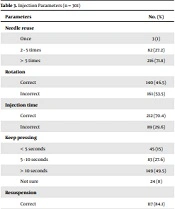
Table 3 shows the frequency of insulin injection parameters among the patients. The majority of participants performed well in terms of insulin storage (n = 243, 80.7%), injection time (n = 212, 70.4%), resuspension (n = 117, 84.1%), and needle entry angle (n = 284, 95.3%). The weakest performance was needle reuse, and almost half of the patients (53.5%) did not rotate the injection sites properly.
Table 3.
Injection Parameters (n = 301)
| Parameters | No. (%) |
|---|---|
| Needle reuse | |
| Once | 3 (1) |
| 2 - 5 times | 82 (27.2) |
| > 5 times | 216 (71.8) |
| Rotation | |
| Correct | 140 (46.5) |
| Incorrect | 161 (53.5) |
| Injection time | |
| Correct | 212 (70.4) |
| Incorrect | 89 (29.6) |
| Keep pressing | |
| < 5 seconds | 45 (15) |
| 5 - 10 seconds | 83 (27.6) |
| > 10 seconds | 149 (49.5) |
| Not sure | 24 (8) |
| Resuspension | |
| Correct | 117 (84.1) |
| Incorrect | 22 (15.9) |
| Opened insulin storage | |
| Correct | 243 (80.7) |
| Incorrect | 58 (19.3) |
| Unopened insulin storage | |
| Correct | 290 (11) |
| Incorrect | 11 (3.6) |
| Skin fold | |
| Correct | 274 (91) |
| Incorrect | 27 (9) |
| Needle entry angle | |
| Correct | 284 (95.3) |
| Incorrect | 14 (4.7) |
| Distance between two injections in one site | |
| < 2 centimeters | 154 (51.2) |
| > 2 centimeters | 147 (48.8) |
| Insulin dosage | |
| Correct | 294 (97.6) |
| Incorrect | 7 (2.4) |
| Paying attention to the expiration date | |
| Yes | 70 (23.3) |
| No | 231 (76.7) |
| Attaching a pen needle | |
| Correct | 157 (52.2) |
| Incorrect | 144 (47.8) |
Table 4 shows inappropriate insulin injection outcomes. Statistically significant differences were observed in injection scores among patients according to HbA1c levels (P = 0.008). The patients who reported pain during injection had statically lower injection scores than others (17.90 vs. 19.38, P = 0.001). Hyperglycemia was more common in patients with inappropriate insulin injections (P = 0.007).
Table 4.
Inappropriate Insulin Injection Outcomes
| Variables | Injection Score (Mean ± SD) | P-Value a |
|---|---|---|
| Hemoglobin A1c (%) | 0.008 | |
| < 7.5 | 19.26 ± 3.65 | |
| ≥ 7.5 | 18.05 ± 3.53 | |
| Lipohypertrophy | 0.060 | |
| Yes | 17.96 ± 3.11 | |
| No | 18.77 ± 3.90 | |
| Pain during injection | 0.001 | |
| Yes | 17.90 ± 3.42 | |
| No | 19.38 ± 3.76 | |
| Hypoglycemia | 0.042 | |
| Yes | 18.72 ± 3.50 | |
| No | 17.81 ± 3.77 | |
| Hyperglycemia | 0.007 | |
| Yes | 17.96 ± 3.67 | |
| No | 19.10 ± 3.40 |
a Independent t-test
Table 5 shows the correlation between insulin injection score and blood sugar variables. There was a significant negative correlation between insulin injection score with FBS (β = -0.232, P < 0.001), 2HPP (β = -0.164, P = 0.005), and HbA1c level (β = -0.263, P < 0.001) in patients.
Table 5.
Correlation of Injection Score and Blood Sugar Variables
| Variables | Injection Score | FBS | 2HPP | HbA1c |
|---|---|---|---|---|
| Injection score | 1 | |||
| r | -0.232 | -0.164 | -0.61 | |
| P | < 0.001 | 0.005 | 0.001 | |
| FBS | 1 | |||
| r | -0.232 | 0.681 | 0.596 | |
| P | < 0.001 | < 0.001 | < 0.001 | |
| 2HPP | 1 | |||
| r | -0.164 | 0.681 | 0.556 | |
| P | 0.005 | < 0.001 | < 0.001 | |
| HbA1c | 1 | |||
| r | -0.263 | 0.596 | 0.556 | |
| P | < 0.001 | < 0.001 | < 0.001 |
Abbreviations: FBS, fasting blood sugar; 2HPP, two-hour postprandial glucose; HbA1c, hemoglobin A1c.
5. Discussion
The present study aimed to investigate the association between insulin injection technique and blood glucose control in patients with type 2 diabetes. According to the results, none of the patients fully implemented the parameters of a correct injection. Needle reuse was one of the common mistakes among the participants in the present study, and about 70% of patients used a needle more than five times. In a similar study in Bangladesh, most participants used a needle ≥ 10 times (15). In India, 40% of patients reused a needle more than 3 - 5 times (16). Although needle reuse is not recommended, individuals use a needle frequently for various reasons (e.g., financial factors); therefore, they should be warned not to reuse the needle more than five times (4).
In the current study, approximately half of the patients had LH. In previous studies of diabetic patients in Italy, China, and Belgium, the prevalence rates of LH were 49%, 53.1%, and 64.3%, respectively (4, 17, 18). The aforementioned results indicate that LH is a major problem for patients treated with insulin in different countries. Furthermore, a significant relationship was observed between the inappropriate insulin injection technique and LH; as a result, it seems that the improvement of the insulin injection technique might reduce the rate of LH among diabetic patients (19, 20).
Most participants in the present study performed well in terms of skin fold during insulin injection. According to the recommendations, lifting the skin fold (pinching) is done to prevent unwanted intramuscular injection, and this should be done with 6 mm or higher needles (especially in children and other patients with thin skin) (4). In the present study, since most patients used 4 mm needles, there was no need to wrinkle the skin. In line with the findings of the current study, Patella and Yang also indicated in their studies that a large number of patients developed skin wrinkles correctly (8, 21).
According to the results, more than 90% of patients performed properly in terms of needle entry angle. In Kamrul-Hasan et al.’s study, the angle of injection was also correct; nevertheless, the maintenance time after injection was not correct (15). Injecting insulin at a 90° angle causes less insulin leakage than angular insertion (~ 45°) (22). In the present study, almost half of the patients (49.5%) removed the needle from the skin after the injection at an appropriate time, which compared to previous studies in Canada (39%), Vietnam (33.8%), and India (12.5%) was higher (23-25). Although the needle should be held under the skin for 6 - 10 seconds according to the recommendations to ensure the complete absorption of insulin (25), some patients do not pay attention to this point; as a result, the effectiveness of insulin is reduced.
In this study, there was a significant relationship between insulin injection scores and HbA1c levels. The patients with higher scores in the insulin injection technique had significantly lower HbA1c levels, which indicated the effect of correct insulin injection on blood sugar control. In similar studies, Misnikova et al. and Gorska-Ciebiada et al. have noted the significant effect of the improved insulin injection technique on lowering blood sugar levels (26, 27).
The improvement of the insulin injection technique by reducing needle reuse, rotating the injection site, and not injecting in areas with LH can increase the effect of insulin on patients and lead to better blood sugar control. In the current study, the patients who had higher scores in the insulin injection technique experienced significantly less pain during the injection. In general, the improper injection of insulin (including the use of an inappropriate needle) leads to increased pain during or after injection among patients (28).
In addition, there was a significant relationship between proper insulin injection and the incidence of hypoglycemia. Therefore, the patients who scored higher on the insulin injection technique reported more hypoglycemia. Although previous studies have shown that proper insulin injection is associated with a reduced risk of hypoglycemia, other studies have shown that the correct injection method can maximize insulin absorption and, in some cases, might lead to hypoglycemia. In these cases, reducing the insulin dose is recommended (29, 30).
Finally, based on the Pearson test, insulin injection scores had a negative correlation with blood sugar variables. In other words, with an increase in the injection technique score, the values of FBS, 2HPP, and HbA1c were reduced by 0.23, 0.16, and 0.26, respectively. The effect of proper insulin injection on blood sugar control has been proven in several studies (17, 28). In the present study, although this effect was small, it was statistically significant. Although patients usually receive insulin injection training at the beginning of insulin treatment, numerous patients either do not remember having been exposed to the information or the information was not conveyed to them at all; therefore, they need education in this field. According to the International Diabetes Federation, insulin injection re-education is required for improved glycemic control among patients with type 2 diabetes (13). Therefore, blood sugar can be controlled by educating and improving the injection technique.
5.1. Conclusions
Although proper insulin injection is one of the effective factors in insulin therapy and ultimately control of blood sugar, none of the patients in the present study fully followed the principles of a proper injection, which can lead to pain during injection, LH, hyperglycemia, and increased HbA1c levels.