Cover image of the article: Diabetes Ketoacidosis and COVID-19: An Insight into the Pathophysiology

Image Credit:Int J Endocrinol Metab

Diabetes Ketoacidosis and COVID-19: An Insight into the Pathophysiology

Authors

Seyed Amirabbas AhadiatSeyed Amirabbas Ahadiat ORCID1,*, Zeinab HosseinianZeinab Hosseinian ORCID2
1The Advocate Center for Clinical Research, Ayatollah Yasrebi Hospital, Kashan, Iran
2Department Biomedicine Bimolecular, University of Girona, Girona, Spain
*Corresponding Author: The Advocate Center for Clinical Research, Ayatollah Yasrebi Hospital, Kashan, Iran. Email: dr.ahadiat61@gmail.com

International Journal of Endocrinology and Metabolism:Vol. 21, issue 2; e133631
Published online:Apr 04, 2023
Article type:Letter
Received:Nov 22, 2022
Accepted:Feb 08, 2023
How to Cite:Ahadiat SA, Hosseinian Z. Diabetes Ketoacidosis and COVID-19: An Insight into the Pathophysiology. Int J Endocrinol Metab. 2023;21(2):e133631. doi: https://doi.org/10.5812/ijem-133631

Dear Editor,
Diabetic ketoacidosis (DKA) is the most common hyperglycemic crisis in decompensated diabetes. However, several studies have reported coronavirus disease 2019 (COVID-19) can lead to DKA in non-diabetic patients (1). According to a study, 42 of 659 patients admitted to a hospital with COVID-19 developed DKA, with 27 of these 42 not having a history of diabetes (2). Based on a meta-analysis involving 124,597 children with type 1 diabetes, DKA rates have increased in newly diagnosed diabetic children, and COVID-19 infection can cause DKA in diabetics and non-diabetics, and the length of hospital stay was also positively associated with the development of ketoacidosis (3). Moreover, a study reported that decreased physical activity and irregular follow-up for blood glucose testing during the quarantine aggravated the metabolic condition of both diabetic and non-diabetic individuals. Thus, diabetic patients are at an increased risk of severe COVID-19 (3, 4).
Diabetic ketoacidosis is developed due to the decreased insulin-to-glucagon ratio, leading to decreased glucose uptake, uncontrolled lipolysis, excess ketone body production, metabolic acidosis, and other consequences (5). This condition is inherently pro-inflammatory; however, it is often caused by an underlying disease. The exact underlying mechanism of DKA development in COVID-19 is not clear. The disease is hypothesized to aggravate metabolic dysfunction in asymptomatic diabetic patients or change the body's metabolic defense mechanisms (6).
Role of Hyperglycemia and Pathological Obesity: Hyperglycemia has been frequently observed in critically ill patients due to increased levels of pro-inflammatory cytokines, including tumor necrosis factor-α (TNF-α), Interleukin-6 (IL-6), IL-1β, and IL-8. It is worth noting that TNF-α and IL-6 secretions are reciprocally associated with insulin resistance and pathological obesity (7). Moreover, adipokines, a group of hormones secreted by adipose tissue, contribute to insulin resistance by showing pro- or anti-inflammatory properties (8). Adipose tissue secretes TNF- and IL-6, inhibiting glucose uptake and impairing insulin signaling. As a result, the inflammation induced by metabolic dysfunction is highly important in developing insulin resistance in obese individuals, increasing the COVID-19-induced cytokine release in these patients (9). Also, the excess visceral adiposity in obese patients can increase the mitochondrial reactive oxygen species (ROS) production, IL-6, and C-reactive protein (CRP) levels. Therefore, the oxidative stress induced by elevated levels of ROS during the infection may exacerbate this inflammatory condition. Finally, the infection can activate the toll-like receptor 4 (TLR4) pathway, aggravating the host's inflammatory response (via the MyD88 dependent or independent pathway) (10).
Under hyperglycemic conditions, excess ROS production causes increased glycolysis and protein kinase C induction, exacerbating cell injury and apoptosis that enhance cellular adhesion and lead to coagulopathy. Generally, the pre-existed metabolic imbalance can be aggravated by infection due to increased oxidative stress (11).
Role of ACE2 Ligand Induction: Typically, the SARS-CoV-2 envelope contains several proteins, including the membrane (M), envelope (E), and spike (S) proteins (12). Among these, the S protein, consisting of two subunits of S1 and S2, is used for viral entry into host cells. During this process, the S1 subunit binds to one of its receptors on the cellular membrane, such as angiotensin-converting enzyme-2 (ACE2), CD26, ezrin, and cyclophilins. Afterward, the S2 subunit allows the entry of the viral genome into the host cell by fusing the viral envelope with the host cell membrane. Therefore, ACE2 has a crucial influence on the pathology of COVID-19. Consequently, the cells expressing high levels of ACE2 on their membranes are more vulnerable to infection and subsequent cell damage (13).
The receptor binding domain (RBD) has a crystal structure for binding the virus to the ACE 2 receptor. Most antibodies block this region, but with the evolution of the virus, the effect of this antibody decreases. According to the latest research, the external region RBD that does not bind to the ACE2 receptor can be a potential target for new antibodies (SW186) (14).
Angiotensin-converting enzyme-2 is widely expressed in various tissues, including the lungs, intestines, liver, pancreas, and macrophages. Moreover, it has been shown that ACE2 expression by SARS-CoV-2 may have several consequences, including hypertension, diabetes, and cardiovascular diseases. Such a situation can indirectly facilitate apoptosis by creating α-TNF, increasing serotonin expression, and stimulating leukocyte immunoglobulin-like receptor subfamily B member 3 (LiLRB3), interfering with the activity of β cells in the pancreas. Also, it is hypothesized that overactivation of the renin-angiotensin-aldosterone system (RAAS) can lead to impaired glucose uptake and insulin resistance, resulting in hyperglycemia and increased oxidative stress due to elevated ROS production (15).
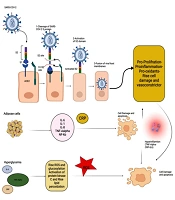
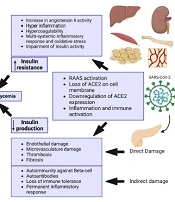
The binding of SARS-CoV-2 to ACE2 causes an overproduction of angiotensin II, stimulating the NF-κB and IL-6 pathways. Subsequently, the NF-κB pathway can aggravate the inflammatory state. Thus, viral binding to ACE2 can lead to hyperglycemia and excessive oxidative stress caused by increased ROS production, disrupting the most important factors involved in RAAS homeostasis and leading to DKA in patients with COVID-19 (Figure 1) (16).
Consequences of the binding of SARS-CoV-2 to angiotensin-converting enzyme-2
Figure 1.
Consequences of the binding of SARS-CoV-2 to angiotensin-converting enzyme-2
Considering the above, evaluating the metabolic and inflammatory abnormalities in COVID-19 patients may provide the researchers with the necessary information for developing effective therapeutic strategies for decreasing the morbidity and mortality of DKA in these patients. These therapeutic options include targeted therapies or anti-inflammatory, antiviral, immunomodulatory, or antioxidant medications. In general, there is a need for further studies in this field investigating the possible underlying mechanisms that may confirm or disprove these hypotheses.
Footnotes

  • Authors' Contribution: S. A., A. A. and Z. H. wrote the first draft and agreed on the final manuscript.

  • Conflict of Interests: The authors of this paper have not to conflict of interest.

  • Funding/Support: There is no fund related to this manuscript.

References

  • 1.
    De Sa-Ferreira CO, da Costa CHM, Guimaraes JCW, Sampaio NS, Silva LML, de Mascarenhas LP, et al. Diabetic ketoacidosis and COVID-19: what have we learned so far? Am J Physiol Endocrinol Metab. 2022;322(1):E44-53. [PubMed ID: 34779657]. [PubMed Central ID: PMC8721947]. https://doi.org/10.1152/ajpendo.00244.2021.
  • 2.
    Li J, Wang X, Chen J, Zuo X, Zhang H, Deng A. COVID-19 infection may cause ketosis and ketoacidosis. Diabetes Obes Metab. 2020;22(10):1935-41. [PubMed ID: 32314455]. [PubMed Central ID: PMC7264681]. https://doi.org/10.1111/dom.14057.
  • 3.
    Elgenidy A, Awad AK, Saad K, Atef M, El-Leithy HH, Obiedallah AA, et al. Incidence of diabetic ketoacidosis during COVID-19 pandemic: a meta-analysis of 124,597 children with diabetes. Pediatr Res. 2022:1-12. [PubMed ID: 35953513]. [PubMed Central ID: PMC9366798]. https://doi.org/10.1038/s41390-022-02241-2.
  • 4.
    McCluskey CK, Zee-Cheng JE, Klein MJ, Scanlon MC, Rotta AT, Remy KE, et al. The Temporal Relationship Between Local School Closure and Increased Incidence of Pediatric Diabetic Ketoacidosis. Front Pediatr. 2022;10:812265. [PubMed ID: 35359897]. [PubMed Central ID: PMC8963207]. https://doi.org/10.3389/fped.2022.812265.
  • 5.
    Ghimire P, Dhamoon AS. Ketoacidosis. Treasure Island (FL): StatPearls [Internet]; 2023.
  • 6.
    Tilinca MC, Gliga MC, Varga A. The Pathophysiology and Management of Diabetic Ketoacidosis in COVID-19 Patients: a Literature Review. J Crit Care Med (Targu Mures). 2022;8(1):6-13. [PubMed ID: 35274050]. [PubMed Central ID: PMC8852291]. https://doi.org/10.2478/jccm-2021-0024.
  • 7.
    Stentz FB, Umpierrez GE, Cuervo R, Kitabchi AE. Proinflammatory cytokines, markers of cardiovascular risks, oxidative stress, and lipid peroxidation in patients with hyperglycemic crises. Diabetes. 2004;53(8):2079-86. [PubMed ID: 15277389]. https://doi.org/10.2337/diabetes.53.8.2079.
  • 8.
    Valencia-Ortega J, Gonzalez-Reynoso R, Ramos-Martinez EG, Ferreira-Hermosillo A, Pena-Cano MI, Morales-Avila E, et al. New Insights into Adipokines in Gestational Diabetes Mellitus. Int J Mol Sci. 2022;23(11). [PubMed ID: 35682958]. [PubMed Central ID: PMC9181219]. https://doi.org/10.3390/ijms23116279.
  • 9.
    Gao T, Chen S, Han Y, Zhang D, Tan Y, He Y, et al. Ameliorating Inflammation in Insulin-resistant Rat Adipose Tissue with Abdominal Massage Regulates SIRT1/NF-kappaB Signaling. Cell Biochem Biophys. 2022;80(3):579-89. [PubMed ID: 35907080]. [PubMed Central ID: PMC9388453]. https://doi.org/10.1007/s12013-022-01085-1.
  • 10.
    Eskandarani RM, Sawan S. Diabetic Ketoacidosis on Hospitalization with COVID-19 in a Previously Nondiabetic Patient: A Review of Pathophysiology. Clin Med Insights Endocrinol Diabetes. 2020;13:1179551420984120. [PubMed ID: 33488135]. [PubMed Central ID: PMC7768872]. https://doi.org/10.1177/1179551420984125.
  • 11.
    Ola MS. Does Hyperglycemia Cause Oxidative Stress in the Diabetic Rat Retina? Cells. 2021;10(4). [PubMed ID: 33918273]. [PubMed Central ID: PMC8067231]. https://doi.org/10.3390/cells10040794.
  • 12.
    Boson B, Legros V, Zhou B, Siret E, Mathieu C, Cosset FL, et al. The SARS-CoV-2 envelope and membrane proteins modulate maturation and retention of the spike protein, allowing assembly of virus-like particles. J Biol Chem. 2021;296:100111. [PubMed ID: 33229438]. [PubMed Central ID: PMC7833635]. https://doi.org/10.1074/jbc.RA120.016175.
  • 13.
    Segars J, Katler Q, McQueen DB, Kotlyar A, Glenn T, Knight Z, et al. Prior and novel coronaviruses, Coronavirus Disease 2019 (COVID-19), and human reproduction: what is known? Fertil Steril. 2020;113(6):1140-9. [PubMed ID: 32482250]. [PubMed Central ID: PMC7161522]. https://doi.org/10.1016/j.fertnstert.2020.04.025.
  • 14.
    Larkin HD. Antibody Found in Mice Neutralizes SARS-CoV-2 and SARS-CoV-1. JAMA. 2022;328(10). [PubMed ID: 36098737]. https://doi.org/10.1001/jama.2022.14711.
  • 15.
    Younis JS, Abassi Z, Skorecki K. Is there an impact of the COVID-19 pandemic on male fertility? The ACE2 connection. Am J Physiol Endocrinol Metab. 2020;318(6):E878-80. [PubMed ID: 32421367]. [PubMed Central ID: PMC7276979]. https://doi.org/10.1152/ajpendo.00183.2020.
  • 16.
    Lu LW, Gao Y, Quek SY, Foster M, Eason CT, Liu M, et al. The landscape of potential health benefits of carotenoids as natural supportive therapeutics in protecting against Coronavirus infection. Biomed Pharmacother. 2022;154:113625. [PubMed ID: 36058151]. [PubMed Central ID: PMC9428603]. https://doi.org/10.1016/j.biopha.2022.113625.

Copyright

Copyright © 2023, International Journal of Endocrinology and Metabolism. This is an open-access article distributed under the terms of the Creative Commons Attribution-NonCommercial 4.0 International License (http://creativecommons.org/licenses/by-nc/4.0/) which permits copy and redistribute the material just in noncommercial usages, provided the original work is properly cited.

Similar Articles

16
Jan
2023
SARS‑CoV‑2 and Seizure: An Insight Into the Pathophysiology

SARS‑CoV‑2 and Seizure: An Insight Into the Pathophysiology

Seyed Amir Abbas Ahadiat,
Zeinab Hosseinian

Ahadiat SAA, Hosseinian Z. SARS‑CoV‑2 and Seizure: An Insight Into the Pathophysiology. Anesth Pain Med. 2023;13(1):e134129. doi: https://doi.org/10.5812/aapm-134129

23
Oct
2023
Type 1 Diabetes and COVID-19: A Literature Review and Possible Management

Type 1 Diabetes and COVID-19: A Literature Review and Possible Management

Kebria Kashfi,
Narges Anbardar,
Artin Asadipooya,
Kamyar Asadipooya

Kashfi K, Anbardar N, Asadipooya A, Asadipooya K. Type 1 Diabetes and COVID-19: A Literature Review and Possible Management. Int J Endocrinol Metab. 2023;21(4):e139768. doi: https://doi.org/10.5812/ijem-139768

19
Sep
2022
ACE2 in SARS-CoV-2-Mediated COVID-19: A Brief Review

ACE2 in SARS-CoV-2-Mediated COVID-19: A Brief Review

Pooria Safarzadeh Kozani,
Setareh Dashti Shokoohi,
Narges Baharifar,
Sepideh Sheikhi,
Fatemeh Khalaf Shamsabadi,
Forough Chamaie Nejad
,et al.

Safarzadeh Kozani P, Dashti Shokoohi S, Baharifar N, Sheikhi S, Khalaf Shamsabadi F, et al. ACE2 in SARS-CoV-2-Mediated COVID-19: A Brief Review. J Adv Immunopharmacol. 2022;2(4):e130682. doi: https://doi.org/10.5812/tms-130682

18
Jun
2023
Comparison of Diabetic Ketoacidosis Characteristics During- and Before the COVID-19 Pandemic

Comparison of Diabetic Ketoacidosis Characteristics During- and Before the COVID-19 Pandemic

Nastaran Injinari,
Hamed Ghoshouni,
Akram Mehrabbeik,
Nasim Namiranian,
Akram Ghadiri-Anari,
Reyhaneh Azizi

Injinari N, Ghoshouni H, Mehrabbeik A, Namiranian N, Ghadiri-Anari A, et al. Comparison of Diabetic Ketoacidosis Characteristics During- and Before the COVID-19 Pandemic. Int J Endocrinol Metab. 2023;21(3):e134882. doi: https://doi.org/10.5812/ijem-134882

12
May
2024
Metformin-Insulin Combination Therapy Ameliorates Hyperglycemia in a COVID-19 Type-1 Diabetic Child with Insulin Resistance: A Case Report

Metformin-Insulin Combination Therapy Ameliorates Hyperglycemia in a COVID-19 Type-1 Diabetic Child with Insulin Resistance: A Case Report

Parisa Tajdini,
Arezoo Akhlaghi Aski

Tajdini P, Akhlaghi Aski A. Metformin-Insulin Combination Therapy Ameliorates Hyperglycemia in a COVID-19 Type-1 Diabetic Child with Insulin Resistance: A Case Report. J Microbiota. 2024;1(1):e147125. doi: https://doi.org/10.5812/jmb-147125

More by these authors

Seyed Amirabbas AhadiatPubMedScholar
Zeinab HosseinianPubMedScholar
Share
Cited by
Metrics