
Cover image of the article: Lipodistrophy and Associated Risk Factors in Insulin-Treated People With Diabetes

Image Credit:Int J Endocrinol Metab

Lipodistrophy and Associated Risk Factors in Insulin-Treated People With Diabetes

Authors

Sandro Gentile1, Felice Strollo2,*, Antonio Ceriello3, 4
1Department of Clinical and Experimental Medicine, Second University of Naples, Naples, Italy
2Department of Pharmacological and Biomolecular Sciences, University of Milan, Milan, Italy
3Department of Endocrinology, Hospital Clinic de Barcelona, Institut d’Investigacions Biomediques August Pi i Sunyer (IDIBAPS), Barcelona, Spain
4Centro de Investigacion Biomedica en Red de Diabetes y Enfermedades Metabolicas Asociadas (CIBERDEM), Barcelona, Spain
*Corresponding Author: Corresponding author: Felice Strollo, Department of Pharmacological and Biomolecular Sciences, University of Milan, Milan, Italy, E-mail: Email: felix.strollo@gmail.com

International Journal of Endocrinology and Metabolism:Vol. 14, issue 2; e33997
Published online:Apr 26, 2016
Article type:Letter
Received:Feb 01, 2016
Accepted:Apr 13, 2016
How to Cite:Gentile S, Strollo F, Ceriello A. Lipodistrophy and Associated Risk Factors in Insulin-Treated People With Diabetes. Int J Endocrinol Metab. 2016;14(2):e33997. doi: https://doi.org/10.5812/ijem.33997

The recently published paper by Al Ajlouni et al. (1) describes the rate of lipodystrophy (LD) in a series of 1090 type 2 diabetes (T2DM) patients. LD has been known for decades, and a large body of evidence supports its relationship with poor metabolic control. Nevertheless, LD is often overlooked by teams involved in insulin treatment of people with diabetes mellitus (DM). In their paper, Al Ajlouni et al. (1) confirm a prevalence of 37.3% and a significant association between LD and a series of parameters including female sex, low cultural level, high BMI, long duration of both disease and insulin treatment, use of longest needles, and especially a lack of injection site rotation.
The authors point out that the variability in LH prevalence in several studies may be related to the lack of routine skin examination in diabetes clinics. However, it should be pointed out that such variability may also be due to doctors/nurses having attained different levels of experience and also due to the lack of a clearly defined, validated methodology devoted to LH identification. In fact, the morphological features of such lesions are extremely variable in size, texture, and protrusion above the skin. The attached Table 1 refers to 60 patients with diabetes and ultrasound-ascertained LD undergoing blind palpation-based examination by four well trained and as many non-trained health professionals. It provides evidence that the diagnostic ability differed significantly between the two groups of health professionals, being influenced by both training level and LD morphological features.
Table 1.
Cumulative Palpation-Based LH Identification Ability of Non-Trained and Well-Trained Health Professionals as Referred to LH Type and Size in 60 People With Diabetes and Ultrasound-Ascertained LH
VariableLipohypertrophy Identification Ability of Health Professionals
Non-Trained ProfessionalsWell Trained Professionals
No LHLHP ValueNo LHLHP Value
Correctly diagnosed subjects, No. (%)39 (65)21 (35)< 0.0019 (15)51 (85)< 0.001
Lipohypertrophy type, %
Flat6929< 0.013763< 0.01
Protruding2971< 0.010100< 0.01
LH size, cm, (mean ± SD)4.1 ± 15.8 ± 1.2< 0.0014.0 ± 0.94.8 ± 1.40.034
Another relevant cause of LD is repeated needle reuse. In fact, when injected into areas of LD, insulin causes a high rate of unexplained hypoglycemic episodes and wide glycemic variability, both of which are not responsive to dosage changes (2, 3). Since educational activity on proper injection techniques in individuals with LD has proven effective in significantly reducing such phenomena (4), we suggest looking systematically for LD lesions in all insulin-treated patients or at least in those displaying repeated unexplained hypoglycemic events and/or wide glycemic variability.
Furthermore, we regret to say that we do not agree with the LD grading method set forth by Al Ajlouni et al. (1), almost suggesting that lipohypertrophy (LH) (grades 1 and 2) and lipoatrophy (LA) (grade 3) express different stages of LH. In our view, being a scarring lesion characterized by subcutaneous fatty tissue atrophy, LA is very different from LH in terms of both morphology (see Figure 1) and pathogenesis. The latter indeed is mainly considered as a consequence of mechanical factors, such as needle reuse and poor injection site rotation (2) as well as typical insulin growth-promoting effects (5), while LA mostly seems to be associated with individual immunoallergic and inflammatory factors (2) and/or with poorly purified insulin preparations (6). This distinction is especially important from a clinical perspective, since, when injected into LA areas, insulin has a much higher chance of reaching into the subcutaneous muscle tissue and thus causing severe hypoglycemic events.
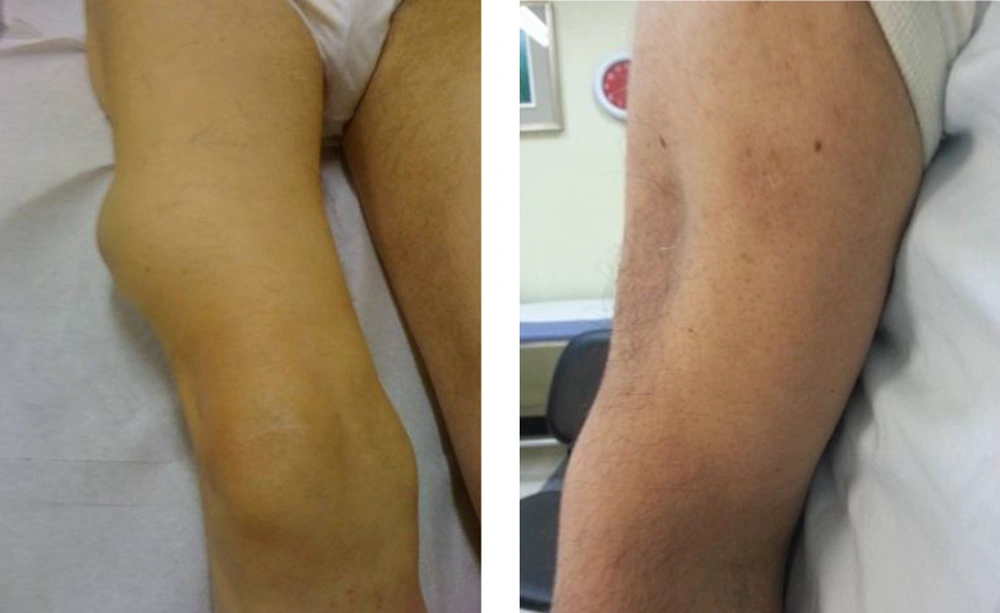
LH Lesion of the Right Thigh (Left Panel) and LA Lesion of the Left Arm (Right Panel)

Figure 1.
LH Lesion of the Right Thigh (Left Panel) and LA Lesion of the Left Arm (Right Panel)

Acknowledgments

Footnotes

  • Authors’ Contribution:All three authors contributed equally to the present letter.

  • Financial Disclosure:No funds were granted to the study.

References

  • 1.
    Al Ajlouni M, Abujbara M, Batieha A, Ajlouni K. Prevalence of lipohypertrophy and associated risk factors in insulin-treated patients with type 2 diabetes mellitus. Int J Endocrinol Metab. 2015;13(2). eeeee20776. [PubMed ID: 25926852]. https://doi.org/10.5812/ijem.20776.
  • 2.
    Blanco M, Hernandez MT, Strauss KW, Amaya M. Prevalence and risk factors of lipohypertrophy in insulin-injecting patients with diabetes. Diabetes Metab. 2013;39(5):445-53. [PubMed ID: 23886784]. https://doi.org/10.1016/j.diabet.2013.05.006.
  • 3.
    Gentile S, Agrusta M, Guarino G, Carbone L, Cavallaro V, Carucci I, et al. Metabolic consequences of incorrect insulin administration techniques in aging subjects with diabetes. Acta Diabetol. 2011;48(2):121-5. [PubMed ID: 20091324]. https://doi.org/10.1007/s00592-009-0172-x.
  • 4.
    Grassi G, Scuntero P, Trepiccioni R, Marubbi F, Strauss KW. Optimizing insulin injection technique and its effect on blood glucose control. J Clin Translational Endocrinol. 2014;1(4):145-50. https://doi.org/10.1016/j.jcte.2014.07.006.
  • 5.
    Richardson T, Kerr D. Skin-related complications of insulin therapy: epidemiology and emerging management strategies. Am J Clin Dermatol. 2003;4(10):661-7. [PubMed ID: 14507228].
  • 6.
    Holstein A, Stege H, Kovacs P. Lipoatrophy associated with the use of insulin analogues: a new case associated with the use of insulin glargine and review of the literature. Expert Opin Drug Saf. 2010;9(2):225-31. [PubMed ID: 20001763]. https://doi.org/10.1517/14740330903496402.

Copyright

Copyright © 2016, Research Institute For Endocrine Sciences and Iran Endocrine Society. This is an open-access article distributed under the terms of the Creative Commons Attribution-NonCommercial 4.0 International License (http://creativecommons.org/licenses/by-nc/4.0/) which permits copy and redistribute the material just in noncommercial usages, provided the original work is properly cited.

Similar Articles

30
Apr
2015
Prevalence of Lipohypertrophy and Associated Risk Factors in Insulin-Treated Patients With Type 2 Diabetes Mellitus

Prevalence of Lipohypertrophy and Associated Risk Factors in Insulin-Treated Patients With Type 2 Diabetes Mellitus

Mo’men Al Ajlouni,
Mousa Abujbara,
Anwar Batieha,
Kamel Ajlouni

Al Ajlouni M, Abujbara M, Batieha A, Ajlouni K. Prevalence of Lipohypertrophy and Associated Risk Factors in Insulin-Treated Patients With Type 2 Diabetes Mellitus. Int J Endocrinol Metab. 2015;13(2):e20776. doi: https://doi.org/10.5812/ijem.20776

4
Oct
2005
Insulin Resistance Syndrome (Syndrome X)

Insulin Resistance Syndrome (Syndrome X)

F Karimi

Karimi F. Insulin Resistance Syndrome (Syndrome X). Shiraz E-Med J. 2005;6(3 and 4):32898. doi:

29
May
2016
Insulin Edema in Type 1 Diabetes Mellitus: Report of a Case and Brief Review of the Literature

Insulin Edema in Type 1 Diabetes Mellitus: Report of a Case and Brief Review of the Literature

Ayse Derya Bulus,
Nesibe Andiran,
Ali Osman Köksal

Derya Bulus A, Andiran N, Osman Köksal A. Insulin Edema in Type 1 Diabetes Mellitus: Report of a Case and Brief Review of the Literature. Inn J Pediatr. 2016;26(4):e5077. doi: https://doi.org/10.5812/ijp.5077

16
Oct
2012
Individual, Psycho-Social and Disease-Related Risk Factors in Diabetic Neuropathy

Individual, Psycho-Social and Disease-Related Risk Factors in Diabetic Neuropathy

Isaac Rahimian-Boogar,
Mohammad Reza Mohajeri-Tehrani,
Negin Anbari-Maybodi,
Masoomeh Nikfarjam-Haftasia

Rahimian-Boogar I, Mohajeri-Tehrani MR, Anbari-Maybodi N, Nikfarjam-Haftasia M. Individual, Psycho-Social and Disease-Related Risk Factors in Diabetic Neuropathy. Zahedan J Res Med Sci. 2012;14(9):e93224. doi:

31
Jul
2006
Nutritional Related Lifestyle of Type 2 Diabetic Patients in Ahvaz-I.R.Iran

Nutritional Related Lifestyle of Type 2 Diabetic Patients in Ahvaz-I.R.Iran

R Amani,
A Mostafavi

Amani R, Mostafavi A. Nutritional Related Lifestyle of Type 2 Diabetic Patients in Ahvaz-I.R.Iran. Int J Endocrinol Metab. 2006;4(3):. doi:

More by these authors

Sandro GentilePubMedScholar
Felice StrolloPubMedScholar
Antonio CerielloPubMedScholar
Share
Cited by
Metrics