Full Text
Full text is available in PDF
International Journal of Endocrinology and Metabolism
Research Institute for Endocrine Sciences
Authors
In 1998 the definition of type 2 diabetes was revised, in particular the fasting plasma glucose (FPG) diagnostic level was lowered from 7.8 mmol/L to 7.0 mmol/L. The purpose of this study was to examine the effects of this change on patient demographics. Materials & Methods: We reviewed data from 1700 type 2 diabetes patients, who attended the St. Paul’s Hospital Diabetes Teaching and Train-ing Centre before (group 1) and after (group 2) the definition change. Demographical data from a baseline and follow-up were analyzed. The frequencies of patients in groups and cohorts <60 years of age and ≥60 years of age were calculated and HbA1c data was analyzed. Results: Compared to Group 1, Group 2 was younger, had a significantly lower mean HbA1c level (7.3% vs 8.1%, p<0.0001), blood pressure (127/78 vs 133/82 mmHg, p<0.05) and cholesterol (5.2 vs 5.5 mmol, p<0.05) and was more often treated with multiple medications (p<0.001). Pa-tients in Group 2 were significantly more likely to meet the target HbA1c level of 7.0% than pa-tients in Group 1 (p<0.0001). It was also found that at baseline, patients ≥60 years old in Group 2 had significantly lower HbA1c values than those <60 years old (p<0.001). Conclusion: Since the change in the definition of type 2 diabetes, a greater frequency of patients presented with lower mean HbA1c values and met target HbA1c levels. Patients ≥60 years old initially presented with lower HbA1c levels than those <60 years old.
© 2009, Author(s). This open-access article is available under the Creative Commons Attribution 4.0 (CC BY 4.0) International License (https://creativecommons.org/licenses/by/4.0/), which allows for unrestricted use, distribution, and reproduction in any medium, provided that the original work is properly cited.
Zibaeenezhad MJ, Aghasadeghi K, Zade Bagheri F, Khalesi E, Moaref A, et al. The Effect of Educational Interventions on Glycemic Control in Patients with Type 2 Diabetes Mellitus. Int Cardiovasc Res J. 2017;9(1):e11660. doi:
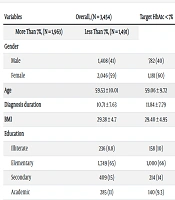
Mehrabbeik A, Tofighi D, Khalilzadeh SH, Azizi R, Namiranian N, et al. Factors Associated with Achieving HbA1c Targets in Patients with Type 2 Diabetes. Jundishapur J Chronic Dis Care. 2024;13(4):e147903. doi: https://doi.org/10.5812/jjcdc-147903
Abdeyazdan Z, Hashemipour M, Barekatain R, Kalantary F, Amini M. Benefits of Metformin Combined with Insulin in Children with Type 1 Diabetes Mellitus.. Shiraz E-Med J. 2011;12(4):. doi:
Naseri M, Rostami S, Dashtebozorgi B. Effect of Group Training on Glycemic Control in Patients With Diabetes Type-I. Jundishapur J Chronic Dis Care. 2015;4(4):e29728. doi: https://doi.org/10.17795/jjcdc-29728
Khandan M, Noohi E, Mirzazadeh A. Effect of electronic self-care education and applying continues care on practice in type 2 diabetic patients; a randomized clinical trial. J Kermanshah Univ Med Sci. 2012;15(6):e78896. doi:
Last Update: 3 weeks ago
Last Update: 3 weeks ago
Last Update: 3 weeks ago
Last Update: 9 hours ago
Last Update: 1 day ago
Last Update: 4 days ago
