1. Background
Type I diabetes is the most common chronic disease and can occur at any age, but the peak incidence is between 10 and 15 years old, and 75% of cases are diagnosed before age of 18 (1). The world health organization has indicated that in 2000, there were 171 million patients with diabetes mellitus (DM), of which 2.1 million cases were in Iran. Moreover, there will be 350 million cases by 2030, of which 6.4 million will be in Iran. In addition, based on recent studies in Iran, the total prevalence rate has been estimated at 6% - 8%, of which 2% occurs in children and adolescents (2). According to the latest studies, the highest rate of type I diabetes is in Caucasians with an incidence of 24 per 1 million people, and the lowest rate is in Cubans with an incidence of 2.6 per 1 million people (3).
The major problems caused by diabetes are due to microvascular and macrovascular complications. Microvascular complications occur within the first 30 years of diabetes. The incidence of complications has been reported as 30% - 40% for retinopathy, 20% - 30% for nephropathy, 26% - 14.2% for microalbuminuria, 26% - 12% for macroalbuminuria, and 30% - 40% for diabetic neuropathy (4, 5).
There is no doubt that improved glycemic control in patients with diabetes reduces the incidence of chronic complications. The basic step in implementing optimal management of blood sugar control is measuring fasting blood sugar (FBS) and glycosylated hemoglobin (HbA1c) (6). By measuring blood sugar levels, the person with diabetes can control their blood sugar regularly three to four times a day, before meals and before bedtime. Measuring HbA1c is suitable for long-term control of blood sugar in diabetic patients. HbA1c is a form of hemoglobin that indicates the mean blood sugar level from the 8 - 12 weeks; it is an estimation of diabetes control during the last 3 months (5, 7). Every 1% reduction in HbA1c level is associated with a 40% reduction in the risk of complications in patients with type I diabetes (8). Given that type I diabetes is more common in teens, poor blood sugar control in individuals remains a challenge that must take into account various aspects of juvenile life (9, 10).
Strategies for disease management (including medication regimen, diet, exercise, and training), prevention of disease complications, and coping with the disease are issues that can be addressed by the nurse through training and education (5).
Training is the most basic and least expensive solution for the patient (11) to obtain good control of blood sugar and, finally, improve the quality of life as one of the most important indicators of health and the main objective diabetes treatment. To educate diabetic patients, it is necessary to use methods in which patients have a greater involvement and to present information that is understandable (12).
Group training is one of the most common and well-known organized training methods (13, 14). Seung-Hyun suggests group training as an ideal way to study the personal feelings of individuals and their beliefs about health and disease. Group members also have the opportunity to change and modify their views by reviewing the behaviors and values of the group and comparing their own views with those of others (15). The main advantages of group training include being able to share ideas, experiences, and knowledge; change attitudes; assess the patients group members; strengthen confidence; enhance appropriate management; and consider learning directly cited (16, 17).
Training is considered an effective element in diabetes management that, in addition to the many positive consequences of preventing complications and comorbidities, provides an opportunity to reduce the financial burden of diabetes on patients, families, and health systems. However, most training programs in Iran are directed toward people with type II diabetes and no Iranian study has examined the effect of group training on glycemic control in adolescents. Therefore, considering the importance and necessity of education to patients, this study aimed to evaluate whether group training intervention is effective for glycemic control in adolescents with type I diabetes.
2. Objectives
The purpose of the present study was to evaluate the effect of group training on glycemic control in adolescents with type I diabetes.
3. Patients and Methods
3.1. Research Environment and Patients
This randomized clinical trial was part of an active study of patients with type I diabetes who were referred to the Golestan and Abuzar outpatient clinic in Ahwaz, Iran. This part of the study was conducted from July 6, 2015, to October 22, 2015. Patients 11 - 21 years of age who were diagnosed with DM for at least 6 months and were registered at the clinic were included.
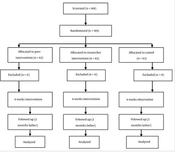
Researchers randomly selected the subjects from among the patients referred to the center. The researchers prepared a list of all candidates eligible to participate in the study, after assessing each patient’s records according to the inclusion criteria. Samples were then selected based on a random number table. Finally, the subjects were randomly divided into intervention (n = 37) and control (n = 37) groups.
Inclusion criteria included residing in Ahvaz, having DM for at least 6 months, and desiring to participate in the training programs. Exclusion criteria included participation in a group training program before starting our program, presence of a disease or condition that affects HbA1c levels (e.g., anemia, hemoglobinopathies, uremia, renal failure, and hemodialysis), failure to participate in the group training program for more than two sessions, and hospitalization during the study.
The sample size was calculated using the following formula (Equation 1):
3.2. Intervention
At the beginning of the study, after getting a referral and coordinating with diabetes clinics for children and obtaining the consent, patients referred to the clinic were sampled based on inclusion and exclusion criteria. How to implement the program, confidentiality and noninstrumental use of information, and the aim of the program was explained to all participants. Both groups completed the questionnaires containing demographic and medical information. A glucometer was used for FBS testing, and a colorimetric method was used for HbA1c testing. The intervention group was divided into three groups for training (two groups of 12 patients and one group of 13 patients), which included group discussions for 8 weeks (two 1-hour sessions per week). There was no training intervention for the control group. Training materials, including a training manual and CD, were available for both groups. The intervention group was given an opportunity, for 3 months from the beginning of the study, to apply the new skills in everyday life, during which time the researchers were in contact with them by telephone. After the trial period, FBS and HbA1c levels were again measured in both groups. The results of this study were analyzed using SPSS version 22. To compare both groups before and after the intervention, the independent t-test was used. Also, the χ2 test was used for qualitative variables (P < 0.05).
3.3. Ethical Considerations
The initial plan of the study was approved by the ethics committee of Ahvaz Jundishapur university of medical sciences (code No. 117.1393).
4. Results
In this study, 48.7% of the intervention group and 46% of the control group were 15 - 18 years of age, and 64.8% of the intervention group and 54% of the control group were girls. Regarding educational level, 37.9% and 46% of the intervention and control groups, respectively, had a secondary degree. The largest proportion of the research subjects in the intervention group (51.3%) and the control group (46%) were Arab. In the intervention and control groups, respectively, 35.2% and 32.4% had a history of diabetes for 6 - 7 years and 54% and 64.8% had a positive family history of diabetes. In addition, 75.7% of the intervention group and 70.3% of the control group earned more than 700,000 Tomans per month. The χ2 tests showed no significant differences between the two groups with respect to age, sex, education, ethnicity, risk of diabetes, family history of diabetes, or monthly income (P > 0.05).
Table 1 shows the demographic data of both groups. Given that no significant differences were found between the two groups according to the χ2 test after comparison of the demographic and underlying variables (P > 0.05), it can be concluded that randomization was successful in this study (Table 1).
Table 1.
Demographic Characteristics of the Intervention and Control Groups a
| Demographic Information of Patients | Group | P Value | |
|---|---|---|---|
| Intervention | Control | ||
| Age, y | 0.96 | ||
| 11 - 14 | 10 (0.27) | 10 (0.27) | |
| 15 - 18 | 18 (48.7) | 17 (0.46) | |
| 19 - 21 | 9 (24.3) | 10 (0.27) | |
| Sex | 0.34 | ||
| Male | 13 (35.2) | 17 (0.46) | |
| Female | 24 (64.8) | 20 (0.54) | |
| Education | 0.77 | ||
| Primary | 3 (8.1) | 4 (10.8) | |
| Secondary | 14 (37.9) | 17 (0.46) | |
| High school | 11 (29.7) | 9 (24.3) | |
| Diploma | 6 (16.2) | 3 (8.1) | |
| University | 3 (8.1) | 4 (10.8) | |
| Ethnicity | |||
| Lor | 13 (35.2) | 12 (32.4) | 0.65 |
| Arab | 19 (51.3) | 17 (0.46) | |
| Fars | 5 (13.5) | 8 (21.6) | |
| Duration of diabetes, y | 0.83 | ||
| 1 - 2 | 6 (16.2) | 4 (10.8) | |
| 3 - 4 | 9 (24.3) | 12 (32.4) | |
| 5 - 6 | 9 (24.3) | 9 (24.3) | |
| 6 - 7 | 13 (35.2) | 12 (32.4) | |
| Family history of diabetes | 0.89 | ||
| Yes | 20 (54.0) | 24 (64.8) | |
| No | 17 (46.0) | 13 (35.2) | |
a Data are presented as No. (%).
Before the intervention, no significant differences were found between the groups with respect to the mean FBS and HbA1c levels, whereas significant differences were observed between the groups for both of these variables after the intervention (P < 0.001) (Table 2).
| Variable | Before Intervention | After Intervention | P Value |
|---|---|---|---|
| FBS | |||
| Intervention | 181.59 ± 94.14 | 135.75 ± 65.50 | 0.017 |
| Control | 43.203 ± 12.91 | 70.212 ± 67.87 | 0.49 |
| P value | 0.31 | < 0001 | |
| HbA1c | |||
| Intervention | 10.68 ± 15.2 | 7.87 ± 2.01 | < 0001 |
| Control | 10.17 ± 2.09 | 11.4 ± 30.2 | 0.002 |
| P value | 0.30 | < 0001 |
a Abbreviations: FBS, fasting blood sugar; HbA1c, glycosylated hemoglobin.
b Data are presented as mean ± SD.
5. Discussion
Type 1 diabetes is one of the most common chronic metabolic disorders during childhood and adolescence and has potentially life-threatening outcomes. Currently, the increasing number of children and adolescents with diabetes necessitates rigorous treatment programs. Training is the most basic and least expensive program for patients.
Our results showed that the group training had improved the patients’ blood sugar levels. DM is among the diseases for which the patients carry the responsibility for their treatment and care. Therefore, providing the patients with DM with opportunities for sharing experiences and receiving constructive feedback is of great importance to improve the patients’ blood sugar levels. Our findings demonstrated that the blood sugar levels of the patients with type I diabetes improved after group training with constructive feedback.
In agreement with our results, Shamsi et al. showed that implementation of a training program for patients with type II diabetes improved their control of their blood sugar levels (17, 18).
Cheraghi et al. showed that after training intervention, the average glucose recorded for children with diabetes declined during 1 week (19). In addition, Kashfi et al. found that implementing educational intervention reduced FBS levels from 207.08 mg/dL before intervention to 124.2 mg/dL after the training intervention in patients with type II diabetes, which is in line with the results of our study (20). Thus, group training programs play an important role in reducing the average blood glucose level in patients. In this study, the reduction was observed for 3 months after the intervention (21).
Our study showed that after training intervention, the mean HbA1c level in juveniles with diabetes was reduced, which is in line with the results of Abolfotouh et al. (22), Tan et al. (23), and Abolfotouh et al. found statistically significant differences in HbA1c levels in their experimental group after the training sessions (22). Tan et al. also found statistically significant differences in HbA1c levels after training (23). Rachsandehroo et al. found that training is effective in patients with diabetes in improving their diabetes control index (13). The results of the present study were consistent with the results of Ooi et al. who showed that group training significantly increased the knowledge of diabetic patients regarding diabetes and prevention of complications, including mental and psychological problems (24).
Sharing positive experiences through group training is an effective method for empowering patients to cope with their diseases; however, this method has been rarely used in patients with type I diabetes. The present study is one of the few studies that used group training in patients with type I diabetes; however, some limitations might affect the generalization of the results. First, this study was conducted on children and adolescents with type I diabetes, and therefore, the results cannot be generalized to adults. Moreover, the small sample size might limit the generalizability of the results. Therefore, further studies with larger sample sizes are suggested.
The results of this study showed that group training and involving individuals with diabetes in their own care and treatment improves the control of blood sugar. Because of the importance of education, especially group training, it is recommended to perform similar studies for individuals with diabetes and other chronic diseases. It is also recommended to provide the possibility of continuing training for vulnerable members of society, especially adolescents, with the support and equipment of diabetes centers.