Full Text
Full text is available in PDF
International Journal of Endocrinology and Metabolism
Research Institute for Endocrine Sciences
Authors
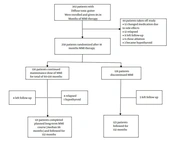
This study was done to compare the clinical course of hyperthyroid patients with and without anti-thyroid drugs immediately post radioactive iodine treatment. Materials and Methods: Patients with mild to moderate hyperthyroidism, aged 18 to 60 years, were divided into 2 groups, those who received RAI plus anti-thyroid (ATD) (propylthiouracil 100 mg q8H) (group A) and those who received RAI only (group B). Fixed doses of 8 mCi 131I were given and symptoms were scored daily for 3 weeks, using 3-severe, 2-moderate, 1-mild scores. Descriptive analysis using mean and standard deviation was used to determine the demographic profiles and Mann Whitney t-test for independent samples was utilized to com-pare the symptoms between the two groups. All statistical tests were pegged at .05 alpha level and p-values less than .05 were considered sig-nificant. Results: There were 3 males and 5 females in group A (n=8, mean age: 38±12.82 yrs) and 2 males and 6 females in group B, (n=8, mean age: 41.37±15.14 yrs). TSH was suppressed in both groups and the mean FT4 for group A was 13.87±16.51 pmol/L, and for group B was 28.51±15.86 pmol/L. There was no significant dif-ference in age, FT4 and TSH. Mean scores were as follows: (Group A vs. Group B), week one: 1.36 vs. 1.55 (p=0.01); week two: 1.08 vs. 0.94 (p= 0.110), and week three: 0.71 vs. 0.92 (p= 0.006). A highly significant decrease in symptoms was noted in week three. Conclusion: Analysis of our data showed that patients given ATD immediately post RAI ex-perienced lesser symptoms of thyrotoxicosis dur-ing the first and third week after RAI treatment, favoring treatment with ATD.
© 2008, Author(s). This open-access article is available under the Creative Commons Attribution 4.0 (CC BY 4.0) International License (https://creativecommons.org/licenses/by/4.0/), which allows for unrestricted use, distribution, and reproduction in any medium, provided that the original work is properly cited.
Shekholeslami F, Ataie L, Hedayati M, Mehrabi Y, Azizi F. Comparison of Outcome in Radioiodine Induced Euthyroid and Hypothyroid Patients. Int J Endocrinol Metab. 2005;3(4):. doi:
Kalantary S. The prevalence of Graves’ disease and related factors recurrence following discontinuation of antithyroid agents. J Inflamm Dis. 2024;8(4):e155096. doi:
kiani J, Yusefi V, Tohidi M, Mehrabi Y, Azizi F. Evaluation of glucose tolerance in methimazole and Radioiodine treated Graves’ patients. Int J Endocrinol Metab. 2010;8(3):e94642. doi:
Saadat N, Masoumi S, Shahrzad MK, Azizi F. Sustained Euthyroidism during Thionamide Antithyroid Drug Treatment: Comparison of Short- and Long-term Methimazole Therapy. Int J Endocrinol Metab. 2024;22(1):e140956. doi: https://doi.org/10.5812/ijem-140956
Soltani A, Rahimian N, Rahbar Z, Moosapour H. Before Moving Towards Recombinant Thyrotropin, Can We Benefit From Anti-Thyroid Drugs? A Case Study. Int J Endocrinol Metab. 2008;6(3):. doi:
Last Update: 3 weeks ago
Last Update: 3 weeks ago
Last Update: 3 weeks ago
Last Update: 9 hours ago
Last Update: 1 day ago
Last Update: 4 days ago
