Full Text
Full text is available in PDF
International Journal of Endocrinology and Metabolism
Research Institute for Endocrine Sciences
Authors
Soluble vascular cell adhesion molecule-1 (sVCAM-1) and intercellular adhesion molecule-1 (sICAM-1) have been shown to be elevated in patients with Graves'disease and may play significant roles in the pathogenesis of the disease. The objective of this study was to measure the levels of sVCAM-1, sICAM-l, IL-6 and thyroid receptor stimulating antibodies (TRAb) in a cohort of hyperthyroid patients and determine their associations to thyroid hormones status, before and after 3 months thexapy with carbimazole.
Patients were given fixed daily dose of 20 mg carbimazole for 3 months and blood samples were collected at baseline and end of the study. Thirty-eight patients were recruited from the Endocrine Clinic, Hospital Universiti Kebangsaan Malaysia, consisting of 26 females and 12 males, age ranging from 16 to 65 years. Blood samples collected before and at end of study were analysed for TSH, Free TJ, Free T4J thyroid receptor stimulating antibodies (TRAb), sVCAM-1, sICAM-1 and lL-6.
TRAb level of ?10 to U/L was taken to be negative, while TRAb level of >10 U/L was considered as positive. Twenty-six patients (68%) were TRAb positive (TRAb+) and 12 patients (30%) were TRAb negative (TRAb-). Median TRAb in TRAb+ patients was 23 UIL at baseline, declining to 16.7 U/L (p<0.00l) in the third 3 month. Sexum sVCAM-1 levels were significantly elevated in TRAb+ patients compared to TRAb-(860 versus 499 nglmL, p<0.00l). The level decreased significantly to 537 nglmL with treatment but remained higher than in TRAb-patients (p=0.003). Irrespective of TRAb status, all but one patient had elevated serum sICAM-l levels that remained unaffected by carbimazole therapy. In contrast, IL-6 levels of hyperthyroid patients were within the reference range of 1.+14.1 pglmL. Baseline and post-treatment sVCAM-l, and not TRAb levels, were significantly correlated to thyroid hormones.
Compared to other inflammatory markers, sVCAM-l showed significant correlation to thyrOid stimulating antibodies and was most sensitive to changes in thyroid status. The significance of these findings in relation to Graves' disease warrants further investigation.
© 2004, Author(s). This open-access article is available under the Creative Commons Attribution 4.0 (CC BY 4.0) International License (https://creativecommons.org/licenses/by/4.0/), which allows for unrestricted use, distribution, and reproduction in any medium, provided that the original work is properly cited.
Azizi F, Amouzegar A, Tohidi M, Hedayati M, Cheraghi L, et al. Systemic Thyroid Hormone Status in Treated Graves’ Disease. Int J Endocrinol Metab. 2019;17(4):e95385. doi: https://doi.org/10.5812/ijem.95385
Okamura K, Bandai S, Fujikawa M, Sato K, Ikenoue H, et al. Long-Term Antithyroid Drug Treatment: Trends in Serum TSH and TSH Receptor Antibody Changes in Patients with Graves’ Disease. Int J Endocrinol Metab. 2020;18(Suppl):e101139. doi: https://doi.org/10.5812/ijem.101139
Shams M, Sharif-Kazemi M, Lankarani K, Sadegholvad A, Omrani G. Are Serum Thyrotropin level and Subclinical Hypothyroidism Predisposing Factors for Coronary Artery Disease?. Int J Endocrinol Metab. 2005;3(2):. doi:
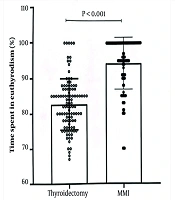
Abdi H, Takyar M, Mehran L, Masoumi S, Amouzegar A, et al. Sustained Control of Hyperthyroidism in Graves’ Disease: Comparison of Thyroidectomy and Long-Term Antithyroid Treatment. Int J Endocrinol Metab. 2026;24(1):e164940. doi: https://doi.org/10.5812/ijem-164940
Santos Palacios S, Pascual-Corrales E, Galofre JC. Management of Subclinical Hyperthyroidism. Int J Endocrinol Metab. 2012;10(2):. doi: https://doi.org/10.5812/ijem.3447
Last Update: 3 weeks ago
Last Update: 3 weeks ago
Last Update: 3 weeks ago
Last Update: 3 hours ago
Last Update: 5 hours ago
Last Update: 4 days ago