
1. Background
As one of the most formative stages of life, adolescence is critical in shaping one’s future personality (1). This stage of life can be full of threats, and most high-risk behaviors originate from this age (2). When compared to other stages of life, characteristics such as risk-taking and excitement can lead adolescents to engage in a multitude of high-risk behaviors (3). Marginalized or slum areas are suspected of being a source of such risks (3, 4). Therefore, adolescents living in these areas are more prone to high-risk behaviors (4, 5). Numerous studies have sought to identify the factors that can aid humans during traumatic events. Resilience is a critical human ability that enables individuals to adapt to risk factors effectively (6, 7).
In general, resilience is a promising concept studied in social harms, such as violence (8) and high-risk behaviors (9), and encompasses the physical, intellectual, social, emotional, and spiritual domains. The term “resilience” is used in this context to refer to children’s positive development in facing adversity and the processes that assist individuals in avoiding harmful, self-destructive, or antisocial behaviors, as well as mental disorders and even threats to their physical well-being (10). In other words, resilience is a characteristic of those exposed to specific risk factors and capable of coping with risks and avoiding negative consequences, including delinquency and behavioral problems (11).
In addition, the role of emotion in the development of such behaviors should not be overlooked (12). Emotional intelligence (EI) is the capacity to manage one’s emotions and develop the necessary skills to influence interpersonal relationships and day-to-day problem-solving situations (13). In this regard, prior research has focused on the associations between EI and delinquent behaviors in students, such as crime, substance abuse, vandalism, pornography, and sexual behaviors (12). Managing emotions is associated with coping strategies, and deficits in those abilities are accompanied by risk-taking behaviors (14).
Furthermore, several studies have examined the relationship between EI and resilience, concluding that resilience training may boost EI (15, 16). Subsequently, higher levels of EI have been linked to increased resilience (15). Resilience-promoting interventions have been introduced as one of the successful programs for vulnerable students in identifying the factors that contribute to some adolescents resisting or adapting to risks (10, 17).
A study in Iran discovered that the outskirts of major cities, including Shiraz, created an environment conducive to crime and social harm due to poverty, partial deprivation, and low quality of life (18). Moreover, two studies conducted on marginalized populations and slum dwellers have highlighted the significant risks associated with living in such areas, the role of poverty in aggravating social harms, and a higher prevalence of high-risk behaviors among residents (18, 19). However, harm does not merely affect everyone in the same way. Some individuals may be resilient, while others are more vulnerable to potential harm (20).
2. Objectives
To our knowledge, little research has been conducted on the relationship between EI and resilience training among adolescents, and gender differences have not been considered in the marginalized areas of Iran (21, 22). Therefore, the purpose of this study was to evaluate the impact of resilience training on improving EI in adolescents and its effectiveness in both genders in the marginalized areas of Shiraz, Iran.
3. Materials and Methods
3.1. Study Setting and Design
This pre-experimental or before-and-after study was conducted in 2019 in the middle schools located in Shiraz’s slum areas. Shiraz is the capital city of Fars province in southwestern Iran, with a population of nearly 1,869,001 and over 200.000 inhabitants living in its urban slums (23). Before-after studies are applied in small-scale interventional investigations in low-resource settings (24, 25). The study intervention consisted of nine 90-min resilience-training sessions, focusing on the 15 components of EI (26). All interactive training sessions were supervised and coordinated by knowledgeable psychologists. Almost all students were engaged in educational subjects through problem- and story-based learning. Table 1 lists the training subjects for each session.
Table 1.
Training Intervention Program
| Session | Target | Training Topic | Training Method | Educator |
|---|---|---|---|---|
| 1 | Interpersonal relationships, self-esteem, and self-expression | Learning about communication and social and family ties | Educational videos, lectures, question, and answer | Psychological and research expert group |
| 2 | Endure psychological stress | Learning about enduring stress, shaking control | Lectures, group discussions, and question and answer | Psychiatrist |
| 3 | Problem-solving skills and challenging beliefs | Learning to solve problems | Educational videos and posters | Consultant |
| 4 | Self-actualization, empathy, optimism, and happiness | Learning about self-actualization, empathy, optimism, and happiness | Lectures, group discussions, and question and answer | Mental health expert |
| 5 and 6 | Emotion adjustment and resilience | Learning about excitement and excitement and training on stress management and anger management | Lectures, group discussions, and question and answer | Research fellow |
| 7 and 8 | Flexibility, self-esteem, and confidence | Learning about momentary resilience | Lectures, group discussions, and question and answer | Research fellow |
| 9 | Perspective and goal setting for life | Learning about social and individual adequacy | Lectures, group discussions, and question and answer | Research fellow |
3.2. Sample Size and Sampling
The participants were selected using a multistage cluster sampling procedure. We began by randomly selecting one slum area in Shiraz from a total of thirteen. Next, we considered three middle schools in that area, one for girls and two for boys. Finally, the study included all first-grade middle school students. Students were free to leave at any point during the study, and those who were not willing to participate in the study or were absent in the post-test were excluded from the study. The educational sessions drew a total of 191 male and female students (out of 221). They were also asked to sign an informed consent form prior to the intervention if they wished to participate. All students voluntarily participated in the study based on announcements by schools’ managers.
3.3. Ethical Approval
The Ethics Committee of Shiraz University of Medical Sciences approved this study under the code IR.SUMS.REC.1398.1084.
3.4. Measurement
The modified Bar-On Emotional Quotient Inventory (EQ-i) was used in this study to assess the outcomes of the resilience-training intervention. The questionnaire has been validated and translated into at least 30 different languages (26). The questionnaire consists of 90 items based on a five-point Likert scale and 15 sub-scales, including intrapersonal skills (i.e., self-regard, emotional self-awareness, assertiveness, independence, and self-actualization), interpersonal skills (i.e., empathy, social responsibility, and interpersonal relationships), stress management skills (i.e., stress tolerance and impulse control), adaptability (i.e., reality testing, flexibility, and problem-solving), and self-actualization (i.e., optimism and happiness) (26). Samouei evaluated and confirmed the validity and reliability of the questionnaire in 2002 (27). Cronbach’s alpha coefficient (α = 0.93) was used to assess the reliability of the questionnaire (27). The EQ-i was completed by study participants prior to and two months after the intervention.
3.5. Data Analysis
The quantitative variables were described as mean ± standard deviation, and the qualitative ones were reported as numbers and percentages. First, the Kolmogorov-Smirnov test was used to determine the normality of the data. To compare the mean differences of the EI components before and after the intervention between genders, we used independent-samples t-tests. Moreover, to compare the pre- and post-intervention mean scores of the EI components, a paired-samples t-test was utilized. Data were analyzed by the SPSS software version 20 and GraphPad Prism software version 9. The significance level for all tests was considered P-value < 0.05.
4. Results
This study surveyed a total of 191 students, of whom 88 (46.1%) were boys. Nearly half of the students (49.2%) were only child, and 86.9% lived with both parents. Moreover, most mothers (30.4%) held a high school diploma, and fathers (38.7%) held a middle school education. Table 2 summarizes the socio-demographic characteristics of the participants.
Table 2.
Description of the Frequency of Demographic Variables of the Studied Individuals
| Variables | No. (%) |
|---|---|
| Gender | |
| Male | 88 (46.1) |
| Female | 103 (53.9) |
| Number of children | |
| One | 94 (49.2) |
| Two | 49 (25.7) |
| Three or more | 48 (25.1) |
| Living with parents | |
| Living with both | 166 (86.9) |
| Living with mother | 20 (10.5) |
| Living with father | 5 (2.6) |
| Mother’s education | |
| Illiterate | 19 (9.9) |
| Elementary | 48 (25.1) |
| Intermediate | 56 (29.3) |
| Diploma | 58 (30.4) |
| College education | 10 (5.2) |
| Father’s education | |
| Illiterate | 13 (6.8) |
| Elementary | 46 (24.1) |
| Intermediate | 74 (38.7) |
| Diploma | 42 (22) |
| College education | 16 (8.4) |
Overall, the intervention increased the mean resilience scores by 8.11 points (14.19 points in boys and 2.92 points in girls). Table 3 compares the EI components before and after the intervention in both genders. Scores on all subscales had a range of 6 - 30. Following the intervention, the scores of boy participants in problem-solving (P = 0.007), happiness (P = 0.001), emotional self-awareness (P = 0.044), optimism (P = 0.029), self-regard (P = 0.046), impulse control (P = 0.013), and social responsibility (P = 0.042), as well as the total EI score (P = 0.005), rose significantly. However, only the optimism score (P = 0.004) augmented significantly in girls post-intervention, while the other components and the total EI score did not show a significant difference.
Table 3.
| Male | Female | |||||
|---|---|---|---|---|---|---|
| Emotional Intelligence Components | Pre-intervention | Post-intervention | P-Value | Pre-intervention | Post-intervention | P-Value |
| Problem solving | 24.01 ± 4.05 | 25.34 ± 3.50 | 0.007 c | 24.50 ± 3.89 | 24.00 ± 4.48 | 0.253 |
| Happiness | 18.39 ± 4.94 | 19.62 ± 17.61 | 0.001 c | 17.94 ± 20.46 | 16.61 ± 2.70 | 0.196 |
| Independence | 18.37 ± 4.94 | 19.55 ± 4.61 | 0.054 | 16.64 ± 4.26 | 17.41 ± 4.05 | 0.063 |
| Stress tolerance | 19.76 ± 4.34 | 20.30 ± 4.22 | 0.386 | 19.72 ± 4.31 | 19.31 ± 4.61 | 0.397 |
| Self-actualization | 18.50 ± 6.67 | 19.87 ± 5.91 | 0.074 | 18.00 ± 6.69 | 18.04 ± 6.97 | 0.931 |
| Emotional self-awareness | 20.60 ± 3.50 | 21.56 ± 3.89 | 0.044 c | 21.0 ± 3.65 | 20.89 ± 3.21 | 0.778 |
| Reality testing | 18.46 ± 4.51 | 18.97 ± 4.31 | 0.378 | 17.16 ± 3.14 | 17.49 ± 2.96 | 0.374 |
| Interpersonal relationship | 19.61 ± 4.86 | 20.00 ± 4.25 | 0.551 | 18.92 ± 4.35 | 19.69 ± 4.10 | 0.104 |
| Optimism | 23.19 ± 4.86 | 24.79 ± 7.09 | 0.029 c | 23.99 ± 3.66 | 24.84 ± 4.02 | 0.004* |
| Self-regard | 22.05 ± 3.44 | 22.94 ± 3.39 | 0.046 c | 22.18 ± 3.33 | 22.26 ± 3.71 | 0.839 |
| Impulse control | 23.54 ± 3.54 | 24.59 ± 3.34 | 0.013 c | 24.04 ± 3.24 | 23.99 ± 2.99 | 0.869 |
| Flexibility | 20.01 ± 3.85 | 20.65 ± 4.39 | 0.273 | 18.80 ± 3.64 | 19.49 ± 3.89 | 0.103 |
| Social-responsibility | 23.50 ± 3.83 | 24.44 ± 3.66 | 0.042 c | 23.93 ± 3.70 | 23.88 ± 3.78 | 0.868 |
| Empathy | 23.31 ± 4.46 | 24.25 ± 4.27 | 0.071 | 24.60 ± 4.30 | 24.67 ± 4.25 | 0.883 |
| Assertiveness | 19.17 ± 4.02 | 19.56 ± 4.48 | 0.420 | 19.28 ± 3.22 | 19.64 ± 3.11 | 0.384 |
| Total score | 312.52 ± 37.79 | 327.31 ± 37.75 | 0.005 c | 310.74 ± 30.05 | 312.20 ± 29.51 | 0.246 |
a Data reported as mean ± SD.
b Paired samples t-test
c Significant at 0.05
Table 4 compares the differences in mean EI components before and after the intervention between the two genders. According to the findings of the current study, there was a statistically significant difference between boys and girls in the mean values of problem-solving (P = 0.006), happiness (P = 0.001), impulse control (P = 0.042), and the total score (P = 0.035). Furthermore, the optimism score had the most significant increase following the intervention in both genders.
Table 4.
| Male | Female | P-Value | |
|---|---|---|---|
| Problem solving | 1.27 ± 4.33 | -0.51 ± 4.45 | 0.006 c |
| Happiness | 1.22 ± 3.41 | -0.33 ± 2.57 | 0.001 c |
| Independence | 1.18 ± 5.66 | 0.77 ± 4.11 | 0.572 |
| Stress tolerance | 0.54 ± 5.65 | -0.41 ± 4.89 | 0.212 |
| Self-actualization | 1.37 ± 7.13 | 0.04 ± 5.70 | 0.155 |
| Emotional self-awareness | 0.96 ± 4.43 | -0.11 ± 3.82 | 0.074 |
| Reality testing | 0.51 ± 5.41 | 0.33 ± 3.75 | 0.786 |
| Interpersonal relationship | 0.38 ± 6.04 | 0.77 ± 4.80 | 0.620 |
| Optimism | 1.60 ± 6.77 | 0.85 ± 2.97 | 0.313 |
| Self-regard | 0.88 ± 4.11 | -0.07 ± 3.85 | 0.164 |
| Impulse control | 1.04 ± 3.85 | -0.05 ± 3.57 | 0.042 c |
| Flexibility | 0.64 ± 5.50 | 0.68 ± 4.24 | 0.953 |
| Social-responsibility | 0.94 ± 4.28 | -0.04 ± 2.95 | 0.061 |
| Empathy | 0.93 ± 4.4776 | 0.07 ± 3.72 | 0.167 |
| Assertiveness | 0.48 ± 5.65 | 0.35 ± 3.86 | 0.852 |
| Total score | 14.19 ± 45.98 | 2.92 ± 25.29 | 0.035 c |
a Data reported as mean ± SD.
b Independent samples t-test
c Significant at 0.05
Figure 1 illustrates the comparison of the EI components between boy and girl participants pre-intervention. It shows significant differences between boys and girls in terms of independence (P = 0.01), reality testing (P = 0.021), flexibility (P = 0.028), and empathy (P = 0.045) at this time. However, prior to the intervention, the total EI score did not differ significantly between genders (P = 0.718). Figure 2 compares the EI components between boy and girl participants post-intervention. Significant differences were observed at this time between boys and girls in problem-solving (P = 0.024), happiness (P = 0.001), independence (P = 0.001), self-actualization (P = 0.05), reality testing (P = 0.006), and flexibility (P = 0.05). Both genders had a statistically significant difference in their total EI score following the intervention (P-value = 0.004).
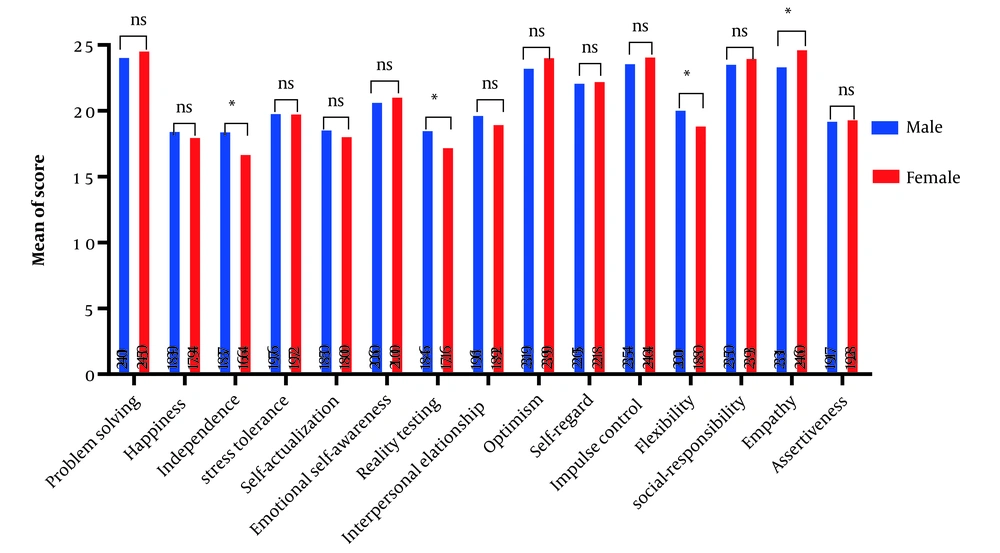
Figure 1.
Emotional intelligence comparison between males and females before intervention
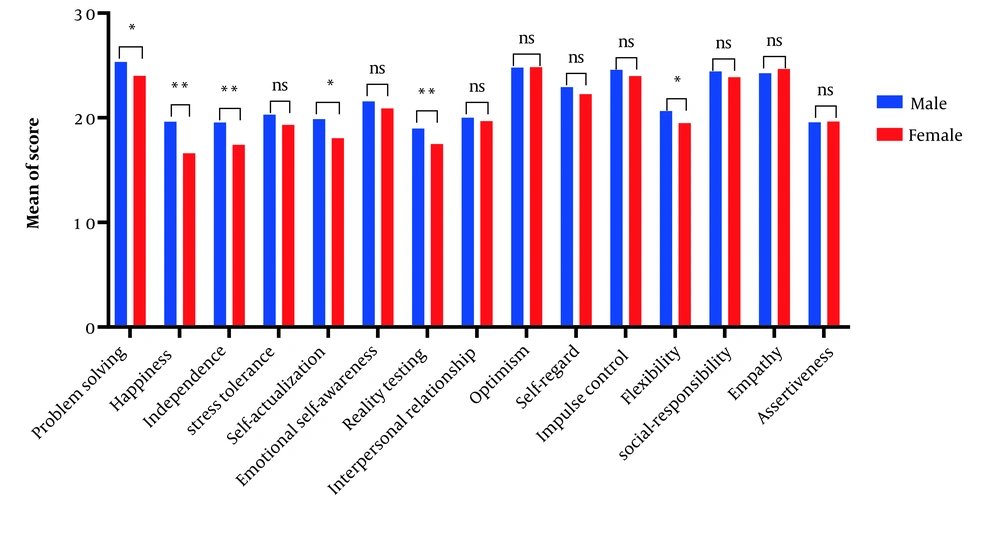
Figure 2.
Emotional intelligence comparison between males and females after intervention
5. Discussion
The present research aimed to evaluate gender differences in the effectiveness of resilience training on EI among adolescents living in the marginalized areas of Shiraz in 2019. Our findings indicated that the changes in EI components, including problem-solving, happiness, impulse control, self-awareness, optimism, and self-regard, as well as the total score, were statistically significant in male adolescents following the intervention.
However, no statistically significant difference was observed in girls when the mean difference of pre- and post-test EI components was compared, except for optimism. Furthermore, there was a significant difference in problem-solving, happiness, impulse control, and total score between the genders (27). The total score of EI in male adolescents was higher than in females. The possible interpretation for such difference would be the higher rate of risk-taking behaviors in male students in Iran than the females (28), which increased male students’ demands for developing resilience skills.
In addition, the results of the present study established the efficacy of resilience training on EI, consistent with previous research (15, 16, 21). In fact, resilience may help to alleviate emotional exhaustion and promote overall well-being (29). In line with previous research, this study established the efficacy of resilience-promoting interventions in vulnerable adolescents living in marginalized areas in both genders (10, 17). Furthermore, our findings indicated that resilience-training interventions only influenced adolescent social responsibility, self-regard, and emotional self-awareness as intrapersonal and interpersonal skills. Unlike the current study, Ghahramani et al. discovered no significant difference in emotional self-awareness between male and female adolescents (30). Molero Jurado et al. also reported that girls performed better than boys, but boys had a greater capacity for engagement (31).
Evidence indicates that resilience-building interventions can reduce the stress levels of students by improving their coping and stress management skills (32). Resilience significantly improved impulse control and stress management skills in male adolescents in the current study. In other words, numerous EI components were gender-specific (33-35). Molero Jurado et al. also noted a significant interaction between gender and stress management skills, indicating that no interaction, which is necessary for overcoming obstacles, was observed in male adolescents (31). The general mood and its components were classified as EI components associated with resilience. The mean EI score increased significantly before and after the intervention, particularly among boys.
In general, happy and optimistic people have lower stress levels and respond more positively and adaptively to specific situations (36), which reduces the likelihood of being engaged in high-risk behaviors (37). Although gender differences in mental health problems have been debated in previous research (30, 38-40), girls may experience depression at a higher rate than boys in puberty conditions (23).
In this study, male adolescents achieved a higher mean score in several EI components both pre- and post-intervention, and their overall EI score was higher than female. Based on these findings, it was concluded that resilience and EI might develop differently depending on gender. Individuals with a high EI are unquestionably capable of correctly comprehending and evaluating their emotional states, adjusting their moods, and knowing how and when to express their emotions. These abilities facilitate successful coping and frequently result in increased reliance on social support, advancement motivation, and life satisfaction (16).
As a result, gender differences in EI components may indicate that female adolescents required significantly more attention. Nonetheless, gender differences in EI subscales were contentious, and it could be concluded that a variety of factors, including the socio-cultural context, may be involved.
5.1. Strengths and Weaknesses
The current study had several strengths and weaknesses. This was the first attempt, given the prevalence of resilience-training interventions in Iran’s marginalized adolescent population. Moreover, this investigation was one of the few studies that have examined gender differences in EI in adolescents. However, one of its shortcomings was the lack of long-term follow-up on the training programs implemented. In addition, self-administration was a weakness of this study, resulting in measurement bias and the misclassification of gender groups. Another limitation was the absence of a control group due to financial constraints and a small population.
5.2. Conclusions
The findings of the current study indicated that resilience training could significantly improve EI and its components and provides critical benefits for dealing with adversity, particularly in male adolescents. Given that the EI scores of boys were higher than female adolescents, the optimal solution for enhancing various components of EI would require reasonable intervention in families and schools.
With EI training programs, social skills and resilience may be valuable tools for reducing behavioral problems and emotional distress in students and an excellent opportunity to improve social adjustment. As a result, developing resilience as a part of educational programs enables at-risk students to better prepare for dealing with problems, adapt to challenges, and manage their reactions, particularly boys. This study suggested that resilience training in schools for adolescents living in the marginalized areas of large cities, such as Shiraz, could help them improve their EI skills. Furthermore, it would empower them in facing adversity, preventing or mitigating their participation in high-risk behaviors and their likely consequences. Finally, we recommend further investigation with control groups to adjust the confounding factors.