
1. Introduction
Facial injuries resulting from lacerations are a significant concern in clinical practice, often requiring immediate and meticulous management to prevent long-term complications (1). Opium, a substance derived from the opium poppy plant, has a long and complex history of use in various cultures for its medicinal properties (2). One intriguing historical practice involving opium is its insertion into lacerations as a form of treatment. Among the diverse array of causative agents implicated in soft tissue damage, opium insertion presents a unique and challenging scenario (3).
Opium, a potent narcotic with known vasoactive properties, can exacerbate tissue trauma when introduced into wounds. The localized effects of opium on facial soft tissues are multifaceted, involving both direct chemical irritation and secondary inflammatory responses. Inserting opium into lacerations can delay wound healing and increase the risk of infection due to its potential to cause tissue irritation, inflammation, and impaired immune response. The practice of inserting opium into lacerations or wounds historically stems from the belief in its analgesic (pain-relieving) properties. Opium contains compounds such as morphine and codeine, which are potent painkillers (4-6).
The notion that inserting opium into lacerations is a beneficial practice originates from several perspectives. From a medical ethics standpoint, there are significant concerns. The use of opium in this manner raises issues regarding patient autonomy, the principle of beneficence (doing good), non-maleficence (avoiding harm), and considerations of justice. Administering opium for pain relief without exploring safer and more effective alternatives conflicts with modern medical ethical standards. Regarding health impact, inserting opium into lacerations can detrimentally affect wound healing processes. This practice introduces a foreign substance into the body, potentially delaying healing and increasing the risk of infection. Moreover, systemic effects such as respiratory depression and impaired wound healing may arise from opium use in this context. In terms of cultural and socio-economic context, the historical use of opium in various cultures has influenced traditional medical practices. However, contemporary medical knowledge underscores evidence-based treatments that prioritize patient safety and effective pain management strategies, avoiding the use of substances that may pose risks to health (2, 3, 7, 8).
Understanding the pathophysiological mechanisms underlying such injuries is crucial for optimizing treatment approaches and achieving favorable patient outcomes. This article explores the clinical manifestations, management strategies, and outcomes associated with facial soft tissue damage caused by opium insertion into lacerations. Effective treatment is critical to ensuring proper wound healing and minimizing complications. This case report investigates an unusual and potentially hazardous self-treatment method: The insertion of opium into facial lacerations. Opium, historically utilized for its analgesic and sedative properties, is not conventionally recognized as a medical treatment for wound care (4, 5).
This case report presents a unique and previously unreported instance of facial soft tissue damage resulting from the insertion of opium into a laceration, highlighting a non-standard, unconventional approach to wound management. The case, involving a 63-year-old male, underscores the severe complications that can arise from such practices, including significant infection and delayed wound healing. The novelty of this report lies not only in the specific use of opium as a wound treatment but also in the comprehensive exploration of the adverse outcomes associated with the application of unproven substances in clinical settings. This article aims to highlight the importance of adhering to evidence-based practices and offers valuable insight into the risks of non-traditional approaches to wound care, providing a critical examination of the potential dangers of deviating from established medical protocols.
2. Case Presentation
A 63-year-old male with no significant systemic diseases presented to the maxillofacial surgery department one month after a fall that resulted in a 1 cm laceration on the left side of the inferior border of the mandible. The patient’s delayed presentation was due to his initial self-treatment of the injury with opium, which he used to manage pain and prevent infection. He mistakenly believed that this would speed up the healing process, a belief commonly held in the southeastern region of Iran. Over the following weeks, the patient experienced worsening symptoms, including escalating pain, significant swelling, and signs of infection at the injury site, which ultimately led him to seek professional medical care.
On physical examination, the patient appeared in mild distress with noticeable localized facial swelling. The facial examination revealed a 2.5 × 2 cm laceration in the middle of the inferior border of the mandible on the left side, accompanied by signs of inflammation such as surrounding erythema, warmth, and purulent discharge (Figure 1). According to the patient, he had been applying opium to the wound multiple times daily for three weeks following the initial injury. Due to the prolonged application of opium to the wound, all exposed areas and surrounding tissues experienced necrosis, including the skin, buccinator muscle, and mucous membrane of the oral cavity. A strong odor of dead tissue emanated from the wound. The lymph nodes on the left side of the patient’s neck were severely inflamed.
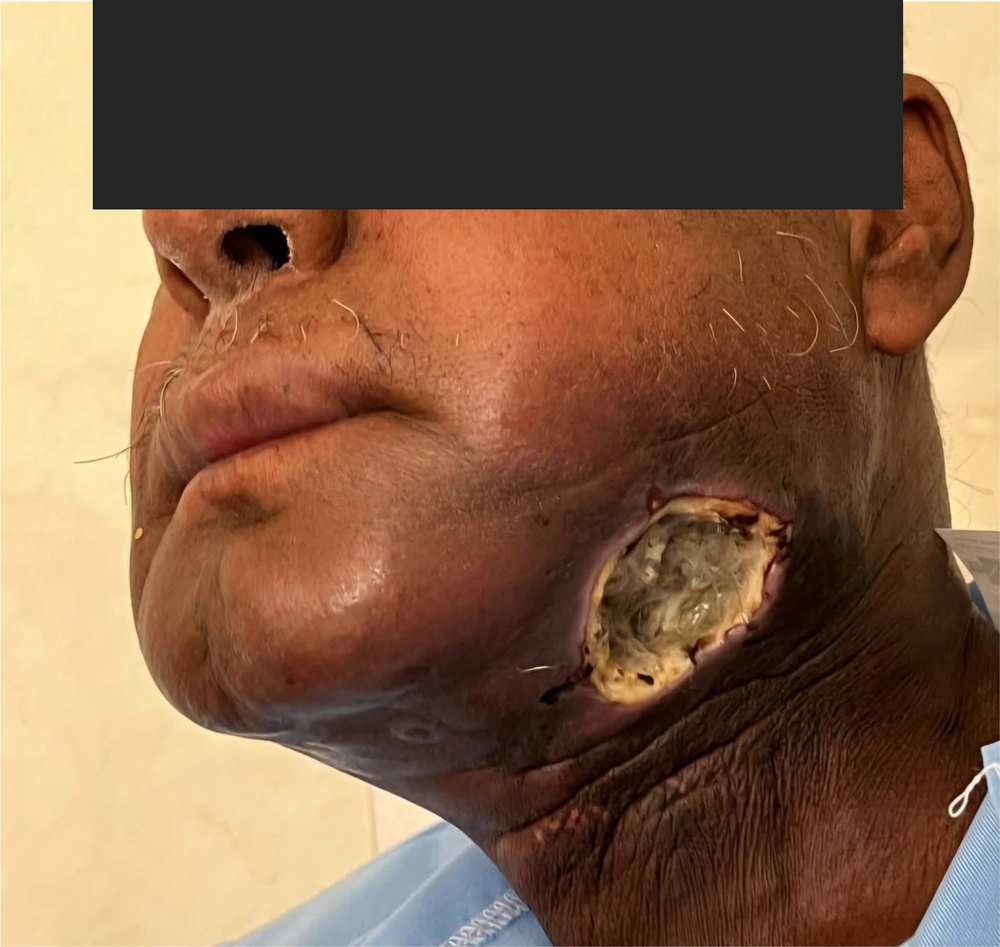
Figure 1.
Clinical view
The patient was diagnosed with soft tissue damage complicated by the insertion of opium into the facial laceration. This intervention resulted in localized infection and delayed wound healing, with opium exacerbating the complications at the laceration site. Unfortunately, the laboratory culture of the sample obtained from the wound showed no growth, and the microorganism could not be identified. Although the patient had consented to the release of information regarding his medical condition, he was not interested in continuing treatment within Iran. As a result, he traveled to a neighboring country to pursue further treatment, and there is no available information regarding the continuation of his care.
3. Discussion
The case of facial soft tissue damage resulting from the insertion of opium into a laceration highlights the serious repercussions of unconventional self-treatment methods. The key issue is the introduction of non-medical substances into an open wound, which can profoundly affect wound healing and overall patient outcomes.
Unfortunately, in the southeastern region of Iran, there is a widespread belief that opium provides complete healing for all wounds. This misconception has led to numerous unexpected incidents (9, 10). Sedighi et al. documented two pediatric cases of opium toxicity resulting from applying opium to burned areas (11). Moshiri et al. reported a case of a child’s death caused by the topical application of opium (12).
Opium, traditionally used for its analgesic properties, is not a sterile substance and carries the potential for severe complications when applied to a laceration. In this case, the insertion of opium led to localized infection and delayed healing, which are well-documented risks associated with the presence of foreign bodies in wounds. The opium likely provided a substrate for bacterial growth, exacerbating the inflammatory response and complicating the wound healing process. The appearance of the patient’s wound following manipulation closely resembled that of Noma disease or a laceration resulting from radiotherapy. Noma is a severe gangrenous condition affecting the mouth and face, often associated with polymicrobial infections and a variety of modifiable risk factors, as well as underlying social determinants that are common to other neglected tropical diseases (NTDs). The patient’s medical history was instrumental in distinguishing the diagnosis and guiding the clinical assessment (3, 6, 8).
The inflammatory response observed in the patient highlights the importance of understanding the role of foreign substances in wound management. The presence of opium not only impeded normal wound repair mechanisms but also introduced additional challenges in managing infection and inflammation. Such complications underscore the necessity for healthcare providers to educate patients about proper wound care and the risks associated with using non-medical substances. Furthermore, this case emphasizes the critical role of timely medical intervention. The patient’s delay in seeking professional care allowed the infection to progress, demonstrating how self-treatment can often lead to worsened outcomes. Prompt and appropriate medical management, including wound debridement, antibiotic therapy, and pain control, was essential in resolving the infection and facilitating healing (3, 13).
In conclusion, this case highlights significant lessons in wound management and patient education. It is imperative to discourage the use of non-sterile substances for wound treatment and to advocate for evidence-based practices. Such cases serve as a stark reminder of the potential hazards of self-medication and the ultimate need for professional medical care in managing injuries. Future research should continue to explore the impact of unconventional treatments on wound healing to further inform clinical practice and patient education strategies.
