
1. Background
Violence is a complex social and behavioral phenomenon with widespread consequences for individuals’ physical, psychological, and social well-being (1, 2). It manifests in various forms — including domestic, street, and institutional violence — and can exacerbate social, cultural, and economic challenges at the community level (1). Understanding its causes and dimensions is thus crucial. Multiple studies have identified a combination of economic, social, psychological, and cultural factors — such as poverty, unemployment, social inequality, and family issues — as contributors to violent behavior (3, 4). These factors are particularly evident among individuals who interact with law enforcement, as they often reflect broader community problems. Police stations serve as vital sources of data regarding social behavior. Reviewing the files of individuals visiting these stations can offer valuable insights into the nature and causes of violence (3, 4).
In Ilam, a city marked by high unemployment and unique cultural features, violence may present differently than in other regions (5). Previous research highlights the role of culture and socioeconomic status in shaping mental health and violent behaviors, especially in the Iranian context (6). Ilam’s distinct cultural landscape — including tribal affiliations and gender norms — makes it essential to consider these factors in studying violence.
2. Objectives
The present study aims to assess the prevalence and types of violence among individuals visiting police stations in Ilam. It explores underlying causes and related socio-cultural and economic variables (e.g., age, gender, SES, and offense type). The findings will support the development of informed policies and targeted interventions to reduce violence and improve community safety.
3. Materials and Methods
3.1. Statistical Population and Sampling
The statistical population included all individuals with violence-related cases registered in the police stations of Ilam city during a three-year study period (from the beginning of 2019 to the end of 2021). Inclusion criteria were all individuals with officially registered case files related to any form of violence (physical, verbal, psychological, or sexual) during this period. Only case files containing sufficient and complete information necessary for analysis, including demographic data and violence-related details, were included. Exclusion criteria involved incomplete or missing case files, cases unrelated to violence, unclear or unconfirmed violence status, and duplicate case files referring to the same incident.
To select 400 case files from the total population, the sampling was conducted using a systematic random sampling method, whereby every nth case file from the list was selected to ensure the representativeness of the sample. However, it should be noted that although random sampling was used, potential selection biases cannot be entirely ruled out due to factors such as incomplete or missing case files, and variations in reporting or registration practices. Therefore, while the sample provides valuable insights, the generalizability of findings to all individuals visiting police stations in Ilam may have some limitations. However the selected sample size was 400.
3.2. Data Collection Tools
A researcher-designed questionnaire was used to collect data on personal, social, and economic characteristics, as well as details of violence related to the cases. The questionnaire was designed to gather precise and comprehensive information regarding the status of violence among individuals visiting the police stations. Given the observational and descriptive nature of the study and the absence of intervention or group assignment, blinding of investigators was not applicable.
3.3. Data Analysis Methods
This study used both quantitative and qualitative methods to assess violence among visitors to police stations in Ilam. Quantitative data were analyzed using means and standard deviations, while qualitative data were examined through absolute and relative frequencies. To explore variable relationships, chi-square tests (for categorical variables), Pearson correlation (for continuous variables), and Kendall’s Tau-c (for ordinal variables) were applied. The analysis aimed to identify key factors associated with different types of violence and support the development of targeted strategies to reduce violence and improve social conditions in the region.
3.4. Ethical Considerations
This study was conducted in full compliance with ethical principles and privacy protection standards. Data were anonymized and extracted from participants’ case files with prior written informed consent from them or their legal representatives. The study adhered to ethical guidelines and was approved by the university’s research ethics committee.
4. Results
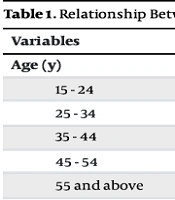
Analysis of demographic variables (Table 1) revealed significant associations with experiences of violence. The 25 - 34 age group reported the highest prevalence of physical (32.5%) and psychological (27.5%) violence (P = 0.01). Construction workers showed the highest rates among occupations for physical (30%) and psychological (20%) violence (P = 0.01), likely due to job-related stress. Individuals without a diploma experienced higher levels of physical (35%), psychological (28%), and sexual (21%) violence (P = 0.02). Unmarried individuals were particularly vulnerable, reporting physical (55%), psychological (60%), and sexual (53%) violence (P = 0.03). These findings highlight the critical impact of age, occupation, education, and marital status on the risk of experiencing violence.
Table 1.
Relationship Between Physical, Psychological, and Sexual Violence with Demographic Characteristics (Age, Occupation, Education, and Marital Status)
| Variables | Physical Violence (%) | Psychological Violence (%) | Sexual Violence (%) | Significant Relationship (P-Value) |
|---|---|---|---|---|
| Age (y) | ||||
| 15 - 24 | 22.5 | 18.5 | 10.0 | 0.03 |
| 25 - 34 | 32.5 | 27.5 | 16.5 | 0.01 |
| 35 - 44 | 20.0 | 19.0 | 14.0 | 0.04 |
| 45 - 54 | 12.5 | 16.0 | 18.5 | 0.06 |
| 55 and above | 12.5 | 19.0 | 19.0 | 0.07 |
| Occupation | ||||
| Construction worker | 30.0 | 20.0 | 15.0 | 0.01 |
| Employee | 12.5 | 16.5 | 10.0 | 0.04 |
| Unemployed | 20.0 | 22.0 | 17.0 | 0.05 |
| Driver | 15.0 | 18.0 | 10.5 | 0.03 |
| Other occupations | 22.5 | 25.5 | 21.5 | 0.02 |
| Education | ||||
| Below diploma | 35.0 | 28.0 | 21.0 | 0.02 |
| Diploma | 25.0 | 24.0 | 20.5 | 0.03 |
| Associate degree | 12.5 | 15.0 | 14.0 | 0.06 |
| Bachelor’s and above | 27.5 | 23.0 | 18.0 | 0.04 |
| Marital status | ||||
| Married | 45.0 | 40.0 | 32.0 | 0.05 |
| Single | 55.0 | 60.0 | 53.0 | 0.03 |
Table 2 demonstrates a significant association between experiences of physical, psychological, and sexual violence and socio-economic factors, including place of residence, economic status, and perceived social class. Individuals living in peripheral urban areas reported the highest levels of violence — physical (55%), psychological (50%), and sexual (45%) — compared to those in city centers, who experienced lower rates (P = 0.01 - 0.02). Economic deprivation was strongly linked to violence, with individuals in poor economic conditions showing the highest prevalence: Physical (50%), psychological (45%), and sexual (40%) (P = 0.001). Similarly, those in lower and middle social classes — particularly the lower class — were more affected, reporting physical (37.5%), psychological (40%), and sexual (38.5%) violence at significantly higher rates than individuals in higher social classes (P = 0.03). These findings highlight how socio-economic disparities contribute to increased vulnerability to violence, emphasizing the need for socially equitable prevention and intervention strategies.
Table 2.
Relationship Between Physical, Psychological, and Sexual Violence with Social and Economic Characteristics (Place of Residence, Economic Status, and Social Class)
| Variables | Physical Violence (%) | Psychological Violence (%) | Sexual Violence (%) | Significant Relationship (P-Value) |
|---|---|---|---|---|
| Economic status | ||||
| Urban periphery | 55.0 | 50.0 | 45.0 | 0.01 |
| City center | 45.0 | 40.0 | 35.0 | 0.02 |
| Economic status | ||||
| Poor | 50.0 | 45.0 | 40.0 | 0.001 |
| Average | 35.0 | 30.0 | 25.0 | 0.04 |
| Good | 15.0 | 18.0 | 13.0 | 0.05 |
| Social class | ||||
| Lower | 37.5 | 40.0 | 38.5 | 0.03 |
| Middle | 45.0 | 42.5 | 39.0 | 0.04 |
| Upper | 17.5 | 17.5 | 18.5 | 0.05 |
Data from Table 3 shows significant associations between the nature and severity of violence and contextual factors such as conflict causes, reasons for police visits, and weapons used. Domestic disputes were the leading cause of violence, with the highest rates of physical (62.5%), psychological (58%), and sexual (54%) violence (P = 0.001), while street fights showed lower prevalence (P = 0.05). Crime reporting and involvement in physical altercations were the most common reasons for police visits, associated with 45 - 55% violence rates (P = 0.02 - 0.03). Knives were the most frequently used weapons in physical (37.5%), psychological (32%), and sexual (30.5%) violence (P = 0.03), followed by blunt objects like pipes and sticks, especially in physical (30%) and psychological (28.5%) violence (P = 0.04). These findings highlight the impact of situational and instrumental factors in violent incidents and provide valuable guidance for targeted prevention and intervention efforts.
Table 3.
Relationship Between Physical, Psychological, and Sexual Violence with Causes and Instruments of Conflict (Cause of Conflict, Reason for Visit, and Type of Weapons Used)
| Variables | Physical Violence (%) | Psychological Violence (%) | Sexual Violence (%) | Significant Relationship (P-Value) |
|---|---|---|---|---|
| Cause of conflict | ||||
| Domestic dispute | 62.5 | 58.0 | 54.0 | 0.001 |
| Street fight | 37.5 | 30.0 | 35.0 | 0.05 |
| Reason for visit | ||||
| Crime report | 50.0 | 45.0 | 48.0 | 0.02 |
| Physical altercation | 50.0 | 55.0 | 52.0 | 0.03 |
| Type of weapons used | ||||
| Knife | 37.5 | 32.0 | 30.5 | 0.03 |
| Pipe and wood | 30.0 | 28.5 | 25.0 | 0.04 |
| Fist and kicks | 32.5 | 29.5 | 34.0 | 0.05 |
Table 4 examines the association between experiences of violence and psychological or criminal background variables, including psychiatric consultations and criminal records. Individuals with a history of psychiatric visits reported high levels of physical (45%), psychological (50.5%), and sexual (47%) violence (P = 0.05). Interestingly, those without psychiatric visits showed even higher rates of physical (55%) and sexual (53%) violence (P = 0.03), suggesting possible untreated psychological distress. A significant correlation was also found between criminal history and violence exposure; individuals with criminal records experienced elevated physical (52.5%), psychological (48%), and sexual (50.5%) violence (P = 0.01), whereas those without such history had lower incidences (P = 0.02). These findings highlight the complex interplay between psychological vulnerability, criminal background, and victimization, underscoring the need for integrated psychosocial interventions in violence prevention and rehabilitation.
Table 4.
Relationship Between Physical, Psychological, and Sexual Violence with Psychological and Criminal Factors (Experience of Visiting a Psychiatrist, and Criminal Record)
| Variables | Physical Violence (%) | Psychological Violence (%) | Sexual Violence (%) | Significant Relationship (P-Value) |
|---|---|---|---|---|
| Experience of visiting a psychiatrist | ||||
| Yes | 45.0 | 50.5 | 47.0 | 0.05 |
| No | 55.0 | 49.5 | 53.0 | 0.03 |
| Criminal record | ||||
| Yes | 52.5 | 48.0 | 50.5 | 0.01 |
| No | 47.5 | 52.0 | 49.5 | 0.02 |
Table 5 shows chi-Square analysis results examining associations between socio-demographic and conflict-related variables and physical, psychological, and sexual violence. Significant relationships (P < 0.05) were found for age, occupation, education, marital status, economic status, social class, and cause of conflict with different types of violence. Younger age, lower education, poor economic conditions, and involvement in family disputes were linked to higher violence exposure. High-stress occupations, like construction work, also correlated with increased violence risk. Place of residence showed no significant effect. These findings highlight the importance of considering demographic, socioeconomic, and contextual factors in designing targeted violence prevention and intervention programs.
Table 5.
Chi-Square Test for Examining the Relationship Between Demographic and Social Variables and Types of Physical, Psychological, and Sexual Violence
| Variables | Physical Violence (χ2) | Psychological Violence (χ2) | Sexual Violence (χ2) | P-Value |
|---|---|---|---|---|
| Age | 12.45 | 9.32 | 5.72 | 0.014 |
| Occupation | 15.22 | 12.36 | 8.21 | 0.003 |
| Education level | 9.81 | 7.56 | 6.02 | 0.044 |
| Marital status | 7.56 | 6.15 | 4.92 | 0.023 |
| Place of residence | 5.32 | 3.75 | 2.60 | 0.069 |
| Economic status | 14.58 | 10.32 | 8.01 | 0.003 |
| Social class | 10.11 | 8.29 | 5.56 | 0.038 |
| Cause of conflict | 18.75 | 14.50 | 11.20 | 0.001 |
Table 6 uses Pearson correlation to examine relationships between demographic variables and experiences of physical, psychological, and sexual violence. Age showed significant positive correlations with physical (R = 0.42) and psychological (R = 0.35) violence, indicating increased exposure with age. Education level was significantly negatively correlated with physical (R = -0.36), psychological (R = -0.29), and sexual (R = -0.24) violence, suggesting higher education reduces violence exposure. Monthly income also had significant negative correlations with all three types of violence, highlighting the protective effect of financial stability. The number of family members showed a weak, non-significant positive correlation (P = 0.055). These results emphasize the influence of age, education, and economic status on vulnerability to violence, while family size has minimal impact.
Table 6.
Pearson Correlation Coefficient for Examining the Relationship Between Demographic Variables and Types of Physical, Psychological, and Sexual Violence
| Variables | Physical Violence (R) | Psychological Violence (R) | Sexual Violence (R) | P-Value |
|---|---|---|---|---|
| Age | 0.42 | 0.35 | 0.20 | 0.005 |
| Education level | -0.36 | -0.29 | -0.24 | 0.012 |
| Monthly income | -0.29 | -0.20 | -0.15 | 0.039 |
| Number of family members | 0.25 | 0.15 | 0.12 | 0.055 |
Kendall’s Tau-c test results reveal significant positive correlations between several factors and types of violence (Table 7). The cause of conflict strongly correlates with all types of violence (P = 0.002), with clearer and more intense causes linked to higher physical, psychological, and sexual violence. Reasons for physician visits also positively relate to violence levels (P = 0.010), increasing with visit frequency. Weapon type shows a weaker but significant correlation (P = 0.042). Experience with psychiatric visits is also significantly associated with all types of violence (P = 0.015). These findings highlight the key roles of these factors in influencing violence levels.
Table 7.
Kendall’s Tau-c Test for Examining the Relationship Between Demographic Variables and Types of Physical, Psychological, and Sexual Violence
| Variables | Physical Violence (τ) | Psychological Violence (τ) | Sexual Violence (τ) | P-Value |
|---|---|---|---|---|
| Cause of conflict | 0.41 | 0.38 | 0.29 | 0.002 |
| Reason for visit | 0.35 | 0.30 | 0.25 | 0.010 |
| Type of weapon used | 0.22 | 0.19 | 0.16 | 0.042 |
| Experience of visiting a psychiatrist | 0.31 | 0.28 | 0.22 | 0.015 |
Table 8 presents the multivariate logistic regression results identifying independent predictors of self-injurious behavior. Major depressive disorder (OR = 2.78; 95% CI: 1.45 - 5.31; P = 0.002), generalized anxiety disorder (OR = 2.46; 95% CI: 1.19 - 5.10; P = 0.015), substance use disorders (OR = 1.89; 95% CI: 1.01 - 3.54; P = 0.047), and borderline personality disorder (OR = 4.91; 95% CI: 1.19 - 20.34; P = 0.028) significantly increased the risk of self-injury. Additionally, living in high-violence areas (OR = 2.22; 95% CI: 1.20 - 4.10; P = 0.011), exposure to domestic violence (OR = 2.63; 95% CI: 1.35 - 5.12; P = 0.004), and history of street fights (OR = 2.15; 95% CI: 1.02 - 4.54; P = 0.043) were also associated with higher self-injury risk. These findings highlight the complex interplay between psychological vulnerabilities and environmental stressors, underscoring the need for integrated prevention strategies.
Table 8.
Logistic Regression Analysis: Predicting the Probability of Self-injury Based on Psychiatric Disorders and Community-Level Violence
| Independent Variables | Crude OR (95% CI) | Adjusted ORa (95% CI) | Adjusted P-Value |
|---|---|---|---|
| Major depressive disorder | 3.52 (2.00 - 6.21) | 2.78 (1.45 - 5.31) | 0.002 |
| Generalized anxiety disorder | 3.18 (1.65 - 6.12) | 2.46 (1.19 - 5.10) | 0.015 |
| Substance use disorders | 2.21 (1.28 - 3.83) | 1.89 (1.01 - 3.54) | 0.047 |
| Borderline personality disorder | 6.58 (1.79 - 24.16) | 4.91 (1.19 - 20.34) | 0.028 |
| High violence in the residence area | 2.49 (1.48 - 4.17) | 2.22 (1.20 - 4.10) | 0.011 |
| Victim of domestic violence | 3.05 (1.72 - 5.40) | 2.63 (1.35 - 5.12) | 0.004 |
| History of street fights | 2.72 (1.41 - 5.25) | 2.15 (1.02 - 4.54) | 0.043 |
| Living in a high-violence neighborhood | 2.13 (1.20 - 3.78) | 1.76 (0.92 - 3.37) | 0.088 |
a Adjusted for age, gender, and socioeconomic status.
5. Discussion
This study revealed significant associations between violence and various demographic, economic, and psychological factors among individuals visiting police stations in Ilam. Age, occupation, education level, and marital status were identified as key contributors, with young adults and individuals in high-stress jobs (e.g., construction workers) being more vulnerable to physical violence (3, 7-9). Lower educational attainment and poor marital status were also linked to higher exposure, likely due to limited access to resources and psychological resilience (10, 11). Economic hardship emerged as a critical factor, aligning with prior research on poverty and inequality as violence drivers (12-15). Those in marginalized neighborhoods and lower social classes reported higher violence levels, emphasizing the role of structural disparities (16, 17). Our findings support the need for multi-sectoral interventions involving health, social, and governmental agencies (18).
Family disputes were the leading cause of physical violence, consistent with earlier findings (19, 20). Knives and blunt objects were commonly used, indicating the need for preventive strategies targeting household violence and weapon accessibility (21). A meaningful relationship was observed between psychiatric history, criminal records, and exposure to violence. Psychological disorders such as depression and anxiety may predispose individuals to violence, while prior offenses increase recurrence risk (22-28). These findings underline the importance of integrating mental health services into violence prevention programs. The study also connected psychiatric and environmental factors with self-injurious behaviors, echoing past research linking mental health disorders and adverse environments with self-harm (29-32). Effective prevention requires a dual focus on treating psychiatric conditions and improving social environments (33, 34).
In summary, violence is shaped by interconnected individual and societal factors. Tailored prevention strategies targeting vulnerable groups — especially youth, the unemployed, and those with mental health issues — are essential for reducing violence in Ilam.
5.1. Conclusions
This study reveals that violence among individuals visiting police stations in Ilam is influenced by a complex interplay of demographic, socioeconomic, psychological, and environmental factors. Young adults, those with lower education, and economically vulnerable groups are at the highest risk, with family conflicts being the predominant setting for violence. Psychiatric disorders and community violence exposure significantly increase the risk of self-injury. These findings call for integrated public health interventions combining mental health support, community safety, and socioeconomic empowerment tailored to high-risk groups, forming a foundation for effective, context-specific prevention policies.
5.2. Limitations
This study has several limitations. Its cross-sectional design restricts causal inference. Self-reported data may be subject to recall or response bias. Moreover, findings are limited to Ilam city and may not generalize to other contexts. Future studies should adopt longitudinal and qualitative methods to provide deeper insights.
5.3. Recommendations
Implementing evidence-based interventions tailored to the socio-cultural and psychological characteristics of Ilam province — such as specialized vocational training, provision of psychological support services, and designing community-engaged violence prevention programs — can play a significant role in enhancing social stability (35). Additionally, it is recommended that more comprehensive and large-scale studies be conducted across different regions to utilize their findings for the more effective development and implementation of preventive and therapeutic policies.