
1. Background
The Islamic Republic of Iran (IR. Iran) is one of the countries in the drug trafficking route named the golden crescent (1), and this is a risk factor for drug abuse in this country. According to the last report of the Iran drug control headquarters (IDCH), the number of drug abusers is approximately 1,325,000 persons, 45% of which are under 29 years old. The mean age at which drug abuse begins is 21 years old (2). Those who use intravenous drugs make up 9 to 16% of drug abusers (3).
Stress is a term that is frequently used in a variety of social, academic, and employment settings. Everyone needs a certain amount of pressure to elicit their best performance. However, when pressure exceeds a person’s ability to cope, this results in stress (4). Stress is a well-known risk factor in the development of addiction and in addiction relapse vulnerability. A series of population-based and epidemiological studies have identified specific stressors and individual-level variables that are predictive of substance use and abuse (5).
In IR. Iran, most of the young men between 18 and 28 years old must complete military service, and this stressful period is one of the high-risk periods for initial or worsening drug abuse (6). Military service is associated with many stressors, such as being placed in a new environment, the hardships of military life, problems with the commander, failure to properly solve problems, and so on (7, 8).
Knowing about the military service predictors that affect addiction status can help decision makers to reduce their severity or eliminate the risk factors and control the deterioration of addiction status in soldiers.
2. Objectives
To find the military service predictors of worsening drug abuse in soldiers.
3. Patients and Methods
3.1. Subjects
This research is a cross-sectional study and data were taken from one of the military services where young soldiers lived in the summer and autumn of 2010. The participants were 3,140 soldiers with a mean age of 22.1 years. They responded to questions about the changing status of addiction in this military period.
3.2. Procedure
In this study, we attempted to select cases from the entire group of the soldiers that had lived in the garrison for at least 3 months of their service period. For Iranian young men, there is a mandatory military service period of 24 months. The soldiers who agreed to participate in this research were informed by the researcher that the survey was voluntary and the results would remain anonymous; the researcher then explained the questionnaires. We used three questionnaires, as follows:
1) The Texas Christian University Drug Screen (TCUDS) is self-administered and serves to quickly identify individuals with a history of heavy drug use or dependency (based on the DSM and the national institute of mental health NIMH diagnostic interview schedule); this tool was validated by Knight et al. (9);
2) The Addiction Severity Index (5th edition), validated by Makela (10), was used to introduce and explain the seven potential problem areas for soldiers: medical, employment/support status, alcohol, drug, legal, family/social, and psychiatric factors;
3) A Researcher-Designed Questionnaire asked about the respondents’ demographic information and veteran status, including age, education level, marital status, job, and types and methods of abused substances. To validate this questionnaire, engage in deeper investigation of the variables in the target population and explore possible mentioned factors, we chose a sample of target population (n = 20) to participate in exploratory interviews with psychologists.
3.3. Dependent and Independent Variables
The dependent variable was changing of the status of drug abuse, with four options in the questionnaire, as follows: 1) beginning, 2) Decreasing, 3) Increasing, and 4) unchanged. We scored these options according to the state of deterioration of soldiers’ drug abuse (Table 1); thus, the scores for these items were as follows: beginning = 4, increasing = 3, unchanged = 2, and decreasing = 1. The cases were divided in to four groups according to their scores (Table 1).
Table 1.
Dependent Variable Definitions, Score, and Frequencya
| Parameters | Short Name | Score | Values |
|---|---|---|---|
| Starting drug abuse during military service | Beginning | 4 | 67 (2.1) |
| Increasing drug abuse during military service | Increasing | 3 | 84 (2.7) |
| No change in drug abuse during military service | Unchanged | 2 | 2,911 (92.7) |
| Decreasing drug abuse during military service | Decreasing | 1 | 78 (2.5) |
| Total | 3,140 (100) |
aValues are expressed as No. (%).
We investigated the factors related to the military situation as the independent variables, including desertion rates during the period of military service, average drug abuse of friends in military service, time of additional service, satisfaction with service location, relationships with other soldiers, and relationships with commander. These variables were all scored from 1 to 5.
3.4. Analyses
Data were analyzed using SPSS 21. We used ordinal logistic regression to analyze the factors by the backward method; also, we used the chi-square and Fisher’s exact tests to determine some factors related to the military predictors of deterioration of soldiers’ drug abuse. In the results, we report three statistical components, as follows: the P value, odds ratio (OR), and standard error (SE). A P value under 0.05 was considered significant.
4. Results
4.1. Descriptive Results
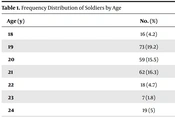
The total number of participants was 3,140 soldiers with a mean age (95% confidence interval [CI]) of 22.1 (21.6, 22.6) years old. The predominant level of education of the soldiers was a diploma (72.6%). Details of the descriptive results are given in Table 1.
The frequency effect of military service in the deterioration soldiers’ drug abuse status was as follows: beginning = 67 (2.1%), increasing = 84 (2.7%), unchanged = 2911 (92.7%), and decreasing = 78 (2.5%; Table 2).
Table 2.
Demographic Information of Soldiers With Drug Abusea
| Variable | Values |
|---|---|
| Age, mean (95% CI), y | 22.1 (21.6, 22.6) |
| Education | |
| Diploma | 72.6 |
| B.Sc | 25.6 |
| M.Sc | 1 |
| Ph.D, MD | 2 |
| Marital status | |
| Single | 87.7 |
| Married | 12.3 |
Abbreviations: B.Sc., Bachelor of Science; M.Sc., Master of Science; Ph.D., Doctor of Philosophy; MD, Medical Doctor.
aValues are expressed as percentage unless otherwise indicated.
4.2. Univariate Results
Univariate analysis of military service independent variables in relation to change in soldier drug abuse status showed that some variables significantly worsened drug abuse status, such as the relationship with the commander, satisfaction with service location, loneliness in military service, and so on. These factors are listed in Table 3.
Table 3.
Univariate Analysis Result of Military Factors Related to Drug Abuse Changea
| Variable | Decreasing | Unchanged | Increasing | Beginning | P Value |
|---|---|---|---|---|---|
| Remaining months of military service | 8.32 ± 5.76 | 8.04 ± 4.48 | 8.61 ± 4.75 | 8.73 ± 5.09 | 0.359 |
| Time of additional service | 2.09 ± 5.34 | 1.59 ± 3.06 | 1.05 ± 1.40 | 1.12 ± 3.73 | 0.056 |
| Average sentry duty time per week | 26.1 ± 49.32 | 23.03 ± 36.39 | 15.43 ± 13.32 | 20.16 ± 87.26 | 0.465 |
| Daily average of leave for the month | 4.55 ± 5.24 | 5.75 ± 16.22 | 7.06 ± 8.70 | 3.8 ± 6.48 | 0.684 |
| Average vacation hours per week | 8.61 ± 16.84 | 6.03 ± 15.30 | 9.90 ± 13.29 | 5.00 ± 10.65 | 0.702 |
| Average nights in the barracks | 12.07 ± 10.78 | 11.04 ± 11.58 | 14.85 ± 11.28 | 11.77 ± 11.53 | 0.121 |
| Absenteeism rate during the period of military service | 8.55 ± 39.01 | 4.99 ± 19.60 | 3.61 ± 11.42 | 1.59 ± 13.12 | 0.009 |
| Desertion rate during the period of military service | 0.34 ± 1.35 | 0.25 ± .86 | 1.4 ± 11.39 | 0.29 ± 9.20 | 0.474 |
| Encouragement in the course of military service | 3.42 ± 12.39 | 2.02 ± 5.01 | 2.1 ± 3.44 | 2.35 ± 4.15 | 0.284 |
| Punishment of the period of military service | 17.18 ± 122.96 | 2.31 ± 3.49 | 1.75 ± 4.50 | 1.69 ± 32.49 | 0.031 |
| Detainment during the period of military service | 0.75 ± 2.02 | 0.41 ± .92 | 0.76 ± 2.58 | 0.45 ± 9.20 | 0.957 |
| Imprisonment during the period of military service | 0.36 ± 1.90 | 1.25 ± 10.06 | 0.28 ± 1.41 | 0.27 ± 9.08 | 0.564 |
| Relationship with commander | 3.36 ± 1.18 | 3.25 ± 1.26 | 2.76 ± 1.01 | 2.45 ± .95 | 0.000 |
| Relationships with other soldiers | 2.62 ± 1.11 | 2.47 ± 1.03 | 2.25 ± .98 | 2.09 ± .83 | 0.000 |
| Satisfaction with service location | 3.60 ± 1.22 | 3.63 ± 1.17 | 3.06 ± 1.08 | 2.75 ± 1.12 | 0.000 |
| Satisfaction with the barracks | 3.93 ± 1.17 | 3.73 ± 1.09 | 3.36 ± 1.06 | 3.16 ± 1.17 | 0.000 |
| Loneliness in military service | 3.70 ± 1.29 | 3.69 ± 1.27 | 3.16 ± 1.12 | 2.88 ± 1.25 | 0.000 |
| Shift work satisfaction | 4.20 ± 1.10 | 4.13 ± 1.02 | 3.55 ± 1.16 | 3.45 ± 1.18 | 0.000 |
| Average number of drug abusing friends in military service | 4.13 ± 5.09 | 7.56 ± 27.68 | 1.34 ± 2.13 | 0.80 ± 4.03 | 0.014 |
aValues are expressed as Mean ± SD.
4.3. Multivariate Results
The results of final logistic model that explain the significant military predictors of drug abuse status are reported in Table 4.
Table 4.
Multivariate Analysis Result of Military Factors Related to Drug Abuse Change
| Variable | OR | SE.OR | P Value |
|---|---|---|---|
| Level of satisfaction with service location | 0.83 | 0.11 | 0.040 |
| Relationships with other soldiers | 0.71 | 0.14 | 0.031 |
| Relationship with commander | 0.79 | 0.14 | 0.001 |
| Time of additional service | 1.15 | 0.05 | 0.002 |
Abbreviations: OR, Odds ratio; SE.OR, Standard error of OR.
In this model, we find that a higher level of satisfaction with service location is associated with higher odds of worsening soldier drug abuse status (OR = 0.83, P = 0.04). Meanwhile, a better relationship with the commander has an inverse relationship with worsening soldier drug abuse status (OR = 0.79, P = 0.001), as does better relationships with other soldiers (OR = 0.71, P = 0.031). Finally, we find that the risk of soldier drug abuse status increases with greater time of additional service (OR = 1.15, P = 0.002).
5. Discussion
We investigated many factors related with the period of military service, and ultimately identified four linked factors as the predictors of drug abuse in them. These factors were as follows: a) relationship with the commander, b) relationships with other soldiers, c) time of additional service, and d. level of satisfaction with the service location.
The relationship with the commander had an inverse relationship with worsening drug abuse. This may be because soldiers’ stress increased when they had a bad relationship with commander; if they were unable to solve problems effectively (8), soldiers may have tended to abuse drugs as a tranquilizer to decrease stress.
In terms of relationships with the other soldiers, we found the same result as for the first factor. Our finding means that if soldiers did not have a good relationship with their peers, because of their high frequency of contact and the challenges this posed, their level of stress and discomfort increased.
The third predictor was time of additional service, which showed an inverse relationship with drug abuse. This means that increased days of additional service as a disciplinary action can increase the odds of worsening drug abuse, perhaps because the psychological stress of this service leads them to cope through drug abuse.
The final predictor was the level of satisfaction with the service location, which had an inverse relation with worsening drug abuse. This finding showed that a lower level of satisfaction with service location can exacerbate the drug abuse status because this is an environmental stressor.
According to Sinha, stress is a well-known risk factor in the development of addiction and in addiction relapse vulnerability (5). This researcher also clarified that there is substantial literature on the significant association between acute and chronic stress and the motivation to abuse addictive substances (11). Moreover, Kaplan and Sadock reported that five factors are related with increasing opium compound abuse, including various crises (12); one of these crises arises from bad relationships with the commander and other soldiers. Lewis listed the predictors of drug abuse and stated that if the peripheral stress is higher than person’s compatibility, the risk of drug abuse is increased (13). In our research, we can conclude that one of the justifications of worsening drug abuse is high peripheral stress and non-compatibility in these soldiers.
According to our findings, we can control some predictors of drug abuse, such as time of additional service. This means that if commanders in the military want to punish the soldiers, it is better to avoid this approach. In addition, if commanders behave better with the soldiers, they can help them to solve their problems rather than turning to drugs.