
1. Background
Every country requires a strong defense force comprising experienced and responsible soldiers to safeguard its territorial integrity and independence. The use of substances is one of the factors that can lead to soldiers’ irresponsibility, deviant lifestyles, economic losses, and social problems. Understanding the prevalence of substance use, predisposing factors, and high-risk groups is crucial for decision-makers and leaders, particularly in military settings.
Substance misuse carries severe health consequences and adversely affects military readiness (1). Awareness about substances is not optimal even among medical students (2). Substance use has been a significant challenge for humanity and a grave threat to physical, psychological, and social health throughout history (3).
Given the demanding conditions of military service, including separation from family and friends, exposure to extreme weather, physical exertion, sleep deprivation, rigorous training, and multiple deployments, various studies in different countries have reported varying statistics on substance abuse among soldiers (4-6). In the British military, for instance, harmful alcohol and illegal substance consumption were reported in 67% of men and 49% of women; nevertheless, in the general population, this issue affected 38% of men and 16% of women (7). Some studies have highlighted an increase in the prevalence of mental disorders among soldiers, resulting in a heavy burden on the military healthcare system (8, 9).
Drug use can lead to stable and long-term changes in the human brain, which can result in harmful behaviors (9, 10). Typically, the initial experience with substance abuse begins in adolescence, and research has shown that substance use is primarily associated with cigarette and alcohol consumption (11).
O’cathail et al.’s review of studies demonstrated that 29.6% of smokers, compared to only 1.6% of non-smokers, used cannabis (10). Having a history of smoking is linked to the use of both hard and soft drugs, in addition to high-risk sexual behaviors. Price et al. conducted a study examining substance use patterns among soldiers during the Vietnam War when compared to their civilian peers (12). Their findings indicated that heroin use was at 1% before deployment to Vietnam but escalated to 35% during military service in Vietnam.
Ahmadi et al., in their study, revealed that opium use was prevalent among 18.8% of soldiers; nevertheless, marijuana was used by 10.6% of them (13). Refahi et al.’s research on military personnel identified a significant correlation between the propensity for substance use and factors such as age, education, rank, marital status, and family history of addiction (14). Additionally, Vest et al.’s study suggested that the periods immediately following deployment and transition out of the military might pose a particularly high risk for heavy substance use and the use of a wider range of substances (15). Bakhshi et al. reported a significant relationship between the age of starting substance use, ease of access to substances, history of addiction, family breakdown, marital dissatisfaction, socioeconomic pressures, job insecurity, education level, and the inclination toward substance use (16).
Considering the problems associated with substance use and the challenges in its treatment, it is crucial to investigate the prevalence and risk factors of this issue in various populations, especially in work environments. Military organizations play a vital role in raising awareness, preventing substance use, and minimizing harm among soldiers (3). Therefore, this study aimed to examine the prevalence of substance use and the demographic characteristics of soldiers admitted to a military hospital.
2. Methods
This study included 380 soldiers who were admitted to a military hospital with various diagnoses in 2018. Urine samples from the soldiers were analyzed using morphine, amphetamine, and cannabis test kits. Demographic characteristic questionnaires, including age, marital status, education level, employment status, income, and economic status, were also completed.
The research protocol received approval following a review by the Ethics Committee of Aja University of Medical Sciences, Tehran, Iran (ID: IR.AJAUMS.REC.1398.018).
3. Results
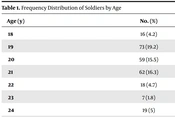
Out of the 380 soldiers hospitalized in the military hospital, 370 subjects (97.3%) were single, and 10 cases (2.7%) were married. Among them, 2 cases (0.5%) had no formal education, 277 cases (72.9%) held diplomas or degrees below a bachelor’s, 95 cases (25%) had a post-graduate or bachelor’s degree, and 6 cases (1.6%) had a master’s degree or higher. Regarding employment status, 256 (67.4%), 116 (30.5%), and 8 (2.1%) soldiers were unemployed, irregular part-time workers, and regular part-time workers, respectively. Additionally, 20 soldiers (5.3%) reported an unknown income, 306 soldiers (80.5%) had an income below 1 million tomans, and 54 soldiers (14.2%) reported an income between 1 and 2 million tomans. Table 1 shows the frequency distribution based on the participants’ age.
Table 1.
Frequency Distribution of Soldiers by Age
| Age (y) | No. (%) |
|---|---|
| 18 | 16 (4.2) |
| 19 | 73 (19.2) |
| 20 | 59 (15.5) |
| 21 | 62 (16.3) |
| 22 | 18 (4.7) |
| 23 | 7 (1.8) |
| 24 | 19 (5) |
| 25 | 48 (12.6) |
| 26 | 1 (0.3) |
| 27 | 39 (10.4) |
| 28 | 16 (4.2) |
| 29 | 6 (1.6) |
| 30-42 | 16 (4.2) |
The frequency of substance use in soldiers referring to the military hospital was 18% (10% cannabis, 6% morphine, and 2% amphetamine).
4. Discussion
In today’s world, most societies are grappling with the consequences of substance abuse, which have far-reaching impacts on various cultural, social, and economic facets of life. This issue is particularly prevalent among young individuals, making active-duty soldiers highly susceptible to its adverse effects (17). The research findings reveal that the prevalence of substance use among soldiers referred to the military hospital was 18%. Cannabis emerged as the most commonly used substance among them, followed by morphine and amphetamine.
A study conducted by Fear et al. (7) in the British military forces unveiled that 67% of men and 49% of women engaged in harmful alcohol and illegal drug consumption. Nevertheless, only 38% of men and 16% of women in the general population faced this issue. Among Spanish military personnel, the most widely used substances were tobacco (54.2%) and alcohol (39.9%). In the realm of illegal drugs, cannabis had the highest prevalence of “use at some stage of life” at 36.2%, followed by cocaine (14.9%) and amphetamines (12.1%). The presence of social support emerged as the most significant factor associated with reduced drug use (18).
Butcher’s study of US military personnel revealed that 36% of them used cannabis; nonetheless, 32% resorted to steroids (19). Additionally, Price et al.’s (12) investigation of Vietnam War soldiers showed that heroin use stood at 1% before deployment to Vietnam but soared to 35% during military service in the country. Ahmadi et al. (13), in their study, observed that opium was used by 18.8% of soldiers; however, marijuana was used by 10.6% of them. Notably, 48.1% of soldiers initiated alcohol consumption before the age of 15 years.
Servies et al. (1), in their study on military personnel, reported that as age, service time, rank, and the number of combat missions increased, the incidence of substance use decreased. The most commonly reported substances (excluding alcohol and tobacco) were cannabis, mixed/unspecified/other substances, and cocaine. The results of the studies conducted by Griffin et al. (20), Sussman et al. (21), Thompson et al. (22), underscore that the primary individual factor contributing to substance use is the pursuit of an interesting or enjoyable experience.
Asayesh et al.’s study (23) findings indicated that individuals with a high school education or diploma have a higher likelihood of substance use than those with a university education. Having friends with addiction issues increases the propensity for substance use, and a history of or current smoking elevates the risk of substance abuse. Furthermore, individuals with permanent employment have a lower likelihood of substance addiction when compared to those with temporary jobs. In summary, addicted friends, smoking, lower education levels, and unemployment were identified as influential factors in substance addiction.
Certain research indicated that combat exposure heightens the risk of substance use disorders (24). Sociodemographic characteristics, such as education, occupation, income, age, marital status, and factors influencing addiction, were considered in the analysis. The findings suggest that young adults with secondary education and low to moderate income are more prone to addiction (25).
Habibi et al.'s study (26) yielded results indicating that family-related factors, such as family patterns of high-risk behavior, parental sanctions, and controls, along with peer-related factors, such as friends' patterns of high-risk behavior, peer controls, and support from friends, were significantly associated with substance use among soldiers.
Considering the family’s role in transmitting norms, values, and modeling behavior for teenagers, those with parents struggling with addiction are more likely to engage in substance use (27). Multiple studies have highlighted a significant correlation between soldiers’ socioeconomic backgrounds and their inclination toward substance use. Additionally, there exists a positive and substantial link between feelings of relative deprivation and the propensity for substance use (27, 28).
Early patient-guided interventions, combining behavioral and pharmacological therapies, have been shown to yield improved outcomes, including enhanced functional status, reduced relapse rates, and a lower incidence of psychiatric and other comorbid conditions (29). Moreover, early diagnosis, brief behavioral change counseling, and motivational communication rather than confrontational approaches during substance abuse screening, counseling, and treatment are crucial for achieving optimal patient outcomes (30).
In light of the substantial prevalence of substance use among soldiers and its association with lower education, unemployment, and financial hardship, it becomes imperative to understand the underlying causes of soldiers’ susceptibility to substance use. This knowledge can inform the development of strategies aimed at prevention and harm reduction related to substance abuse.
4.1. Conclusions
The findings suggest that the frequency of substance use is notably high among unmarried individuals, those with lower levels of education, unemployed soldiers, and those with low income.