
1. Background
Today, delinquency is one of the most important health and psychological challenges that affects most countries in the world and is associated with widespread and severe problems affecting societies (1). Research in Iran shows the high prevalence of high-risk behaviors, such as smoking and the use of hookah, alcohol, and drugs among adolescents aged 14 - 18 years (2). The spread of violence and aggression, especially in recent years, is considered one of the most serious social damages in Iranian society (3).
Some studies have pointed to the impact of family factors and the weakness of parental supervision on delinquency incidence (4). Social support is one of the effective factors in preventing delinquency among adolescences. Social support refers to the sense of belonging to and receiving the affection of the family, in which the individual feels close to the other family members (5).
Deviant behaviors (including violence) occur when the link between an individual and his community is loosened or interrupted. Meanwhile, two important factors in creating this link are family and community (6). Family, and teachers’ supervision and performance affect the proper socialization process of adolescents and their behavioral development (7).
Nye believes that the family deals with the following four approaches to strengthening the social bond of the adolescent with society, which has a role in reducing his/her deviant behavior: (1) internal monitoring or control; (2) indirect monitoring; (3) direct monitoring and punishment; and (4) the family’s ability to fund the adolescent (6). Thus, the family and the relationships govern it, and how to deal and bond with adolescent, are very effective factors in children’s behavior. Various studies have shown the role of family and inter-family relationships in their offspring's behavior. Poormand showed that the family, directly and indirectly, affects becoming a victim of bullying. Parent-child relation forms adolescent behavior patterns. Therefore, training parents for appropriate child-raising methods could play an important role in preventing many social harms in the future (8). Navah declared a significant relationship between the variables of socialization in the family, socialization by peers, and the age of the respondents, and the sabotaging behavior of the students (9). Delinquency is the fault of families who do not teach their children values and norms well (10). Irreparable injuries and damages caused by adolescents’ delinquent behavior and increased financial and temporal costs of behavioral change measures at individual and social levels introduce prevention as the best approach to reduce risky and threatening behaviors at the community level (11). Protective and risk factors should be emphasized, and prevention of risky behaviors and healthy developmental issues of adolescents are also needed to be identified (12). On the other hand, considering that the best time to take preventive behaviors on risky behaviors is the teenage age and even the younger age, a key condition for any effective action is to be aware of the current situation and to examine the current status of such risky behaviors among adolescents (13).
Qualitative research is a method of research that is used to describe life experiences and give meaning to them (14). In qualitative research, with a comprehensive approach, we analyze the phenomena and concepts, including recognizing the conditions, in which psychological and social processes occur, understanding the social conditions that are the source of behavior, and explaining the hidden social and effective variables, in which human behavior is shaped (15, 16).
2. Objectives
Paying attention to the role and influence of family in adolescents’ violence is essential and should be considered. Therefore, the purpose of the present study was to explain family factors affecting violence in adolescents using the qualitative content analysis method to take more effective steps in preventing adolescent violence using information resulted.
3. Materials and Methods
This qualitative study was done using the conventional content analysis approach, and because of its qualitative design, it was guided by a constructivism philosophy (paradigm).
The participants who were able to express their perceptions about the prevention of violent behavior of adolescents and were willing to participate and provide their perceptions in the study, including students and other people mentioned in the interviews, parents of students, school administrators, school teachers, educational counselors, health instructors, and students’ grandmothers were included. In such studies, targeted purposive sampling is used, which is not a kind of probabilistic sampling (17). Thus, participants were chosen based on purposive sampling, and data were obtained using semi-structured interview forms. In-depth individual interviews were performed in an isolated room in the schools for the participants’ comfort and privacy.
Inclusion criteria were the ability to understand questions and express one’s own opinions and desire to participate in the study, whereas exclusion criterion included unwillingness to participate in the study. The interviews lasted between 20 and 115 min with an average of 89 min. Except for one case, just one interview was held with the rest of the participants.
In the present study, the data were analyzed using content analysis by a method described by Graneheim and Lundman (2004), which is a systematic and transparent eight-step method for processing and analyzing data (18).
The researcher achieved saturation after 46 interviews, and to make sure, 4 additional interviews were carried out. For a semi-structured interview, a general guide or survey list was prepared. At this stage, after each interview, the data were implemented, classified, and sorted and the interview questions were edited and revised as needed for further interviews. Then, data analysis was done with coding, continuous comparison, and noting. This step continued recursively until data saturation, otherwise, the researcher returned to the participant selection stage, and this process was repeated again. Because the qualitative research is conducted in a real-world environment, a deep interview was conducted with students who had the inclusion criteria in a quiet place with sufficient psychological security. The participants were assured that answering the questions is completely arbitrary, and they can refuse to answer the question or even discontinue the interview. The interview place was agreed by the interviewees to be the counseling room of Roodsar girl schools in 48 cases, and it was the interviewer’s house for two others.
Zhang (2009) quoted Lincoln's criteria of credibility, dependability, confirmability, and transferability for accuracy in content analysis (19). In this research, to achieve dependability, the researcher gave feedback to the participants and used the peer-review process by the research team as well as two colleagues with experience in qualitative studies. Also, observer review was used to establish the confirmability, and interviews, codes, and classes extracted by some experienced professors in qualitative research were reviewed. In this research, to increase the credibility of the data, various strategies, such as member check and peer check (supervisor and advisor) were used.
Participants were given feedback and endorsed repeatedly during the interview when interviews were not meaningful to the researcher and the participant's purpose was not properly understood. In addition, participants were asked, either in person or by telephone, to clarify the underlying codes of their interviews and ambiguities. The full transcript of the interviews was also sent to the esteemed guides and consultants along with coding and initial classes, and their confirmatory and complimentary comments were received regarding implementation, coding, and initial grades.
Also, to increase the transferability of the results, the researcher studied the experiences of the main participants. The researcher tried to use participants from all ages, and academic, cultural, and social groups. A more accurate description of the research, participants, methodology of the research, and the results would help to make the findings more translatable. Also, peer reviews of the research co-workers and confirming the steps can enhance the transferability of the findings.
This research was derived from the approved research of the School of Public Health of Shahid Beheshti University, Tehran, with the ethical code of IR.SBMU.PHNS.1395.95 at the ninth session of the Ethics Committee on Neuroscience Research, dated Dec 31, 2016, with the tracking number of 10599. Based on the right to privacy, participants have the right to anonymity and the right to know that the data collected will be kept confidential. Thus, we have used numbers when presenting their comments and remarks.
4. Results
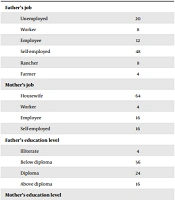
In this study, a total of 50 subjects were interviewed, including 26 students, 12 school administrators, and 12 students’ family members. Numbers 1 to 50 were assigned to fifty participants to maintain confidentiality. Students’ demographic characteristics are listed in Table 1. Demographic characteristics of other participants (teachers and family members) are listed in Table 2.
Table 1.
Demographic Characteristics of the Students
| Demographic Characteristics | Frequency (Percent) |
|---|---|
| Father's job | |
| Unemployed | 20 |
| Worker | 8 |
| Employee | 12 |
| Self-employed | 48 |
| Rancher | 8 |
| Farmer | 4 |
| Mother's job | |
| Housewife | 64 |
| Worker | 4 |
| Employee | 16 |
| Self-employed | 16 |
| Father's education level | |
| Illiterate | 4 |
| Below diploma | 56 |
| Diploma | 24 |
| Above diploma | 16 |
| Mother's education level | |
| Illiterate | 4 |
| Below diploma | 48 |
| Diploma | 24 |
| Above diploma | 24 |
Table 2.
Demographic Characteristics of Other Participants
| Demographic Characteristics | Frequency (Percent) |
|---|---|
| Individual's job | |
| Unemployed | 20 |
| Worker | 0 |
| Employee | 20 |
| Self-employed | 60 |
| Spouse's job | |
| Unemployed | 16 |
| Manual worker | 0 |
| Employee | 16 |
| Self-employed | 64 |
| Doctor | 4 |
| Individual's education level | |
| Illiterate | 0 |
| Below diploma | 24 |
| Diploma | 8 |
| Above diploma | 68 |
| Spouse's education level | |
| Illiterate | 0 |
| Below diploma | 36 |
| Diploma | 4 |
| Above diploma | 60 |
Data analysis using conventional qualitative analysis led to the extraction of 357 primary codes, 21 sub-sub-categories, 4 sub-categories, and 1 main category (Table 3). In this section, the main category and sub-categories are considered as research findings and are supported by contributions statements.
Table 3.
The Extracted Main Categories and Sub-Categories of Family Factors Affecting Violence
| Main Categories | Sub-Categories | Sub-Sub-Categories |
|---|---|---|
| 1. Insecure family | 1. The broken family | 1. The vulnerable family |
| 2. The lack of close family relationships | ||
| 3. Students’ family problems | ||
| 4. Mother's violent pregnancy | ||
| 5. Discrimination in the family | ||
| 6. Demographic characteristics affecting family violence | ||
| 7. the existence of a patient in the family | ||
| 8. Lack of family financial support | ||
| 9. the absence of parents at home | ||
| 10. Lack of parenting skills | ||
| 11. student's insignificance to family | ||
| 12. The violence of relatives towards themselves | ||
| 13. no close relationships with relatives | ||
| 2. Incorrect parenting style | 1. Strict parents | |
| 2.Ineffective parenting style | ||
| 3. Student modeling of family violence | ||
| 3. Correct parenting style | 1.Parents subtle control | |
| 2.Effective parenting style | ||
| 4. Family with open borders | 1.Rejection of students by relatives | |
| 2.Relatives violence towards the student | ||
| 3.Strict relatives towards the student |
4.1. Main Category: Insecure Family
Broken families with incorrect parenting practices and open borders provide an insecure environment for the student that results in violent behavior in adolescents, including four sub-categories of the broken family, incorrect parenting practices, correct parenting practices, and family with an open border. An extensive description of the insecure family is provided in the next sections.
4.2. The First Sub-Category: Broken Family
Vulnerable families with no close relationships, family problems, mother's violent pregnancy, demographic characteristics affecting family violence, the existence of a patient in the family, lack of family financial support, the absence of parents at home, lack of family skills in parenting, student's insignificance to family, the violence of relatives towards themselves, and no close relationships with relatives (disrupted family) are called broken families, which provide an insecure environment for the psychological development of adolescent and ultimately, lead to adolescent violence.
Participant No. 15 was a 16 years old student talked about the family status of one of her friends who was severely incongruous and aggressive in school: "the father of one of my friend is addicted, and she says, many times, I have no peace at home."
4.3. The Second Sub-Category: Improper Parental Practices
The interviewees' statements indicated that parenting, inadequate parenting practices, and student modeling of family violence are inappropriate parenting practices, which are family-related factors affecting adolescent violence.
Participant No. 17 was a 17 years old student who was overwhelmed by the excessive strictness of her parents and showed violent behavior toward them said: "parents or even their control can have a great impact on putting the student under the pressure."
4.4. The Third Sub-Category: Incorrect Parental Practices
The interviewees' statements indicated that parents' subtle control and effective parenting practices are the proper parenting practices that are among family factors affecting the prevention of adolescent violence.
Participant No. 35, was a 52 years old girl's school counselor with 22 years of work experience said: "one of the reasons for adolescences violence is the lack of adequate time spending by mother for her child, and mother should spend time listening to the student's words."
4.5. The Fourth Sub-Category: Family with Open Borders
The interviewees' statements indicated that rejection of the students by relatives, relatives’ violence towards students, and the relatives’ strictness towards the student can lead to creating a family with open borders, which is an effective factor leading to violence in adolescents.
Participant No. 7 was a 15 years old student who was in incompatibility with her friends at school, lived with her mother's family after her parent’s divorce, but her aunt saw her as an extra person at home and told her mother repeatedly that send her to her father's house. She said: "after my living in my grandmother's house following my parents' divorce, all relatives would look at me like an extra person."
5. Discussion
Family factors affecting adolescent violence, in general, provided an insecure family to the adolescence. According to the findings, an insecure family was defined as: "broken families with inappropriate parenting practices and open borders that create an insecure environment for a student leading to violent behaviors in adolescents". According to the findings of this study, the vulnerable family was one of the family factors affecting adolescent violence.
Many studies have pointed to family factors affecting adolescent violence, such as inconsistent interpersonal relationships, chaotic family backgrounds, family's defective and unfavorable relationships, the use of improper parenting practices, such as rejection, lack of proper care, beatings, deprivation of affection, child abuse and violence against children leading to feelings of insecurity and anxiety, negative self-concept, malice towards others, parental supervision, solidarity in family, parent-adolescent relationship, family functioning, domestic violence, parent-child relationship, witnessing the violence physical aggression of fathers, mother’s functionality disorder confusion, mother–child role confusion, father’s anger, mother’s physical aggression, emotional problems in children, parental rejection, child discrimination, unhealthy competition in the family, poor economic status, troubled families, unhealthy family structure, undesirable relationships between parents and children because of their social status, and family cohesion (8, 13, 20-29).
Certainly, personality formation, manners, and behavior are influenced by genetic inheritance and living environment, but a significant percentage of human behavior is acquired and shaped by learning, especially in childhood. An individual's early experience of living at home with his family and parents, in general, is an important determinant of the adjustment process during adolescence and future life (23). The family has very powerful effects on developing a child and his attitudes, beliefs, opportunities, habits, and personality traits. The family plays a critical role in determining who a child will become and what he will accomplish (30). Following the increased conflict and break the relationship between parents and children, adolescents’ relationships with different peer groups increases, and as a result, the risk of having high-risk behaviors in adolescents increases (13). Therefore, positive family relationships are important factors in preventing violent behavior. For the contextual factors, family conflict was the strongest predictor of violence, and school commitment/attachment was the weakest predictor (31).
Based on the findings, among demographic characteristics affecting adolescent violence, family density, parents’ job, type and level of parents’ education, and mother's age were noteworthy. Many studies have pointed to the role of these variables in adolescent violence (26, 32-34).
The findings of the study indicated that lack of family skills in parenting and inappropriate parenting practices, and relatives’ strictness towards the student were other family factors in affecting adolescent violence. In contrast, a correct parenting style was considered an effective way in reducing and preventing adolescent violence. Appropriate parenting styles and perceived educational styles were effective factors in high-risk behaviors in students, and also, family communications have been shown with an important effect on risk-taking behaviors (35).
Anti-social and risky behaviors are increased as a result of inappropriate parenting practices, such as tyrannical or easy-going practices. Children whose parents openly and positively communicate with them, and giving them age-related freedom and independence, experience fewer behavioral problems. Many studies have pointed to the role of these factors in adolescent violence (36-38).
According to the findings of this research, the violence of relatives towards themselves was another family-related factor affecting adolescent violence. Many studies have declared the role of these factors in adolescent violence (39-41).
Student's modeling of family violent behavior was another family factor affecting adolescent violence. Family as the first institution of socialization and parents as the first behavioral patterns play a very important role in guiding the experiences of adolescents through direct and indirect education and support them, and they can reduce and prevent risky behaviors (42-44).
5.1. Conclusion
According to the results of this study, which were extracted from participants' experiences, family factors are related to adolescent violence. The adolescence stage is a critical period for initiating high-risk behaviors due to self-centeredness and lack of proper understanding of adolescent of his/her behavior. Regarding the independence of adolescents at this age and the role of other socializing formal and informal institutions that affect adolescent behavior, the strong and influential role of the family on adolescent behavior is quite obvious. In this study, it was difficult to interact and collaborate with some education authorities and the process of obtaining satisfaction from students and their teachers. The students' fears and concerns about expressing their feelings and perceptions, the process of obtaining satisfaction from students and their teachers, and the need to gain the confidence of the participants in the confidentiality of information were among the other limitations of the present study. Other limitations were the data-based participants' self-report, the lack of generalizability of the findings, the taboo of violence in society, and the lack of similar qualitative studies in this field to compare the results.