
1. Background
Adolescence begins with physical, psychological, social, and spiritual changes and encompasses the age range from 10 to 19 years (1). In addition to the physical and emotional upheavals, this transition also changes adolescents' value systems and social attitudes (2). The developmental process and brain changes during this time make adolescent girls vulnerable to emotional reactivity and poor decision-making, leading to susceptibility to risky behaviors such as delinquency (3).
Deviant behaviors such as tobacco use, violence, aggression, addiction, drug dealing, school vandalism, theft, and murder are recognized as delinquent acts (4). Juvenile delinquency is associated with a variety of negative consequences, such as poor academic performance (5, 6), social adjustment (6), and substance abuse (7). The process of detachment from the family can also be hindered by institutional influences, leading to frustrations that cause adolescents to engage in behaviors that demonstrate independence, such as delinquent behaviors, in an attempt to express maturity (8). To explain this temporary increase in delinquency, Moffitt (9) hypothesizes in her developmental taxonomy that delinquency confined to adolescence is motivated by the developmental need for autonomy and independence arising from role ambiguity caused by a discrepancy between biological and social maturation (i.e., the maturation gap). Deviance could thus become a normative part of the search for gender identity (10). Gender identity is a crucial concept that can have a significant impact on the physical and psychological condition and quality of life of adolescent girls, whether or not they are delinquent (11). Psychologists define gender identity as the image and feeling individuals have of their femininity or masculinity and the expectations they have of themselves as different genders (12). Socio-cultural conditions, upbringing and instilled values and teachings influence individuals' understanding and beliefs about their gender identity. Therefore, gender identity is a composite identity directly or indirectly influenced by various personal and social conditions, factors, and roles (13). Gender identity disorders can lead to deviant and antisocial behaviors, including criminality (14). Researchers also believe that the occurrence of gender identity disorders may be associated with delinquency. For example, delinquency and personal identity are related during adolescence. Experimentation with delinquency hampers identity formation by increasing rumination and decreasing commitment (15). Delinquency was found to be associated with self-esteem (16). Focusing on promoting positive self-esteem may also reduce the risk of male adolescents struggling with the harmful consequences of delinquency (17). Traditionally; self-esteem has been considered an important correlate of psychosocial competence and adjustment (18). Several studies have shown a high correlation between low self-esteem dimensions and deviant and delinquent behavior (19). For example, Mier and Ladny's (16) meta-analysis of 42 studies showed that adolescents with low self-esteem commit criminal and delinquent acts. High self-esteem had a significant effect on preventing delinquency (16). Another study found a significant positive relationship between drug use and social self-esteem (20). Self-esteem is also a factor directly related to lower delinquency rates (21, 22). From an ecological perspective, the lack of a healthy family life is considered one of the most influential factors that can lead to delinquency in adolescents through lowered self-esteem and gender identity disorders (23). Ode et al. (24) found that the rupture of family ties leads to adolescent delinquent behavior. Parsons emphasizes the importance of positive family functions such as emotional support, love, and a safe environment for children to prevent deviant behavior (25).
Positive parental relationships can help buffer this stress and have been associated with lower-risk behaviours, including delinquency (26, 27). Parental efficacy significantly affected delinquency, even after controlling for self-control (28, 29). In this context, Kroese et al. (30), who compared the family atmosphere of delinquent and nondelinquent youth, showed that the family relationships of delinquent youth were not as conventional as those of nondelinquent youth. That is, there was a lack of understanding between parents and delinquent youth, and there was less respect and solidarity among family members, leading to a decline in self-esteem, especially among children. In addition, the protective effect of parental warmth on delinquency has been demonstrated (31).
Studies by Bezin et al. (23) and Rezaei-Dehaghani et al. (as cited by Aggarwal et al.) (32) have found that those who grow up in healthy families have higher self-esteem and better coping skills, leading them to be less prone to delinquency. However, girls who experience humiliation or failure, have cold and inferior relationships with their parents and face gender discrimination may engage in delinquent behavior to boost their self-esteem or compensate for feelings of inadequacy resulting from experiencing gender inequalities in the family.
As you can see, the issue of crime and deviance among youth has always been an important topic for many scholars. A review of crime rates worldwide, including Iran, shows that crime is one of the critical issues in our society. In surveys conducted in most countries, crime rates and delinquency, especially between the ages of 12 and 25, continue to rise. The quantitative trend of juvenile delinquency in Iran increased from 7,644 cases in 1995 to 25,089 cases in 2000 (33).
Considering the importance of the issue of delinquency among girls as future mothers and creators of the next generation, which can be a serious obstacle to the development of individual talents and the development and progress of a country, and considering that most studies on this issue have been quantitative, the main difference of this research is its qualitative exploration based on the lived experiences of delinquent adolescent girls.
2. Objectives
The purpose of the current phenomenological study was to look into how the family affected the gender identity and self-esteem of teenage delinquent girls. It made use of a phenomenological methodology.
3. Methods
3.1. Study Design
This qualitative research used Smith's interpretive phenomenological approach (34). Quantitative research is based on the researcher's perspective, while phenomenology is used to investigate and directly understand experiences and observations, phenomena manifested in direct experience. This method was chosen because it allows the researcher to examine a phenomenon as it exists and to describe the lived experiences of individuals. Data are obtained through interviews. Through interviews with individuals, we can understand the experiences and perceptions of the participants and obtain richer data from their experiences (35).
3.2. Setting and Participants
The study population consisted of delinquent adolescent girls aged 17 - 18 years in Tehran (Qarchak Women's Rehabilitation and Detention Center in Varamin). The researcher conducted purposive sampling considering the research objectives and existing conditions. This process continued until data saturation occurred, i.e., no new information or data were obtained. Data saturation occurs when responses to questions provide no new information. Data saturation occurs when responses to questions do not provide new information. In this study, interviews were conducted with 30 participants, but after interviewing approximately 22 participants, the data reached saturation and no new insights were gained.
3.3. Data Collection
Data collection began after receipt of the Code of Ethics from the Ethics Committee of IR.IAU.TNB.REC.1401.030 data collection was conducted through in-depth and semistructured interviews. Interviews were conducted face-to-face for 35 - 45 minutes at the Qarchak Women's Rehabilitation and Detention Center in Varamin. Before the interviews, participants were informed about the objectives of the study and their written consent to participate in the study was obtained from them and parent to participate in the study.
To ensure security and protect the dignity of participants, interviews were conducted without recording. At the end of each interview, a copy of the transcript was provided to the participant for review and correction in case of inaccuracies. The data were then coded and analyzed anonymously. Expert opinions were sought for the design of the interview questions in addition to reviewing scientific sources. Several individual interviews were conducted with three college faculty members with research and clinical experience with delinquent girls. The responses of each delinquent girl to the above questions were categorized and organized. Subsequently, the collected data were categorized and interpreted concerning one another using Smith et al.'s interpretive phenomenological method (34). Smith et al. (34) suggests three stages for the phenomenological method for analyzing data: (1) Data production, (2) data analysis, and (3) cross-case analysis. After the interviews were recorded and put into written form, the subthemes were identified and labeled. Then, the researcher arranged and grouped the subthemes. By continually comparing and considering the differences and similarities between the subthemes, broader themes (essences) were extracted. Ultimately, synthesis produced a comprehensive list of themes (6 major themes, 14 subthemes, and 73 primary codes).
3.4. Data Validity
Considering the importance of validity and reliability of research findings, the method of member checking was used to assess the reliability and validity of the study (36). To ensure that the respondents understood their statements correctly, the information was shared with them and what they understood was communicated to them for confirmation. In addition, to validate the research findings, reduce personal interpretations, and ensure that the researcher provided readers with enough detail to evaluate the data collected and its analysis, quotes from the participants were included in the findings section. To increase the reliability of the data analysis, in addition to the recoding technique, the opinions of five experts and colleagues on the extracted themes and concepts were sought and consensus was reached among them. The Lawshe's content validity ratio (CVR) coefficient obtained was 0.99, indicating the content validity of the interview questions. Finally, to increase the reliability of the study, the results were compared and analyzed with the results of other studies.
3.5. Statistical Analysis
Statistical analysis was performed using SPSS 27.0 software (IBM, Armonk, NY, USA). All the continuous variables were expressed as mean ± standard deviation (SD). Independent t-test was employed to compare differences between groups. Categorical variables were analyzed by using the Pearson’s chi-squared test or Fisher’s exact test. Statistical significance was considered when P < 0.05.
4. Results
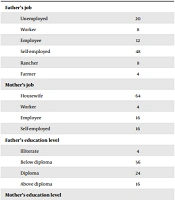
Among these delinquent girls, 17 came from single-parent families, 4 had parents with severe conflicts, 1 was orphaned, and the rest had both parents. Regarding their education, 13 had graduated from high school and 17 had completed high school. Their criminal offenses included drug possession in 4, involvement in or aiding murder in 8, theft or aiding theft in 11, moral corruption in 4, robbery in 2, and aiding trafficking in girls in 1. The research, study, and detailed summary of the delinquent girls' responses about their experiences reveal six main themes concerning the role of the family in their gender identity and self-esteem: (1) Inadequate access to parents; (2) parental conflicts; (3) ineffective interaction styles; (4) ineffective parental modeling; (5) ineffective rules; and (6) gender discrimination.
4.1. Inadequate Access to Parents
An important finding was the lack of adequate parental access for delinquent girls. Factors such as the absence of one or both parents and the excessive employment of parents were considered important by the delinquent girls in this topic.
Respondents felt that factors such as the death of a parent, divorce of parents, and issues such as parents' absence from home, their overtiredness, lack of adequate communication with children, and preoccupation with other tasks at home posed significant challenges for them. Consequently, these factors prevented the girls from obtaining the necessary support and emotional connection with their parents.
Participant with code R5 stated, "My parents got divorced and I live with my grandmother. They each have their own lives and don't care about me".
4.2. Parental Conflicts
Regarding the component of parental conflicts, respondents highlighted the role of factors such as emotional distance of parents, high level of parental tensions, violence in the family, and harmful remarriage of one of the parents. They mentioned that persistent conflicts and tensions between parents created a stressful and anxiety-provoking environment for them. Moreover, these conflicts led to decreased acceptance and authority of the parents' role in their lives.
The participant with code R7 stated, "My mother and father never agree. They argue all the time, and sometimes it even turns into physical violence. They have so many problems, but they expect me to be perfect. You should take charge of your own life if you are capable".
4.3. Ineffective Interaction Styles
The third main theme was ineffective interaction styles, which included cold interactions between parents and children or harmful and tense interactions with children. Respondents indicated they did not have good, warm, healthy relationships with their parents. Their parents' relationships were characterized by coldness, indifference, lack of support and intimacy, or were constantly dominated by tension, conflict, and endless arguments.
The participant with code R7 stated, "The relationship with my parents was dictatorial and they never allowed me to say anything. No one ever listened to me or showed me respect... They never considered me as a person to consult with...".
4.4. Ineffective Parental Modeling
The fourth major theme was ineffective parental modeling, including components of ineffective maternal and paternal modeling. According to the delinquent girls, their mothers had ineffective modeling patterns such as lack of assertiveness, low self-esteem, incompetence in problem-solving, controlling behavior, passive-aggressive communication style, instilling pessimism, and distrust of others. In addition, their fathers exhibited behavioral patterns such as violence, aggression, criticism, humiliation, disrespect, and indifference toward their daughters. These parental behaviors and attitudes resulted in these patterns being passed on to the girls.
Participant with code R2 said, "My mother was never able to stand up for her rights; she was always submissive". We often ask her why she gives in so much, but she never changes. "I hate to be like my mother, but I feel I am the same in my relationships with others."
4.5. Ineffective Rules
The fifth major theme from the participants’ responses was ineffective rules. The delinquent girls expressed factors such as the lack of appropriate rules of behavior or the presence of inappropriate and inflexible rules that led to their dissatisfaction with their parents and feelings of neglect of their basic needs. According to the participants' answers, these parents either had vague and unclear rules in the household, where many behaviors were not subject to unambiguous rules and norms, or they had strict and inflexible rules that were not in line with the children's developmental and environmental needs. Their opinions were not taken into account in these rules.
The participant with code R7 said, "I don't want to repeat any of my parents' behaviors and I never want to be like them". They never taught me how to manage my life; there was only violence, threats, and fear. They didn't even advise me to avoid making mistakes that could lead to addiction. They were just irrelevant rules that would never change.
4.6. Gender Discrimination
On the topic of gender discrimination by parents, participants cited factors such as overt and covert discriminatory behavior related to gender and gender stereotypes. They stated that their parents set up double standards for girls and boys, and these standards and gender stereotypes often favored boys, resulting in girls being dissatisfied with their gender identity and desiring a masculine identity and gender.
Participant with code R2 said, "Why does my younger brother, who is eight years younger than me, get more pocket money and more love? I always felt that my family was not happy with me being a girl and wished I was a boy. It's so painful that I sometimes wish I were a boy myself".
5. Discussion
The main objective of this study was to investigate the role of the family in the gender identity and self-esteem of delinquent girls. The results of this study and the experiential reports of delinquent adolescent girls indicate that delinquent girls generally have low satisfaction with their gender, primarily due to limitations and negative stereotypes related to femininity in the family. In addition, these girls reported lower self-esteem compared to non-delinquent girls, which may be attributed to negative family functioning. In general, the results of this study are consistent with the findings of other studies examining the effects of family functioning on adolescents' self-esteem and gender identity components (24-33). The results of the study indicate a high proportion of broken families and a high rate of delinquency (23). The results of another study show that good performance characterized by a cordial parent–child relationship leads to increased parental control self-efficacy, which in turn helps prevent future delinquency in the child (31). Also, the study by Rezaei-Dehaghani et al. (as cited by Aggarwal et al.) (32) showed that adolescents’ self-esteem is strongly correlated with their family's performance.
Although these findings have several explanations, more precise explanations may shed light on the dynamic effects of family functioning on self-esteem and gender identity. From this perspective, it can be argued that childhood experiences in the family context play an important role in personality development and psychological well-being. Negative childhood experiences such as psychological trauma, physical abuse, sexual abuse, neglect, and emotional devaluation within the family are considered risk factors for self-harm and delinquent behavior in adolescence and adulthood (37). As reported, the majority of the participating delinquent girls in this study had experienced aggression, hostility, and verbal abuse from their parents. In addition, a significant number had witnessed their sisters or mothers being physically assaulted by their fathers or brothers.
The relationship between childhood maltreatment within the family and delinquency and self-injury problems can be explained by three developmental pathways:
5.1. Representative Pathway
Through the internalization of childhood experiences of abuse, people develop dysfunctional ideas of themselves as inadequate, of others as malevolent, and of relationships as threatening (38). This can sometimes lead them to commit crimes out of revenge or to show hostility toward others or parents, indicating an external control mechanism rather than an internal control mechanism in delinquent youth. In other words, childhood experiences set the stage for vulnerability and problems in adolescence, including the development of an external locus of control due to low self-esteem (38).
5.2. Regulatory Pathway
Due to environmental vulnerabilities, adolescents' abilities to regulate and process symbolic, integrated, and deep emotions and affects are impaired. This creates a context for external behaviors such as self-harm or delinquency as a means of regulating emotions (38).
5.3. Reactivity Pathway
Experiences of abuse and maltreatment in childhood have effects on the nervous system and hormone regulation that set the stage for risky behaviors in adolescence. As a result, these three cognitive pathways that adolescents have about themselves form a negative self-image and self-schema in which they do not fully accept their own identity because they have not developed sufficient self-esteem. One aspect that is affected by this is their image of their gender identity (38).
Furthermore, girls who have witnessed gender inequalities in the family, such as being physically beaten by their father or brother or experiencing more restrictions compared to their brothers, may blame themselves as the cause of these harmful events in the family and consequently develop feelings of inferiority, shame, and guilt about their gender identity (23). A person who did not experience love and care in childhood, who never experienced the warm embrace of his parents and was constantly belittled, therefore seeks revenge and compensates for the deficiencies, inadequacies, and discrimination through crime, disregard for the rights and desires of others, and violent behaviors associated with masculinity because he has learned from childhood that he must achieve everything he wants by force and without regard for the rights and desires of others.
Furthermore, family abuse in childhood leads to strong ambivalence toward caregivers (37). To maintain a positive image of the caregiver, the child may internalize responsibility for the caregiver's abusive behavior and internalize negative emotions that lead to feelings of guilt, shame, depression, and anger toward self. As a result, it can be observed that the family can affect children's self-esteem in various ways, leading to shame about their gender identity and possibly delinquent behavior.
Patchin and Hinduja (39) also pointed out that children whose parents use harsh parenting methods can often become violent offenders. The research of Heimer and DeCoster (as cited by Boyle) (40) provides a more nuanced picture of how gender influences family processes and, in turn, delinquency. These researchers found that emotional attachment to the family was inversely related to learning definitions of violence in girls, but that coercive parenting practices influenced learning definitions of violence in girl. This suggests that in some cases it is necessary to go beyond a general scheme in assessing the influence of the family (and other domains) on the delinquent acts of boys and girls. Bottcher (as cited by Savage) (41) found that girls "spend more time with their mothers and other female relatives" and that boys have much greater freedom of movement: "Males spent more time in less traveled areas and were less supervised by their families" and also noted that "boys have greater access to night". Bottcher (as cited by Savage) (41) drew attention to how some of the routine practices of gender (a kind of gendered "routine activities" perspective) help explain the important fact that girls who grow up in high-risk circumstances are nevertheless significantly less likely to engage in delinquent behavior. Bottcher (as cited by Savage) (41) also found that girls tend to take on more childcare responsibilities, another gender-specific practice that promotes a stronger orientation toward the parental home. These studies of intra-family differences contribute significantly to our understanding of gender differences in criminality, even in risky family circumstances.
Social control theory (42) emphasizes the importance of close emotionalizes and attempts to explain how these ties influence adolescents’ commitment to criminal behavior. Social control theory emphasizes that the parent-child relationship plays a key role in developing and internalizing norms that can serve as deterrents to delinquent behavior. Even in infancy, the strength of children’s relationships with their parents is related to their developing consciences: Children become more receptive to socialization towards prosaically intentions when they have strong bonds with empathetic and responsive caregivers (43). Through strong relationships with their parents, children learn that adherence to conventional norms of behavior (e.g. sharing, taking turns) promotes emotional attachments and gives them an interest in others. Furthermore, Hirschi's expectation (as cited by Hindelang) (42) that weakened attachments can lead to delinquency is consistent with Erikson’s expectation that adolescents who find meaningful attachments have difficulty successfully forming their identities. Women experience different socialisation processes and are influenced to behave differently from men.
5.4. Strengths, Limitations and Suggestions for Future Research
This study was the first phenomenological investigation of the role of the family in the gender identity and self-esteem of adolescent delinquent girls. One of the inherent limitations of the present study was the limitations associated with qualitative research, which may introduce some margin of error in generalising the findings. Although a phenomenological methodology was used in this study, the findings are limited to a specific population and generalisation should be cautiously approached. Another limitation of this study falls under implementation limitations, namely the conservative culture of the participating youth. Some of their responses may not fully reflect their life experiences. First, we suggest that future research explore the other issue with adolescent delinquent girls. Second, future studies should replicate these findings in different groups of adolescents from different backgrounds or in high-risk and clinical samples with different measures and externalizing problems to determine whether our findings can be further generalized to adolescents who (are at risk of) exhibiting higher levels of delinquent behavior. Finally, counselors are advised to prepare interventions for families to improve self-esteem and gender identity. Thus, tailored interventions can help prevent adolescent delinquency.
5.5. Conclusions
In summary, the analysis of the interviews in this study confirms that the impact of family on girls' gender identity and self-esteem is significant and that there is always an underlying cause and motivation for delinquent behavior. Parents and educators must strive to determine what adolescent needs or desires are being met by such behaviors. Certainly, future research should examine the role of gender identity and self-esteem in juvenile delinquency as one of the potentially implicating consequences of family functioning.