
Int J Infect

Image Credit:Int J Infect

COVID-19 Associated Mesenteric Ischemia in a Patient from Duhok City, Kurdistan Region of Iraq: A Case Report

Author(s):
Dildar H. MusaDildar H. Musa1, Nawfal Rasheed HusseinNawfal Rasheed HusseinNawfal Rasheed Hussein ORCID2, Nashwan IbrahimNashwan Ibrahim1, Zana Sidiq M. SaleemZana Sidiq M. Saleem1, Ibrahim A NaqidIbrahim A NaqidIbrahim A Naqid ORCID2,*
1Department of Internal Medicine and Surgery, College of Medicine, University of Duhok, Kurdistan Region, Iraq
2Department of Biomedical Science, College of Medicine, University of Zakho, Kurdistan Region, Iraq
*Corresponding Author: Department of Biomedical Science, College of Medicine, University of Zakho, Kurdistan Region, Iraq. Email: [email protected]

International Journal of Infection:Vol. 8, issue 2; e111246
Published online:Apr 27, 2021
Article type:Case Report
Received:Nov 15, 2020
Accepted:Feb 13, 2021
How to Cite:H. Musa D, Hussein NR, Ibrahim N, Sidiq M. Saleem Z, Naqid IA. COVID-19 Associated Mesenteric Ischemia in a Patient from Duhok City, Kurdistan Region of Iraq: A Case Report. Int J Infect. 2021;8(2):e111246. doi: https://doi.org/10.5812/iji.111246

Abstract

Introduction:

The severe acute respiratory syndrome-coronavirus-2 (SARS-CoV-2) causes severe respiratory infection. Gastrointestinal symptoms have been reported in up to 10% of patients.

Case Presentation:

We here report a case of COVID-19-associated acute mesenteric ischemia in a patient presenting with fever and abdominal pain, deteriorating over a four-day period. The diagnosis was initially missed due to a low suspicion level. COVID-19 infection was confirmed by chest CT scan and RT-PCR. Then the patient underwent an emergency laparotomy showing segmental small bowel ischemia of about 2 meters (between the lower jejunum and upper ileum). Resection of the ischemic segment was performed by end-to-end anastomosis. He was then discharged from the hospital after recovering from COVID-19.

Conclusions:

The present case report highlights the importance of being vigilant about mesenteric ischemia symptoms in the patients with COVID-19, presenting with progressive abdominal pain for timely ordering appropriate diagnostic and therapeutic procedures.

1. Introduction

Severe acute respiratory syndrome coronavirus 2 (SARS-CoV-2) emerged in Wuhan city, China, in December 2019. The novel coronavirus disease (COVID-19) became a global pandemic over a few months (1, 2). At the beginning of the pandemic, in the Kurdistan region of Iraq, strict measures were implemented to combat the spread of the SARS-CoV-2 infection (1). However, political necessity and mounting socioeconomic pressure demanded a reopening process that was started at a progressively rapid pace (2). After reopening, the number of COVID-19 cases increased sharply with a concurrent increase in the number of symptomatic patients and a two-fold increase in the case-fatality rate (2).
We here report a 39-year-old male who underwent emergency surgery for COVID-19-associated intestinal ischemia.

2. Case Presentation

A 39-year-old married non-smoker male presented with intractable abdominal pain and fever for about a few hours. He had no past medical history of this condition. Localized central pain started gradually from the past four days, and it was dull in nature. The patient suffered from severe pain and showed generalized tenderness, mainly above the umbilicus. Other clinical findings included pallor, a heart rate of 110 B/min, respiratory rate of 22 breaths/min, and blood pressure of 115/65 mmHg. Serum amylase, lipase, and liver functional enzymes were normal. Other laboratory tests showed the following: hemoglobin level = 12.8 g/dL, white blood cell count = 12.8 × 10⁹/L, platelet count = 188 × 109/L, C-reactive protein = 59 mg/L, blood urea nitrogen (BUN) = 62 mg/dL, and serum creatinine = 2.1 mg/dL. Abdominal X-ray at the erect position showed multiple air-fluid levels, and CT scan was not available for urgent scanning. Written informed consent was taken from the patient. Exploratory laparotomy was performed under general anesthesia and through a midline incision.
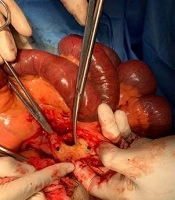
The patient underwent an emergency laparotomy showing segmental small bowel ischemia of about 2 meters (between the lower jejunum and upper ileum). The bowel was floppy and in an irreversible ischemic status (Figure 1). The resection of the ischemic segment was performed through the end-to-end anastomosis.
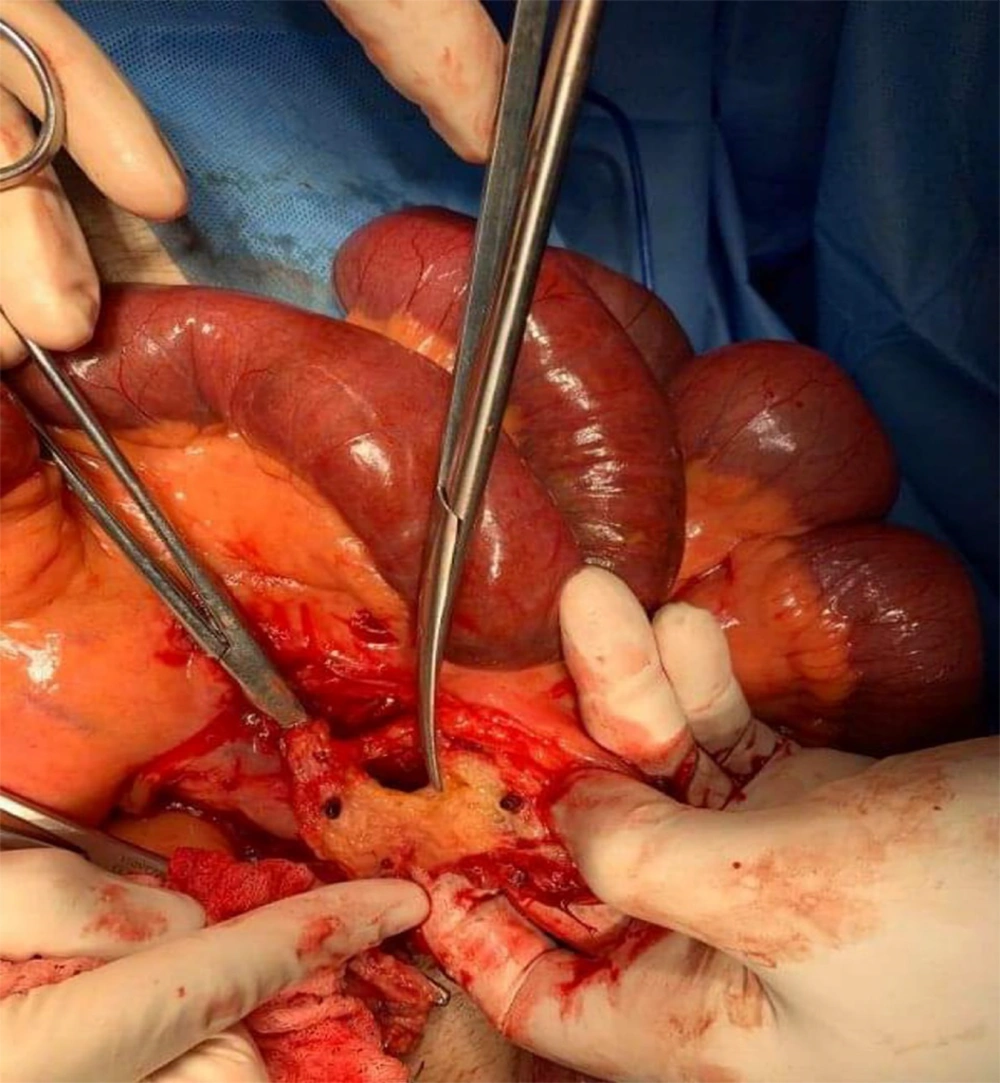
Gangrenous small intestine showing infarcted segments in a COVID-19 patient
Figure 1.

Gangrenous small intestine showing infarcted segments in a COVID-19 patient

After the surgery, the patient was admitted to the HDU ward and greatly improved within two days. The pain subsided, urine output was adequate, and bowel movements became positive. Subsequently, oral liquid diets started for the patient. Both BUN and serum creatinine returned to normal. However, the patient still suffered from mild fever and cough. Because of persistent post-operative fever, a chest CT-scan was conducted, revealing focal-patchy peripheral and subpleural ground glass involvement of both lungs, mainly at the posterior segments of both lower lobes. Then a nasopharyngeal swab test was performed, which confirmed the COVID-19 diagnosis. The patient was admitted to a COVID-19 hospital where he was treated with favipiravir (800 mg P.O. bid on the first day and then 600 mg P.O. bid for five days) plus levofloxacin (500 mg po for seven days). Then the patient clinically improved, and the PCR test rendered a negative result two weeks later.

3. Discussion

COVID-19 is an acute respiratory infection caused by SARS-CoV-2. Facing a pandemic emergency is challenging in low-resource countries such as Iraq. Around the world, gastrointestinal (GI) symptoms, mainly diarrhea, have been described in 10% of COVID-19 patients. Such symptoms are usually mild and without deleterious consequences (3). However, a few cases may present with severe GI symptoms associated with intestinal ischemia. In a report from Italy on seven patients with COVID-19-associated intestinal ischemia, an increased mortality rate was demonstrated in such patients (4). Our patient presented with severe and intractable abdominal pain and fever. The patient had no history of a similar clinical phenomenon and previous surgery, as well as no thromboembolism risk factors. During the operation, there was evidence of ischemia involving about two meters of the bowel length. Although the patient started to complain of mild pain from four days earlier, due to a low suspicion threshold, the diagnosis was missed, and therefore he was treated as a case of UTI. Due to the growing evidence linking COVID-19 to coagulopathy and previous reports of COVID-19-associated bowel ischemia, the role of COVID-19 infection in the occurrence of intestinal ischemia in our patient was highly probable. The exact mechanism of acute mesenteric ischemia is not fully understood yet. Four putative mechanisms have been proposed for such a fulminant complication, including the hypercoagulability provoked by systemic inflammation, endothelial activation, hypoxia, and immobilization, which may lead to mesenteric vascular thrombosis (4).
Based on the case presented here and previous reports on COVID-19-associated bowel ischemia, this condition should be considered in the COVID-19 patients presenting with gastrointestinal complications, including abdominal pain. Early interventions in such a condition may save the patient’s life, particularly in low-resource countries where CT scanning may not be available in emergency situations and in all hospitals. Simple X-ray at the erect position may help to early detect the condition and timely decisions on the operation.

3.1. Conclusions

Mesenteric ischemia should be highly suspected in the patients with COVID-19 presenting with severe progressive abdominal pain in order to perform timely diagnostic testing and appropriate decision making. Further studies are needed to understand the role of SARS-CoV-2 in the pathogenesis of this condition.
Footnotes

  • Authors' Contribution: All the authors were involved in designing and conducting the research, collecting data, and drafting the manuscript. All authors have accepted the responsibility for the final content of the manuscript, and all of them have read and approved the final manuscript.

  • Conflict of Interests: There are no known conflicts of interest associated with this publication.

  • Ethical Approval: The study was approved by the Scientific and Ethics Committee, College of Medicine, University of Zakho, Zakho, Iraq.

  • Funding/Support: No funding or support has been noted for this study.

  • Informed Consent: Written informed consent was obtained from the participant.

References

  • 1.
    Hussein NR, Naqid IA, Saleem ZSM. A retrospective descriptive study characterizing coronavirus disease epidemiology among people in the Kurdistan Region, Iraq. Mediterr J Hematol Infect Dis. 2020;12(1). e2020061. [PubMed ID: 32952972]. [PubMed Central ID: PMC7485477]. https://doi.org/10.4084/MJHID.2020.061.
  • 2.
    Hussein NR, Naqid IA, Saleem ZSM, Almizori LA, Musa DH, Ibrahim N. A sharp increase in the number of COVID-19 cases and case fatality rates after lifting the lockdown in Kurdistan region of Iraq. Ann Med Surg. 2020;57:140-2. [PubMed ID: 32754314]. [PubMed Central ID: PMC7377994]. https://doi.org/10.1016/j.amsu.2020.07.030.
  • 3.
    Mao R, Qiu Y, He JS, Tan JY, Li XH, Liang J, et al. Manifestations and prognosis of gastrointestinal and liver involvement in patients with COVID-19: A systematic review and meta-analysis. Lancet Gastroenterol Hepatol. 2020;5(7):667-78. [PubMed ID: 32405603]. [PubMed Central ID: PMC7217643]. https://doi.org/10.1016/S2468-1253(20)30126-6.
  • 4.
    Norsa L, Bonaffini PA, Indriolo A, Valle C, Sonzogni A, Sironi S. Poor outcome of intestinal ischemic manifestations of COVID-19. Gastroenterology. 2020;159(4):1595-1597 e1. [PubMed ID: 32569772]. [PubMed Central ID: PMC7305715]. https://doi.org/10.1053/j.gastro.2020.06.041.

Copyright

Copyright © 2021, International Journal of Infection. This is an open-access article distributed under the terms of the Creative Commons Attribution-NonCommercial 4.0 International License (http://creativecommons.org/licenses/by-nc/4.0/) which permits copy and redistribute the material just in noncommercial usages, provided the original work is properly cited.

Similar Articles

12
Oct
2021
Int J Infect

Acute and Massive Aortic Thrombosis and Embolic Occlusion in a Patient with COVID-19: A Case Report

Seyedjavad Davarisani,
Javad Koushki,
Saeed Moghaddamzade,
Hamzeh Sherafati,
Mehdi Jamalinik,
Ali Abedi
,et al.

Davarisani S, Koushki J, Moghaddamzade S, Sherafati H, Jamalinik M, et al. Acute and Massive Aortic Thrombosis and Embolic Occlusion in a Patient with COVID-19: A Case Report. Int J Infect. 2021;8(4):e110736. doi: https://doi.org/10.5812/iji.110736

15
Jun
2020
Jundishapur Journal of Microbiology

Gastrointestinal Presentation in a Patient with COVID-19 Without Respiratory Tract Symptoms: A Case Report From Qom, Iran

Ahmad Hormati,
Alireza Shahhamzeh,
Reza Aminnejad,
Mahbobeh Afifian,
Sajjad Ahmadpour

Hormati A, Shahhamzeh A, Aminnejad R, Afifian M, Ahmadpour S. Gastrointestinal Presentation in a Patient with COVID-19 Without Respiratory Tract Symptoms: A Case Report From Qom, Iran. Jundishapur J Microbiol. 2020;13(5):e102844. doi: https://doi.org/10.5812/jjm.102844

26
Sep
2020

Abdominal Signs and Symptoms of COVID-19 in Children

Rana Saleh,
Hamid Rahimi,
Niloofar Javadi,
Sheida Amini,
Shima Saeidi,
Zahra Pourmoghaddas

Saleh R, Rahimi H, Javadi N, Amini S, Saeidi S, et al. Abdominal Signs and Symptoms of COVID-19 in Children. Arch Pediatr Infect Dis. 2020;9(3):e107259. doi: https://doi.org/10.5812/pedinfect.107259

9
Jun
2023

Acute Renal Failure in a Patient with Coronavirus: A Case Report of a Rarely-Seen Presentation

Asieh Aref,
Zohre Valizadeh,
Mohammad Sakiani,
Mohsen Maleknia,
Zahra Shahpouri Arani,
Hashem Kazemi

Aref A, Valizadeh Z, Sakiani M, Maleknia M, Shahpouri Arani Z, et al. Acute Renal Failure in a Patient with Coronavirus: A Case Report of a Rarely-Seen Presentation. Gene Cell Tissue. 2023;10(4):e135159. doi: https://doi.org/10.5812/gct-135159

19
Feb
2022
Jundishapur J Microbiol

Upper Limb Ischemia Following COVID-19 Infection: A Case Report

Mohsen Arabi,
Hazhir Heidari Beigvand,
HamidReza Samimagham,
Nastaran Salimi,
Mitra Kazemi Jahromi

Arabi M, Heidari Beigvand H, Samimagham H, Salimi N, Kazemi Jahromi M. Upper Limb Ischemia Following COVID-19 Infection: A Case Report. Jundishapur J Microbiol. 2022;15(1):e122074. doi: https://doi.org/10.5812/jjm.122074

Download PDF2.31 MB

Crossmark

Crossmark

Checking

Share on
Cited by
Metrics

Ordering Reprints

Articles are published under the Creative Commons license stated on each article. No permission or royalty fee is required for uses permitted by that license. CCC handles optional bulk and customized reprint orders. Any quotation covers production and delivery services only, not copyright permission. > Request Reprints from CCC 

Search Relations

Author(s):

Related Articles