
1. Background
In clinical settings, the prompt diagnosis of many sexually transmitted diseases (STDs) is often restricted by the absence of acute clinical symptoms and the insufficient availability of appropriate diagnostic tests (1). Trichomoniasis represents one of the most prevalent STDs worldwide, with its incidence varying across different populations, timeframes, and age demographics (2). Currently, it is estimated that one billion individuals globally are infected with Trichomonas vaginalis, and the World Health Organization (WHO) reports that approximately 250 million new infections occur annually. This protozoan is described as flagellated and anaerobic, and it is a known cause of vaginitis (3, 4).
In developed countries, more than 50% of patients referred to general gynecological clinics are infected with trichomoniasis, and the global prevalence of trichomoniasis is estimated to be between 5% and 20% for women and 1% for men, depending on cultural and social status (5). Various studies have estimated this rate in Iran to be less than 1% to more than 43% (6, 7). Studies have shown that trichomoniasis is not only a critical cause of vaginitis in women but also a possible cause of pelvic inflammatory disease, cervical malignancies, and transmission of HIV and human papillomavirus (HPV). More notably, trichomoniasis may damage the end of pregnancy, causing premature rupture of the fetal membranes and toxin-like secretions, leading to premature birth before 37 weeks, low birth weight, and even fetal death. The most important fetal complications of this disease include nephritis, intraventricular hemorrhage, and respiratory distress. The double prevalence of puerperal fever seen after delivery in women infected with T. vaginalis expands the importance of the pathogenesis of this infection (8).
Trichomoniasis has an incubation period of 4 to 28 days. In symptomatic women, clinical signs include vaginal discharge, itching, inflammation, and redness of the vaginal mucosa. Other clinical symptoms of the disease include a greenish-yellow discharge with a frothy, foul-smelling appearance and microscopic spots of bleeding in the cervix that appear strawberry-shaped. Clinical manifestations occur in 50% of infected women, and the rest are asymptomatic (9). Emerging data have revealed a connection between trichomoniasis and bacterial vaginitis, vaginal candidiasis, cervical infection, infection with HPV 1 and 2, chlamydial infection, gonorrhea, and syphilis (10). It should not be ignored that bacterial and yeast infections represent prevalent forms of vaginitis that impact a significant number of women. Under such conditions, bacterial infection occurs when Lactobacillus species are reduced or eliminated and replaced by bacteria such as Gardnerella vaginalis and other anaerobic species (11). On the other hand, vaginal yeast infection is the second most common reason for vaginitis, caused by Candida albicans (12).
One frequently utilized method for diagnosing T. vaginalis is the preparation of a direct smear from vaginal discharge using normal saline. However, this approach has exhibited a sensitivity range of only 44 - 68%, notably low compared to molecular diagnostic methods (13). In the early 1940s, the Pap smear test was introduced following the recognition of cervical cell changes and cervical epithelial cell neoplasia. Epidemiological studies have shown that Pap smears have a significant impact on mortality rates from cervical cancer. For example, approximately one million cytology tests are performed annually in Sweden, of which 3 - 4% have atypical cellular changes. Cytology tests have resulted in a reduction of approximately 75% in cervical carcinoma cases (14).
In light of the widespread prevalence of T. vaginalis, which poses significant health risks to women within the community and facilitates the transmission of other sexually transmitted infections, the present study aims to examine the incidence of vaginitis attributed to T. vaginalis.
2. Objectives
This investigation is based on Pap smear tests performed on women attending gynecology clinics under the coverage of Zahedan University of Medical Sciences in Zahedan from 2013 to 2022.
3. Methods
This descriptive, cross-sectional, and retrospective study was conducted on 20,607 patient documents concerning Pap smear evaluations of pregnant women and those attending periodic checkups at gynecology clinics under the coverage of Zahedan University of Medical Sciences in Zahedan from 2013 to 2022. The study included 103 individuals diagnosed with T. vaginalis, identified via a census methodology. Demographic data and data associated with possible risk factors were collected. Demographic and personal records of the patients, along with the associated risk factors, were collected using a questionnaire. The data encompassed all patients who visited the gynecology clinics during the specified years and underwent a Pap smear test, regardless of vaginitis symptoms. Among the positive samples for T. vaginalis infection, inflammation, and fungal and bacterial infections were also assessed. Factors such as patient age, number of pregnancies, contraceptive methods, and number of abortions were examined to evaluate their potential impact on the incidence of T. vaginalis infection.
To ensure compliance with ethical standards concerning patient information, the assembled data were anonymized and entered into SPSS software (version 22) using coded identifiers. A chi-square test was employed to analyze the relationship between various factors — such as age, number of pregnancies, contraceptive method, and number of abortions — and the incidence of T. vaginalis. A significance threshold was set at a P-value of less than 0.05.
4. Results
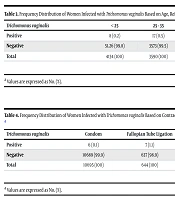
Over the past ten years, 20,607 cases have been documented. The highest number of referrals was in 2017, consisting of 3,065 individuals, accounting for 14.87% of all cases. In contrast, 2021 had the highest ratio of positive cases, with 10 cases (0.66%) (Table 1). Of the 103 cases studied, 72 (69.9%) had inflammation, 8 (75.7%) had fungal infection, and 23 (22.35%) had bacterial infection (Table 2). The average age of the patients was 39 years, with the majority in the 35 - 45 age group. Additionally, 64 (62.13%) women had 3 to 5 pregnancies. A total of 7,989 (38.76%) of the patients used fallopian tube ligation, and 3,587 (17.40%) used condoms as a method of contraception. Table 3 illustrates the frequency and percentage of women infected with this parasite across various age groups. The prevalence of T. vaginalis was found to be highest among individuals aged 35 to 45 years, while the lowest prevalence was documented in those under 25 years of age. A chi-square test revealed a statistically significant association between women's age and the parasite's prevalence (P = 0.0001).
Table 1.
Frequency Distribution of Positive Trichomonas vaginalis Samples in Women Referring to the Gynecology Clinics in Zahedan from 2013 to 2022
| Variables | Year | Total | |||||||||
|---|---|---|---|---|---|---|---|---|---|---|---|
| 2013 | 2014 | 2015 | 2016 | 2017 | 2018 | 2019 | 2020 | 2021 | 2022 | ||
| Number of hospital visits | 2274 | 2038 | 1982 | 2168 | 3065 | 1883 | 1154 | 1496 | 2352 | 2195 | 20607 |
| Positive cases; No. (%) | 9 (0.39) | 8 (0.39) | 14 (0.70) | 13 (0.59) | 15 (0.48) | 12 (0.63) | 6 (0.52) | 10 (0.66) | 7 (0.29) | 9 (0.41) | 103 (0.49) |
Table 2.
Frequency Distribution of Fungal, Bacterial and Inflammatory Infections in Patients with trichomoniasis Referred to the Gynecology Clinics in Zahedan from 2013 to 2022
| Patients infected with Trichomonas vaginalis | Frequency (%) |
|---|---|
| Inflammation | 72 (69.9) |
| Fungal infection | 8 (7.75) |
| Bacterial infection | 23 (22.35) |
| Total | 103 (100) |
Table 3.
Frequency Distribution of Women Infected with Trichomonas vaginalis Based on Age, Referred to the Gynecology Clinics in Zahedan from 2013 to 2022 a
| Trichomonas vaginalis | < 25 | 25 - 35 | 35 - 45 | 45 < | Total |
|---|---|---|---|---|---|
| Positive | 8 (0.2) | 17 (0.5) | 54 (1) | 24 (0.4) | 103 (0.5) |
| Negative | 51.26 (99.8) | 3573 (99.5) | 5546 (99.0) | 4959 (99.6) | 20504 (99.5) |
| Total | 4134 (100) | 3590 (100) | 5600 (100) | 6283 (100) | 20607 (100) |
a Values are expressed as No. (%).
Among the patients, 3,275 individuals (15.89%) reported a history of one abortion, and 1,746 individuals (8.47%) reported a history of two or more miscarriages. Furthermore, the chi-square test indicated no statistically significant difference between the history of abortion in women and the prevalence of parasites (P = 0.34). The analysis revealed that the highest prevalence of T. vaginalis infection was identified among women who utilized fallopian tubal ligation. In contrast, the lowest prevalence was reported among those who employed condoms as a contraceptive method. A chi-square test demonstrated a statistically significant association between the selection of contraceptive method and the incidence of T. vaginalis infection, with P = 0.0003 (Table 4). Furthermore, the highest infection rate was recorded in women with three to five previous pregnancies (Table 5). The chi-square test also indicated a statistically significant relationship between the number of pregnancies experienced by women and the parasite infection, with P = 0.0003. Additionally, Table 6 showed that T. vaginalis infection had a significant relationship with the degree of inflammation (P = 0.007). Analysis of the data in Table 6 shows that patients with moderate, severe, and mild degrees of inflammation were included in this study, respectively.
Table 4.
Frequency Distribution of Women Infected with Trichomonas vaginalis Based on Contraceptive Methods, Referred to the Gynecology Clinics in Zahedan from 2013 to 2022 a
| Trichomonas vaginalis | Condom | Fallopian Tube Ligation | Contraceptive Pills | Others | Total |
|---|---|---|---|---|---|
| Positive | 6 (0.1) | 7 (1.1) | 61 (1.0) | 29 (0.9) | 103 (0.5) |
| Negative | 10689 (99.9) | 637 (98.9) | 5903 (99.0) | 3275 (99.1) | 20504 (99.5) |
| Total | 10695 (100) | 644 (100) | 5964 (100) | 3304 (100) | 20607 (100) |
a Values are expressed as No. (%).
Table 5.
Percentage of Women Infected with the Trichomonas vaginalis According to the Number of Pregnancies, Referred to the Gynecology Clinics in Zahedan from 2013 to 2022
| Number of children | Frequency (%) |
|---|---|
| 0 | 7 (6.8) |
| 1 - 2 | 14 (13.59) |
| 3 - 5 | 64 (62.13) |
| 5 < | 18 (17.48) |
| Total | 103 (100) |
Table 6.
Inflammation Grade Based on Trichomonas Infection in Pap Smears of Patients, Referred to the Gynecology Clinics in Zahedan from 2013 to 2022 a
| Trichomonas and Inflammation | Positive | Negative | Total |
|---|---|---|---|
| Negative | 31 (0.3) | 10449 (99.7) | 10480 (100) |
| Mild | 14 (0.6) | 2249 (99.4) | 2263 (100) |
| Moderate | 33 (0.5) | 6412 (99.5) | 6445 (100) |
| Severe | 25 (1.76) | 1394 (98.24) | 1419 (100) |
| Total | 103 (0.5) | 20504 (99.5) | 20607 (100) |
a Values are expressed as No. (%).
5. Discussion
The current study aimed to examine the prevalence of T. vaginalis in Pap smear samples collected from women referred to gynecology clinics in Zahedan from 2013 to 2022. The investigation included 20,607 participants, with an average age of 39.68 years. The findings indicated that the prevalence of Trichomonas in the Pap smears was 0.5%. Additionally, the results revealed that 50.85% of the individuals exhibited no inflammation, while 10.98% had mild, 27.31% experienced moderate, and 6.88% presented with severe inflammation.
The World Health Organization (WHO) has indicated that the global prevalence of trichomoniasis surpasses that of gonorrhea, syphilis, and chlamydia, with an estimated 276.4 million cases reported annually. Research conducted in various regions has revealed disparities in the prevalence of this infection among different populations and genders (15). In the present study, the prevalence of trichomoniasis infection among women was observed to be relatively low. The incidence of T. vaginalis infection among women is associated with a range of risk factors, including multiple sexual partners, current or previous infections with other STDs (such as HSV, HIV, and syphilis), drug abuse, and incarceration (16, 17). Some authorities have demonstrated a positive correlation between T. vaginalis infection and age in women; conversely, some studies have revealed a negative correlation (18).
As previously indicated, the prevalence of trichomoniasis is influenced by factors such as geographic region, the timeframe of the study, and the specific population under investigation. Prevalence estimates vary significantly across different demographics, ranging from 5% to 74% in women and 5% to 29% in men (19, 20). In a study conducted by Baka in 2013, cultures were collected from the vagina and cervix of women presenting with inflammation on their Pap smear, as well as from those with regular Pap smears, to evaluate the predictive value of these findings in the presence of pathogens among asymptomatic individuals. The study revealed that more than 60% of women exhibiting inflammatory changes on their cervical smears had positive cultures for various pathogens, which is consistent with the findings of our research (21).
A study conducted in 2008 by Bolbolhaghighi et al. on the prevalence of trichomoniasis indicated that the highest prevalence of T. vaginalis, determined via clinical diagnoses, occurred in individuals aged 21 to 35, at a rate of 52.6%. In contrast, the lowest prevalence was noted among those aged 20 years and younger, at 10.3%. The authors documented a total of 78 cases of Trichomonas based on clinical observations; however, none were confirmed via culture media. Furthermore, they highlighted that the clinical diagnosis method resulted in a 26% false positive rate compared to culture results, with one case of Trichomonas being confirmed via wet smear and Pap smear analysis (22).
In another descriptive cross-sectional study conducted by Beiromvand and Daneshbakhtyar, the prevalence of T. vaginalis in Pap smear samples collected from women in Ahvaz between 2005 and 2014 was assessed. The study analyzed 37,332 Pap smear files for the presence of T. vaginalis infection. Results indicated that the frequency of T. vaginalis in the examined population was lower than that reported in other regions of Iran. Given that this protozoan may act as a predisposing factor for the transmission of various viral, fungal, and bacterial STDs, the implementation of sexual health education could play a vital role in preventing such infections. Notably, the prevalence of Trichomonas identified in the aforementioned study was comparable to our findings, indicating a prevalence of less than 1% (23).
A study by Akhlaghi et al. in 2005 examined a population of women in Robat Karim City. The research found no statistically significant relationship between T. vaginalis infection and various factors, including age, level of education, number of deliveries, contraceptive method, or the presence of symptoms such as itching, irritation, and painful intercourse. In contrast, positive cases exhibited a significant association with vaginal pH, discharge, and the count of white blood cells per microscopic field. Furthermore, the study indicated that using Loeffler's and diluted carbol fuchsin dyes was ineffective for the rapid diagnosis of T. vaginalis. Additionally, the prevalence observed in this study was slightly higher than that reported in our investigation (24).
In a descriptive-analytical cross-sectional study conducted by Fattahi et al. from September 2012 to September 2013, the prevalence of candidal vaginitis among women attending health centers in Yazd was assessed. Out of a total of 360 women, 120 (33.33%) were diagnosed with vaginitis attributed to one of three pathogens: Candida, bacterial vaginosis, or Trichomonas. The most frequently observed infection was bacterial vaginosis, affecting 55 individuals (15.6%), followed by Candida albicans, which impacted 40 individuals (8%). Trichomonas vaginalis recorded the lowest prevalence, affecting 25 individuals (5.9%). It is important to note that co-infection with all three pathogens was not identified in any patient, although certain epidemiological factors showed trends toward significance. The findings indicate that the prevalence of infection in the Yazd desert region is minimal. This low rate may be attributed to the absence of long-lasting infectious forms under hot and dry environmental conditions. Furthermore, cultural and ethical beliefs among women and men in the region may also play a role in the observed decline in infection rates. The findings of the aforementioned study regarding the prevalence of different types of vaginal pathogens were slightly higher than our study, indicating an increase in public awareness in recent years and a decrease in prevalence (25).
A study by Salimi Khorashad et al. in 2021 examined a population of women in Zahedan city. The results showed that in 514 pregnant women, by the direct method, both the direct and culture methods, and only the culture method, 29 (5.64%), 24 (4.67%), and 24 (4.67%) were reported as positive samples for T. vaginalis, respectively. According to this result, there were significant differences between trichomoniasis and history of STI (OR = 12.6; 95% CI = 3.9 - 40.6), previous abortion (OR = 6.840; 95% CI = 2.906 - 16.100), vaginal discharge (OR = 2.9; 95% CI = 1.2 - 7.1), and antenatal care (OR = 0.2; 95% CI = 0.1 - 0.7) in the studied infected pregnant women (P < 0.05) (26).
5.1. Conclusions
The current study indicates that the prevalence of T. vaginalis is relatively low compared to other studies conducted within the country. Nonetheless, more extensive research and accurate health information to the general public regarding the symptoms of this infection and its modes of transmission are essential. Additionally, it is crucial to encourage women exhibiting symptoms to seek medical evaluation for appropriate treatment. Moreover, prospective research should investigate the infection rates of T. vaginalis in males. Many physicians may misdiagnose the infection by relying exclusively on clinical symptoms. Therefore, it is important to implement diagnostic measures such as culture tests or direct smears before initiating treatment. Given the role of this protozoan in causing various pathological complications and facilitating the transmission of certain viral and bacterial infections, it is imperative to educate women about the risks associated with the sexual transmission of parasitic, viral, and bacterial infections. Such education could significantly contribute to the prevention and reduction of infection rates.