
1. Background
Opportunistic fungal infections are among the most common infections threatening patients with immunodeficiency (1). These infections can cause complications in individuals receiving prolonged antibiotic therapy, antipsychotic drugs, or corticosteroids; older adults; individuals with infectious diseases; hospitalized patients; and those exposed to infection in healthcare settings (2). Yeasts, particularly Candida species, are the fungi most commonly isolated from human infections. Despite advances in hospital care and the treatment of infectious diseases, the incidence of Candida infections involving mucosal sites, including the gastrointestinal and respiratory tracts and the vaginal mucosa, has increased substantially (3, 4).
Azole antifungal agents, particularly fluconazole, are used to reduce the risk of invasive fungal infections. However, drug resistance has created challenges for this therapeutic approach. Identifying antifungal-resistant species is therefore essential for effective treatment and for preventing excessive drug use. Resistance develops through several mechanisms that can lead to treatment failure (5). Mechanisms of fluconazole resistance in Candida albicans include reduced intracellular drug accumulation, alterations in enzymes involved in ergosterol biosynthesis, modification of the fluconazole target through point mutations or increased gene expression, and increased drug efflux via membrane pumps (6).
Fluconazole targets lanosterol 14α-demethylase, the product of ERG11 and an enzyme in the C. albicans ergosterol biosynthesis pathway. Point mutations and increased expression of this gene in pathogenic fungi can reduce susceptibility to azole antifungals and may cause cross-resistance to other antifungal drugs (7). Increased ERG11 expression can increase the abundance of lanosterol 14α-demethylase, potentially requiring higher drug concentrations to inhibit the organism. Clinical strains from patients susceptible to nosocomial infection or with C. albicans infection have been identified using microscopy, phenotypic culture, and isolation methods (8).
2. Objectives
This study investigated fluconazole susceptibility among C. albicans isolates obtained from patients with mucosal candidiasis in Zahedan and determined whether ERG11 transcripts could be detected using conventional reverse-transcription polymerase chain reaction (RT-PCR). Because the molecular method consisted of RT-PCR followed by agarose gel electrophoresis, the molecular findings are reported as transcript detection rather than as quantitative ERG11 overexpression. The study also aimed to assess whether the disk-diffusion resistance results were consistent with the RT-PCR findings.
3. Methods
3.1. Study Design and Setting
This laboratory-based cross-sectional study was conducted in 2018 at the Infectious Diseases Ward of Bu-Ali Hospital and the Obstetrics and Gynecology Clinic of Nabi Akram Hospital, Zahedan, Iran. In total, 65 inpatients from Bu-Ali Hospital and 135 outpatients from Nabi Akram Hospital were randomly selected after ethical considerations had been addressed, written informed consent had been obtained, and questionnaires had been completed.
3.2. Inclusion Criteria
Individuals attending the Obstetrics and Gynecology Clinic of Nabi Akram Hospital or the Infectious Diseases Ward of Bu-Ali Hospital who consented to participate were eligible.
3.3. Exclusion Criteria
The exclusion criteria were refusal to cooperate, use of antifungal medication within 2 - 3 months before sampling, and contamination of samples with fungal elements before testing began.
3.4. Ethical Considerations
The study was approved by the Medical Ethics Committee of Islamic Azad University, Mashhad Medical Sciences, Mashhad, Iran (IR.IAU.MSHD.REC.1398.005).
3.5. Specimen Processing and Mycological Culture
Respiratory mucosal specimens and vaginal secretions were collected from individuals with suspected fungal infections and transferred under sterile conditions to the Mycology Laboratory of the Faculty of Medicine. Mucosal swabs were cultured directly on 4% Sabouraud dextrose agar (Merck, Germany), prepared by dissolving 65 g in 1 L of water, along with standard fluconazole-resistant strains. Cultures were incubated at 37 °C for 24 hours. Single colonies were used for phenotypic testing.
Positive fungal cultures were subcultured on chromogenic agar (CHROMagar Candida, France) for presumptive species identification, along with Candida species used as positive controls. The standard C. albicans strain PTCC 424 - 624 was purchased from the Pasteur Institute of Iran and used as a positive control throughout the experiments. A vial containing distilled water served as a negative control. No molecular confirmation of species identification was performed.
3.6. Fluconazole Susceptibility Testing
After C. albicans identification, susceptibility was assessed using the disk-diffusion method described in the Clinical and Laboratory Standards Institute (CLSI) document M27M44. According to the guideline, 34 g of commercial Mueller-Hinton agar powder was dissolved in 1 L of water by heating, and the medium was poured into susceptibility-testing plates. After the medium cooled and solidified, pure C. albicans colonies were inoculated onto the agar, and a 25-μg fluconazole disk was placed at the center of each plate. Inhibition-zone diameters were assessed after incubation at 37 °C for 24 - 48 hours. Mueller-Hinton agar was obtained from Condalab, Spain, and fluconazole disks were obtained from Behnogen, a laboratory-equipment distributor. The inoculum was standardized to 0.5 McFarland according to the applicable CLSI procedure. Inhibition-zone diameters were measured in millimeters. A clear zone exceeding 19 mm indicated susceptibility, whereas a diameter below this value was considered indicative of fluconazole resistance (Table 1). Results were interpreted using standard values.
Table 1.
Sensitive, Resistant, and Intermediate Zone-Diameter Breakpoints for the 25-Μg Fluconazole Disk
| S | SDD/Intermediate | R |
|---|---|---|
| ≥ 19 mm | 18 - 15 mm | ≤ 14 mm |
3.7. RNA Extraction and cDNA Synthesis
RNA was extracted using glass beads and TRIzol solution. After disruption of the yeast cell wall, a commercial FAVORGEN kit supplied by Pishgam Biotechnology was used for RNA extraction. RNA purity and extraction quality were assessed by electrophoresis and spectrophotometry. Absorbance at 260 and 280 nm was compared to assess RNA quality. Complementary DNA (cDNA) was then synthesized using a commercial kit (catalog no. YT4500; Yekta Tajhiz Azma) according to the manufacturer's instructions.
For cDNA synthesis, 5 μL of extracted RNA, 1 μL of random hexamer primer, and 7.4 μL were added to a 0.2-mL microtube and mixed thoroughly. The tube was placed in a water bath at 70 °C for 5 minutes and then gently transferred to ice to cool. Next, 4 μL of the 5× first-state reagent, 1 μL of RNase inhibitor, 0.5 μL of RNase inhibitor, and 1 μL of M-MLV were added. After mixing, the tube was placed in a water bath at 37 °C for 37 minutes for synthesis. Immediately afterward, it was placed in a water bath at 70 °C for 5 minutes to stop RNase activity and complete the process. The synthesized cDNA could be stored at -20 °C until PCR.
ERG11 was the target gene, and ACT1 served as the internal amplification control. All 27 fluconazole-resistant clinical isolates were tested; the 12 susceptible clinical isolates were not tested by RT-PCR. Primer design and performance were checked using the Basic Local Alignment Search Tool (BLAST) at the National Center for Biotechnology Information (NCBI) and Gene Runner software. The primer sequences are presented in Table 2.
Table 2.
Primers Used for Identifying Fungal Infection and Candida albicans
| Primer name | Sequence (5′ to 3′) | Size (bp) |
|---|---|---|
| ERG11/F | 5′-TTTGGTGGTGGTAGACATA-3′ | 134 |
| ERG11/R | 5′-GAACTATAATCAGGGTCAGG-3′ | 134 |
| ACT1/F | 5′-CCAGCTTTCTACGTTTCC-3′ | 209 |
| ACT1/R | 5′-CTGTAACCACGTTCAGAC-3′ | 209 |
Polymerase chain reaction was performed in a final volume of 12.5 μL using a Gene Scan device. Each reaction contained 1 μL of synthesized cDNA, 2 μL of each primer, and 6.25 μL of PCR master mix, with sterile distilled water added to reach the final volume. The reaction mixture was placed in a thermocycler. The program consisted of initial denaturation at 94 °C for 5 minutes; 34 cycles of denaturation at 94 °C for 50 seconds, primer annealing at 60 °C for 45 seconds, and extension at 72 °C for 50 seconds; and final extension at 72 °C for 10 minutes. PCR products were electrophoresed on a 1.5% agarose gel. Amplified bands were examined using a gel documentation system.
3.8. Statistical Analysis
Data were entered into SPSS version 26 (SPSS Inc., Chicago, Illinois, USA) and analyzed descriptively using frequency distributions, graphs, and summary statistics. Proportions were reported with 95% confidence intervals (CIs). The primary descriptive outcomes were the proportion of participants with C. albicans isolation among the 200 enrolled participants, the proportion of fluconazole-resistant isolates among the 39 C. albicans isolates, and the proportion of resistant isolates with detectable ERG11 transcripts. Because conventional endpoint RT-PCR does not provide quantitative gene-expression measurements, no statistical comparison of ERG11 expression levels was performed.
4. Results
A total of 200 participants were randomly selected from among patients attending the Obstetrics and Gynecology Clinic of Nabi Akram Hospital and the Infectious Diseases Ward of Bu-Ali Hospital. Specimens were evaluated for C. albicans by culture on CHROMagar Candida. Of the 200 participants, 39 had confirmed C. albicans infection. A representative C. albicans isolate is shown in Figure 1, and infection frequencies by clinical center are presented in Table 3. A standard C. albicans strain was used as a positive control, and a Candida krusei strain was used as a negative control to assess identification accuracy. Disk diffusion testing was performed at 37 °C, and inhibition zones were assessed after 24 hours. Based on inhibition-zone diameters and the applied interpretive criteria, 27 isolates were classified as fluconazole-resistant (Table 4).
Table 3.
Prevalence of Candida clbicans Infection by Clinical Center
| Candida albicans Infection | Bu-Ali Hospital Infectious Diseases Center | Nabi Akram Obstetrics and Gynecology Clinic |
|---|---|---|
| Confirmed cases | 11 | 28 |
| Unconfirmed cases | 54 | 107 |
| Total | 65 | 135 |
Table 4.
Frequency and Percentage of Isolate Responses to Fluconazole Using Disk Diffusion
| Candida albicans infection | Frequency | Percentage |
|---|---|---|
| Fluconazole-resistant | 27 | 69.2 |
| Fluconazole-sensitive | 12 | 30.8 |
| Total | 39 | 100 |

Figure 1.
Candida albicans growth on chromogenic agar
Extracted RNA was evaluated spectrophotometrically. Antifungal resistance may arise through several mechanisms, including increased gene expression, point mutations, and alterations in enzymes involved in ergosterol biosynthesis. Increased ERG11 expression can elevate lanosterol 14α-demethylase levels, thereby promoting ergosterol biosynthesis and reducing the inhibitory effects of azole antifungals. In this study, RT-PCR using ERG11- and ACT1-specific primers was performed on standard strains with known fluconazole susceptibility or resistance, as well as on the 27 resistant clinical isolates. Adequate ERG11 amplification was achieved. Following agarose gel electrophoresis, visualization with a gel documentation system, and assessment of band sizes, ERG11 transcripts were detected in 18 of the 27 isolates classified as fluconazole-resistant by disk diffusion (Figure 2).
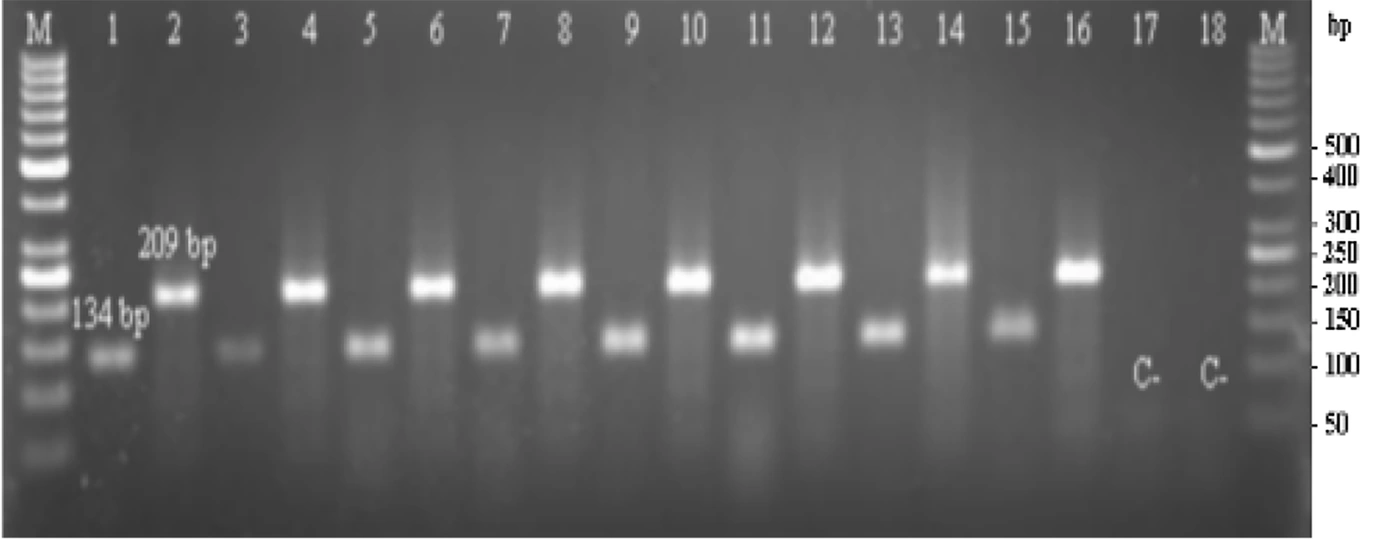
Figure 2.
Electrophoresis of ERG11 and ACT1 PCR products. Lanes 3, 5, 7, 9, 11, 13, and 15: ERG11 from fluconazole-resistant Candida albicans; lanes 2, 4, 6, 8, 10, 12, 14, and 16: ACT1.
5. Discussion
Azole antifungals, particularly fluconazole, are among the most effective and commonly used agents for treating C. albicans infections. Fluconazole is widely used because of its therapeutic properties, absorption, and effectiveness against Candida infections. Resistance to azole antifungals was rare until the 1980s but has increased substantially since 2021. The increasing prevalence of fungal infections has led to greater antifungal use and increased resistance among Candida species (7, 9-12). The prevalence of acute and systemic Candida infections, antifungal treatment, particularly with azoles, and resistance to these agents underscore the need for susceptibility testing (8). Determining pathogen susceptibility helps guide treatment and eradicate fungal infections while limiting unnecessary drug use and secondary resistance.
Several genes associated with resistance, including CDR1, CDR2, MDR1, ERG3, ERG6, ERG9, ERG11, RTA2, and NAG2, have been identified in C. albicans. These genes contribute to antifungal resistance through different molecular mechanisms (9). In C. albicans, ERG11 encodes lanosterol 14α-demethylase, the target enzyme of azoles. Fluconazole resistance is associated with increased expression, point mutations, and alterations in ergosterol biosynthesis. ERG11 overexpression increases the abundance of lanosterol 14α-demethylase, promoting ergosterol synthesis and reducing fluconazole effectiveness (10).
Among the 200 randomly selected participants, 39 had C. albicans infection (19.5%), indicating a high prevalence of mucosal candidiasis in this sample. Disk diffusion identified fluconazole resistance in 27 of the 39 isolates (69.2%). This high proportion of resistance highlights the importance of evaluating more effective therapeutic approaches. Because fluconazole targets lanosterol 14α-demethylase, this study assessed amplification of the transcript encoding this enzyme. Susceptibility testing is an initial step in selecting appropriate treatment for candidiasis and avoiding excessive drug use and the development of resistance. Among the 27 resistant isolates, ERG11 transcripts were detected in 18. These isolates were also classified as fluconazole resistant by disk diffusion. Resistance in 27 of the 39 confirmed C. albicans isolates suggests that multiple factors and genes with different molecular mechanisms may contribute to the resistant phenotype.
The observed resistance proportion was higher than several previously reported estimates from Iranian C. albicans populations. A systematic review and meta-analysis of Iranian clinical isolates reported substantial variation in antifungal resistance, with pooled estimates generally lower than the proportion observed in this sample (11). Differences in patient populations, anatomical sampling sites, prior antifungal exposure, geographic settings, laboratory methods, and interpretation criteria may contribute to these variations. Previous Iranian studies have also demonstrated geographic and clinical variation in fluconazole susceptibility. Studies of vulvovaginal candidiasis and other clinical Candida infections have reported different distributions of C. albicans and non-albicans Candida species and variable fluconazole resistance (12). These findings support local surveillance rather than extrapolation of resistance rates between populations.
ERG11 is biologically relevant to azole susceptibility because it encodes lanosterol 14α-demethylase, the enzyme targeted by azole antifungals. However, resistance is not determined by a single gene. ERG11 mutations and regulatory changes can contribute to azole resistance, and efflux-pump systems and their regulatory genes may also play important roles (7). In this study, conventional endpoint RT-PCR detected ERG11 transcripts in 18 resistant isolates. This finding should not be interpreted as evidence of ERG11 overexpression. An ERG11 amplicon demonstrates detection of the target transcript under the experimental conditions but does not establish transcript abundance relative to that in susceptible isolates. This distinction is particularly important because fluconazole-susceptible C. albicans isolates also possess and express ERG11.
Quantitative studies have demonstrated variation in ERG11 expression among isolates and shown that increased expression alone does not necessarily correspond to resistance. One recent clinical study found ERG11 upregulation in a substantial proportion of fluconazole-susceptible isolates, emphasizing the multifactorial nature of antifungal resistance (9). The present findings therefore cannot establish that ERG11 expression caused fluconazole resistance or that transcript detection has diagnostic value for identifying resistant isolates. Such conclusions would require quantitative expression measurements, appropriate susceptible and resistant comparison groups, biological and technical replicates, and statistical analysis of the relationship between expression and phenotype.
A strength of this study is the combination of clinical sampling, phenotypic susceptibility testing, and molecular investigation.
5.1. Study Limitations
Several limitations should be considered. First, the study was conducted at two clinical sites in Zahedan, which may limit generalizability to other populations and geographic regions. Second, the sample size was relatively small, particularly for molecular analysis. Third, conventional endpoint RT-PCR could not quantify ERG11 transcript abundance. Fourth, other important resistance mechanisms, including ERG11 mutations and overexpression of efflux-pump genes such as CDR1, CDR2, and MDR1, were not investigated. Fifth, the absence of complete individual inhibition-zone measurements in the original report limited assessment of the distribution of susceptibility results.
5.2. Conclusions
Recent research supports a broader molecular approach to azole resistance. Alongside ERG11, efflux-pump pathways and regulatory genes such as TAC1 and MRR1 may contribute to resistance (13). Future studies should therefore combine standardized phenotypic susceptibility testing with quantitative RT-PCR and, where feasible, ERG11 sequencing and assessment of relevant efflux-pump genes. Disk diffusion is inexpensive and allows large numbers of samples to be examined in each experiment; it can be used alongside genotypic methods to investigate resistance and the genes involved. Investigating fluconazole and other antifungal resistance genes in indigenous C. albicans isolates in Iran can support ongoing surveillance. Further studies in different patient populations and with larger numbers of isolates are recommended to provide a comprehensive assessment of C. albicans in Iran. Given the prevalence of opportunistic fungal infections and the high resistance proportion observed in this study, simple, cost-effective methods, such as disk diffusion, used alongside molecular analyses can aid in controlling the spread of drug resistance.