
1. Context
The global pandemic of coronavirus disease 2019 (COVID-19), caused by severe acute respiratory syndrome coronavirus 2 (SARS-CoV-2), has posed an unprecedented challenge to global health systems (1, 2). Although the clinical spectrum ranges from asymptomatic infection to mild respiratory symptoms, a substantial proportion of patients develop severe complications, including acute respiratory distress syndrome (ARDS), septic shock, and multiorgan failure (3, 4).
A defining feature of severe COVID-19 is the "cytokine storm," characterized by the rapid, massive release of proinflammatory cytokines (5, 6). Among these, interleukin-6 (IL-6) serves as a central orchestrator of the systemic inflammatory response. Elevated plasma IL-6 levels are strongly associated with greater disease severity, extensive lung involvement on computed tomography (CT), and a higher risk of mortality (5). Statistical analyses have shown that IL-6 levels are significantly higher in intensive care unit (ICU) patients than in non-ICU patients (5, 7). This inflammatory cascade is not merely a consequence of viral replication but is also tightly regulated at the epigenetic level by microRNAs (miRNAs) (5). In this review, the term "IL-6 axis" encompasses IL-6 production, IL-6R/gp130 signaling, the downstream JAK/STAT3 and NF-κB pathways, the inflammatory genes that they regulate, and the miRNA-mediated regulatory networks that modulate these components.
2. Evidence Acquisition
A literature search was conducted using predefined keywords ("COVID-19" OR "SARS-CoV-2") AND ("IL-6" OR "interleukin-6") AND ("microRNA" OR "miRNA" OR "miR"). The following electronic databases were searched: Scopus, Google Scholar, ISI Web of Knowledge, and PubMed. The search was performed on January 15, 2026, and included English-language articles published between January 2020 and January 2026. Full-text articles were assessed for relevance based on the direct evaluation of miRNAs in the context of COVID-19 and IL-6 signaling. Reference lists of included articles and relevant reviews were manually searched to identify additional studies. Preprints were excluded unless they were subsequently published in peer-reviewed journals. Given the narrative nature of this review, formal quality scoring or meta-analysis was not performed; instead, findings are presented qualitatively, with emphasis on the level of evidence (human, animal, in vitro, or in silico).
3. Results
3.1. Biology and Biogenesis of microRNAs
MicroRNAs are a class of endogenous, small (approximately 17 - 24 nucleotides), noncoding RNA molecules that posttranscriptionally regulate gene expression by targeting messenger RNAs (mRNAs) (5, 8). They play a pivotal role in maintaining immune homeostasis and are estimated to regulate up to 90% of the human protein-coding genome (5, 9, 10).
Biogenesis pathway: miRNA production is a complex multistep process. In the nucleus, miRNA genes are transcribed by RNA polymerase II into primary transcripts (pri-miRNAs) (5, 8, 11). These transcripts are then processed by the Microprocessor complex, consisting of the RNase III enzyme Drosha and the DGCR8 protein, into 70-nucleotide precursor miRNAs (pre-miRNAs) (2, 5, 12). After export to the cytoplasm via Exportin-5, Dicer cleaves them into mature double-stranded miRNA duplexes (5).
Mechanism of gene silencing: One strand of the mature miRNA is incorporated into the RNA-induced silencing complex (miRISC), in which the Argonaute (AGO) protein acts as the functional core (5). The miRNA guides this complex to the 3'-untranslated region (3'-UTR) of a target mRNA. The "seed region" (nucleotides 2 - 7) is critical for target recognition (13, 14). Depending on the degree of complementarity, this interaction leads to either direct mRNA degradation or translational inhibition (2, 13).
3.2. IL-6 Signaling Network and Pathophysiology
Interleukin-6 is a central pleiotropic cytokine and a key mediator of the inflammatory response to COVID-19, with a dual role in disease pathology. IL-6 is among several proinflammatory cytokines, along with TNF-α, IL-1β, and IL-8, involved in the cytokine storm. In severe cases, uncontrolled elevation of IL-6 is a hallmark of the cytokine storm and correlates with acute lung injury, ARDS, and multiorgan failure. High IL-6 concentrations are associated with poor prognosis, the need for mechanical ventilation, and increased mortality among ICU patients. Furthermore, IL-6 contributes to clinical deterioration and coagulopathy by stimulating hepatic synthesis of acute-phase proteins, such as C-reactive protein (CRP), and by increasing vascular permeability through the promotion of vascular endothelial growth factor (VEGF) secretion (1, 5, 6).
From a molecular perspective, IL-6 exerts its effects through 2 primary signaling modes: classic signaling, through binding to membrane-bound receptors, and trans-signaling, through soluble receptors. Classic signaling is generally associated with anti-inflammatory and regenerative functions, whereas trans-signaling is recognized as a major driver of the hyperinflammatory response and vascular damage in severe COVID-19. Activation of these pathways triggers Janus kinases (JAKs), leading to phosphorylation of STAT3 and activation of NF-κB, which sustain an inflammatory amplification loop and promote continued production of proinflammatory cytokines. Hyperactivation of IL-6 signaling is also linked to reduced numbers and functional exhaustion of key immune cells, including CD4+ and CD8+ T lymphocytes and natural killer (NK) cells, thereby impairing effective host defense against SARS-CoV-2 (3, 5, 7, 8).
IL-6 acts through 2 main pathways that are important in COVID-19 pathogenesis:
1) JAK/STAT3 signaling: When IL-6 binds to its receptor (IL-6R) and the gp130 coreceptor, it activates JAKs, leading to phosphorylation and dimerization of STAT3. STAT3 then translocates to the nucleus and induces expression of genes involved in inflammation, cell survival, and tissue fibrosis (5).
2) NF-κB signaling: This pathway is a key signaling node for inflammation. Viral structural proteins, such as spike (S) and nucleocapsid (N) proteins, can trigger NF-κB activation, which in turn drives transcription of IL-6 and other proinflammatory cytokines, creating a proposed positive feedback loop (5, 8, 14) (Figure 1).
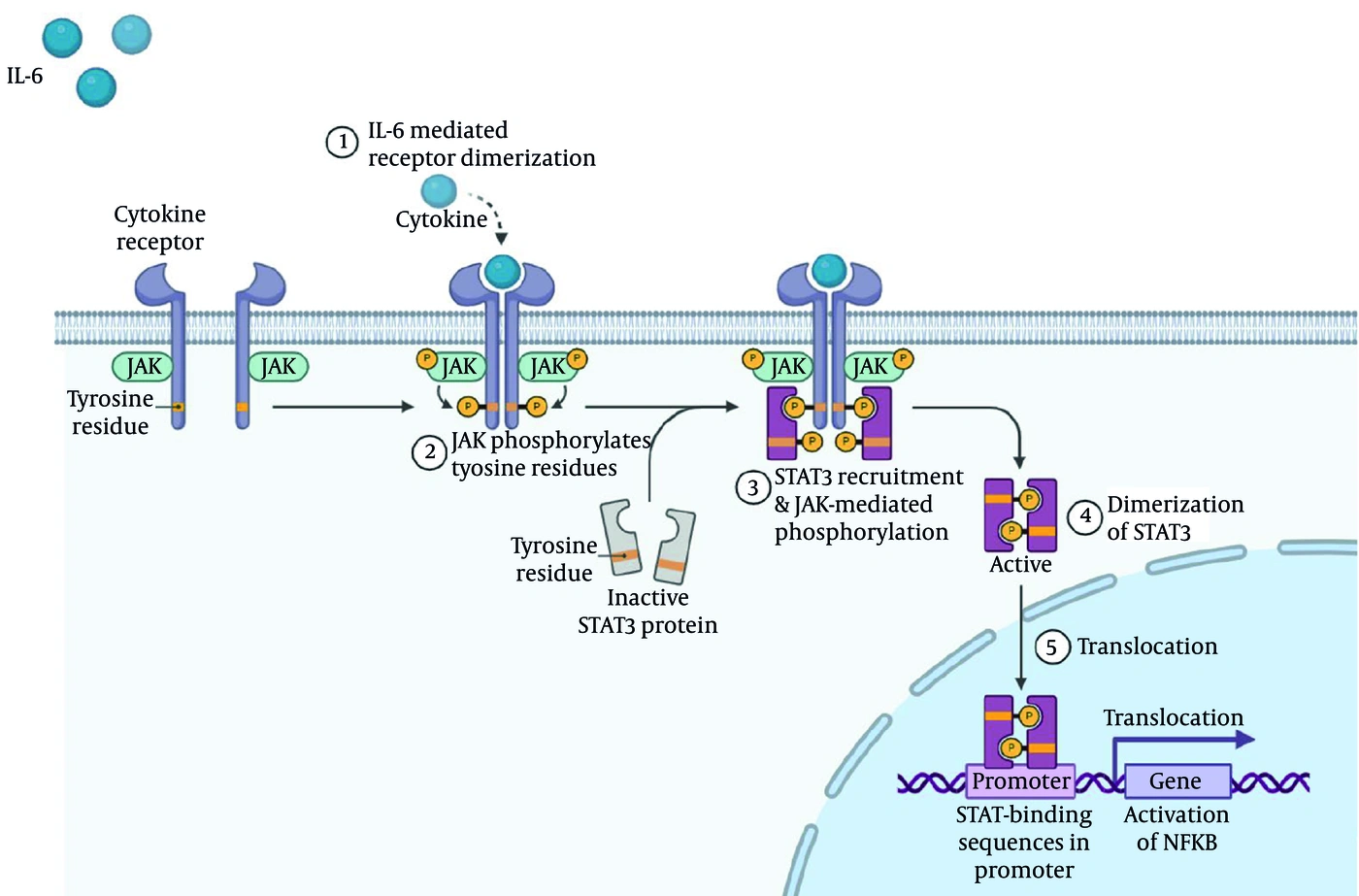
Figure 1.
IL-6 signaling pathway. JAK, Janus kinase; STAT3, signal transducer and activator of transcription 3; NF-κB, nuclear factor kappa B. Created with BioRender.com.
3.3. Statistical Evidence of miRNA Dysregulation in COVID-19
Quantitative studies have provided evidence that SARS-CoV-2 alters the host miRNA network to drive the IL-6 axis.
3.3.1. Proinflammatory Role of miR-155
1) Repression of negative regulators (SOCS1 and SHIP1): The primary mechanism by which miR-155 enhances IL-6 production is the downregulation of negative feedback regulators. miR-155 directly targets the messenger RNA of SOCS1 (suppressor of cytokine signaling 1) and SHIP1 (Src homology 2-containing inositol phosphatase 1). SOCS1 is a critical inhibitor of the JAK/STAT signaling pathway; therefore, its repression by miR-155 leads to hyperactivation of STAT3. Activated STAT3 then translocates to the nucleus and drives transcription of large amounts of IL-6 and other proinflammatory cytokines. In patients with COVID-19, miR-155 is significantly upregulated. This finding is supported by in vitro studies and hACE2-transgenic mouse models, in which inhibition of miR-155 reduced lung inflammation (2, 5).
2) NF-κB positive feedback loop: miR-155 is tightly integrated into the NF-κB pathway, a key signaling node in inflammation. Viral immune activation triggers NF-κB signaling, which induces transcription of miR-155. In turn, miR-155 further amplifies NF-κB signaling by activating IKK (IκB kinase) and the PI3K/Akt pathway. This creates a self-sustaining proinflammatory loop in which NF-κB and miR-155 continuously promote each other, leading to sustained release of IL-6 and IL-1β (1, 2).
3) Direct induction via transcription factors: Beyond the JAK/STAT and NF-κB axes, miR-155 influences the expression of multiple transcription factors that regulate IL-6. Specifically, it has been shown to induce the IL-6 signaling pathway through the transcription factor C/EBPβ (CCAAT/enhancer-binding protein beta), which directly stimulates the IL-6 gene promoter (1, 7).
3.3.2. Loss of miR-451a and IL-6R Overexpression
In COVID-19, the miR-451a/IL-6R axis represents a regulatory network in which loss of a specific microRNA leads to pathological sensitivity of host cells to inflammatory signals. The mechanism underlying this overexpression involves epigenetic silencing and molecular "sponging" by long noncoding RNAs (lncRNAs). Circulating miR-451a levels are significantly downregulated in the plasma of patients with COVID-19, particularly in severe cases. This observation is primarily based on human cohort studies, and the proposed mechanism is supported by in silico target prediction (2, 5, 9).
1) Normal regulatory function: Under healthy conditions, miR-451a acts as a negative regulator of IL-6R translation. It binds to the 3'-UTR of interleukin-6 receptor (IL-6R) mRNA, either promoting its degradation or, more commonly, inhibiting translation into a functional protein. This prevents receptor overexpression and maintains immune homeostasis.
3.3.3. miR-98 - 5p as a Diagnostic Marker
miR-98 - 5p has emerged as a potentially important epigenetic diagnostic and prognostic biomarker for COVID-19 because of its central role in regulating the host inflammatory response and viral entry mechanisms (5, 16). Its diagnostic value is linked to its biological function as a hub regulator of the cytokine storm and viral infectivity. miR-98 - 5p is a candidate regulatory hub that directly binds to the 3'-UTR of IL-6 mRNA and inhibits its translation. Its dysregulation is a proposed driver of overactivation of the IL-6/STAT3 signaling pathway in severe cases. Downregulation of miR-98 - 5p has been observed in blood samples from nonsurvivors after ICU admission in human studies. Bioinformatics analyses have identified it as a hub regulator, although direct functional validation in COVID-19 models remains limited (1, 5).
miR-98 - 5p acts as a defensive marker by targeting TMPRSS2 mRNA. Beyond the direct inhibitory effect of miR-98 - 5p on IL-6 mRNA, this microRNA also targets TMPRSS2 mRNA, the host-cell surface protease required for SARS-CoV-2 spike protein priming, suggesting a dual role in inflammation control and modulation of viral entry (7). Furthermore, the IL-6 axis regulates a broad network of genes involved in inflammation and cell survival, including IL-10, STAT3, NFKB2, and BCL2 (5).
3.3.4. Protective Role of miR-146a
Inhibition of the NF-κB pathway: The primary defensive mechanism of miR-146a is the direct targeting of mRNAs encoding IRAK1 (interleukin-1 receptor-associated kinase 1) and TRAF6 (tumor necrosis factor receptor-associated factor 6). By repressing these transducers, miR-146a inhibits the NF-κB signaling pathway, a key signaling node for the production of proinflammatory cytokines. In patients with COVID-19 who responded well to tocilizumab, miR-146a levels increased significantly. This finding is derived from human clinical data, and the mechanistic basis is supported by in vitro studies showing its role in targeting IRAK1/TRAF6 (6).
Reduction of proinflammatory cytokines: Through suppression of NF-κB, miR-146a leads to a significant decrease in expression of IL-6, IL-1β, TNF-α, and IL-8. Under healthy conditions, this activity maintains immune homeostasis and helps prevent a cytokine storm (5, 8).
In the postacute phase, miR-146a levels may become upregulated in some patients. This has been theorized to represent a compensatory anti-inflammatory feedback mechanism that attempts to resolve persistent inflammation within the NF-κB axis (6, 14). miR-146a is consistently identified as a negative regulator of innate immune signaling and functions as a critical "molecular brake" against an excessive inflammatory response.
3.3.5. Reduced miR-20a and miR-106a
Reduction of miR-20a and miR-106a in patients with COVID-19 is a significant epigenetic feature that contributes to the development of the cytokine storm, particularly the elevation of IL-6. miR-106a is recognized as a candidate regulatory hub of the immune response with the ability to suppress proinflammatory genes.
Downregulation and IL-6 surge: A highly significant decrease in serum miR-106a levels has been reported in patients with COVID-19 compared with healthy controls. This microRNA typically provides negative feedback regulation of inflammation. When its levels are reduced, translational inhibition of its targets is relieved, leading to increased levels of inflammatory cytokines such as IL-6, TNF-α, and IL-1β. miR-106a-5p is also known to orchestrate expression of IL-6 and other cytokines through transcription factors such as ERK, STAT1, and STAT3. Receiver operating characteristic (ROC) curve analyses in human COVID-19 cohorts demonstrated that downregulation of miR-106a and miR-20a can discriminate patients from healthy controls, with area under the curve (AUC) values of 0.92 and 0.86, respectively. The mechanistic roles are primarily derived from computational and in vitro analyses (6, 15).
miR-20a is a member of the miR-17 - 92 cluster and plays a protective role by targeting proinflammatory signaling. The significant reduction in miR-20a is strongly associated with clinical indicators of severe disease. Levels are significantly lower in patients with lymphopenia, a hallmark of severe COVID-19 and high mortality; a high chest CT severity score (CSS > 19), indicating extensive lung involvement; and hypoxia (O2 saturation < 90%) (6, 9).
Proinflammatory gene targeting: miR-20a targets several proinflammatory genes, including TNF, CCL2, CXCL9, and IL-10, as well as cytokine receptors such as IL1R1. Its downregulation in severe cases contributes to inadequate control of these inflammatory mediators, thereby fueling the cytokine storm.
In summary, miR-155 indirectly enhances IL-6 production by directly targeting the negative regulators SOCS1 and SHIP1, thereby leading to hyperactivation of STAT3 and subsequent IL-6 transcription. miR-451a directly binds to the 3'-UTR of IL-6R mRNA and regulates IL-6 receptor expression. miR-146a indirectly suppresses IL-6 production by directly targeting IRAK1 and TRAF6, key upstream adaptors in the NF-κB pathway. miR-98 - 5p directly binds to the 3'-UTR of IL-6 mRNA, leading to direct inhibition of IL-6 translation. Table 1 summarizes these effects on IL-6 regulation in patients with COVID-19.
Table 1.
Summary of Key microRNAs Involved in IL-6 Regulation in COVID-19 a
| miRNA | Expression Change in COVID-19 | Direct Target(s) | Biological Effect / Mechanism | Experimental Model / Evidence Source | Level of Evidence | Clinical Relevance / Diagnostic/Therapeutic Application |
|---|---|---|---|---|---|---|
| miR-155 | Upregulated (proinflammatory driver) | SOCS1, SHIP1 | Represses negative regulators of JAK/STAT → hyperactivates STAT3 → drives IL-6 transcription; activates IKK and PI3K/Akt → amplifies NF-κB; induces C/EBPβ | in vitro / hACE2-transgenic mice | Strong (functional validation in animal models) | Therapeutic target: AntagomiR-155 reduced IL-6 by ~31% and dampened lung inflammation |
| miR-451 | Downregulated (one of the 5 most decreased in plasma) | IL-6R (3'-UTR) | Normally inhibits IL-6R translation; loss of miR-451a leads to IL-6R overexpression and pathological sensitivity to IL-6 | Circulating plasma of patients with COVID-19 | Moderate (observational, correlational) | Diagnostic biomarker for disease progression; therapeutic strategy: miRNA mimics to restore miR-451 |
| miR-98 - 5p | Downregulated (especially in nonsurvivors after ICU admission) | IL-6 mRNA, TMPRSS2, IL-10, STAT3, NFKB2, BCL2 | Candidate regulatory hub that directly inhibits IL-6 translation; also targets TMPRSS2 (viral-entry protease) and multiple inflammatory genes | Blood samples of ICU patients/nonsurvivors | Strong (prognostic data from ICU cohorts) | Prognostic indicator for fatal outcomes; candidate for interactomics-based diagnostic panels |
| miR-146a | Variable (may be upregulated in the postacute phase as a compensatory mechanism) | IRAK1, TRAF6 | Inhibits the NF-κB pathway by targeting IRAK1/TRAF6 → reduces IL-6, IL-1β, TNF-α, and IL-8; acts as a molecular brake on innate immunity | Patients with COVID-19 treated with tocilizumab | Moderate-to-strong (clinical response data) | Predictor of response to tocilizumab; therapeutic target: miRNA mimics to restore anti-inflammatory function |
| miR-106a (miR-106a-5p) | Downregulated (significantly decreased in serum) | ERK, STAT1, STAT3 | Normally provides negative feedback on inflammation; loss leads to increased IL-6, TNF-α, and IL-1β | Serum of patients with COVID-19 vs healthy controls | Strong (ROC AUC = 0.92 for discrimination) | Diagnostic biomarker (AUC = 0.92); potential therapeutic target (mimics) |
| miR-20 | Downregulated | TNF, CCL2, CXCL9, IL-10, IL1R1 | Targets proinflammatory genes and cytokine receptors; loss contributes to cytokine storm | Patients with COVID-19 with lymphopenia and high CT severity score | Strong (ROC AUC = 0.86 for discrimination; AUC = 0.73 for high CT severity) | Diagnostic biomarker (AUC = 0.86); predictor of clinical deterioration |
a Abbreviations: AUC, area under the curve; ROC, receiver operating characteristic.
3.4. Temporal Dynamics of miRNA Expression in COVID-19
COVID-19 is not a biologically uniform disease, and miRNA expression patterns may differ across clinical stages. In early infection, viral replication triggers an initial wave of miRNA dysregulation, including upregulation of miR-155 and downregulation of miR-451a. During severe acute disease (ICU admission), further changes occur, such as the pronounced suppression of miR-98 - 5p observed in nonsurvivors. In the recovery phase, some miRNAs may return toward baseline, whereas others, such as miR-146a, may become upregulated as a compensatory anti-inflammatory mechanism. In postacute sequelae (long COVID), persistent miRNA dysregulation has been implicated in ongoing inflammation and tissue remodeling. These temporal differences underscore the importance of considering sampling time and clinical context when interpreting miRNA data. The influence of vaccination status, prior immunity, viral variants, treatment era, age, sex, and comorbidities should also be acknowledged when comparing findings across studies (2, 5, 6, 7, 9, 14).
3.5. Interactomics and Systems Biology
To explore the regulatory networks underlying the cytokine storm, bioinformatic analyses were performed using the STRING database and Cytoscape software. A set of 16 cytokine-regulating immune-expressed genes (CRIEGs) was selected based on their known involvement in inflammatory pathways and their differential expression in COVID-19. Protein-protein interaction (PPI) network analysis revealed an average clustering coefficient of 0.977, indicating a densely interconnected network structure. This high clustering coefficient reflects intense molecular interactions during the cytokine storm but should not automatically be interpreted as evidence of biological dominance or therapeutic actionability. Within this network, 10 miRNAs, including miR-106a-5p, miR-155 - 5p, and miR-98 - 5p, were identified as highly connected nodes (hub miRNAs) based on their ability to target multiple genes in the JAK/STAT and NF-κB pathways. This computational identification suggests that these miRNAs may serve as important regulatory nodes; however, functional validation and mechanistic studies are required to confirm their biological significance and therapeutic potential (9, 17).
3.6. Diagnostic and Therapeutic Applications
Although circulating miRNAs show promising associations with disease severity and mortality in COVID-19, several preanalytical and biological factors must be considered before these findings can be translated into clinical practice. These include specimen type (plasma vs serum), hemolysis, platelet contamination, RNA extraction methods, normalization strategies (eg, endogenous controls such as U6 or miR-16), assay platforms (qPCR vs sequencing), sampling time relative to disease onset, concurrent treatments (eg, corticosteroids or tocilizumab), age, sex, comorbidities, vaccination status, and viral variant (4, 6, 8). Each factor may substantially influence circulating miRNA measurements and could explain some of the heterogeneity observed between studies. The high stability of miRNAs in biofluids makes them promising noninvasive biomarkers. Technologies such as Oxford Nanopore Sequencing (ONS) allow real-time profiling of miRNA isoforms (isomiRs), which can predict clinical deterioration with more than 95% accuracy (5, 14, 18).
Given the role of IL-6 as an amplifier of inflammation, miR-155 is a target for clinical intervention. Experimental inhibition of miR-155 using specific oligonucleotide inhibitors (antagomiRs) has been shown to reduce IL-6 expression by approximately 31% and significantly dampen lung inflammation. Furthermore, the success of glucocorticoids such as dexamethasone in treating COVID-19 is partly attributed to their ability to inhibit NF-κB, which indirectly suppresses miR-155 production and consequently reduces the IL-6-driven inflammatory burden (1, 2, 5, 7).
Because miR-451a is predominantly expressed in blood cells and released in extracellular vesicles, its significant decrease serves as a biomarker of disease progression. Researchers have suggested that reversing this loss, either by inhibiting upregulated lncRNA sponges or by using miRNA mimics to restore miR-451a levels, could be a viable therapeutic strategy to "calm" the cytokine storm by reducing the cellular density of IL-6 receptors (3, 5, 8).
Significant suppression of miR-98 - 5p has been observed specifically in blood samples from nonsurvivors after ICU admission, suggesting its utility as a prognostic indicator of fatal outcomes. Furthermore, its ability to simultaneously target multiple nodes in the JAK/STAT and NF-κB pathways makes it a candidate for interactomics-based diagnostic panels aimed at predicting the onset of systemic hyperinflammation (2, 3, 7).
miR-146a levels may serve as a determinant of clinical response. Patients with COVID-19 who respond well to tocilizumab, an anti-IL-6 receptor antibody, exhibit a significant increase in miR-146a levels after treatment, whereas nonresponders show a continued decrease (6).
In a cohort of 112 patients with COVID-19 and 98 healthy controls, downregulation of miR-106a discriminated patients from controls with an AUC of 0.92 (sensitivity, 88%; specificity, 84%; 95% CI, 0.87 - 0.96), whereas miR-20a yielded an AUC of 0.86 (95% CI, 0.80 - 0.92) for the same comparison. For prediction of a high chest CT severity score (> 19), miR-20a showed an AUC of 0.73. These findings were derived from discovery cohorts and require independent external validation before clinical implementation. Additionally, Oxford Nanopore Sequencing demonstrated > 95% accuracy in predicting clinical deterioration in a pilot study, but these results remain preliminary and require confirmation in larger, multicenter cohorts (5, 9, 15, 17).
Based on the sources, the 2 major emerging therapeutic strategies for managing molecular disturbances caused by COVID-19 and its long-term sequelae are miRNA mimics and antagomiRs. These approaches aim to manipulate the host epigenetic network to either restore natural "brakes" on inflammation or silence disease "amplifiers" (3, 5, 7).
3.6.1. miRNA Mimics (Functional Restoration)
This strategy involves synthetic, double-stranded RNA molecules designed to imitate the function of endogenous miRNAs that are depleted or downregulated during infection (3). Mimics bind to the same target mRNAs as the natural miRNA, causing gene silencing through either translational inhibition or mRNA degradation (3).
Key targets for COVID-19 include the following:
miR-146a: Mimics can restore this "molecular brake" to suppress the NF-κB pathway and dampen the cytokine storm. Sources indicate that although miR-146a may be naturally upregulated as a failed compensatory mechanism, providing additional mimics can help control persistent inflammation (6).
3.6.2. AntagomiRs (miRNA Inhibition)
AntagomiRs, or antimiRs, are chemically modified synthetic antisense oligonucleotides used to sequester and inhibit specific miRNAs that are abnormally induced or upregulated during disease. They function as silencing agents by binding with high affinity to the target miRNA and preventing it from interacting with its intended mRNAs. This allows expression of beneficial proteins that were previously suppressed by the virus-induced miRNA surge (1, 5, 9).
Anti-miR-155: Because miR-155 contributes to the IL-6 surge, its inhibition has been shown in hACE2-transgenic mice to reduce lung damage and significantly improve survival rates (9, 13, 14).
Anti-miR-21: This strategy is being explored to block fibrotic signaling in the lungs because miR-21 promotes fibroblast activation and tissue remodeling (14).
Clinical example: Miravirsen was the first miRNA-based drug successfully used in humans for hepatitis C. It works by sequestering miR-122 away from the viral genome to suppress replication, providing proof of concept for similar strategies in COVID-19 (5, 13). Table 2 presents preclinical concepts and clinically validated therapies for the miRNA/IL-6 axis in COVID-19.
Table 2.
Preclinical Concepts vs Clinically Validated Therapies for the miRNA/IL-6 Axis in COVID-19
| Categories and Strategies / Agents | Mechanism of Action | Evidence Level / Status | Key Limitations (Delivery, Specificity, Toxicity, Pharmacokinetics, Off-target) |
|---|---|---|---|
| Clinically validated (indirect miRNA modulators) | |||
| Tocilizumab (anti-IL-6R mAb) | Blocks the IL-6 receptor; response correlates with upregulation of miR-146a in responders | Approved for COVID-19 (clinical use) | Not a direct miRNA therapy; response is biomarker-dependent (miR-146a levels); risk of secondary infections and hepatotoxicity |
| Dexamethasone (corticosteroid) | Inhibits NF-κB → indirectly suppresses miR-155 production → reduces the IL-6 surge | Approved for severe COVID-19 | Broad immunosuppression; not miRNA-specific; adverse effects include hyperglycemia, osteoporosis, and psychosis |
| Preclinical (direct miRNA-based therapies) | |||
| Anti-miR-155 (antagomiR) | Inhibits miR-155 → restores SOCS1 and SHIP1 → reduces JAK/STAT3 hyperactivation and IL-6 | Preclinical (hACE2-transgenic mice) | Delivery: poor bioavailability in lung tissue; specificity: miR-155 has > 100 targets (eg, tumor suppressors); off-target: may impair normal immune surveillance; toxicity: liver accumulation of carriers; PK: rapid nuclease degradation and short half-life |
| miR-146a mimic | Restores the "molecular brake" → targets IRAK1/TRAF6 → inhibits NF-κB and proinflammatory cytokines | Preclinical (in vitro/animal models) | Delivery: need for efficient lung-targeted carriers; specificity: may also regulate other innate immune genes; off-target: potential suppression of beneficial inflammatory responses; toxicity: immunostimulation via TLR activation; PK: unstable in serum and renal clearance |
| miR-451a mimic | Restores miR-451a → binds to the IL-6R 3'-UTR → reduces IL-6 receptor density on cells | Preclinical (proposed based on observational data) | Delivery: requires EV-based or nanoparticle systems; specificity: miR-451a also targets other mRNAs (eg, AKT, MYC); off-target: could affect hematopoietic cell function; toxicity: unknown long-term effects; PK: poor tissue penetration |
| miR-98 - 5p mimic | Directly targets the IL-6 mRNA 3'-UTR and TMPRSS2 → reduces IL-6 translation and viral entry | Preclinical (bioinformatics + observational) | Delivery: challenges in reaching alveolar epithelium; specificity: regulates multiple genes in JAK/STAT and NF-κB networks; off-target: may alter apoptosis-related genes (eg, BCL2); toxicity: potential hepatotoxicity; PK: rapid clearance by liver and spleen |
| Anti-miR-21 | Inhibits miR-21 → reduces fibroblast activation and pulmonary fibrosis | Preclinical (exploratory) | Delivery: lung fibrosis target is difficult to reach; specificity: miR-21 is involved in many pathways (cardiac, renal); off-target: may affect wound healing; toxicity: unknown immune responses; PK: limited data on tissue retention |
| Proof of concept (from other diseases) | |||
| Miravirsen (anti-miR-122) | Sequesters miR-122 → used for hepatitis C (not COVID-19) | Approved for HCV (not for COVID-19) | Not tested for COVID-19; miR-122 is liver-specific, whereas COVID-19 targets the lung/immune system; different tissue distribution and safety profile |
Despite promising preclinical evidence, translating miRNA-based therapies into clinical practice faces substantial hurdles. Key challenges include 1) tissue specificity, because miRNA mimics or antagomiRs must be delivered specifically to pulmonary or immune-cell compartments without affecting off-target tissues; 2) pharmacokinetics and degradation, because unmodified miRNAs are rapidly degraded by serum nucleases and cleared by the liver and kidneys; 3) off-target effects, because each miRNA can regulate hundreds of mRNAs, raising concerns about unintended modulation of critical pathways, including potential tumor suppressor genes; 4) innate immune activation, because synthetic RNA molecules can trigger Toll-like receptor (TLR)-mediated immune responses; and 5) toxicity, because liver accumulation of delivery vehicles and potential hepatotoxicity have been reported in preclinical studies. Furthermore, excessive suppression of inflammatory pathways could interfere with effective antiviral host defense, a critical consideration in COVID-19, in which early viral clearance is essential. Therefore, the therapeutic window for miRNA modulation must carefully balance anti-inflammatory effects with preservation of antiviral immunity.
Beyond their direct therapeutic potential, miRNA profiles may ultimately guide the use of established immunomodulatory therapies in COVID-19. For example, miR-146a levels have been associated with response to tocilizumab, suggesting that baseline or early-treatment miRNA measurements might help identify patients most likely to benefit from IL-6 receptor blockade. Similarly, because dexamethasone acts partly through NF-κB inhibition, miRNA signatures reflecting NF-κB activity could potentially inform corticosteroid responsiveness. However, these possibilities remain exploratory and should be clearly framed as future research questions until direct clinical evidence is available.
4. Conclusions
miRNA-mediated regulation of the IL-6 axis represents an important aspect of COVID-19 pathophysiology and is supported by substantial observational evidence. miR-155, miR-451a, miR-98 - 5p, miR-146a, miR-106a, and miR-20a have emerged as candidate regulatory hubs associated with disease severity and clinical outcomes. However, the current evidence should be interpreted with caution. Direct targeting of IL-6 mRNA by miR-98 - 5p, IL-6R by miR-451a, and SOCS1/SHIP1 by miR-155 is mechanistically well supported. Robust statistical correlations have been reported between circulating miRNA levels and disease severity, with ROC AUC values reaching 0.92 for miR-106a. Although in vitro and animal studies support the functional roles of these miRNAs, direct evidence in human SARS-CoV-2 infection is often lacking. miRNA mimics and antagomiRs show promise in preclinical models, but major translational barriers remain. Key limitations that must be addressed before clinical implementation include heterogeneous study cohorts, a lack of standardized miRNA assay protocols, tissue-specific delivery challenges, confounding factors (age, sex, comorbidities, vaccination, and treatment), limited longitudinal validation, and the absence of human interventional trials demonstrating safety and efficacy. Furthermore, the balance between dampening pathological inflammation and preserving antiviral immunity remains a critical concern (5, 15, 19). Overall, the available evidence positions these miRNAs not as established master regulators or ready-to-use biomarkers but as promising candidate regulators whose biological and clinical significance requires further mechanistic, longitudinal, and externally validated investigation. This evidence-graded approach may enhance the credibility and scientific rigor of the review.
4.1. Limitations
This review has several limitations. First, as a narrative review, it may be subject to selection bias and lacks the structured methodology of a systematic review with predefined criteria or formal quality scoring. Second, most of the evidence discussed is derived from observational or preclinical studies; therefore, firm conclusions regarding causality cannot be drawn. Third, differences in sample types, laboratory methods, and data normalization across studies hinder direct comparisons of miRNA expression levels. Fourth, the miRNA-based therapies discussed remain in early experimental stages, and their safety and effectiveness in humans have not been established. Finally, the available data mainly reflect acute COVID-19, with limited information on long-term complications.