
1. Background
Mortality in children under 5 years is one of the main representative factors of development and public health worldwide, affected by socioeconomic variables. Based on Millennium Development Goal 4 (SDG, target 4), mortality among children aged under 5 years must be reduced two-thirds over 1990-2015 (1, 2). Therefore, the number of deaths among children aged under 5 years decreased from 12.5 million in 1990 to 5.6 million in 2016. In addition, a significant reduction in mortality rate (about 60%) was observed in these children from 1990 to 2019 (3). Assuming that all countries accomplish this aim, it is estimated that 5.6 million deaths will occur in children before their fifth birthday by 2030 (4). Many studies showed that the mortality rate in children younger than 5 years old has diminished in recent years in Iran (5, 6). In this regard, it was observed that the rate of death in 1000 live births in Iran decreased from 91 in 1990 to 43 in 2015 (7).
An investigation of the global burden of disease demonstrated that the most important causes of death in children under 1 year old included lower respiratory infections (20.1%), diarrheal diseases (17.4%), malaria (11.8%), other non-communicable diseases (8.1%), and nutritional deficiencies (6.7%). The common causes of death among children under 5 years entailed malaria (20.8%), lower respiratory infections (12.4%), diarrhea (11.9%), chronic non-communicable diseases (9.9%), and nutritional disorders (7.2%) (8-10). Moreover, regional factors, such as air and water pollution and environmental factors, are important in this regard (11, 12).
Despite many advances in medical devices and methods, nothing can validate and find the cause of death more accurately than an autopsy. Approximately 30% of the causes of death may be determined wrong without an autopsy (13). Autopsy of noncriminal deaths is optional in Iran, and it is mainly performed by forensic specialists, and the postmortem examination rate for fetuses and infants is very low. Therefore, very little information is available on the cause of death among children under 5, determined by autopsy findings from previous studies conducted in Tehran, Iran. The data about children with unknown causes of death, the possibility of malpractice, and criminal death, such as infanticide, are limited. Furthermore, distinguishing intentional and unintentional death based on postmortem data analysis is necessary to identify available factors for designing interventions and preventing deaths caused by similar reasons.
2. Objectives
With this background in mind, the main objective of the present study was to evaluate the causes and manner of death in children under 5 years using autopsy findings.
3. Methods
This retrospective cross-sectional study was conducted in the autopsy hall of Legal Medicine Center of Tehran, Iran, during January 2009-December 2019. The data of all deaths in children under 5 years old who were referred to autopsy hall were identified from their forensic postmortem examinations and medical records. Detailed information on the cause of deaths was collected in a checklist consisting of demographic characteristics (ie, gender, age, height, weight, as well as abdominal, head, and chest circumferences), autopsy, toxicological, and pathological findings, hospital records, and judicial documents. All the data were analyzed using the Statistical Package for the Social Sciences (SPSS) version 25 (IBM Corp., Armonk, NY, USA). The causes of death can be broadly divided into natural and unnatural groups. According to ICD-10, information on the cause of mortality was collected and analyzed.
3.1. Statistical Analysis
Qualitative variables were presented as percentage and frequency, and quantitative variables were described as mean ± standard deviation (SD) with 95% confidence interval (CI). The chi-squared and Fisher’s Exact tests were used to determine the relationship between qualitative variables. In addition, the t-test and Mann-Whitney’s U-test were used to compare quantitative variables based on the distribution of data. Data were analyzed utilizing the SPSS software version 20. The level of statistical significance was set at P < 0.05. Moreover, the cause and manner of death were investigated using autopsy findings in descriptive analysis.
4. Results
This retrospective analysis of postmortem findings revealed 1750 deaths in children under 5 years referred to the autopsy hall of Legal Medicine Organization of Tehran, Iran. Among these deaths, 898 (51.3%) cases were male, 997 (56.9%) were hospitalized before death, and 380 (21.7%) died when arriving at medical centers. The demographic characteristics of children are shown in Table 1.
Table 1.
Demographic Characteristics of Children Under 5 Years Who Referred to Autopsy Hall (2009 - 2019)
| Characteristics | Mean ± SD | Median | Range |
|---|---|---|---|
| Age (d) | 285.5 ± 25.6 | 60 | 0 - 1825 |
| Height (cm) | 60.8 ± 1.2 | 54 | 0 - 155 |
| Weight (gram) | 6049.5 ± 322.2 | 3642 | 0 - 28000 |
| Head circumstance (cm) | 67 ± 35.27 | 34 | 0 - 50 |
| Chest circumstance (cm) | 32.83 ± 0.498 | 32 | 0 - 64 |
| Abdominal circumstance (cm) | 50.37 ± 18.68 | 31 | 0 - 3525 |
Our results showed that most of the mortality in these children occurred about two months after birth (median=60 days). Moreover, nearly 50% of deaths occurred in children of weight under 3.64 kg and height under 50 cm. Our postmortem examination demonstrated fixed lividity in 1435 (82%) of cadavers and decomposition in 40 (2.3%) cases. A toxicological evaluation was performed in 222 (12.7%) medico-legal autopsied cases suspicious of poisoning. CO was found in 29 (1.7 %) cases, and in 12 (0.7%) of them, opioids and other drugs were found. Pathologic examinations were performed on 932 (53.3%) of the cases. The samples included the brain, cerebellum, heart, lung, liver, kidney, pharynx, larynx, and intestine. Pathologic results were positive in 475 (51%) of the specimens. Pathologic findings are presented in Table 2.
Table 2.
Pathologic Findings of Specimens in Children Under 5 Years Who Were Referred to the Autopsy Hall (2009 - 2019)
| Specimens | Positive, No. (%) | Cause of Positive Results | No. (%) |
|---|---|---|---|
| Brain and cerebellum | 128 (7.3) | Infection | 35 (2) |
| Others | 93 (5.3) | ||
| Heart | 192 (11) | Myocarditis | 4 (0.23) |
| Congenital anomalies | 194 (11.1) | ||
| Lung | 537 (30.7) | Infection | 292 (16.7) |
| Hyaline membrane disease | 110 (6.3) | ||
| Others | 135 (7.7) | ||
| Liver | 53 (3) | Metabolic storage disorders | 40 (2.3) |
| Congenital anomalies | 12 (0.7) | ||
| Kidney | 17 (1) | Infection | 5 (0.3) |
| Congenital anomalies | 12 (0.7) | ||
| Pharynx and larynx | 17 (1) | Tracheal anomalies | 5 (0.3) |
| Hemorrhage | 12 (0.7) | ||
| Intestine | 5 (0.3) | Inflammatory cell infiltration | 5 (0.3) |
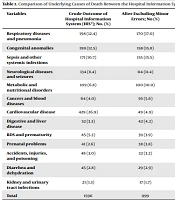
The results of the present study indicated that the leading cause of death in this age group of children was congenital cardiovascular anomalies, followed by pneumonia and preterm labor. On the other hand, myocarditis and asthmatic attacks were the least observed causes of death. Further findings and details are shown in Figure 1.
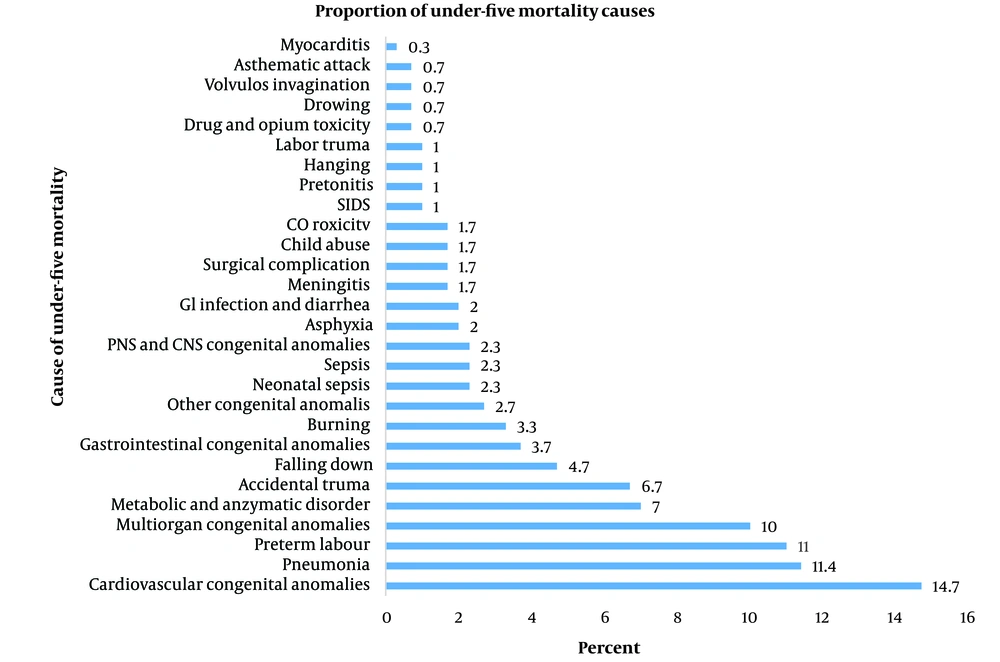
Figure 1.
Proportion of under-five mortality causes referred to the autopsy hall of Legal Medicine Center of Tehran, Iran (2009 - 2019). Abbreviations: GI, gastrointestinal; PNS, peripheral nervous system; CNS, central nervous system.
The manner of death was assessed based on autopsy results, circumstantial evidence, and police data. Natural deaths (1360 cases) were found as the most prevalent manner of death. Figure 2 illustrates the proportion of different manners of death in our study. Homicide includes child abuse and hanging, and accidental manners entail accidental trauma, falling, burning, toxications, and drowning.
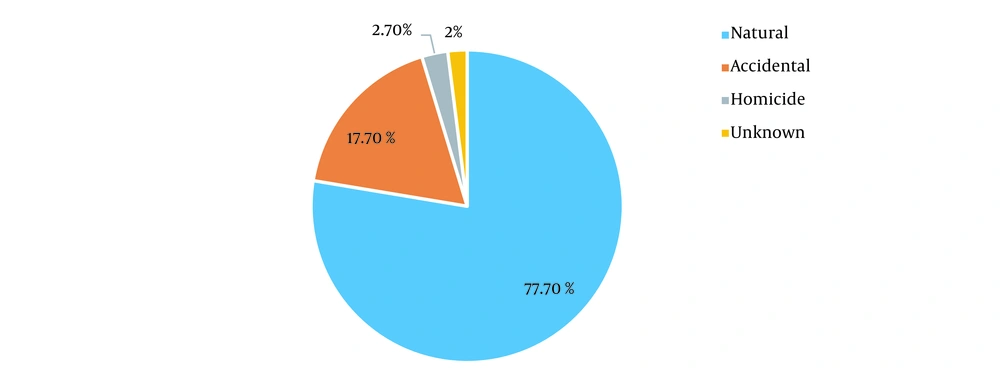
Figure 2.
The manner of death in children aged under 5 years who referred to the autopsy hall of Legal Medicine Center of Tehran, Iran (2009 - 2019)
5. Discussion
Autopsy and histopathologic examinations play major roles in the postmortem investigation of children under 5 years old, and these assessments provide valuable information for clinicians by determining the cause, manner, and pathology of death (14). The need for epidemiologic information to plan, prioritize, and implement public health interventions, and reduce the mortality rate in children under 5 years old is obvious. Therefore, the present study aimed to determine the cause of death based on the autopsy findings in children under 5 years old referred to the Legal Medicine Center of Tehran, Iran. The institute conducts autopsies in the cases of unknown causes of death, suspicion for malpractice, and criminals.
According to our findings, most of the deaths occurred in children with the median age of 2 months, and pathologic results mainly were consistent with the infections of different organs. Moreover, congenital anomalies were the leading cause of death in children referred to the Legal Medicine Organization of Tehran, followed by pneumonia and preterm labor as the following frequent causes. In addition, natural deaths were the most common manner of death. In other studies, most mortality was observed in children with the age range of 1 month to 1 year (9, 15, 16). The latter finding is consistent with our results, suggesting that in the specific population of our study, the trend in the age of death is similar to the general population.
Congenital anomalies were found to be the leading cause of death in our study. The mentioned finding contradicts the results of some other studies in which the primary cause for under-5 mortalities was infectious diseases, such as pneumonia and diarrhea (17, 18). This issue can be because most death cases from infections are not autopsied. In addition, the cumulative percentage for the infectious diseases of different organs is considered (ie, pneumonia, sepsis, neonatal sepsis, and diarrhea). A study in China assessed the common causes of death and showed that preterm complications, birth asphyxia, and congenital anomalies are the most observed cause of death in children aged under 5 years (9). The minor difference with our results might result from the difference in our population, which was described earlier.
The present study indicated that congenital cardiovascular anomalies were the leading cause of death among the cases of an autopsy, showing that these defects are neglected and need more attention. This result is in line with the study by Rajiah et al., which emphasized the importance of these defects and the high mortality rate among these children (19). Earlier diagnosis and genetic consultation are among the measures of prevention. In order to elaborate on the next cause of death, pneumonia may be a case of interest, as it was the second cause in children referred to autopsy hall, keeping in mind that pneumonia usually is not convincing enough to perform an autopsy. Pneumonia is among the top causes of death in many areas (20-22), and our results highlight the importance of early diagnosis and the careful management of this potentially lethal disease in children under 5 years. Preterm labor is another significant cause of death found out by autopsy. This problem accounted for 16.6% of deaths worldwide and was the third most frequent cause in our study (23).
Poisoning occurred in 2.4% of the children in our study, which is lower than figures for other countries (24), possibly due to proper education and enhanced awareness of parents in Iran. In the current investigation, the most common manner of death in children younger than five years was natural causes, followed by accidental causes, homicide, and undetermined causes. The rate of accidental death, as the second most common manner of death in children younger than 5 years old, was lower than the reports of San Diego, the U.S., and South Africa, which is due to the lower rate of burning and assault compared to Iran (25, 26).
Finally, the present research revealed that autopsy in children under 5 years has several benefits, such as determining the cause of death, manner of death, and pathology of the underlying condition. This study was on autopsied cases, and there is not enough evidence for the specific types of deaths mentioned. Therefore, the results and implications of our work can lead to the prevention of communicable diseases, applying protective interventions, instructing children and parents to avoid injuries, and increasing health awareness as essential factors influential on the development of public health status. Subsequently, the mortality rate declines in children aged under 5 years.
5.1. Strengths and Limitations
This research was the first analysis of postmortem examination in a reference center in Tehran, Iran, with full coverage of various kinds of deaths as the strengths of this study. However, it had several limitations as follow: (1) This was a retrospective study and lacked complete data in the Legal Medicine Organization, such as disease history and the characteristics of parents that could affect the data quality, (2) This study focused on the cadaver of children aged under 5 years who were referred to our region for autopsy, and our findings should not be generalized to other populations in different geographical areas and with other ethnicities, (3) Emigrations and the relocation of people caused a bias in the estimation of mortality rate during this study, which consequently affected the quality of data, and (4) The autopsy rates varied in terms of death and age that might have variable results among cases and death categories. Therefore, we recommend further investigations with complete demographic, clinical, subclinical, and postmortem data to determine the causes of death in children aged under 5 years old.
5.2. Conclusions
Postmortem examination to determine the cause of death could help clinicians and policymakers propose a suitable intervention to reduce the mortality rate in children under five years. Therefore, the findings of this research emphasize the importance of autopsy as a component of pediatric practice.