


1. Background
Health indicators represent the level of health in different societies, and the child mortality rate is one of the important indicators that is influenced by various factors such as the health, economic, political, and cultural status of societies (1-3). Due to the importance of the mortality rate of children under 5 years of age, in 2000, the member states of the United Nations agreed to reduce this rate to two-thirds between 1990 and 2015 as part of the Millennium Development Goals (1, 4-6). Globally, the number of deaths under the age of 5 decreased from 7.12 million in 1990 to 5.9 million in 2015. In Iran, the rate of this indicator decreased significantly from 91 per thousand live births in 1990 to 43 deaths in 2015 (1).
Although child mortality is declining worldwide, it is estimated that more than six million children die before the age of 5. This is despite the fact that most causes of death are preventable and occur mainly in poor countries. There is a considerable disparity between countries in child mortality rates, with six countries responsible for 50% of the world's under-5 deaths (2). After the end of the Millennium Development Era, the international community created a new framework called the Sustainable Development Goals. In this new commitment, member states must reduce the mortality of children under 5 years to 25 per thousand live births by 2030 (7, 8). The first step to reducing child mortality is to identify its risk factors. By identifying risk factors and preventing their occurrence, fewer children will be lost, and fewer parents will suffer grief and emotional and social damage (4).
The most common causes of death vary in different regions. In a study conducted in 2007 in Iran, the most common causes of death among children aged 1 to 59 months were congenital and chromosomal abnormalities, accidents and unintentional injuries, respiratory diseases, infectious and parasitic diseases, and neurological diseases. In this study, according to the report of the World Health Organization (WHO), the causes of death in children under 5 years old in the EMRO region were diarrhea, pneumonia, and other causes, respectively. In Africa, it was pneumonia, diarrhea, and malaria, and in the Western Pacific Region, it was pneumonia, non-communicable diseases, accidents, and unintentional injuries (9). In a study conducted in Mazandaran, the most common causes of death in children under 5 years old were respiratory diseases, cardiovascular diseases, and congenital anomalies (10). The most common causes of death in children aged 1 to 59 months in Kermanshah were accidents, respiratory system diseases, and cardiovascular system diseases (3), while in Zabul, accidents, respiratory and digestive system diseases were the most common causes of death (11).
According to Khazaei et al., in Iran, among 21,011 children under the age of 5 who died in 2015, the cause of 52.3 percent was infectious diseases. There was a significant decline in death rates from all causes except HIV/AIDS and pertussis. The range of these significant reductions in lower respiratory infections, diarrhea, injuries, and meningitis or encephalitis between 2000 and 2015 ranged from 53 to 77 percent. During this period, the greatest decrease in mortality was observed for diarrheal diseases. It decreased from 2.85 per thousand live births in 2000 to 0.65 per thousand live births in 2015, which showed a decrease of 77.2 percent with a decrease rate of 12.8 percent (2).
The results of previous studies show that the western and southeastern regions of Iran, including Sistan and Baluchistan, South Khorasan, Hamedan, West Azerbaijan, and Kurdistan, have the highest number of deaths of children under 5 years of age and the lowest life expectancy (1). The death rate of children in Sistan and Baluchistan province decreased from 336 per thousand live births in 1962 to 23 in 2015, which shows a 93 percent decrease and a significant improvement in the survival of children in this province. The average annual rate reduction during 52 years was almost equal to 5 percent. This may indicate a reduction in communicable diseases through health interventions such as vaccination, improved nutrition, increased public knowledge, and access to medical services. It can be stated that Sistan and Baluchistan Province has reached the Millennium Development Goals (MDGs) and even sustainable development. Considering that the rate of reduction in the early years was more than in recent years (2), monitoring the mortality trend and investigating the most common causes of death is very important to inform the prioritization of diseases. It can help policymakers to better plan for health at the national and local levels (6).
Many death statistics from different centers and countries are not comparable with each other. For the comparability of mortality information at the international level, the same definitions and formats should be used. In this regard, the WHO has proposed a standard death certificate for global use in the second volume of the tenth edition of the ICD-10. Determining the correct underlying cause of death has an important impact on clinical trials and studies related to examining the outcomes of the care system (12).
2. Objectives
The systematic evaluation of the causes of death of children aged 1 to 59 months is important to identify the risk factors and causes of death. The results can be used to design and implement more appropriate interventions to reduce or prevent the recurrence of such deaths. This study was conducted with the aim of determining the causes related to the death of children aged 1 to 59 months in Zahedan University of Medical Sciences (ZAUMS) from 2018 to 2020 using the 10th edition of the International Classification of Diseases.
3. Methods
The research population of this descriptive and cross-sectional study consisted of 1072 children aged 1 - 59 months who died between 2018 and 2020 in the population covered by ZAUMS. The research data were collected from the death surveillance system of children aged 1 - 59 months of the Vice-Chancellors for Health and Treatment Affairs of ZAUMS. The data collection tool was a checklist. The collected data were imported into SPSS software version 22 and analyzed using descriptive statistics.
4. Results
During the years 2018, 2019, and 2020, respectively, 370, 365, and 337 deaths occurred in children aged 1 - 59 months in the population covered by ZAUMS. The death rates in the mentioned years were 7.6, 7.9, and 6.9 per thousand live births, respectively. The highest percentage of death in the years under study was related to the ages of 1 - 12 months (Figure 1).
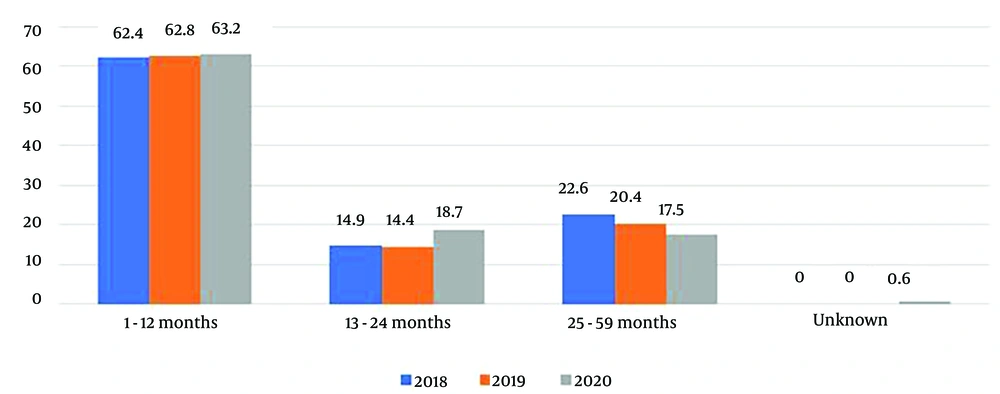
Figure 1.
Comparison of death percentage among children 1 - 59 months in different age groups
In 2018, the highest percentage of deaths (51.5%) was related to boys, and in 2019 and 2020, girls had the highest percentage of deaths (51.4%, 51.6%). About 0.1 - 0.2 percent of those who died did not have Iranian nationality. During the years under investigation, most of the deceased were residents of urban areas (Figure 2).
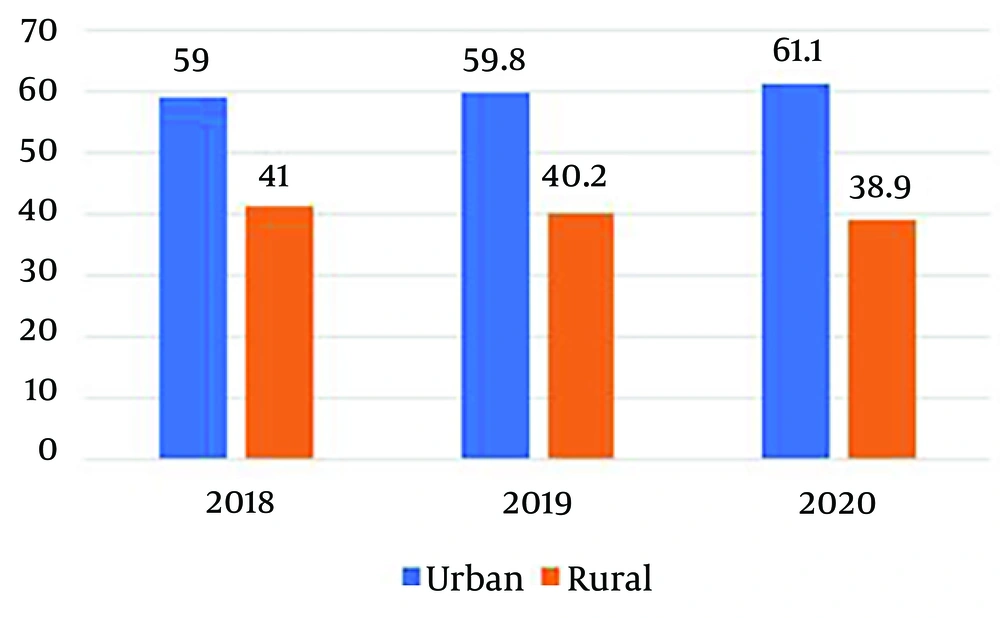
Figure 2.
Distribution of death percentage among children aged 1 - 59 months by place of residence
In 2018 and 2019, most of the deaths in the population covered by ZAUMS were due to respiratory diseases, while the causes of most deaths in Iran in 2018 were congenital malformations, deformations, and chromosomal abnormalities, and in 2019, they were injuries, poisoning, and other certain consequences of external causes. In 2020, the causes of most deaths in the population covered by ZAUMS and Iran were similar and related to injuries, poisonings, and other certain consequences of external causes (Table 1).
Table 1.Comparison of Percentage Distribution of the Death Causes Among Children Aged 1 - 59 Months Based on the International Classification of ICD-10
| The Causes of Death According to ICD-10 | 2018 | 2019 | 2020 | |||
|---|---|---|---|---|---|---|
| Iran | ZAUMS | Iran | ZAUMS | Iran | ZAUMS | |
| Chapter 1: Certain infectious and parasitic diseases | 5.5 | 7.9 | 4.8 | 7.1 | 6.1 | 12.8 |
| Chapter 2: Neoplasms | 3.9 | 2.7 | 4.2 | 2.7 | 4.2 | 1.8 |
| Chapter 3: Diseases of the blood and blood-forming organs and certain disorders involving the immune mechanism | 2.4 | 1.6 | 3.2 | 2.5 | 2 | 2.1 |
| Chapter 4: Endocrine, nutritional, and metabolic diseases | 6.4 | 3.8 | 6.4 | 4.1 | 5.6 | 3.3 |
| Chapter 5: Mental and behavioral disorders | 0.1 | - | - | - | 0.1 | - |
| Chapter 6: Diseases of the nervous system | 8.3 | 7.4 | 9.3 | 9.3 | 8.7 | 10.6 |
| Chapter 9: Diseases of the circulatory system | 6.8 | 8.5 | 6.7 | 7.1 | 7 | 6.8 |
| Chapter 10: Diseases of the respiratory system | 10.9 | 18 | 13 | 22.7 | 10.6 | 10.4 |
| Chapter 11: Diseases of the digestive system | 6.2 | 10.4 | 5 | 6.8 | 5.9 | 8.3 |
| Chapter 14: Diseases of the genitourinary system | 1.4 | 1.4 | 1.4 | 1.2 | 1.8 | 2.1 |
| Chapter 16: Certain conditions originating in the perinatal period | 2.4 | 0.8 | 1.8 | - | 2.4 | 0.9 |
| Chapter 17: Congenital malformations, deformations, and chromosomal abnormalities | 19.7 | 14.2 | 18.2 | 9.8 | 17.7 | 14.2 |
| Chapter 18: Symptoms, signs, and abnormal clinical and laboratory findings not elsewhere classified | 7 | 9.6 | 6.3 | 10.9 | 6.3 | 9.2 |
| Chapter 19: Injury, poisoning, and certain other consequences of external causes | 19 | 13.4 | 19.7 | 15.8 | 20.3 | 16.3 |
| Chapter 20: External causes of morbidity and mortality | - | 0.3 | - | - | - | - |
| Chapter 22: Codes for special purposes | - | - | - | - | 1.3 | 1.2 |
| Total | 100 | 100 | 100 | 100 | 100 | 100 |
The highest percentage of the causes of unintentional accidents was related to transportation (Table 2).
Table 2.Comparison of the Percentage Distribution of External Causes of Death Among Children Aged 1 - 59 Months Due to Unintentional Accidents
| External Causes | 2018 | 2019 | 2020 |
|---|---|---|---|
| Transportation | 31.4 | 31 | 34.5 |
| Drawing | 25.5 | 10.3 | 9.1 |
| Other respiratory obstruction incidents | 11.8 | 10.3 | 23.6 |
| Contact with hot water and heat | 9.7 | 5.2 | 3.7 |
| Poisoning | 7.8 | 12.2 | 9.2 |
| Exposure to smoke and fire rays | 3.9 | 5.3 | 9.1 |
| Exposure to electricity and radiation | 2 | 10.3 | 1.8 |
| Contact with poisonous animals and plants | 2 | - | - |
| Fall | 2 | 10.3 | 3.6 |
| Rape and violence | - | 1.7 | - |
| Dealing with inanimate mechanical forces | - | 1.8 | |
| Other external causes | 3.9 | 3.4 | 3.6 |
The most common types of congenital malformations, deformations, and chromosomal abnormalities were related to the circulatory system (Table 3).
Table 3.Comparison of the Percentage of Death Distribution Among Children Aged 1 - 59 Months According to the Type of Congenital Anomalies
| Type of Congenital Abnormalities | 2018 | 2019 | 2020 |
|---|---|---|---|
| Circulatory system | 38.9 | 50 | 60.4 |
| Digestive system | 16.7 | 13.9 | 10.4 |
| Nervous system | 13.9 | 19.4 | 12.5 |
| Respiratory system | 2.8 | 5.6 | 4.2 |
| Genitourinary system | 2.8 | - | - |
| Chromosomal abnormalities | 11.1 | - | 6.3 |
| Cleft lip and cleft palate | 2.8 | - | 2.1 |
| Other cases | 11.1 | 11.1 | 4.2 |
5. Discussion
According to the results of this study, the highest and lowest death rates were in 2019 and 2020, respectively. The general trend of death in children aged 1 - 59 months in this study decreased from 7.6 per thousand live births in 2018 to 6.9 per thousand live births in 2020. In the studies conducted on the same topic in Kermanshah, Babol, Fars, and Dezful, the decreasing trend of death was also reported, which is consistent with the results of this study (3, 13-15). However, the studies conducted in Nishapur and Ardabil reported an increasing trend of death (16, 17), which is not consistent with the results of this study. Considering that various factors affect the child death index, awareness of these factors and designing effective interventions to reduce the repetition of deaths with similar and avoidable causes can be important in reducing the amount of this indicator, which policymakers and managers should consider.
The results of the present study showed that the highest percentage of deaths were related to the ages of 1 - 12 months, which is consistent with the results of most previous similar studies (3, 9, 11, 14, 15, 18-21). The prevalence of congenital and hereditary diseases, as well as infectious agents, can be the reason for the occurrence of more deaths at this age (15, 22, 23), which highlights the importance of pre-pregnancy care and genetic counseling and the implementation of prenatal screenings to prevent the birth of such newborns. Also, paying special attention to high-risk newborns and taking effective measures can prevent such deaths.
In this study, boys had the highest percentage of deaths in 2018, and girls had the highest percentage of deaths in 2019 and 2020. In most studies, the percentage of deaths of boys was reported to be higher than that of girls (3, 10, 11, 14, 15, 17, 24). In some studies, the death rate of girls was higher than boys. In Safari and Namkin's studies, the death rate of girls was reported to be higher than boys (25, 26). Still, in most studies, no significant relationship between gender and death rates has been reported (3, 15, 26-28). Most of the deceased in this study lived in urban areas, which is in line with the results of the studies of Izadi, Hosseini, and Tarajedini (3, 15, 28). Also, in this study, 0.1 - 0.2 percent of the deceased were not Iranian nationals. In the Tajedini study, 10 percent of the deceased did not have Iranian nationality, which is in line with the results of this study.
In the years 2018 and 2019, most of the deaths in the population covered by ZAUMS were due to respiratory diseases, while the causes of most deaths in the country in 2018 were congenital malformations, deformations, and chromosomal abnormalities, and the causes were external. The most common causes of death in the studies conducted in Dezful and Mazandaran were respiratory diseases, which is consistent with the results of this study (10, 14). In 2020, the most causes of death in the population covered by ZAUMS and Iran were related to injury, poisoning, and certain other consequences of external causes, which is consistent with the results of studies conducted by Izadi, Shahraki, Namkin, XU, and Ntuli (3, 11, 24, 25, 29). Therefore, it can be claimed that the pattern of causes leading to the death of children in the studied community has changed and is more consistent with the national pattern.
In conclusion, the death trend of children 1 - 59 months in the years 2018 to 2020 was decreasing, and the most common causes of death were related to respiratory system diseases, injury, poisoning, and certain other consequences of external causes, congenital malformations, deformations, and chromosomal abnormalities. Therefore, the following measures can prevent avoidable deaths and thus improve the health index of children: Educating parents on timely treatment of respiratory diseases in children, improving the knowledge level of families to control accidents, and taking better care of children in high-risk environments where there is a possibility of burns, respiratory obstruction, poisoning, and drowning, reforming and promoting policies related to genetic screening plans to identify congenital abnormalities during pregnancy, and premarital counseling to prevent high-risk family marriages.


