
1. Background
Chronological age estimation has been a subject of intense research for many decades (1). Age estimation is of great importance in many medical fields, including endocrinology and dentistry, especially pediatric dentistry, orthodontics, and orthogonathic surgery (2, 3). It is also extensively used in archeology, criminology, and forensic medicine (2, 4). When there is no precise information regarding a person’s age, one can use four major indicators to estimate the age: Height, physical manifestations of maturity (e.g., menstruation), skeletal age, and dental development (4, 5). Dental development is one of the most consistent predictors of age in children and adolescents (6), as it is largely controlled by genetics and less affected by factors, such as malnutrition, endocrine diseases, and environmental damage (7, 8).
One of the most widely used and accepted methods of dental age estimation is the method proposed by Demirjian et al. in 1973 (9) and modified in 1976 (10) for the French-Canadian population. This method involves examining the calcification of seven permanent left mandibular teeth in a panoramic radiograph, using the charts provided by Demirjian et al. for classifying them into developmental stages (A - H) (9). The score of each tooth is determined based on its development stage, and finally, a table provided by the same researchers is used to convert the sum of the obtained scores (0 - 100) to an estimate of dental age (9, 10). One drawback of this method is that it involves repetitive and time-consuming calculations, requires multiple charts and tables, and was originally designed for Canadian people.
In 2011, Willems et al. modified the Demirjian method based on the data collected from the Belgian population (11). They provided new gender-specific charts, where unlike the Demirjian charts, summation of scores obtained by the calcification stage determined the dental age directly, without requiring any conversion. This simple change makes it much easier and faster to obtain an age estimate with the Willems method (11).
2. Objectives
Previous studies on the subject of dental age estimation in Iran have only examined the accuracy of methods developed for non-Iranian populations and have failed to provide a specific method for Iranians. Therefore, in this study, we aimed to evaluate the accuracy of Willems and Demirjian methods in estimating the dental age of 7- to 15-year-old of north of Iran and to develop a specific dental age estimation method for this population.
3. Methods
This cross-sectional study was approved by the Ethics Committee of Babol University of Medical Sciences (IR.MUBABOL.REC.1397.048). The data of patients were kept confidential. In this study, we evaluated 1320 panoramic radiographs, from 2016 to 2019, which were requested by dentists for diagnostic purposes. The minimum sample size was calculated 1300 cases in accordance to 10 samples for each independent variable developed by Halinski and Feldt (12) and new modified method’s goodness of fit consideration.
Samples were obtained via simple non-random sampling from the Orthodontics Department of Babol Dental School and three oral and maxillofacial radiology and orthodontic clinics in Babol (north of Iran). The inclusion criteria for the panoramic radiographs were as follows: (1) Radiographs obtained in the age range of 7 - 15 years; (2) coverage of seven permanent teeth or buds on the left side of the mandible; (3) acceptable diagnostic accuracy; and (4) documentation of the radiography date and the patient’s date of birth (to determine the patient's exact chronological age at the time of radiography).
Radiographs were examined and scored by a dental student and an orthodontist. To ensure inter-observer agreement, 50 collected radiographs were randomly selected and rated by both the dental student and orthodontist. Moreover, to ensure intra-observer agreement, these 50 radiographs were re-examined after two weeks (13, 14). The chronological age at the time of radiography was calculated by subtracting the patient’s date of birth from the date of radiography.
In addition, to estimate the dental age based on the Demirjian method, the developmental stage of seven left mandibular teeth was determined, as instructed in this method (based on stages A - H). Next, gender-specific Demirjian tables were used to score each tooth. The scores were summed to obtain the dental maturity score of each patient. Finally, Demirjian tables were used to estimate the patient’s age, based on the dental maturity score (9, 10). Similarly, to estimate the dental age by the Willems method, the Willems charts and tables were used to classify the teeth according to their development stage. However, unlike the Demirjian method, the dental age of each person was determined directly by summing the scores of the teeth (11).
To modify the Willems method for higher accuracy in the target population, stepwise linear regression was performed with gender and dental age used as variables. The results of this regression are presented below (Formula 1):
Where G is 0 for girls and 1 for boys, and WDA is Willems method dental age. The goodness of fit of the regression model was evaluated using the R2 index (percentage of variance explained by predictor variables) and residual plots.
The inter-observer and intra-rater agreements were evaluated by measuring Cohen’s kappa coefficient. The accuracy of each method was calculated for each gender and age group (and in total) by subtracting the actual age from the estimated age. The positive and negative values obtained in this stage indicated overestimation and underestimation, respectively. The mean error (ME) and standard error of the mean (SEM) of the methods were computed for each gender and age group (and in total) and then used to compare the methods by paired t-test. t-test was also used to compare the calculated values in different age and gender groups. In all statistical tests, the significance level was α = 0.05.
4. Results
Of 1320 panoramic radiographs evaluated, 828 belonged to girls (63%) and 492 belonged to boys (37%) (Table 1). Intra-observer and inter-observer agreements were evaluated by asking the raters to determine the development stage of teeth in 50 randomly selected radiographs. The kappa coefficients showed high intra-observer and inter-observer reliability (92% and 93%, respectively). The mean chronological age of the patients was 10.89 ± 1.98 years. The mean dental age estimates obtained by the Demirjian method and the Willems method were 11.3 ± 2.28 and 10.97 ± 2.15, respectively.
Table 1.
Age and Gender Distribution of the Samples a
| Age Group | Female | Male | Total |
|---|---|---|---|
| 7 - 7.99 | 64 (5) | 48 (4) | 112 (9) |
| 8 - 8.99 | 76 (6) | 62 (5) | 138 (11) |
| 9 - 9.99 | 143 (11) | 65 (5) | 208 (16) |
| 10 - 10.99 | 144 (11) | 109 (8) | 253 (19) |
| 11 - 11.99 | 124 (9) | 74 (5) | 198 (14) |
| 12 - 12.99 | 111 (8) | 57 (4) | 168 (12) |
| 13 - 13.99 | 94 (7) | 54 (4) | 148 (11) |
| 14 - 15 | 72 (6) | 23 (2) | 95 (8) |
| Total | 828 (63) | 492 (37) | 1320 (100) |
a Values are expressed as No. (%).
The Demirjian method overestimated the chronological age for every age group and every individual. This overestimation was statistically significant in all groups, except boys aged 13 - 15 years. The Willems method also overestimated the chronological age of all girls, except those in the age groups of 10 - 10.99 and 13 - 13.99 years. Moreover, the Willems method overestimated the chronological age of all boys of all age groups, except those in the age group of 13 - 15 years. However, overestimations of the Willems method were only significant for boys, aged 7 - 8.99 years, and girls, aged 8 - 8.99 and 13 - 13.99 years. For the total population of girls, the misestimating were statistically significant for the Demirjian method, but not for the Willems method. In addition, for the total population of boys, the misestimating of both methods were statistically significant.
As shown in Table 2, the Demirjian method overestimated the chronological age by 0.49 years, while the Willems method overestimated the age by 0.07 years, indicating the higher accuracy of this method. The Willems method had the highest accuracy for boys, aged 14 - 15 years (minimum error: 0.01) and the lowest accuracy for boys, aged 8 - 8.99 years (maximum error: 0.34). In all groups except boys aged 13 - 13.99 years, estimates of the Willems method were closer to the chronological age, compared to the Demirjian method. The Demirjian method showed larger overestimations for girls than for boys, whereas the opposite was true for the Willems method.
Table 2.
Difference Between Chronological Age and Dental Age Estimated by the Demirjian and Willems Methods (P-Values for Girls and Boys of Different Age Groups)
| Age and Gender | Number | Chronological Age a | Demirjian Age a | Difference a, b | P-Value | Willems Age a | Difference a, b | P-Value |
|---|---|---|---|---|---|---|---|---|
| 7 - 7.99 | ||||||||
| Girl | 64 | 7.60 ± 0.27 | 7.92 ± 0.63 | 0.32 ± 0.63 | 0.001 > | 7.63 ± 0.62 | 0.02 ± 0.64 | 0.733 |
| Boy | 48 | 7.59 ± 0.29 | 7.98 ± 0.61 | 0.38 ± 0.61 | 0.001 > | 7.82 ± 0.76 | 0.23 ± 0.76 | 0.041 |
| 8 - 8.99 | ||||||||
| Girl | 76 | 8.51 ± 0.29 | 8.96 ± 0.99 | 0.44 ± 0.88 | 0.001 > | 8.75 ± 0.89 | 0.24 ± 0.79 | 0.010 |
| Boy | 62 | 8.50 ± 0.29 | 8.88 ± 0.87 | 0.37 ± 0.87 | 0.001 > | 8.84 ± 0.79 | 0.34 ± 0.87 | 0.001 |
| 9 - 9.99 | ||||||||
| Girl | 143 | 9.50 ± 0.28 | 10.80 ± 1.25 | 0.58 ± 1.15 | 0.001 > | 9.57 ± 1.06 | 0.06 ± 0.96 | 0.390 |
| Boy | 65 | 9.50 ± 0.27 | 10.02 ± 1.39 | 0.52 ± 1.22 | 0.002 | 9.82 ± 1.21 | 0.31 ± 1.13 | 0.21 |
| 10 - 10.99 | ||||||||
| Girl | 144 | 1.45 ± 0.27 | 10.99 ± 1.15 | 0.54 ± 1.12 | 0.001 > | 10.42 ± 0.99 | -0.02 ± 0.97 | 0.743 |
| Boy | 109 | 10.51 ± 0.27 | 10.89 ± 1.81 | 0.32 ± 1.18 | 0.001 | 10.67 ± 0.98 | 0.16 ± 0.98 | 0.090 |
| 11 - 11.99 | ||||||||
| Girl | 124 | 11.46 ± 0.28 | 12.23 ± 1.56 | 0.77 ± 1.53 | 0.001 > | 11.58 ± 1.13 | 0.12 ± 1.11 | 0.225 |
| Boy | 74 | 11.50 ± 0.29 | 11.84 ± 1.04 | 0.33 ± 1.07 | 0.009 | 11.51 ± 0.99 | 0.01 ± 1.01 | 0.920 |
| 12 - 12.99 | ||||||||
| Girl | 111 | 12.47 ± 0.29 | 13.41 ± 1.16 | 0.93 ± 1.16 | 0.001 > | 12.62 ± 1.18 | 0.14 ± 1.18 | 0.187 |
| Boy | 57 | 12.46 ± 0.31 | 12.97 ± 1.08 | 0.5 ± 1.08 | 0.001 | 12.65 ± 1.07 | 0.18 ± 1.05 | 0.194 |
| 13 - 13.99 | ||||||||
| Girl | 94 | 13.45 ± 0.27 | 13.82 ± 1.14 | 0.36 ± 1.13 | 0.002 | 13.15 ± 1.17 | -0.03 ± 1.15 | 0.013 |
| Boy | 54 | 13.44 ± 0.28 | 13.53 ± 1.21 | 0.09 ± 1.12 | 0.548 | 13.26 ± 1.27 | -0.18 ± 1.19 | 0.265 |
| 14 - 15 | ||||||||
| Girl | 72 | 14.47 ± 0.32 | 14.83 ± 0.92 | 0.36 ± 0.96 | 0.002 | 14.51 ± 1.23 | 0.03 ± 1.25 | 0.791 |
| Boy | 23 | 14.42 ± 0.28 | 14.64 ± 0.88 | 0.22 ± 0.89 | 0.238 | 14.14 ± 1.11 | -0.01 ± 1.12 | 0.949 |
| 7 - 15 | ||||||||
| Girl | 828 | 11 ± 2.01 | 11.58 ± 2.34 | 0.57 ± 1.16 | 0.001 > | 11.04 ± 2.21 | 0.03 ± 1.04 | 0.279 |
| Boy | 492 | 10.72 ± 1.94 | 11.09 ± 2.15 | 0.36 ± 1.07 | 0.001 > | 10.86 ± 2.06 | 0.14 ± 1.01 | 0.002 |
| Girl + boy | 1320 | 10.98 ± 0.98 | 11.3 ± 2.28 | 0.49 ± 1.13 | 0.001 > | 10.97 ± 2.15 | 0.07 ± 1.03 | 0.006 |
a Values are expressed as mean ± standard deviation.
b Difference between the estimated age and chronological age
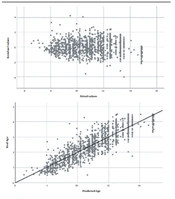
The formula 1 explains 77% (R2 = 0.77) of variance in age estimates. As shown in Figure 1, the model was a good fit and had a very low error in the total population. The mean dental age obtained by the modified method was 10.89 ± 1.74. As shown in Table 3, the modified method overestimated the chronological age in the 7 - 7.99 age group and underestimated it in the 11 - 15-year-old age group. Table 3 presents the errors (mean error and standard deviation) of the Willems and modified Willems methods, as well as the percentage of age estimates in a one-year period (95% confidence interval) for different age and gender groups.

Figure 1.
Distribution of the predicted age versus the error of the modified model and the subjects’ chronological age. Fitted value and predicted age: Age estimates from the modified Willems method; Real age: chronological age; Residual: Differences between the chronological age and predicted age.
Table 3.
Comparison of the Original Willems Method and the Modified Willems Method for Girls and Boys of Different Age Groups
| Age and Frequency | Gender | Willems Method | Modified Willems Method | ||
|---|---|---|---|---|---|
| % < 1 year | Error a | % < 1 year | Error a | ||
| 7 - 7.99 | |||||
| 64 | Female | 92.2 | 0.02 ± 0.64 | 84.4 | 0.64 ± 0.54 b |
| 48 | Male | 77.1 | 0.23 ± 0.76 b | 68.8 | 0.66 ± 0.62 b |
| 112 | Female + male | 85.7 | 0.11 ± 0.70 | 77.7 | 0.65 ± 0.57 b |
| 8 - 8.99 | |||||
| 76 | Female | 77.6 | 0.24 ± 0.79 b | 71.1 | 0.64 ± 0.63 b |
| 62 | Male | 79.0 | 0.34 ± 0.78 b | 77.4 | 0.58 ± 0.64 b |
| 138 | Female + male | 78.3 | 0.28 ± 0.78 b | 73.9 | 0.61 ± 0.63 b |
| 9 - 9.99 | |||||
| 143 | Female | 67.8 | 0.06 ± 0.96 | 78.3 | 0.31 ± 0.77 b |
| 65 | Male | 69.2 | 0.31 ± 1.13 b | 78.5 | 0.37 ± 0.91 b |
| 208 | Female + male | 68.3 | 0.14 ± 1.02 b | 78.4 | 0.33 ± 0.81 b |
| 10 - 10.99 | |||||
| 144 | Female | 70.8 | -0.02 ± 0.97 | 82.6 | 0.05 ± 0.79 |
| 105 | Male | 70.6 | 0.16 ± 0.98 | 77.1 | 0.05 ± 0.80 |
| 253 | Female + male | 70.8 | 0.05 ± 0.98 | 80.2 | 0.05 ± 0.79 |
| 11 - 11.99 | |||||
| 124 | Female | 63.7 | 0.12 ± 0.11 | 75.0 | -0.02 ± 0.90 |
| 74 | Male | 64.9 | 0.01 ± 1.01 | 74.3 | -0.25 ± 0.83 b |
| 198 | Female + male | 64.1 | 0.08 ± 1.07 | 74.7 | -0.11 ± 0.88 |
| 12 - 12.99 | |||||
| 111 | Female | 55.9 | 0.14 ± 1.18 | 70.3 | -0.19 ± 0.96 b |
| 57 | Male | 59.6 | 0.18 ± 1.05 | 70.2 | -0.30 ± 0.86 b |
| 168 | Female + male | 57.1 | 0.16 ± 1.14 | 70.2 | -0.23 ± 0.93 b |
| 13 - 13.99 | |||||
| 94 | Female | 60.6 | -0.30 ± 1.15 b | 50.0 | -0.74 ± 0.93 b |
| 54 | Male | 70.4 | -0.18 ± 1.19 | 48.1 | -0.78 ± 0.96 b |
| 143 | Female + male | 64.2 | -0.25 ± 1.16 b | 49.3 | -0.76 ± 0.94 b |
| 14 - 15 | |||||
| 72 | Female | 45.8 | 0.03 ± 1.25 | 61.1 | -0.66 ± 1.02 b |
| 23 | Male | 56.5 | -0.01 ± 1.12 | 47.8 | -0.84 ± 0.91 b |
| 95 | Female + male | 48.4 | 0.02 ± 1.21 | 57.9 | -0.71 ± 1.00 b |
| 7 - 15 | |||||
| 828 | Female | 66.2 | 0.03 ± 1.04 | 72.6 | 0.00 ± 0.94 |
| 492 | Male | 69.3 | 0.14 ± 1.01 b | 70.7 | 0.00 ± 0.94 |
| 1320 | Female + male | 67.3 | 0.07 ± 1.03 b | 71.9 | 0.00 ± 0.94 |
a Error values are reported as mean ± standard deviation.
b Difference is statistically significant.
5. Discussion
In this study performed on 1320 panoramic radiographs, the Demirjian and Willems methods both overestimated the chronological age of the patients. The Demirjian method had a mean error of 0.57 years for females, 0.36 years for males, and 0.49 years for all subjects; all of the results were statistically significant. The mean error of the Willems method for females, males, and all subjects was 0.07, 0.03, and 0.14 years, respectively. Statistically, this error was not significant for females, while it was significant for males and the total population. Overall, age estimates of the Willems method were closer to the chronological age, which shows its higher accuracy compared to the Demirjian method.
Consistent with our results, several studies conducted in Iran (2, 4, 15-21), Turkey (22, 23), Thailand (7), India (24), Malaysia (25), Sri Lanka (26), South Africa (5), and Italy (27) have reported that the Demirjian method overestimates the age of both genders. Similar to our study, several studies from Iran (4, 21), Turkey (23), India (24), Malaysia (25), and South Africa (5) have found that the Willems method also overestimates the age of both genders. Nevertheless, multiple studies from Turkey (22), Thailand (7), and Sri Lanka (26) have reported that the Willems method underestimates the chronological age of both genders. In a study conducted by Cameriere (27), the Willems method overestimated the chronological age of boys and underestimated the chronological age of girls. These differences may be attributed to differences in the sample size, age group, and ethnicity of the subjects, besides environmental and nutritional factors.
In all of the reviewed studies, except the one conducted in Thailand, the Willems method was more accurate than the Demirjian method, which is in line with our results. Since none of the reviewed articles provided an age estimation method for the Iranian population, in this study, we attempted to devise a formula for estimating the dental age of 7- to 15-year-old Iranians. This goal was achieved by using the Willems method to estimate the age of a group of Iranian children and adolescents, and then, applying the results in a regression analysis to find a formula for modifying the Willems score. Comparison of the modified Willems method with the original method showed that although the modified version had a lower error for the entire population, the unmodified version produced more accurate results for most of the examined age groups (both boys and girls). Therefore, there is no merit in using the modified method.
A study by Franco et al. (28), which presented the Brazilian version of the Willems method, also reported that the new Brazilian model was not helpful because the original Willems method yields the same results as the new model in Brazilian children. In a study by Willems et al. (8) from South Africa, in which the dental maturity scores based on the Willems method were modified to fit the South African population, age estimates according to the new scores were better than those determined by the original Willems method; however, the difference was small and not clinically significant. A study by Metsaniitty et al. (29) from Somalia also reported that the new model developed for Somalis produced the same results as the Willems method. Similarly, in a study by Yusof et al. (30), which developed a new model for Malaysian children based on the Willems method, the two methods showed almost the same rate of error. These studies, similar to our research, indicate that for some populations, it is unnecessary to modify the Willems method.
Considering the age range of subjects in the present study (7- to 15-years old), the early developmental stages of some teeth were not detected on the radiographs. Therefore, while attempting to design a new dental maturity table for the studied population, we could not obtain new scores for nearly half of the dental development stages. Therefore, regression analysis and formulation were used to modify the Willems method.
5.1. Conclusions
The present results showed that the Demirjian and Willems methods both overestimated the chronological age; however, the overestimations were smaller in the Willems method. Comparison of the original method with the modified Willems method showed that although the modified score was more accurate for the studied population as a whole, it had a larger error for many age subgroups. Therefore, the original Willems method is still the preferred choice for age estimation in the population of Iranian children, aged 7 - 15 years.
5.2. Suggestions
Future studies are recommended to design a new dental maturity score for the Iranian population by including younger patients in the sample and taking samples of appropriate size from each age group.