





1. Background
Age estimation is an important issue in the identification and forensic sciences, orthodontic treatment, and legal matters (1). During the growth process, skeletal, odontological, anthropological, and psychological methods help us to evaluate the age (2). Teeth are commonly used for age assessment. The large number of teeth and their development in children suggest multiple methods of age estimation (3).
In 1973, Demirjian presented a method based on the stages of tooth development on panoramic radiographs (4). Because of the absence of sufficient numbers of younger and older children in the standardizing sample, Demirjian modified the method in 1976, and today this method is acceptable (5). In 2006, Cameriere et al. introduced a method for age assessment in children based on the relationship between age and measurement of apices’ diameter in open apices teeth, which was a reliable method for 455 Italian Caucasian children (3). Recently, many articles reported that the Cameriere method is suitable and efficient for estimating dental age in some populations (6). However, there is only one study conducted on the Iranian population to investigate dental age by the Cameriere method (7).
2. Objectives
Hence, this study aimed to compare Cameriere and Demirjian methods in estimating chronological age (Age) in an Iranian population (age range: 5 - 15 years) in Babol, northern Iran, in 2019 and develop a modified version of the Cameriere method.
3. Methods
This cross-sectional study examined 509 panoramic radiographs (taken for prognosis purposes) adopted from two craniofacial radiology centers in Babol, northern Iran, in 2019. All panoramic radiographs were taken by CaranexD (Soredex-Finland) radiology device. Inclusion criteria were having seven mandibular teeth left, no systemic disease, and no dental disorders. The radiographs which had artefacts or were unclear were excluded. Finally, 486 cases (208 boys and 278 girls) in the age range of 5 - 15 years were included in the study. First, 50 subjects were examined with two observers and reexamined by the same observers after two weeks to determine inter- and intra-observer agreement. If the agreement was not sufficient, the ideas of both two observers were considered. Chronological age (Age) was calculated by subtracting the date radiographs were taken from the subjects' birth date, and reported in decimal form.
3.1. Radiographic Evaluation
3.1.1. Demirjian Method
In this method, seven permanent mandibular teeth left were scored from "A" to "H" depending on the stage of calcification (Figure 1) and converted to a numerical score according to gender (4, 8). Then, the sum of these scores reported as maturity index was converted to dental age (DAge) by using a conversion diagram. Scores used in this study were reported by Demirjian and Goldstein in 1976 (5).
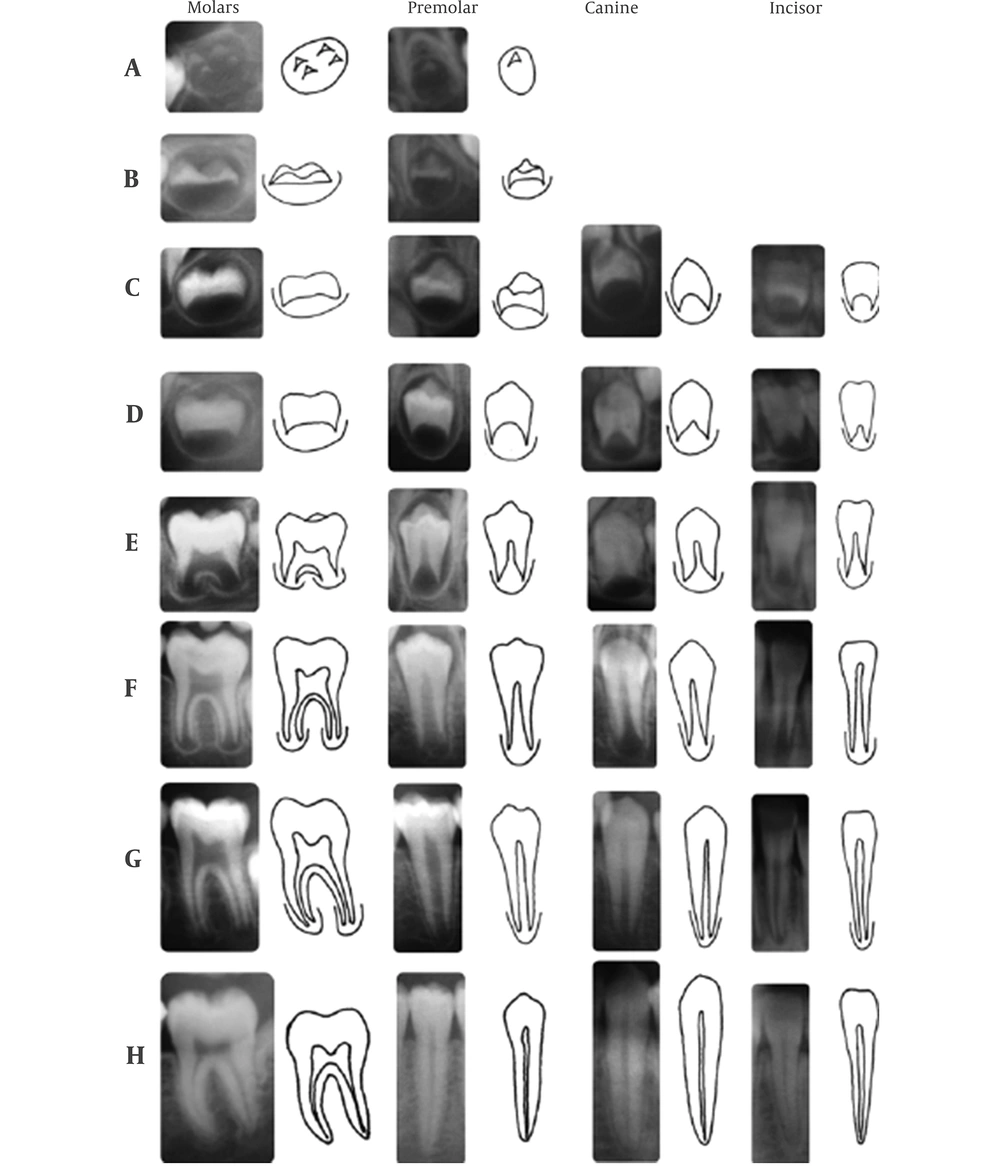
Figure 1.
Developmental Stages in Demirjian Method (8)
3.1.2. Cameriere Method
The seven permanent mandibular teeth were evaluated. The number of teeth with closed apices (N0) was calculated. In the teeth with open apices and one root, the distance between the inner sides of the apex was measured (Ai, i = 1,...,5), and for teeth, with multi-roots the mean of the distances between the inner sides of the two apices was measured (Ai, i = 6, 7). To eliminate the effect of radiology magnification, the distances were normalized by dividing the distances on tooth length (Li, i = 1,..,7) (Figure 2) (9). Finally, dental age (CAge) was calculated using the normalized measurements of the teeth (Xi = Ai/Li, i = 1,…,7), the sum of the normalized open apices teeth (s), and the number of teeth with closed apices (N0) via formula 1.
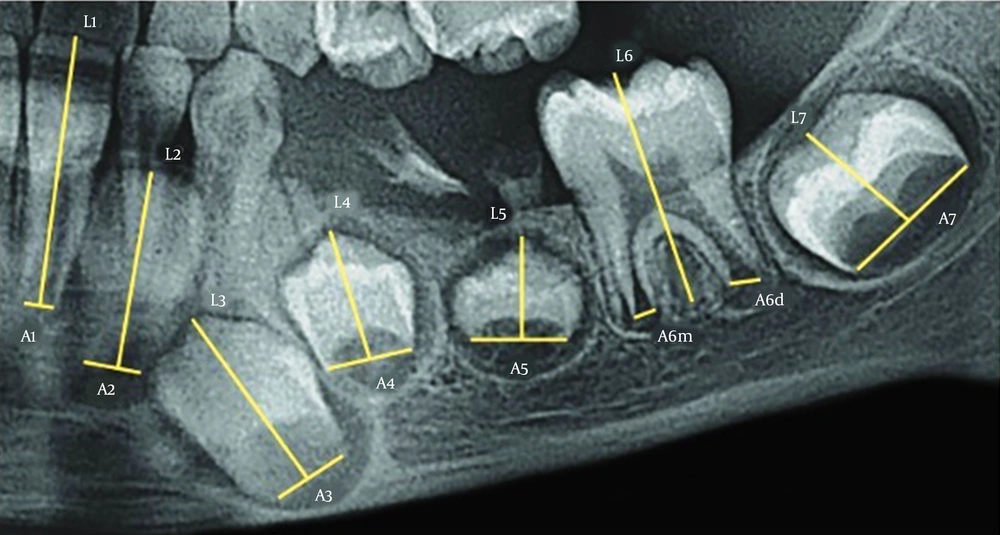
Figure 2.
Method for measurement of “Li” and “Ai” in Cameriere method (Li represents the lengths of the teeth measured and Ai represents the measurements of the open apices, where i = 1,...,7) (9)
* g is 1 for males and 0 for females.
3.2. Statistical Analysis
The data of all subjects were analyzed with SPSS ver. 25 and MedCalc ver. 14.8.1. The Cohens Kappa test was used to evaluate observers' inter- and intra-agreement. The accuracy of each method was calculated by the difference between the Age and the age estimated by the Demirjian (DAge) and Cameriere (CAge) methods for each age group, gender, and all subjects. The positive values indicated overestimation, and the negative values indicated underestimation. The paired t-test and Pearson correlation coefficient were used to calculate the accuracy of DAge and CAge, and t-test was used to compare the calculated values in different age groups and genders with chronological values. To correct the Cameriere formula and increase the accuracy of computational methods for estimating dental age by gender and morphological variables, a multiple linear regression method was used by the stepwise method, and R2 was reported. Because some teeth may have closed apices, and the standardized value may not be defined for some teeth, it seems better to choose the sum of the standardized values as the input variable. Besides, the Bland-Altman diagram was drawn to investigate the agreement of methods. P-value < 0.05 was considered as statistically significant.
4. Results
The mean ± SD of observers' inter and intra agreement were 0.989 ± 0.010 and 0.981 ± 0.015 for the Demirjian method and 0.995 ± 0.004 and 0.961 ± 0.063 for the Cameriere method, respectively.
Also, DAge and CAge were compared with the Age (Table 1). The mean differences between CAge and DAge with Age were 0.60 and 0.28, respectively (P < 0.001), and the mean differences between the two methods was 0.88 (P < 0.001).
Table 1.The Mean ± SD of Chronological Age (Age), Dental Age Estimated by Demirjian (DAge), Cameriere (CAge), and Modified Cameriere (MCAge) Methods by Gender
| Gender | n | Age | Demirjian | Cameriere | Modified Cameriere | ||||||
|---|---|---|---|---|---|---|---|---|---|---|---|
| DAge | DAge-Age | P-Value | CAge | (CAge-Age) | P-Value | MCAge | MCAge-Age | P-Value | |||
| Female | 278 | 10.55 ± 2.33 | 10.88 ± 2.48 | 0.32 ± 1.06 | < 0.001 | 9.96 ± 2.06 | -0.58 ± 0.94 | < 0.001 | 10.55 ± 2.14 | 0.00 ± 0.90 | 0.993 |
| Male | 208 | 10.16 ± 2.24 | 10.38 ± 2.06 | 0.22 ± 0.91 | 0.001 | 9.52 ± 1.92 | -0.63 ± 0.93 | < 0.001 | 10.16 ± 2.07 | 0.00 ± 0.89 | 0.998 |
| Total | 486 | 10.38 ± 2.30 | 10.67 ± 2.33 | 0.28 ± 1.00 | < 0.001 | 9.77 ± 2.01 | -0.60 ± 0.94 | < 0.001 | 10.38 ± 2.12 | 0.00 ± 0.90 | 0.993 |
As Table 1 shows, dental age was overestimated by the Demirjian method and underestimated by the Cameriere method, and the difference was higher in the Cameriere method.
Figure 3 presents the Bland-Altman diagram, which shows the correlation of dental age with chronological age. According to the results (Table 1 and Figure 3), it seems that Cameriere method needs a correction. Hence, we used a regression model to correct the formula. The morphological variables and gender were used via a stepwise regression analysis to modify the model. The correlation coefficient of N0, S, and gender with participants’ chronological ages were 0.871 (P < 0.001), -0.872 (P < 0.001), and -0.86 (P = 0.057), respectively. Since S was the sum of X1,…, X7 variables, we did not enter X1,…, X7 into the model.
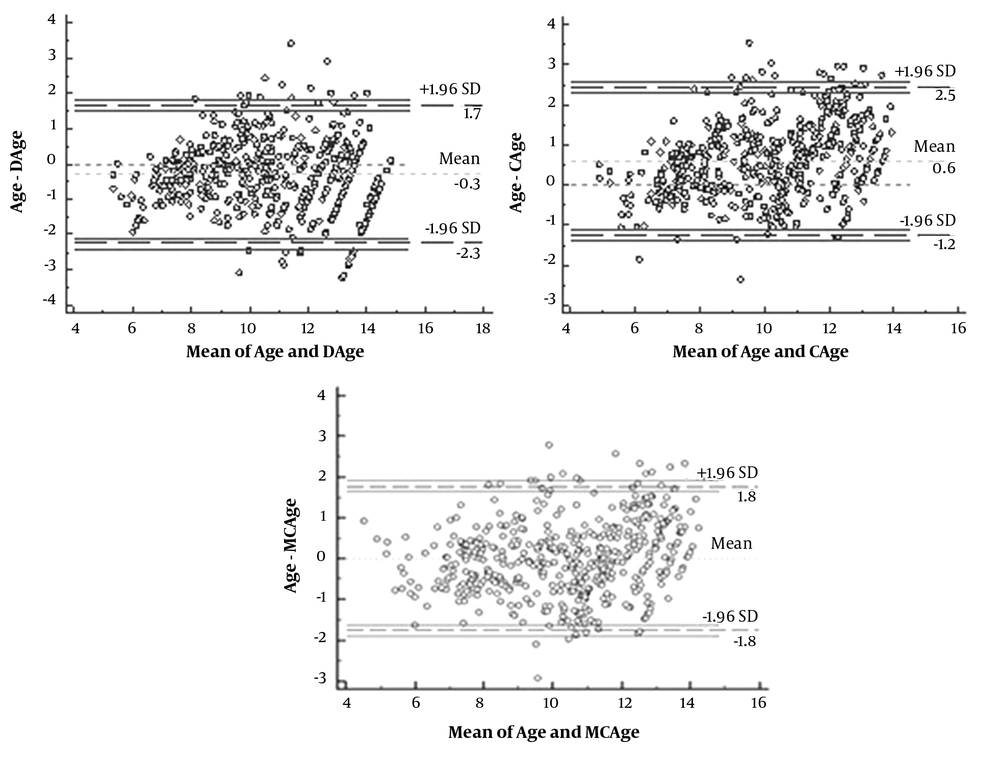
Figure 3.
Bland-Altman diagram: Correlation of dental age estimated by Demirjian (DAge), Cameriere (CAge), and modified Cameriere (MCAge) methods with chronological age (Age).
The results of the regression model are shown in Table 2 and presented as a modified formula to calculate MCAge (Formula 2).
Table 2.Stepwise Regression Analysis to Calculate Individuals’ Age Based on Morphological Variables and Gender
| Variables | Coefficients Values | P-Value | |
|---|---|---|---|
| Standard | Non-standard ± SD | ||
| Constant | 10.365 ± 0.150 | < 0.001 | |
| g | 0.096 | 0.446 ± 0.086 | < 0.001 |
| N0 | 0.439 | 0.526 ± 0.034 | < 0.001 |
| s | -0.557 | -1.005 ± 0.052 | < 0.001 |
| s.N0 | -0.086 | -0.218 ± 0.047 | < 0.001 |
* g is 1 for males and 0 for females
Formula 2 by imported variables covers 92% (R2 = 0.920) of the total age distribution in individuals. The value of R2 shows the goodness of fit regression model.
As it can be seen (Table 1 and Figure 3), there is no significant difference between Age and MCAge. The results of the comparison of Age with DAge, CAge, and MCAge by gender were shown in Table 3.
Table 3. The Mean Dental Age Estimated by Demirjian (DAge), Cameriere (CAge), Modified Cameriere (MCAge) Methods and Their Differences with Chronological Age (Age) by Age and Gender
| Age Groups and Gender | N | Age | Demirjian | Cameriere | Modified Cameriere | ||||||
|---|---|---|---|---|---|---|---|---|---|---|---|
| DAge | DAge-Age | P-Value | CAge | CAge-Age | P-Value | MCAge | MCAge-Age | P-Value | |||
| 5 - 5.99 | |||||||||||
| Female | 7 | 5.46 | 6.18 | 0.71 | 0.011 | 6.03 | 0.56 | 0.082 | 5.96 | 0.49 | 0.161 |
| Male | 8 | 5.37 | 6.76 | 1.39 | < 0.001 | 5.37 | 0.36 | 0.129 | 5.70 | 0.33 | 0.161 |
| Total | 15 | 5.41 | 6.49 | 1.07 | < 0.001 | 5.87 | 0.46 | 0.015 | 5.82 | 0.40 | 0.038 |
| 6 - 6.99 | |||||||||||
| Female | 16 | 6.73 | 7.29 | 0.55 | < 0.001 | 6.88 | 0.14 | 0.249 | 7.52 | 0.52 | 0.001 |
| Male | 6 | 6.57 | 7.41 | 0.84 | 0.002 | 6.82 | 0.24 | 0.033 | 7.08 | 0.51 | 0.011 |
| Total | 22 | 6.69 | 7.32 | 0.63 | < 0.001 | 6.86 | 0.17 | 0.071 | 7.21 | 0.51 | < 0.001 |
| 7 - 7.99 | |||||||||||
| Female | 27 | 7.55 | 7.90 | 0.35 | 0.001 | 7.26 | -0.28 | 0.003 | 7.70 | 0.15 | 0.151 |
| Male | 26 | 7.58 | 7.93 | 0.35 | 0.001 | 7.24 | -0.33 | 0.005 | 7.70 | 0.12 | 0.314 |
| Total | 53 | 7.56 | 7.92 | 0.35 | < 0.001 | 7.25 | -0.31 | < 0.001 | 7.70 | 0.13 | 0.084 |
| 8 - 8.99 | |||||||||||
| Female | 22 | 8.61 | 8.89 | 0.27 | 0.058 | 8.37 | -0.24 | 0.070 | 8.91 | 0.29 | 0.057 |
| Male | 25 | 8.44 | 9.23 | 0.78 | < 0.001 | 8.38 | -0.05 | 0.689 | 8.94 | 0.49 | 0.005 |
| Total | 47 | 8.52 | 9.07 | 0.54 | < 0.001 | 8.38 | -0.14 | 0.141 | 8.93 | 0.40 | 0.001 |
| 9 - 9.99 | |||||||||||
| Female | 36 | 9.50 | 9.75 | 0.33 | 0.182 | 9.15 | -0.35 | 0.034 | 9.81 | 0.30 | 0.072 |
| Male | 25 | 9.49 | 9.82 | 0.33 | 0,063 | 9.05 | -0.44 | 0.028 | 9.72 | 0.23 | 0.251 |
| Total | 61 | 9.50 | 9.78 | 0.28 | 0.030 | 9.10 | -0.39 | 0.002 | 9.77 | 0.27 | 0.032 |
| 10 - 10.99 | |||||||||||
| Female | 43 | 10.37 | 10.55 | 0.18 | 0.296 | 9.87 | -0.49 | 0.001 | 10.54 | 0.16 | 0.212 |
| Male | 44 | 10.37 | 10.36 | -0.17 | 0.896 | 9.75 | -0.62 | < 0.001 | 10.53 | 0.15 | 0.293 |
| Total | 87 | 10.37 | 10.45 | 0.08 | 0.452 | 9.81 | -0.56 | < 0.001 | 10.53 | 0.16 | 0.103 |
| 11 - 11.99 | |||||||||||
| Female | 38 | 11.45 | 12.20 | 0.74 | 0.002 | 10.39 | -0.52 | 0.004 | 11.66 | 0.20 | 0.173 |
| Male | 28 | 11.44 | 11.57 | 0.13 | 0.423 | 10.52 | -0.91 | < 0.001 | 11.27 | -0.17 | 0.260 |
| Total | 66 | 11.45 | 11.93 | 0.48 | 0.002 | 10.76 | -0.69 | < 0.001 | 11.49 | 0.04 | 0.665 |
| 12 - 12.99 | |||||||||||
| Female | 39 | 12.48 | 13.10 | 0.61 | 0.002 | 11.75 | -0.73 | < 0.001 | 12.40 | -0.08 | 0.506 |
| Male | 19 | 12.55 | 12.48 | -0.07 | 0.755 | 11.44 | -1.11 | < 0.001 | 12.19 | -0.36 | 0.042 |
| Total | 58 | 12.51 | 12.90 | 0.38 | 0.013 | 11.65 | -0.86 | < 0.001 | 12.33 | -0.17 | 0.094 |
| 13 - 13.99 | |||||||||||
| Female | 35 | 13.42 | 13.37 | -0.05 | 0.754 | 12.05 | -1.37 | < 0.001 | 12.62 | -0.80 | < 0.001 |
| Male | 20 | 13.50 | 13.23 | -0.27 | 0.261 | 11.95 | -1.55 | < 0.001 | 12.68 | -0.82 | < 0.001 |
| Total | 55 | 13.45 | 13.32 | -0.13 | 0.340 | 12.01 | -1.43 | < 0.001 | 12.64 | -0.81 | < 0.001 |
| 14 - 15 | |||||||||||
| Female | 15 | 14.27 | 13.90 | -0.36 | 0.253 | 12.58 | -1.68 | < 0.001 | 13.13 | -1.14 | < 0.001 |
| Male | 7 | 14.22 | 13.77 | -0.45 | 0.127 | 12.69 | -1.53 | 0.001 | 13.34 | -0.87 | 0.007 |
| Total | 22 | 14.25 | 13.86 | -0.39 | 0.090 | 12.61 | -1.63 | < 0.001 | 13.20 | -1.05 | < 0.001 |
The intraclass correlation coefficient (ICC) analysis between the Age with DAge, CAge, and MCAge was presented in Table 4.
Table 4.Intraclass Correlation Coefficient (ICC) for All the Methods b
a Correlation significant at level 0.01.
b Variables in table are ICC (CI 95%).
However, comparing the ICC of DAge, CAge, and MCAge methods, it can be concluded that MCAge had a better reliability with Age.
5. Discussion
Many studies investigated the use of teeth for age estimation in various races. However, the accuracy and reliability of these methods is still under investigation (7). This study was performed to compare the chronological age of an Iranian population (age range: 5 - 15 years) with dental age based on Demirjian and Cameriere methods. Meanwhile, it aimed to develop a modified Cameriere formula for the studied population.
In the present study, a high intra-observer agreement was observed in both methods, and this agreement was higher in the Demirjian method than Cameriere one. Dhanjal et al. stated that the reason for very good intra-observer agreement of the Demirjian method is the existence of obvious evolutionary and the absence of intermediate stages to investigate radiographies (10). Maber et al., in comparison to the Demirjian, Nolla, and Haaviko methods, reported that interpretation of the evolutionary stages of the tooth by the Demirjian method was clearer and simpler (11).
In this study, similar to the studies by Cameriere et al. and Guo et al. (2, 12), the number of samples was fewer in the younger age groups due to the lower demand for panoramic radiology.
The results proved overestimation of dental age using the Demirjian method, while the Cameriere method showed mostly underestimation, which is inconsistent with the results of Pinchi et al. (13). According to the study by Javedinejad et al. (7), the Demirjian method overestimated dental age by a mean value of 0.87 years, while Cameriere method underestimated dental age by a mean value of 0.19 years with a significant difference with chronological age. Also, Abesi et al. concluded that the Demirjian method overestimated the dental age significantly by a mean value of 0.38 years (14). This difference might be due to using different methods for converting maturity indices to dental age. In this study, we used a conversion diagram to calculate dental age, which seems to be more accurate. In another study conducted by Sheikhi et al. (15), in contrast to Abesi et al. (14) and our study, there was no significant difference between chronological age and Demirjian method, which might be attributed to different sample sizes. In the study by Niar et al. (1), in contrast to the Demirjian method, there was a significant difference between Cameriere method and chronological age.
Javadinejad et al. compared the four methods to calculate dental age. In agreement with our study, they concluded that while the Demirjian method overestimated the dental age, the Cameriere method underestimated it. In contrast, the difference between chronological age and DAge was higher than CAge (7).
In the study conducted by Wolf et al. (16), the Demirjian method overestimated the age of both boys and girls with an average of 0.6 and 0.18, and the Cameriere method slightly underestimated the age of boys and girls with an average of 0.07 and 0.08, respectively. However, in the present study, the difference between chronological age and CAge was higher than Dage, which could be due to different races of the subjects.
The current study is consistent with the study by Javadinejad et al. (7). In contrast with Wolf et al. (16), the Cameriere method had higher accuracy in boys than girls. Conversely, in agreement with Wolf et al. (16) and unlike Javadinejad et al. (7), the accuracy of Demirjian method was higher in boys than girls. In the study by Wolf et al. (16), the number of boys was higher than girls, but in the study by Javadinejad et al. (7) and our study the number of girls was higher than boys. Since gender has a direct effect on the Cameriere formula, it seems that accuracy would be higher in each gender with more subjects.
According to the results, comparing the chronological age with dental age in a 1-year range, the Demirjian method showed an overestimation in all age groups except 12 - 13 and 14 - 15 age groups for boys and 13 - 15 for girls, and Cameriere method showed an overestimation for 5 - 7 age range and underestimation for 7 - 15 age group.
When the age groups were analyzed in the study by Wolf et al., the Demirjian method showed an overestimation in all age groups except for 9 - 10 in boys and 8 - 9 and 13 - 14 in girls. The Cameriere method showed an overestimation for 6 - 11 and underestimation for 12 - 14 age ranges in boys and overestimation for 6 - 10, and underestimation for 11 - 14 age ranges in girls (16).
Since in the current study, the difference between chronological age and CAge was higher than DAge, and the formula proposed in the Cameriere method was for the different community, so we tried to modify this formula for the studied population.
To create a regression model, similar to the study by Cugati et al. (17), gender and morphological variables such as the standardized sum of values of teeth with open apices, the number of teeth with closed apices, and their interactions were used. In some studies, other variables such as standardized values of teeth number 1 to 7 were also included in the model (2, 3, 12, 18-20). AlShahrani et al. (20) entered the number of teeth with closed apices and standardized values of each tooth in addition to gender. Because some teeth may have closed apices, and the standardized value may not be defined for some teeth, it seems better to choose the sum of the standardized values as the input variable. In a study conducted by Rai et al. (18) in India, there was no significant difference between the two genders in estimating dental age, so they did not include the gender factor in their model and simply included the race in the formula. This seems to be mandatory in multinational countries such as India. However, since our study was conducted in a small city in northern Iran where most people have a unique race, there was no need to enter the race factor. In the study of Cugati et al. (17) in Malaysia, while the race factor had no significant effect on regression model output, it was not included in their formula.
The estimated mean age by the modified Cameriere method in our study, similar to the study by AlShahrani et al. (20), was very slightly different from the chronological age. This difference, in agreement with the study by Guo et al. (12), was not statistically significant. Furthermore, this difference in girls was higher than boys, which was in agreement with the results of Halilah et al. (19) and in contrast with Guo et al. (12), who investigated the validity of the Cameriere method in estimating the ages of a community in northern China by evaluation of 785 panoramic radiographies. In their study, the estimated dental age of girls in all age ranges except 8 - 9 and boys in all age ranges except 7 - 9 and 10 - 11 had statistically significant differences with chronological age, which was not consistent with our study.
According to the results, the MCAge overestimated the ages of girls up to 12 and boys up to 11 years old but underestimated the age in subjects with higher ages. The overestimation at younger ages and underestimation at older ages were also reported by Cameriere et al. (2).
In the comparison of chronological age with MCAge in both genders, the highest difference was in the 14 - 15 age group, whereas the lowest difference was in the 12 - 13 age group in girls and 7 - 8 age group in boys. Differences in the age ranges of 6 - 7 and 13 - 15 in girls and 6 - 7, 8 - 9, and 12 - 15 in boys were significant. These significant differences can be due to the small number of subjects in some age groups. On the other hand, at the age of over 13, because the teeth apices are closing, the Cameriere method, which is based on measuring the diameter of the teeth apices, does not have a good accuracy.
In the study conducted by Halilah et al. (19) on 1000 children in northern Germany, the dental age of girls in the age ranges of 5 - 7, 9 - 10, and 11 - 13 and boys up to 10 years old was overestimated, while it was underestimated in other age groups. Similar to our study, the greatest difference between dental age and chronological age in girls was in the range of 14 - 15, but in boys, unlike our study, the greatest difference was in the age range of 6 - 7. Also, the lowest difference in girls was in the age range of 10 - 11 and in boys in the range of 8 - 9, which is in contrast to the results of the current study.
The reason for the disagreement between the two above studies and the present study may be due to differences in the sample size in various age ranges and different races.
Generally, the modified Cameriere method had a good accuracy in our studied population. However, it did not have an acceptable accuracy in some age ranges in girls and boys, which is similar to the results of some other studies (12, 19). The reason can be the inequality of subject numbers in different age ranges.
5.1. Conclusions
There were statistically significant differences between chronological age and dental age estimated by Demirjian and Cameriere methods. However, the Demirjian method was more accurate than the Cameriere one in our population. Also, the modified Cameriere formula had a very high accuracy compared to Demirjian and Cameriere methods. Thus, it is recommended to be used for estimating the age of children and adolescents in the Iranian population and as a reference for comparison with other methods.



