1. Background
In the last two decades, there has been an increasing interest in orofacial pains due to their negative impact on the quality of life. Toothache has the highest prevalence among orofacial pains (1-3). Various conditions such as dentinal hypersensitivity or gingivitis, teeth eruptions, trauma, exfoliation, carious teeth, or abscesses can cause toothache. Still, many studies have shown that caries is the major cause of toothache (2-5). Toothache can be recognized as a subjective indicator of oral health (6). It can affect a person’s life, social relationships (7), and daily activities, such as eating and studying (7-10). It can also lead to sleep and nutritional problems and absenteeism (11, 12), and its prevalence can be reduced by promoting oral health.
Studies have generally reported that the prevalence of children’s toothache is between 5% and 88% (13-15). Santos et al. estimated that the overall pooled prevalence of toothache in children and adolescents was 36.2% (16). According to Costa et al., the prevalence of toothache in 12-year-old adolescents from the State of Minas Gerais in Brazil was 19.1% (17). Bakar et al. found that the prevalence of toothache among Indonesian children was 15.55% (18). According to Paredes et al., the prevalence of dental pain in 5-year-old children in Northeast Brazil was 28.7% (19).
In Iran, toothache is highly prevalent among children (20). In a study by Kakoei et al. in Kerman Province, Iran, the prevalence of toothache in people aged 18 years and over was 55.1% (21). A study by Bashirian et al. showed that the prevalence of toothache during the past 12 months was 43.3% in children aged 6 - 12 in Hamadan Province, Iran (22).
Studies on the prevalence of toothache have identified some factors associated with toothache prevalence in 12-year-old children. These factors include dental caries, socioeconomic status, and parental awareness of children’s health conditions (16-19, 23). Moreover, people who lived in deprived areas and had limited access to dental services appeared to have more untreated caries and experience more pain (15, 24-26), and regular dental visits were associated with a reduced prevalence of toothache (27).
To the best of our knowledge and based on the literature search, there is no study at the national level to investigate the prevalence of toothache throughout the whole country children in Iran.
2. Objectives
The present study aimed to investigate the prevalence of toothache and its determinants among 12-year-old
3. Methods
This was a population-based, cross-sectional, descriptive-analytical study. Data collection was conducted from January 2020 to July 2020. The sampling design was based on the World Health Organization (WHO) standard pathfinder sampling method (28). Three provinces of Iran, namely Tehran, Kerman, and Fars, were selected. In each province, the capital city, a city with a large population (more than 20,000 people), and a city with a small population (less than 20,000 people) were chosen. Two boys’ and 2 girls’ schools were randomly selected from the large cities, and 1 boys’ and 1 girls’ schools were selected from the small cities. In total, 24 schools were selected. It is recommended that at least 25 to 50 subjects be recruited from each sampling location to determine the sample size in the pathfinder sampling method. In this study, each school was estimated to have at least 50 students (28), and all the students of each school were invited to participate.
Accessing individuals precisely at the age of 12 years for the study required significant resources. Therefore, we included children within the age range of 12 years ± 11 months who resided in Tehran, Kerman, and Fars provinces for at least the past 2 years. The children whose parents were unwilling to participate were excluded. The data were collected using a questionnaire developed and validated by Kakoei et al. (21) based on previous studies (27, 29). The questionnaire had three parts. The research process and its objectives were written in the first part, and the literate parent was asked to sign the informed consent form. The second part examined the information and demographic characteristics of children and their parents, such as age, sex, number of family members, parents’ occupation, educational level, and place of residence. The third part included information about the history of toothache in the last 6 months, dental visits, absenteeism from school due to toothache, and the use of toothbrushes, toothpaste, dental floss, and mouthwash (Has your child had a toothache in the last 6 months? Has your child visited a dentist in the last 6 months? How often does your child brush his/her teeth? How often does your child floss? Does your child use mouthwash? Has your child been absent from school due to toothache in the last 6 months?) The questionnaires were anonymous, and the subjects were reassured about the confidentiality of the data. The questionnaires were filled out by the parents. The questionnaires were given to the children in an envelope at school, and they were asked to give them to their parents and take the envelope from them again.
The data were analyzed in SPSS v. 22 (IBM Corp., Armonk, NY, USA), and the chi-square test was used to analyze the categorical data. A multivariate random effects logistic regression model was employed to assess the factors associated with toothache prevalence. The Hosmer-Lemeshow test showed that the model fit well with the data. The statistical significance level was set at P < 0.05. This study was approved by the Ethics Committee at Kerman University of Medical Sciences (Ethical code: IR.KMU.REC.1398.568).
4. Results
The study included 1468 students, and 8 students were excluded due to having illiterate parents. The response rate was 83.5%. Among the participants, 590 (40.2%) were residents of Tehran Province, 484 (33%) of Kerman Province, and 394 (26.8%) of Fars Province. More than 60% of the students had parents with an education level lower than a high school diploma. Of the 1468 students included, 51.5% were female, and the majority of the students’ mothers (72.4%) were unemployed. In the last 6 months, (987) 67.2% of the students had not visited a dentist. Moreover, 894 (60.9%) of the students brushed their teeth at least once a day, and 788 (53.6%) of the participants had never flossed (Table 1).
Table 1.
Prevalence of Toothache in the Last 6 Months, According to the Parents’ Report, by Geographic, Demographic, and Oral Hygiene Practice in a Sample of 12-Year-Olds in Iran (N = 1468)
| Variable and Category | No. (%) | Unadjusted Prevalence of Toothache During the Last 6 Months | P-Value |
|---|---|---|---|
| Geographic | |||
| Province | < 0.001 | ||
| Tehran | 590(40.2) | 215(36.44) | |
| Kerman | 484(33) | 251(51.86) | |
| Fars | 394(26.8) | 136(34.52) | |
| City | < 0.001 | ||
| Tehran | 406(27.7) | 142(34.98) | |
| Kerman | 326(22.2) | 167(51.23) | |
| Shiraz | 292(19.9) | 85(29.11) | |
| Varamin | 127(8.7) | 47(37.01) | |
| Sirjan | 135(9.2) | 67(49.63) | |
| Lamerd | 62(4.2) | 31(50) | |
| Javadabad | 56(3.8) | 26(45.61) | |
| Zangiabad | 24(1.6) | 17(73.91) | |
| Mohr | 40(2.7) | 20(50) | |
| Demographic | |||
| Sex | 0.832 | ||
| Female | 756(51.5) | 308(40.74) | |
| Male | 712(48.5) | 294(41.29) | |
| Mothers’ employment status | 0.286 | ||
| Unemployed | 1061(72.4) | 445(41.94) | |
| Employed | 404(27.6) | 157(38.86) | |
| Father’s education | > 0.001 | ||
| Illiterate and elementary school | 306(21.5) | 155(50.65) | |
| Middle school and high school | 603(42.4) | 247(40.96) | |
| Above high school diploma | 513(36.1) | 187(36.45) | |
| Mother’s education | 0.019 | ||
| Illiterate and elementary school | 222(15.4) | 101(45.5) | |
| Middle school and high school | 708(49.1) | 306(43.22) | |
| Above high school diploma | 513(35.6) | 184(35.87) | |
| Oral hygiene practice | |||
| Dental visit in the last 6 months | < 0.001 | ||
| No | 987(67.2) | 287(29.08) | |
| Yes | 481(32.8) | 315(65.49) | |
| Brushing with toothpaste | < 0.001 | ||
| None | 98(6.7) | 47(47.96) | |
| Sometimes | 476(32.4) | 237(49.79) | |
| Once a day | 638(43.5) | 227(35.58) | |
| Twice a day or more | 256(17.4) | 91(35.55) | |
| Flossing | < 0.001 | ||
| None | 788(53.7) | 334(42.39) | |
| Sometimes | 534(36.4) | 230(43.07) | |
| Once a day or more | 146(9.9) | 38(26.03) | |
| Use of mouthwash | 0.430 | ||
| No | 1237(84.3) | 509(41.15) | |
| Yes | 231(15.7) | 93(40.26) | |
4.1. Univariate Analysis
In the last 6 months, 41% [95%CI = (38.4, 43.5)] of the children experienced a toothache. There were significant differences in the percentage of participants with toothache between the provinces of Tehran, Kerman, and Fars, with Kerman having the highest prevalence (51.2%) and Tehran having the lowest (36.4%) (P = 0.001; Figure 1). Sex was not a significant factor in the prevalence of toothache (P = 0.286). However, the participants’ toothache was significantly related to the mothers’ education (P = 0.019), fathers’ education (P = 0.001), visiting a dentist (P = 0.001), brushing with toothpaste (P = 0.001), and flossing (P = 0.001). Among the children with toothache, 75 (12.8%) skipped classes, with Kerman having the highest absenteeism rate (15.3%) and Fars the lowest (8.8%). The average duration of absence days was 1.47±1.04 days; more details on absenteeism prevalence can be found in Figure 2.
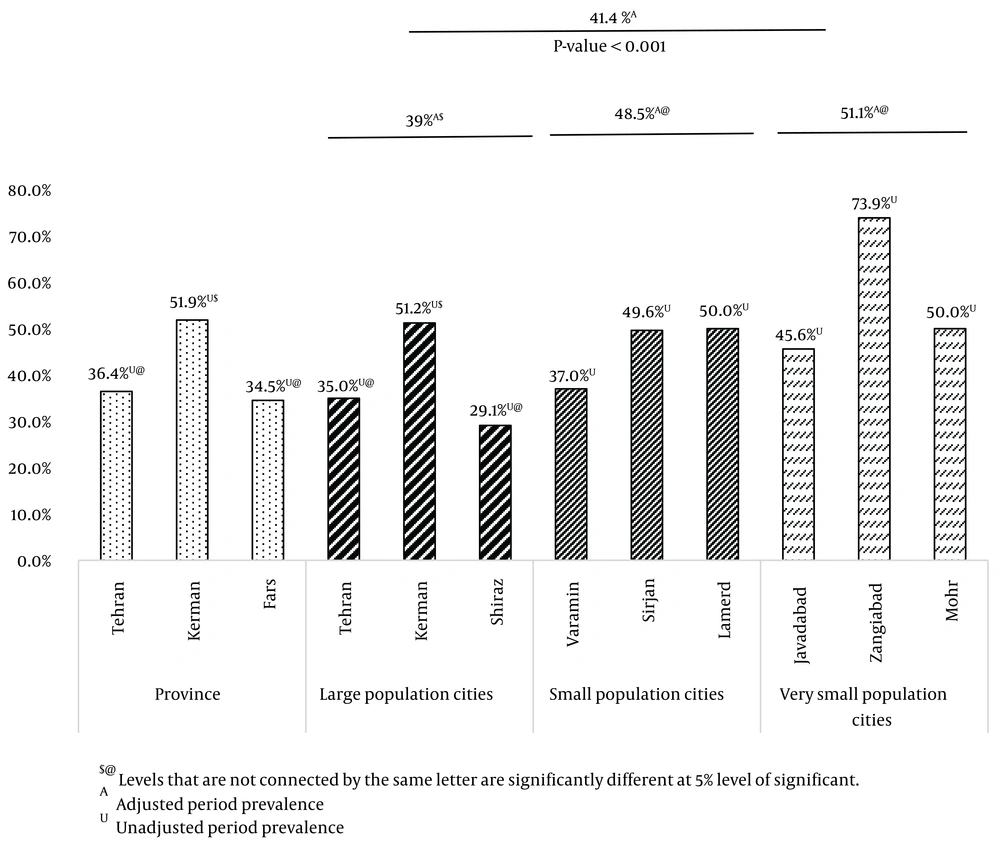
Figure 1.
Prevalence of toothache during the last 6 months in sampling areas
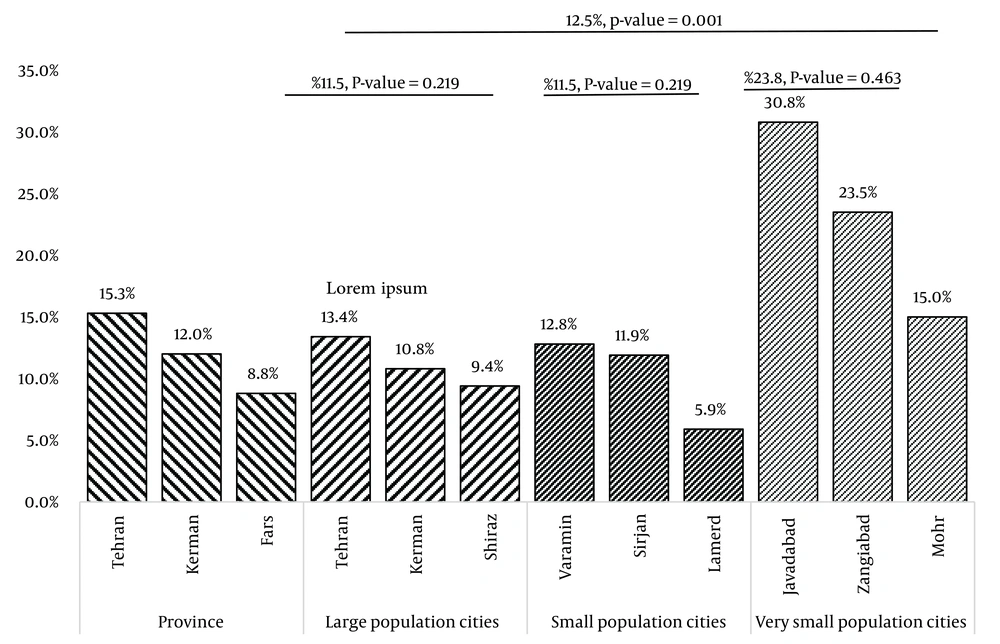
Figure 2.
Prevalence of student absenteeism in the last 6 months in sampling areas
4.2. Multivariate Analysis
Participants whose father was illiterate had a higher chance of toothache (adjusted OR = 1.8, P = 0.003), while this chance was different in the participants whose fathers had a middle school degree and diploma (AOR = 1.15, P = 0.368) than those whose father had at least a university degree. Those who had never brushed with toothpaste (AOR = 1.95, P = 0.047) or sometimes brushed their teeth (AOR = 1.92, P = 0.001) were more likely to experience toothache than those who had brushed twice a day or more. Those who had never flossed (AOR = 2.24, P = 0.001) or had flossed occasionally (AOR = 2.39, P = 0.001) were also more likely to experience toothache than those who had flossed regularly. The chance of toothache was much higher in those who visited a dentist in the last 6 months than in those who did not (AOR = 5.88, P < 0.001; Table 2).
Table 2.
Adjusted Odds Ratios for Toothache Prevalence
| Variables | Adjusted Odds Ratio | 95% CI | P-Value | |
|---|---|---|---|---|
| Lower | Upper | |||
| Sex | ||||
| Female | 0.96 | 0.76 | 1.22 | 0.735 |
| Male | 1 | |||
| Mothers’ employment status | ||||
| No | 1.03 | 0.78 | 1.37 | 0.819 |
| Yes | 1 | |||
| Mother’s education | ||||
| Illiterate and elementary school | 1.14 | 0.73 | 1.76 | 0.565 |
| Middle school and high school | 1.22 | 0.91 | 1.64 | 0.190 |
| Above high-school diploma | 1 | |||
| Father’s education | ||||
| Illiterate and elementary school | 1.8 | 1.23 | 2.64 | 0.003 |
| Middle school and high school | 1.15 | 0.85 | 1.54 | 0.368 |
| Above high-school diploma | 1 | |||
| Dental visit in the last 6 months | ||||
| No | 0.17 | 0.13 | 0.22 | < 0.001 |
| Yes | 1 | |||
| Brushing with toothpaste | ||||
| Never | 1.95 | 1.05 | 2.87 | 0.047 |
| Sometimes | 1.92 | 1.32 | 2.79 | 0.001 |
| Once a day | 0.95 | 0.67 | 1.35 | 0.761 |
| Twice a day or more | 1 | |||
| Flossing teeth | ||||
| Never | 2.24 | 1.4 | 3.58 | 0.001 |
| Sometimes | 2.39 | 1.5 | 3.8 | < 0.001 |
| Once a day or more | 1 | |||
| Use of mouthwash | ||||
| No | 1.01 | 0.72 | 1.41 | 0.973 |
| Yes | 1 | |||
5. Discussion
This study highlights the high prevalence of toothache among 12-year-old students in Iran, with 41% of the participants experiencing toothache in the past 6 months. Cities with smaller populations had a higher prevalence of toothache, which may be due to limited access to dental services or a lack of awareness of the residents about oral health. Additionally, the study identified a correlation between the educational level of fathers and the prevalence of toothache in their children; those whose fathers had lower education experienced higher levels of toothache. These findings suggest a need for targeted efforts to improve access to dental services and education programs aimed at promoting good oral hygiene practices, particularly in areas with a higher prevalence of toothache and absenteeism.
Note that the 12-year-old children in our study were only those attending school. Although this population covers a significant proportion of 12-year-old children, the estimates of our study may be a lower bound, as 12-year-old children who have dropped out of school are expected to have a higher prevalence of toothache. We estimated the country-level prevalence of toothache in 12-year-old children at 41%. According to a systematic review of the global prevalence of toothache among children aged 6-12 years in 2020, the prevalence was 40% [95% CI = (33.3, 50.2)] in 2021 (20) and 36.2% [95%CI = (33.0,39.42)] in 2022 (16). In Iran, the prevalence of toothache in 12-year-old children is remarkably close to the global prevalence. The prevalence of toothache in Asia for all ages is estimated to be 36.8% [95% CI = (32.3, 44.8)]. While the prevalence of toothache in Iran falls within the 95% confidence interval of the prevalence in Asia, the point estimate of toothache incidence in 12-year-old children in Iran is significantly different from that in Asia. This difference may be due to differences in age categories used to calculate the two prevalence estimates. As the first study to estimate toothache prevalence at the national level, there is currently insufficient data to compare our results to other country-level estimates.
The prevalence of toothache in Kerman Province (51.9%) was higher than that in Tehran and Fars provinces. A study by Bashirian et al. (22) reported a toothache prevalence of 71.2% among 7 to 8-year-old children in Hamadan Province, Iran, over a year and confirmed the high prevalence of toothache among children. Kakoei et al. (21) estimated the toothache prevalence in the center of Kerman Province to be 55.1% [95% CI = (52.8, 57.3)]. In 2019, the prevalence of toothache in children was estimated at 51.2% [95% CI = (45.7, 56.6)] using the same questionnaire as that used in our study; this indicates the high and unchanged prevalence of toothache in Kerman Province over time. As the prevalence of toothache in Kerman Province was higher than that in the Fars and Tehran provinces, there is a need to encourage preventive policies and provincial plans that include immediate dental care to reduce dental problems and improve oral health in the province. Identifying problems through various studies in this field can be useful in enacting such policies.
The fathers’ education was found to be significantly associated with the prevalence of toothache in children. Several studies showed that parental awareness of children’s health conditions is associated with the prevalence of toothache (16-19, 23). Parents’ education could be a surrogate variable of parental awareness of children’s health conditions, and the association can be attributed to parents’ awareness. This study showed that the mothers’ education had a significant association with children’s toothache prevalence in the univariate analysis but not in the multivariate analysis. This discrepancy may be because the parents’ education levels are typically similar, and the father’s education has a more significant impact on the family’s economic status in Iran. The data also revealed that the mothers’ employment status was not significantly associated with the prevalence of toothache in children. Previous research has revealed that children from families with higher socioeconomic status tend to have better oral health and lower rates of dental caries (30). Iran has been subjected to severe sanctions and economic pressures over the past 5 years, leading to a significant increase in household expenses, particularly medical expenses (31-34). Low-income families may have difficulty maintaining good oral hygiene due to a lack of financial resources, with necessities such as food, housing, and clothing taking priority over oral hygiene products such as toothbrushes, dental floss, and mouthwash. Further research is needed to investigate the effects of mothers’ education and employment status on the prevalence of toothache in children.
The present study demonstrated that the prevalence of toothache was significantly higher in children living in towns than in cities. It would be compelling evidence of geographic disparities in oral health in Iran. People who live in deprived areas with limited access to dental services appear to have more untreated caries and experience more pain (15, 25, 26). A study in Tanzania showed that toothache prevalence was higher in children in rural areas than in children in urban areas, which is consistent with the results of the present study (35). Consistent with the results of this study, the study by Lotfi et al. on the distribution of healthcare resources in Iran found evidence of a balanced distribution of dental care resources among the provinces (36). Still, there was a significant difference within the provinces. There is also strong evidence indicating that residents of small areas have lower functional health literacy than their urban counterparts (37, 38).
The prevalence of toothache was found to be significantly higher in children who had visited a dentist in the past 6 months compared to those who had not had a dental examination. In line with this result, it was shown that caries are the main cause of toothache in children (15, 24-26), and regular dental visits were associated with a reduced prevalence of toothache (27). This suggests that children only seek dental care when they experience pain. This finding is consistent with the results of previous studies, which have also demonstrated a higher prevalence of toothache in children who infrequently or irregularly use toothbrushes and dental floss (20, 39-41).
The study had some limitations, including a lack of financial and logistical resources to collect more data. Moreover, children with parents who were both illiterate and those who had dropped out of school were excluded, which may have underestimated toothache prevalence. Future studies should consider these groups to obtain a more comprehensive understanding of the issue. Health literacy and informed consent should also be taken into account. Another limitation of the study was its reliance on parent-reported toothache prevalence, which may be subject to reporting bias. Future studies could explore the use of self-reports by children. Additionally, the oral health and toothache status of children who have dropped out of school, as well as the influence of socioeconomic factors, the status of tooth decay, and psychological factors on tooth decay prevalence in children, merit investigation.
5.1. Conclusions
This study found that 41% [95%CI = (38.4, 43.5)] of 12-year-old students had experienced toothache in the past 6 months. This result highlights the high prevalence of toothache among schoolchildren in Iran, with a significant association with demographic, socioeconomic, and behavioral factors. The findings emphasize the need for public health interventions aimed at promoting oral health awareness and education among parents, children, and healthcare providers, especially in low-income and rural areas. The results also suggest the need for equitable access to dental care services and resources, including preventive and curative measures, to reduce the burden of toothache among children. Further studies are needed to explore the underlying mechanisms and risk factors associated with toothache among children, as well as the effectiveness and sustainability of interventions to improve oral health outcomes.