
1. Context
The blood oxygen level-dependent (BOLD) contrast effect generated by the coupling of cerebrovascular flow and neural activity is used in functional magnetic resonance imaging (fMRI), a noninvasive technique. The increase in cerebral blood flow that occurs as a result of neuronal activity causes a relative increase in oxyhemoglobin concentration and a relative decrease in deoxyhemoglobin concentration (1).
The use of fMRI to evaluate children's brains is becoming increasingly popular. Many brain functions, such as language, memory, learning, and cognitive human functions, have been mapped using this technique; these had previously been impossible to study using imaging procedures. The fact that fMRI provides a functional examination with the resolution, attractiveness, cost-effectiveness, variety, and convenience of anatomical exams is part of its success (2).
Dyslexia, autism spectrum disorders, attention-deficit/hyperactivity disorder (ADHD), speech delay, schizophrenia, and stuttering are just a few of the neurological and psychiatric pediatric diseases that have been researched by fMRI. Regardless of the severity of the disease, no clear chemical, genetic, or anatomical indicators have been identified, which has been a barrier to medicine. In many of these illnesses, functional MRI findings have been described, although the impact of these findings is still being studied (3).
Since its inception in the early 1990s, the field of fMRI has continued to grow, bringing to light numerous previously hidden mental processes, revealing their nature, and paving the way for better understanding, treatment, and control. It used to be possible to sit down and study the entire fMRI literature in a week, but now, it is nearly impossible to read all the related articles published even in the last week. Most authors, institutes, and larger organizations may not be aware of the crucial elements of pediatric fMRI research or the best approach to invest their time and efforts in this field.
The ability to study scientific problems is the highest level of knowledge. Although the quantity of publications can show productivity, it is not a genuine indicator of research quality or impact. Scientometrics is a basic bibliographical instrument that quantifies a research's academic status and professional renown in terms of productivity, quality, and impact (4).
Scientometrics aims to evaluate the most recent advances in research and scientific activities and uncover their hidden essential elements, such as evolution patterns, overpriced or underpriced themes, author networks, current trends, and well-known authors or institutions. As a result, it assists researchers by allowing them to do more tailored and aligned studies with the least amount of waste of available resources (5). The goal of this study was to conduct a bibliometric global analysis of research literature focusing on fMRI to gain a better overall understanding of functional MRI publications and to use this information in policy and management contexts to make more efficient decisions.
2. Methods
Our objective in this scientometric study was to describe the state of the art of scientific publications related to the development of research on fMRI in pediatrics. We used a combination of data mining methods to show the current research status, hotspots, and trends in this field. Citation data used in bibliometric research was downloaded from the 1990s to the end of 2021 in Scopus, based on the theme of fMRI in pediatrics in title, abstract, keywords, and MeSH terms.
The Scopus database was selected for this bibliometric study, as it is the largest and one of the most reliable databases for publications and citations, combining the characteristics of both PubMed and Web of Science (6, 7).
The search was confined to articles. Other types of documents were excluded from this study. The retrieved research articles from these databases were analyzed and visualized with the Bibliometrix package in R software individually for each database to explore the inner knowledge structure of the field. The level of significance in this study was set to P-value<0.05. Results are illustrated in tables, graphs, and networks.
3. Results
Our search resulted in 8,544 documents consisting of different types of articles, 1,167 of which were reviews. These documents were retrieved from 1,279 sources, including journals and books, and were written by 25,697 authors, 333 of whom had written at least one single-authored article. The main information of the included articles, including the number of authors per document, citations, collaboration index, and authorship characteristics, are summarized in Table 1. Also, the first 5 articles mentioning the use of fMRI in pediatrics were written from 1992 to 1994, and their general information, including their titles, citation numbers, and journals, are available in the Supplementary File.
Table 1.
Main Information of the Articles
| Description | Results |
|---|---|
| Main information about the data | |
| Timespan | 1992 - 2021 |
| Sources (Journals, Books, etc.) | 1279 |
| Documents | 8544 |
| Average years from publication | 7.65 |
| Average citations per document | 44.77 |
| Average citations per year per document | 4.356 |
| Document types | |
| Article | 7377 |
| Review | 1167 |
| Authors | |
| Authors | 25697 |
| Author appearances | 56173 |
| Authors of single-authored documents | 333 |
| Authors of multi-authored documents | 25364 |
| Authors' collaboration | |
| Single-authored documents | 365 |
| Documents per author | 0.332 |
| Co-authors per document | 6.57 |
| Collaboration index | 3.1 |
The annual number of documents on fMRI in pediatrics is rising enormously, like the general theme of fMRI, from less than 10 annual studies in the early years to approximately 900 annual studies nowadays. Besides, the average number of citations per article is in the shape of a bell curve with a left skew, while the average total citations are compatible with a right-skewed bell shape (Appendices are illustrated in the Supplementary File). The most-cited articles and the articles with the highest number of total citations are also summarized in the Supplementary File.
The top 10 authors in the field of fMRI in pediatrics regarding the number of articles, their dominance factors (DFs), and types of documents are given in Table 2. Table 2 demonstrates that Pine DS, Leibenluft E, and Holland SK are respectively the top 3 authors regarding the number of publications in the field; however, Rubia K, Wang J, and Li Y are respectively the top 3 authors regarding their DF. The DF indicates a ratio of the fraction of multi-authored publications in which an author appears as the first author (DF 1 means that an author is the first author in all of his or her multi-authored papers) (8).
Table 2.
Some Information About the Top 10 Authors
| Author | Dominance Factor (DF) | Total Articles | Single-Authored | Multi-Authored | First-Authored | Rank by Articles | Rank by DF |
|---|---|---|---|---|---|---|---|
| Rubia K | 0.2754 | 70 | 1 | 69 | 19 | 6 | 1 |
| Wang J | 0.2500 | 72 | 0 | 72 | 18 | 5 | 2 |
| Li Y | 0.2258 | 62 | 0 | 62 | 14 | 9 | 3 |
| Booth JR | 0.1486 | 74 | 0 | 74 | 11 | 4 | 4 |
| Wang Y | 0.1111 | 63 | 0 | 63 | 7 | 8 | 5 |
| Zhang Y | 0.0645 | 62 | 0 | 62 | 4 | 9 | 6 |
| Holland SK | 0.0440 | 91 | 0 | 91 | 4 | 3 | 7 |
| Leibenluft E | 0.0421 | 95 | 0 | 95 | 4 | 2 | 8 |
| Pine DS | 0.0350 | 146 | 3 | 143 | 5 | 1 | 9 |
| Dapretto M | 0.0312 | 64 | 0 | 64 | 2 | 7 | 10 |
The publication timeline of the top 10 authors is illustrated in the Supplementary File; the darkness of the color of circles for each author in each year accounts for the number of total citations (TC) per year, and the size of the circles accounts for the annual number of articles published by the author. In this regard, Pine DS, Booth JR, Rubia K, Dapretto M, and Wang Y are among the authors with the longest period of activity in the field; among whom, Pine DS and Rubia K seem to have the highest number of citations for their publications. However, authors such as Zhang Y and Li Y have started publication in the field with a 10-year delay in comparison to the previously mentioned authors and currently have a higher number of current studies in the field.
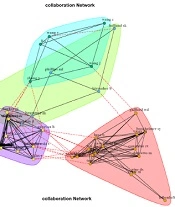
Furthermore, the collaboration network for the top authors indicates that Rubia K has direct collaboration with Holland SK, while Wang J, Wang Y, Zhang Y, and Li Y form a collaboration network, and Pine DS, Leibenlift E, and Dapretto M share another collaboration network; these networks have indirect connections with each other with the help of intermittent authors. The collaboration network of the top 50 authors of the field is illustrated in Figure 1A. Moreover, the top 20 universities shape 2 main collaborative networks with intermittent connections (Figure 1B).
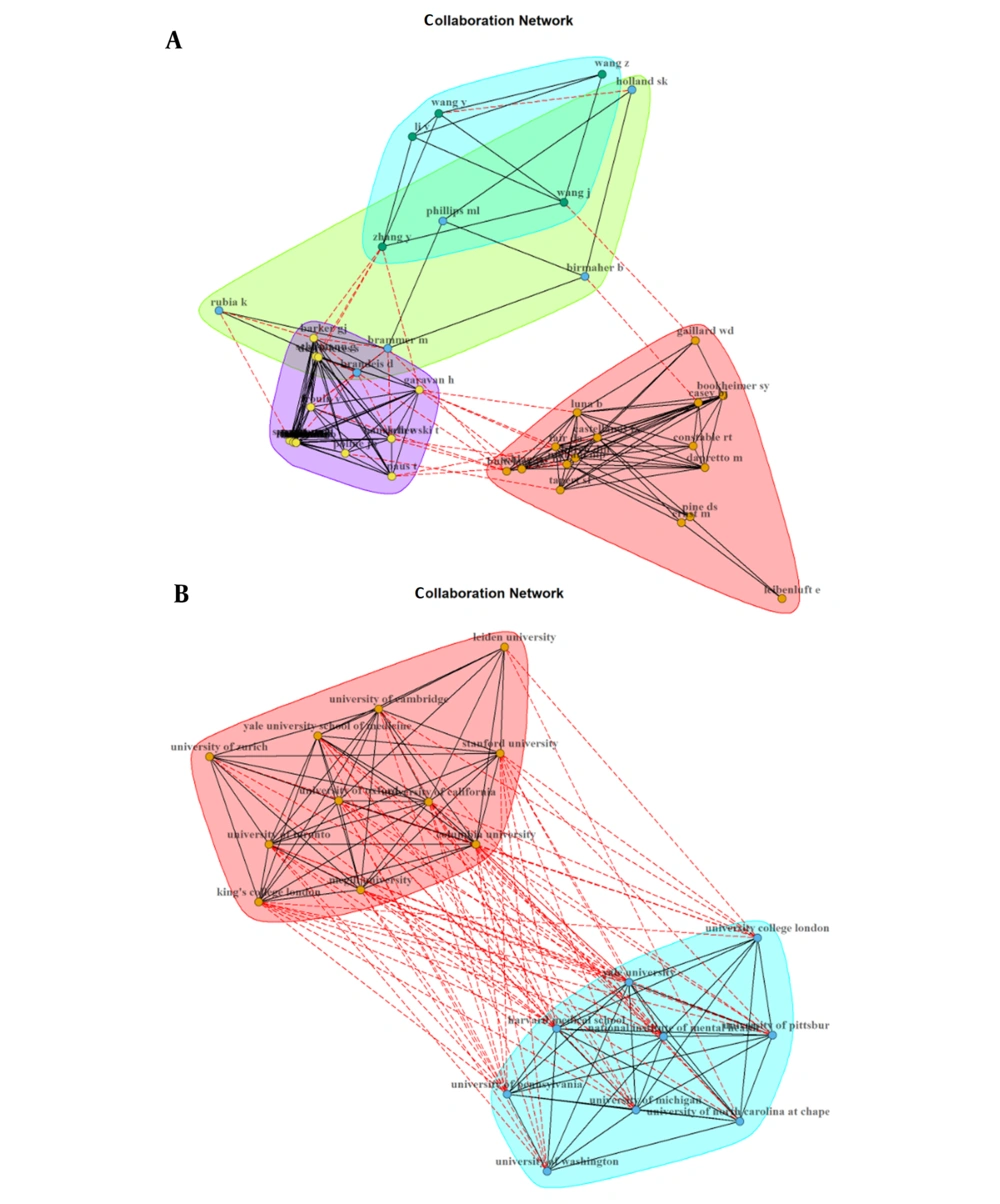
Figure 1.
Collaboration network of the top (A) 50 authors and (B) 20 universities
The United States of America (USA) is by far the most productive country in the field, with a total of 3 609 publications (accounting for 45.08% of all the publications in this field) and a multi-center publication (MCP) ratio of 0.171, followed by China and Germany with 655 and 562 documents and MCP ratios of 0.279 and 0.365, respectively (Top 10 countries in the field and their MCP ratios are illustrated in Figure 2). However, regarding the average article citations, Sweden is at the top of the list with 77.79 average citations, followed by the United Kingdom and the USA with 68.82 and 59.67 average citations, respectively (Top 10 countries regarding total citations and average article citations are summarized in the Supplementary File).
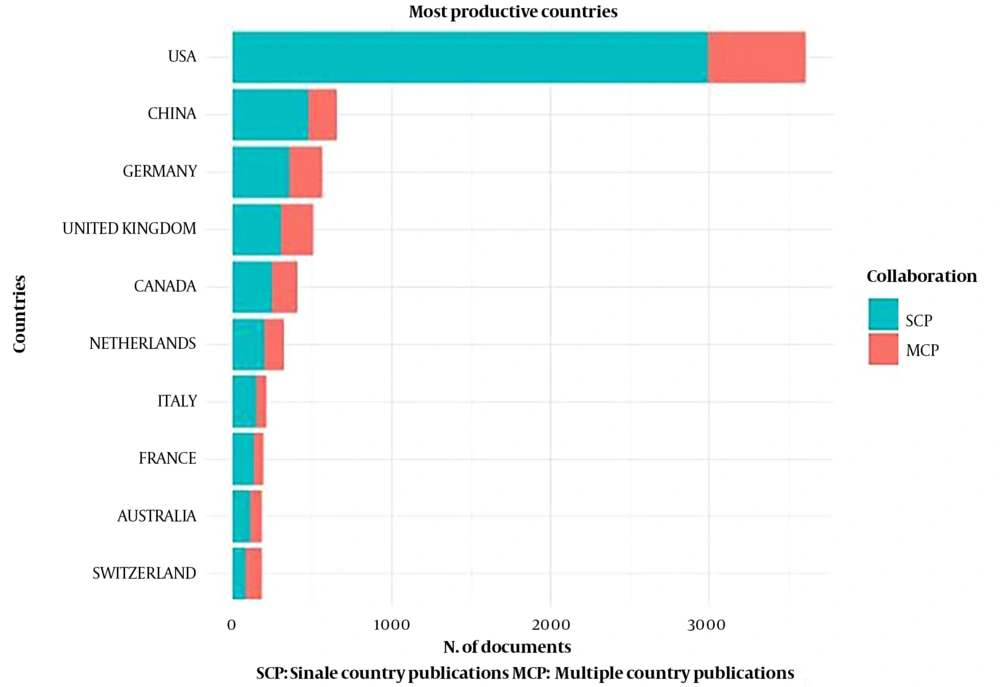
Figure 2.
Most productive countries in the field of fMRI in pediatrics. SCP, Single-country publications; MCP, Multi-country publications
Neuroimage, Human Brain Mapping, and Developmental Cognitive Neuroscience are the journals with the highest number of articles published in the field of fMRI in pediatrics. However, while Developmental Cognitive Neuroscience started publishing articles in the field with almost 10 years of latency in comparison to the Human Brain Mapping journal, it currently publishes more related articles. The top 10 journals regarding the number of publications in the field, along with the timeline of the top 3 journals, are available in the Supplementary File.
The thematic map of the article clusters in the field, based on their titles and abstracts, is represented in Figure 3. The X-axis represents the centrality (i.e., the degree of interaction of a network cluster in comparison with other clusters) and gives information about the importance of a theme. The Y-axis symbolizes the density (i.e., measures the internal strength of a cluster network and can be assumed as a measure of the theme's development) (9). Accordingly, well-developed and important themes in the field of fMRI in pediatrics include studies of emotion, autism spectrum disorders, ADHD, childhood maltreatment, bipolar disorders, and epilepsy surgery. Also, highly developed and isolated themes with limited importance for the field include frontal and temporal lobe studies, cerebral palsy, epilepsy, and electroencephalogram (EEG)-based studies. Furthermore, emerging or declining themes, which are weakly developed, include systematic reviews, injury and trauma studies, pain studies, and studies on the prefrontal and visual cortex and the anterior cingulate. Finally, basic and transversal themes concerning general topics that are transversal to different research areas include language, memory, motor, stress disorder, and cognitive control.
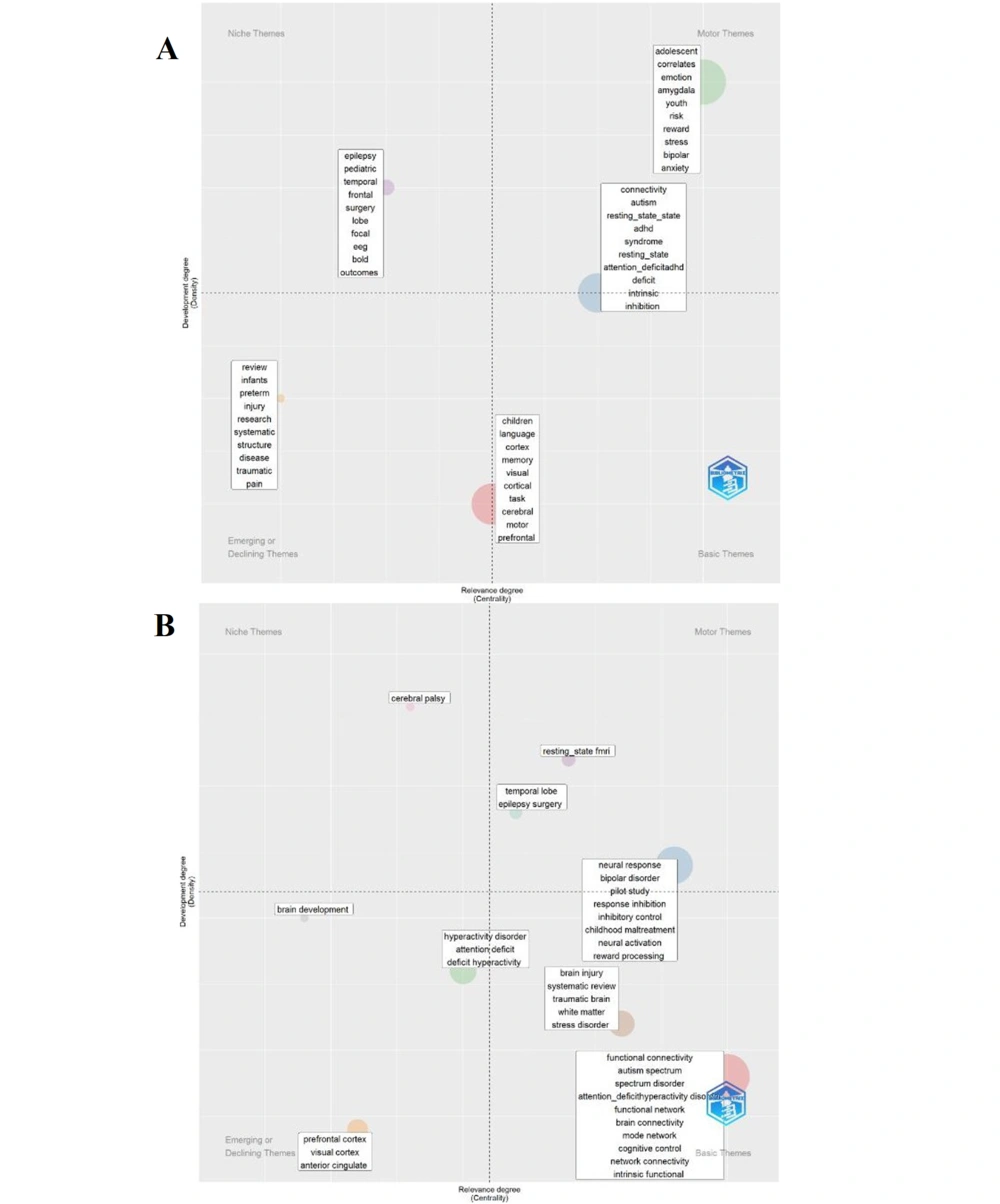
Figure 3.
Thematic map plotted based on (A) single words and (B) double words in the titles and abstracts of the included studies.
We conducted a three-field plot analysis to determine the areas of interest and their evolution over the years. This study establishes a link between the years 1992 to 2007, 2008 to 2013, 2014 to 2017, and 2018 to 2021. The results of the three fields' plots for double-word themes are illustrated in Figure 4. This figure summarizes the most prevalent words studied in each timeline and their evolution to new themes in the next timelines.
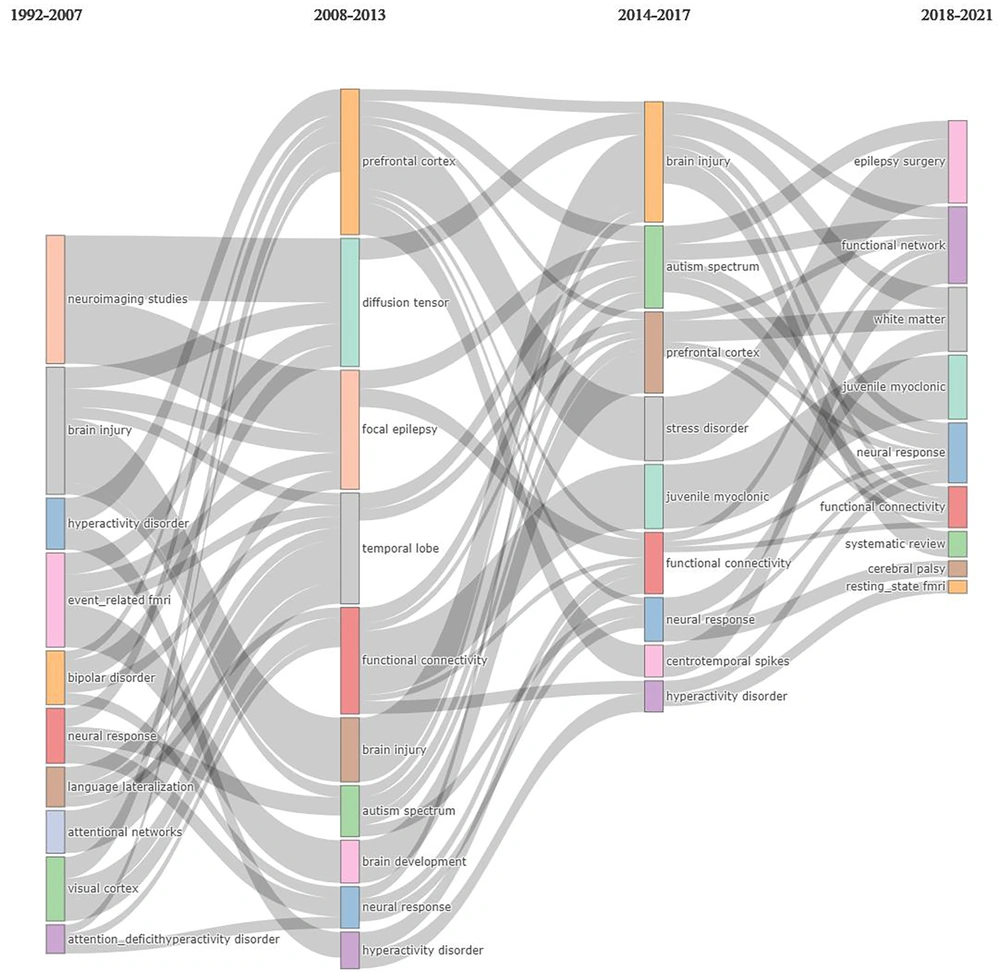
Figure 4.
Thematic evolution map plotted based on double words in the titles and abstracts of the included studies.
4. Discussion
This study provides a thorough review of fMRI in pediatrics, including information on the number of documents, authors, collaboration networks, nations, and thematic analysis. It provides insightful information about the state of research in this area and highlights its rapid development over time. The fact that there are now more documents every year, up to 900 annually, shows that there is a substantial and ongoing interest in this field. Additionally, a greater knowledge of the major contributions to this discipline is provided through the examination of top authors, their DFs, and collaborative networks.
It is clear that our study adds to their findings when compared to other reviews published in this field. While our study goes into the scientometric aspects of the area, older studies mostly concentrated on the usability and applicability of fMRI in pediatric settings, touching upon technical and clinical concerns. With a larger perspective on the advancement of fMRI research in pediatrics, our work offers crucial data that serves as a backdrop to the clinical and technical discussions in these research papers (2, 10, 11).
Functional MRI has been widely employed in pediatric research to better understand active and resting state networks in the brain. A number of fascinating scientific issues have already been addressed with fMRI in children, but there are still many more unanswered. Many of these are only addressed in youngsters, whose neurological characteristics differ from those of adults. Understanding normal function development appears to be critical in addressing a wide range of neurological problems in both children and adults, and these once-in-a-lifetime possibilities should not be passed up (10).
Some clinical uses of fMRI are nearly ready for widespread usage, but many practical problems remain unanswered. Complex acquisition and post-processing challenges, in particular, continue to necessitate significant local experience and background so that we not only properly acquire but also critically appraise fMRI results. Constant technical and theoretical advancement, on the other hand, will bring the ideal of a rigorous and regular examination of pediatric neurosurgery patients closer to reality (12). However, due to the large number of publications on this topic, it may be difficult and deceiving, particularly for researchers with less expertise in the field, to identify the proper study theme and stay up to date. This is the condition that emphasizes the importance of doing bibliographic investigations on the topic, identifying current ideas, old topics, and themes that need to be focused on further, and providing researchers and corporations with a good description of the study path so that they may invest their time and money more efficiently.
To the best of our knowledge, although many reviews have been published on the overall applications of the fMRI in pediatrics (13-15), no previous scientometric studies have been conducted in this respect to give a more detailed and clear description of different aspects of the previously published articles on fMRI in pediatrics, regarding the authors, countries, affiliations, subjects, and so on.
Our results show that the most productive countries in the field are not necessarily the countries with more citations and average citations per article. For instance, Sweden, with relatively fewer publications in the field, ranking it out of the top 10 countries regarding productivity, has the highest number of average citations per article; however, the USA, with the highest rate of productivity, is in the third place regarding the average number of citations. This comparison can be extended to all the top-listed countries mentioned in the Results section. Although the number of citations is not a complete index for the quality of an article, we should still keep in mind not to judge or rank the countries only by taking their productivity index into account.
The same discussion can be made regarding the top listed authors in the field since the authors with the highest number of published articles in this field are not the authors with the highest number of first-authored articles or the highest DF; in contrast, they have relatively lower rates of first-authored articles or DF (number of first-authored articles divided by the number of multi-authored articled), showing that the reason for their higher number of articles in the field is their working as a random author in big groups, resulting in more publications (16). Therefore, it is better not to discuss the authors of the field only by the number of their articles instead of taking their DF and number of first-authored publications into account.
The most useful results gained from this study are the thematic maps, showing that studies of emotion, autism spectrum disorders, ADHD, childhood maltreatment, bipolar disorders, and epilepsy surgery are of more importance in this area, while frontal and temporal lobe studies, cerebral palsy, epilepsy, and EEG-based studies are nowadays considered old themes and are limited. Furthermore, systematic reviews, injury and trauma studies, pain studies, and studies on the prefrontal and visual cortex and the anterior cingulate are weakly developed and may become more popular in the future if they become more developed by researchers and become worthy of investment. The weak development of injury and trauma in this field may be due to its emergency condition, which requires immediate medical action. However, with the development of more practical tools in the future, this theme may become more popular and may be among the trend topics in the field.
This study has used the specific scientometric package R software, which is well-known for its well-developed graphs that make it possible to obtain the highest amount of analysis out of bibliographic results (17). The results of the present study can also be discussed in numerous methods by the readers in terms of making all kinds of comparisons between the authors, companies, topics, and available networks (which could not be discussed in the present article because of the description limitations) and help the individuals to get the most out of their research in the field by working more directly and wasting less time and money. This approach will ultimately result in more rapid development of the theme in the future and the use of the fMRI technology for pediatrics of both clinical and research as soon as possible.
There are several potentials for new researchers to make significant contributions to the field of pediatric fMRI. They can expand scientific knowledge and improve the clinical results of pediatric patients by working with established leaders, filling in research gaps, following topical trends, and upholding ethical considerations. Pediatric fMRI research is interdisciplinary, necessitating open-minded collaboration and a dedication to ethical research methods.
Pediatric fMRI research productivity and trends are directly related to pediatric neuroimaging's practical uses and effects. They support the improvement of clinical diagnoses, individualized therapies, ethical standards, and the development of an informed and cooperative community. The area remains active and responsive to changing clinical demands thanks to the discovery of developing themes. The real-world applications and impacts on the diagnosis and treatment of juvenile neurological diseases are anticipated to become more prominent as pediatric fMRI research develops.
Nevertheless, it is important to keep the limitations of the present study in mind. For instance, the greatest limitation of this study is using only one database for performing the scientometric analysis since it was not possible to overlap the results of different databases with the packages used herein. Also, this study does not provide an in-depth analysis of research content as a systematic review may offer. Due to the high number of included studies, we focused on quantity, rather than quality, of publications, and it was not possible to perform a quality assessment of the included studies; therefore, this study is susceptible to data biases. Therefore, it is highly recommended that upcoming studies focus on a smaller group of included articles and perform a quality assessment of the included articles.
We further recommend that future bibliometric or systematic studies of pediatric fMRI should concentrate on examining sex variations in authorship, tracking keyword changes over time, and examining the effects of funding sources. Additionally, these studies should use qualitative content analysis, look at international collaboration networks, assess citation networks, and perform longitudinal analyses of author productivity. They can also gauge the effectiveness of open scientific projects, chart the development of a theme through time, analyze real-world effects, explore patterns in collaboration in multi-center and multidisciplinary research, and examine ethical issues in research procedures. Another crucial area for investigation is the level of public and patient involvement in determining research goals. This will give researchers a thorough grasp of the field's dynamics and its potential to improve pediatric healthcare.
4.1. Conclusions
In conclusion, due to the large number of publications in pediatric fMRI, it may be difficult and deceiving, particularly for researchers with less expertise, to identify the proper study of the theme and stay up to date. The present study demonstrated a quantitative scientometric method and explored fMRI research in pediatrics by using references published in the Scopus database. The results will be helpful for professional workers to visually understand the pediatric modes and trends in fMRI.