


Full Text
Full text is available in PDF
IJ Radiology
Magnetic resonance Imaging (MRI) is increasingly used for detailed visualization of the fetus as well as pregnancy structures although ultrasound(US) remains the predominant modality for evaluating disorders related to pregnancy overall. MRI does not have the limitations of US thanks to its multiplanar capability, lack of ionizing radiation, and excellent soft-tissue contrast. The most common indications for fetal MRI are neurological. MRI is commonly used to investigate underlying etiologies of brain abnormalities that are not detected by US. Cortical malformations, heterotopias and anomalies of the corpus callosum are well depicted by MRI. It can confirm the diagnosis of ventriculomegaly or other associated abnormalities not detected by sonography. Posterior fossa abnormalities that can be evaluated by prenatal MRI include Dandy-Walker syndrome, Dandy-Walker variant, mega cisterna magna (> 10 mm), arachnoid cyst and Chiaris malformation type II. Evaluation of the spinal column is important to detect abnormalities such as neural tube defects.
We intend to investigate the prenatal MRIs performed in our center for frequency of different central nervous system anomalies.
In a cross sectional retrospective study, from September 2011 to December 2013 pregnant women referring for fetal MRI with suspected anomalies diagnosed in prenatal ultrasound were included in the study. All MRIs were done on a 1.5 T Siemens Avanto Magnet with a 4 channel body coil. Mothers with GA of 20 weeks or above were examined in the right tilt position. Sequences include T2 HASTE, Trufisp images 6 mm thick in axial, coronal and sagittal planes to mothers body. T2 HASTE and Trufisp images were also taken with 4 mm slice thickness relative to specific fetal body part being evaluated. T1 flash images were obtained in at least one plane based on clinical indication. We investigated the available images for any abnormality in central nervous system. Descriptive analysis was done on the collected data to achieve the index of frequency.
Most of patients (74%) were referred with primary impression of borderline ventriculomegally on ultrasound. A total of 11 patients out of 60 (18.3%) were found to have CNS anomalies and others were normal neurologically. Detected anomalies were as follows: 3 fetuses had complete agenesis of corpus callosum (27.2%), 2 had partial agenesis of corpus callosum (18.18%), 2 had myelomeningocele (18.18%) and 2 had Dandy-Walker variant (18.18%). Chari II malformation, aqueductal stenosis, tethered cord, schizencephaly and enlarged cisterna magna were anomalies presenting each in one patient (9%). 3 of the patients had concomitant findings.
MRI is superior to ultrasound in detection of CNS anomalies which seems to over diagnose some brain anomalies and miss some others. Although most of the patients were provisionally diagnosed with ventriculomegally, the majority of them came as normal. Just 18.3% of fetuses had CNS anomalies with complete agenesis of corpus callosum as the most common finding. Other findings were partial agenesis of corpus callosum, myelomeningocele, Dandy-Walker variant, Chari II malformation, aqueductal stenosis, tethered cord, schizencephaly and enlarged cisterna magna, in order of frequency.
© 2014, Author(s). This open-access article is available under the Creative Commons Attribution 4.0 (CC BY 4.0) International License (https://creativecommons.org/licenses/by/4.0/), which allows for unrestricted use, distribution, and reproduction in any medium, provided that the original work is properly cited.
Sefidbakht S, Dehghani S, Safari M, Vafaei H, Kasraeian M. Fetal Central Nervous System Anomalies Detected by Magnetic Resonance Imaging: A Two-Year Experience. Inn J Pediatr. 2016;26(4):e4589. doi: https://doi.org/10.5812/ijp.4589
Ghavami M, Abedinzadeh R. Prevalence of Perinatal Central Nervous System Anomalies in East Azarbaijan-Iran. I J Radiol. 2011;8(2):. doi:
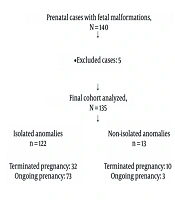
Shirazi M, Mohammadi E, Feizabad E, Rahimi Sharbaf F, Sahebdel B, et al. Prenatal Central Nervous System Malformations: Patterns and Outcomes at a Referral Center. Inn J Pediatr. 2026;36(4):e169649. doi: https://doi.org/10.5812/ijpediatr-169649
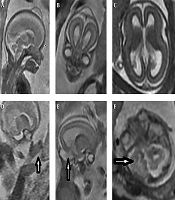
Tahmasebpour AR, Moradi B, Kazemi MA. A Case of Apert Syndrome: Early Detection of Temporal Lobe Abnormalities and Scalp Cyst in Fetal Brain MRI. Inn J Pediatr. 2020;30(6):e103841. doi: https://doi.org/10.5812/ijp.103841
Tahmasebi M, Afsar N, Bastani M. Accuracy of Ultrasound in Detection of Gross Prenatal Central Nervous System Anomalies after the Eighteenth Week of Gestation . I J Radiol. 2007;4(4):e79082. doi:

Checking
Last Update: 2 weeks ago
Last Update: 2 weeks ago
Last Update: 2 weeks ago
Last Update: 4 days ago
Ordering Reprints
Articles are published under the Creative Commons license stated on each article. No permission or royalty fee is required for uses permitted by that license. CCC handles optional bulk and customized reprint orders. Any quotation covers production and delivery services only, not copyright permission. > Request Reprints from CCC
Author(s):