
1. Background
Despite conspicuous advances and improvements in child health, malnutrition still remains one of the main public health challenges in Iran and some other developing countries (1). In the year 2011, almost 6.9 million children under 5 years died worldwide, a large proportion of deaths being related to increased susceptibility to illnesses due to undernutrition (2). Malnutrition has decreased in Asia (3) affecting preschool children from 16.0% in China to 64.0% in Bangladesh (4). Globally, it is estimated that childhood stunting (short stature for age) reduced from 34% to 27% and underweight from 27% to 22%, between 1990 and 2000 (5) and stunting is predicted to reduce to 22% by the next decade. However, evidence shows that global estimates cannot be used to monitor progress at regional level (6).
Anthropometry is an easy tool for assessing nutritional status in individuals and communities and offers the advantages of objective evidence with relatively low technology. The childhood malnutrition is complex and the etiology involves biological, cultural, and socioeconomic influences (7). Consequently, secular growth differences among ethnic groups have been seen in the United States (8). The role of genetic factors on the secular growth was shown in Sri Lankan Australian children (9) using free fat mass (FFM) instead of body mass index (BMI) in filed studies (10). Researchers recommend to design a regional growth chart (11).
Of 1,700,000 populations in Golestan province (north of Iran), 43.9% and 56.1% are living in urban and rural area, respectively. The main job of rural population is agriculture and different ethnic groups such as Fars-natives, Turkmans and Sistanis are living in this region (12).
2. Objectives
Beside obesity, under nutrition and growth failure are the health problems in Iranian children (13). This study was conducted to compare the nutritional status of under-five children among three ethnic groups (Fars-native, Turkman and Sistani) during 15 years. This is carried out in a three steps study in rural area in Golestan province (south east of Caspian Sea). Data on children with under nutrition trends will help to establish a proper prevention program.
3. Patients and Methods
Totally, 7575 subjects were evaluated in three cross-sectional studies. The first study was conducted on 2339 children in 2004 (14), the second on 2749 children in 1998 (13), and the third study on 2487 children in 2013. 20 out of 118 villages were chosen by random sampling and all of under-five-children enrolled in the study. The sample villages were constant in all three studies. With resumption of 40% rate (13), a confidence level of 95% and a maximum marginal error of about 0.02, the sample size was calculated at least 2304 subjects.
Anthropometric measurements of the children were performed in light dress and without shoes in the morning. Body-weight was measured to the nearest 0.1 kg using a balanced-beam scale, and height was measured to the nearest 0.5 cm while standing up with head, back, and buttock on the vertical band of the height-gauge. The height of children, who were not able to stand, was measured in lying posture.
In this study, children’s anthropometric data were compared with those in Centers for disease control and prevention (CDC) reference population, which has been approved by WHO. The parameters used for body index were the following: weight-for-age as the present nutrition indicator or underweight, height-for-age as the past nutrition indicator or stunting, weight-for-height as the present and past nutrition indicator or wasting. Z-score was used for nutritional classification with following category: normal: Z>= ≥ -1 SD, slight malnutrition: -1 SD Z=< ≤-2 SD, medium malnutrition:-2 SD Z=<≤ -3 SD, acute malnutrition Z < -3 SD. Under nutrition was defined as underweight, stunting and wasting lower than -2 SD (Z < -2 SD) (15).
The subjects were divided into three ethnic groups: 1) Fars-native: the original inhabitants of the Fars province, recognized with the same name in the society, 2) Turkman: the inter marriage of this ethnic group with other ethnic groups happens seldom, so that this ethnic group can be considered as a pure race, 3) Sistani: this ethnic group immigrated from Sistan-Beluchestan province from east Iran far earlier.
Economic status was categorized based on possession of 16 consumer items considered necessary for modern day-life. According to this list, the economic status of the sample population was: low ≥ 6, moderate = 7 - 10, and good = 11 - 16. According to regular education in Iran, educational level was categorized in three groups: 1) uneducated, 2) 1 - 12 years schooling and 3) college graduate. Socio-economic status has been considered only in the third study.
SPSS 19.0 software was used for statistical data analysis. Chi squared test was used for qualities of the groups and P value under 0.05 indicated significance rate. Logistic regression analysis was applied to estimate the odds ratio (OR) of under nutrition in genders, ethnic groups, economic status, and paternal education level. Children, whose mothers did not agree with participation of their children in the study, were excluded. We used the ENA (emergency nutrition assessment) software for anthropometric data analyzes. The studies were approved by Ethical Research Committee of Golestan University of Medical Sciences (G-P-35-1112).
4. Results
Table 1 shows the sex and ethnicity distribution of subjects in the three stages of the study. These consisted of 51.1% (3870) boys and 48.9% (3705) girls. 1685 (22.2%) cases were Fars-natives, 2917 (38.5%) Turkmans and 2973 (39.3%) Sistanis. Economic status was 22.9% in low, 52.4% in moderate and 24.7% in good level. 6.0% of mothers and 5.0% of fathers were illiterate. Poor economic status and low levels of education were seen more in Sistani families than in other ethnic groups.
Table 1.
Characteristics of the Subjects a
| Parameter | Fars-Native | Turkman | Sistani | Total |
|---|---|---|---|---|
| Male | 224 (49.5) | 480 (52.8) | 224 (49.5) | 480 (52.8) |
| Female | 229 (50.5) | 429 (47.2) | 229 (50.5) | 429 (47.2) |
| Total | 453 (19.3) | 909 (38.9) | 977 (41.8) | 2339 |
| Male | 321 (53.3) | 558 (54.8) | 321 (53.3) | 558 (54.8) |
| Female | 281 (46.7) | 460 (45.2) | 281 (46.7) | 460 (45.2) |
| Total | 602 (21.9) | 1018 (37.0) | 1129 (41.1) | 2749 |
| Male | 331 (52.5) | 518 (52.3) | 331 (52.5) | 518 (52.3) |
| Female | 299 (47.5) | 472 (47.7) | 299 (47.5) | 472 (47.7) |
| Total | 630 (25.3) | 990 (39.8) | 867 (34.9) | 2487 |
| Whole | 1685 (22.2) | 2917 (38.5) | 2973 (39.3) | 7575 |
| Low | 83 (13.2) | 128 (12.9) | 359 (41.4) | 570 (22.9) |
| Moderate | 334 (53.0) | 547 (55.3) | 421 (48.5) | 1302 (52.4) |
| Good | 213 (33.8) | 315 (31.8) | 87 (10.0) | 615 (24.7) |
| Uneducated | 6 (1.0) | 53 (5.4) | 114 (13.1) | 173 (6.0) |
| 1 - 12 yr schooling | 593 (94.1) | 918 (92.7) | 740 (85.4) | 2251 (90.5) |
| College | 31 (4.9) | 19 (1.9) | 13 (1.5) | 63 (2.5) |
| Uneducated | 10 (1.6) | 41 (4.2) | 73 (8.4) | 124 (5.0) |
| 1 - 12 yr schooling | 577 (91.6) | 915 (92.4) | 783 (90.3) | 2275 (91.5) |
| College | 43 (6.8) | 34 (3.4) | 11 (1.3) | 88 (3.5) |
a Values are presented as No (%).
b The variable is valid only for the third study.
The prevalence of underweight (weight-for-age) regarding ethnicity and gender in the three stages are presented in Table 2. Underweight has increased 0.5% and 3.2% in Fars-natives and Turkmans while decreased 0.9% in Sistanis. Statistical difference in the three studies in Turkman children is significant (P = 0.001). The prevalence of underweight in 2013, was 5% (4.8% in boys and 5% in girls), 7% (8.1% in boys and 5.9% in girls) and 7.3% (7.4% in boys and 7.1% in girls) in Fars-natives, Turkmans and Sistanis, respectively. In this 15 year-period, underweight in Turkman children was seen more in boys than in girls (4.2% vs. 2.4%) while in Sistani children, it was reverse (0.7% vs. 1.2%).
Table 2.
Distribution of Underweight (Weight-for-Age) in Three Studies Based on Gender a
| Study Year | ||||||||||||
|---|---|---|---|---|---|---|---|---|---|---|---|---|
| 1998 (1161) | 2 (0.9) | 11 (4.9) | 211 (94.2) | 2 (0.4) | 17 (3.5) | 461 (96.1) | 8 (1.8) | 29 (6.3) | 420 (91.9) | 12 (1.0) | 57 (4.9) | 1092 (94.1) |
| 2004 (1429) | 1 (0.3) | 7 (2.2) | 313 (67.5) | 4 (0.7) | 8 (1.4) | 546 (97.9) | 2 (0.4) | 29 (5.3) | 519 (94.3) | 7 (0.5) | 44 (3.1) | 1378 (96.4) |
| 2013 (1262) | 4 (1.2) | 12 (3.6) | 315 (95.2) | 22 (4.2) | 20 (3.9) | 476 (91.9) | 9 (2.1) | 23 (5.3) | 399 (92.6) | 35 (2.7) | 55 (4.3) | 1190 (93.0) |
| 0.131 | 0.006 | 0.280 | 0.002 | |||||||||
| 1998 (1178) | 1 (0.4) | 6 (2.6) | 222 (97.0) | 5 (1.2) | 10 (2.3) | 414 (3.5) | 4 (0.8) | 39 7.5) | 477 (91.7) | 10 (0.8) | 55 (4.7) | 1113 (94.5) |
| 2004 (1320) | 2 (0.7) | 5 (1.8) | 274 (97.5) | 2 (0.4) | 10 (2.2) | 448 (97.4) | 8 (1.4) | 45 (7.8) | 526 (90.8) | 12 (0.9) | 60 (4.5) | 1248 (94.6) |
| 2013 (1207) | 4 (1.3) | 11 (3.7) | 284 (95.0) | 10 (2.1) | 18 (3.8) | 444 (94.1) | 8 (1.8) | 23 (5.3) | 405 (92.9) | 22 (1.8) | 52 (4.3) | 1133 (93.9) |
| 0.231 | 0.029 | 0.488 | 0.726 | |||||||||
| 1998 (2339) | 3 (0.7) | 17 (3.8) | 433 (95.5) | 7 (0.8) | 27 (3.0) | 875 (96.2) | 12 (1.2) | 68 (7.0) | 917 (91.8) | 22 (0.9) | 112 (4.8) | 2205 (94.3) |
| 2004 (2749) | 3 (0.5) | 12 (2.0) | 587 (97.5) | 6 (0.6) | 18 (1.8) | 994 (93.8) | 10 (0.9) | 74 (6.6) | 1045 (92.5) | 19 (0.7) | 104 (3.8) | 2626 (95.5) |
| 2013 (2487) | 8 (1.3) | 23 (3.7) | 599 (95.0) | 32(3.2) | 38(3.8) | 920 (93.0) | 17 (2.0) | 46 (5.3) | 804 (92.7) | 57 (2.3) | 107 (4.3) | 2323 (93.4) |
| 0.073 | 0.001 | 0.723 | 0.003 | |||||||||
a Chi-2 test was used between > -2 SD and others.
b Values are presented as No. (%).
Table 3 shows the distribution of stunting (height-for-age) in the three stages of the study according to ethnicity and gender. Stunting has decreased 28.7% and 35.1% in Fars-natives and Sistanis respectively while it increased 9.3% in Turkmans. The trend of under nutrition is statistically significant in all of the studied ethnic groups (P = 0.001 for all). The prevalence of stunting in 2013 in Fars-natives was 10.9% (11.4% in boys and 10.3% in girls), in Turkmans 16.3% (16.6% in boys and 15.9% in girls) and 18.4% (1 8.8% in boys and 18.1% in girls) in Sistanis. In Fars-natives the decrease in stunting in girls (30.7%) was more remarkable compared to boys (26.6%) in contrary to Sistani children (30.6% vs. 39%). Variation of stunting was seen more in boys than in girls in Turkman group (9.5% vs. 7.1%).
Table 3.
Distribution of Stunting (Height-for-Age) in Three Studies Based on Gender a
| Study Year | Height-for-Age (Z-Score) | |||||||||||
|---|---|---|---|---|---|---|---|---|---|---|---|---|
| Fars-Native | Turkman | Sistani | Total | |||||||||
| < -3 SD | -2 SD to ≤ 3 SD | > -2 SD | < -3 SD | -2SD to ≤3 SD | > -2 SD | < -3 SD | -2 SD to ≤ 3 SD | >-2SD | < -3 SD | -2SD to ≤3 SD | > -2 SD | |
| 1998 (1161) | 42 (18.8) | 43 (19.2) | 139 (62.0) | 11 (2.3) | 23 (4.8) | 446 (92.9) | 143 (31.3) | 121 (26.5) | 193 (42.2) | 196 (16.9) | 187 (16.1) | 778 (67.0) |
| 2004 (1429) | 6 (1.9) | 14 (4.4) | 301 (93.7) | 5 (0.9) | 18 (3.2) | 535 (95.9) | 48 (8.7) | 89 (16.2) | 413 (75.1) | 59 (4.1) | 121 (8.5) | 1249 (87.4) |
| 2013 (1262) | 15 (4.5) | 23 (6.9) | 293 (88.6) | 47 (9.1) | 39 (7.5) | 432 (83.4) | 41 (9.5) | 40 (9.3) | 350 (81.2) | 103 (8.0) | 102 (8.0) | 1057 (84.0) |
| 0.001 | 0.001 | 0.001 | ||||||||||
| 1998 (1178) | 33 (14.4) | 61 (26.6) | 135 (59.0) | 12 (2.8) | 25 (5.8) | 392 (91.4) | 141 (27.1) | 113 (21.7) | 266 (51.2) | 186 (15.8) | 199 (16.9) | 793 (67.3) |
| 2004 (1320) | 4 (1.4) | 11 (3.9) | 266 (95.7) | 3 (0.7) | 14 (3.0) | 443 (96.3) | 54 (9.3) | 103 (17.8) | 422 (72.9) | 61 (4.6) | 128 (9.7) | 1131 (75.7) |
| 2013 (1207) | 13 (4.3) | 18 (6.0) | 268 (89.7) | 37 (7.8) | 38 (8.1) | 397 (84.1) | 31 (7.1) | 48 (11.0) | 357 (81.9) | 81 (6.7) | 104 (8.6) | 1022 (84.7) |
| 0.001 | 0.001 | 0.001 | ||||||||||
| 1998 (2339) | 75 (16.6) | 104 (23.0) | 274 (60.4) | 23 (2.5) | 48 (5.3) | 838 (92.2) | 284 (29.1) | 234 (24.0) | 459 (46.9) | 382 (16.3) | 386 (16.5) | 1571 (67.2) |
| 2004 (2749) | 10 (1.7) | 25 (4.2) | 567 (94.1) | 8 (0.8) | 32 (3.1) | 978 (96.1) | 102 (9.0) | 192 (17.0) | 835 (74.0) | 120 (4.4) | 249 (9.1) | 2380 (86.5) |
| 2013 (2487) | 28 (4.4) | 41 (6.5) | 561 (89.1) | 84 (8.5) | 77 (7.8) | 829 (83.7) | 72 (8.3) | 88 (10.1) | 707 (81.6) | 184 (7.4) | 206 (8.3) | 2097 (15.7) |
| 0.001 | 0.001 | 0.001 | ||||||||||
a Chi-2 test was used between > -2 SD and others.
b Values are presented as No. (%).
Distribution of wasting (weight-for-height) in the three stages with regard to ethnicity and gender is presented in Table 4. As can be seen, wasting has increased 2.9% in Fars-natives and 2.3% in Sistanis while it has decreased 1.3% in Turkmans. The trend of stunting is statistically significant in the three stages of the study in all groups (P < 0.05 for all). The prevalence of wasting in 2013, in Fars-natives was 3.5% (3.9% in boys and 3.0% in girls), in Turkmans 1.4% (1.9% in boys and 0.8% in girls) and in Sistanis 3.6% (3.2% in boys and 3.9% in girls). Wasting rate has declined deeply in Sistani children both in boys and girls.
Table 4.
Distribution of Wasting (Weight-for-Height) in Three Studies Based on Gender a
| Study Year | Weight-for-Height (Z-Score) | |||||||||||
|---|---|---|---|---|---|---|---|---|---|---|---|---|
| 1998 (1161) | 2 (0.9) | 1 (0.4) | 221 (98.7) | 4 (0.8) | 7 (1.5) | 469 (97.7) | 1 (0.2) | 5 (1.1) | 451 (98.7) | 7 (0.6) | 13 (1.1) | 1141 (98.3) |
| 2004 (1429) | 0 (0) | 1 (0.3) | 320 (99.7) | 3 (0.5) | 16 (2.9) | 539 (96.6) | 3 (0.5) | 8 (1.5) | 539 (98.0) | 6 (0.4) | 25 (1.7) | 1398 (97.9) |
| 2013 (1262) | 2 (0.6) | 11 (3.3) | 318 (96.1) | 2 (0.4) | 8 (1.5) | 508 (98.1) | 4 (0.9) | 10 (2.3) | 417 (96.9) | 6 (0.6) | 29 (2.3) | 1243 (97.1) |
| 0.003 | 0.276 | 0.132 | 0.232 | |||||||||
| 1998 (1178) | 0 (0) | 0 (0) | 229 (100) | 4 (0.9) | 9 (2.1) | 416 (97.0) | 1 (0.2) | 6 (1.2) | 513 (98.6) | 5 (0.4) | 15 (1.3) | 1158 (98.3) |
| 2004 (1320) | 0 (0) | 2 (0.7) | 279 (99.3) | 2 (0.4) | 12 (2.6) | 446 (97.0) | 4 (0.7) | 11 (1.9) | 564 (97.4) | 6 (0.5) | 25 (1.9) | 1289 (97.9) |
| 2013 (1207) | 3 (1.0) | 6 (2.0) | 290 (97.0) | 1 (0.2) | 3 (0.6) | 468 (99.2) | 4 (0.9) | 13 (3.0) | 419 (96.1) | 8 (0.7) | 22 (1.8) | 1177 (97.5) |
| 0.002 | 0.036 | 0.044 | 0.371 | |||||||||
| 1998 (2339) | 2 (0.4) | 1 (0.2) | 450 (99.4) | 8 (0.9) | 16 (1.8) | 885 (97.3) | 2 (0.2) | 11 (1.1) | 964 (98.7) | 12 (0.5) | 28 (1.2) | 2299 (98.3) |
| 2004 (2749) | 0 (0) | 3 (0.5) | 599 (99.5) | 5 (0.5) | 28 (2.8) | 985 (97.7) | 7 (0.6) | 19 (1.7) | 1103 (97.7) | 12 (0.4) | 50 (1.8) | 2687 (97.8) |
| 2013 (2487) | 5 (0.8) | 17 (2.7) | 608 (96.5) | 3 (0.3) | 11 (1.1) | 976 (98.6) | 8 (0.9) | 23 (2.7) | 836 (96.7) | 16 (0.6) | 51 (2.1) | 2420 (97.3) |
| 0.001 | 0.026 | 0.009 | 0.069 | |||||||||
a Chi-2 test was used between > -2 SD and others.
b Values are presented as No. (%).
Generally, stunting has declined 17.1% (17.0% in boy, 17.4% in girl) while underweight and wasting have increased 0.9% (1.1% in boys and 0.6% in girls) and 1% (1.2% in boys and 0.8% in girls), respectively during 15 years (1998 - 2013).
The estimation of OR with 95% CI for malnutrition was obtained from logistic regression. Compared with good economic group, the OR was 1.831 in poor economic group (P = 0.001). The risk of malnutrition in Sistani ethnic group was 1.754 times more than in Fars-natives group (P = 0.001). The OR relating genders and educational level was not significant in Turkmans compared with Fars-natives (Table 5).
Table 5.
Odds Ratio (OR) Estimated for Under Nutrition Among Under-Five-Year Children in North Iran a
| Variable | P | OR (Lower - Upper) |
|---|---|---|
| Male | - | (1) |
| Female | 0.298 | 1.110 (0.912 - 1.353) |
| Fars (native) | - | (1) |
| Turkman | 0.216 | 1.163 (0.916 - 1.476) |
| Sistani | 0.001 | 1.754 (1.337 - 2.302) |
| Good | - | (1) |
| Moderate | 0.093 | 1.220 (0.976 - 1.538) |
| Low | 0.001 | 1.831 (1.355 - 2.475) |
| College | - | (1) |
| Uneducated | 0.354 | 1.436 (0.668 - 3.088) |
| 1 - 12 yr Schooling | 0.178 | 1.285 (0.892 - 1.850) |
| College | - | (1) |
| Uneducated | 0.187 | 1.628 (0.789 - 3.357) |
| 1 - 12 yr Schooling | 0.147 | 1.400 (0.888 - 2.206) |
a Confidential Interval 95%.
The small decrease in under nutrition existed in Fars-native and Turkman children from 1998 to 2004 and then increased from 2004 to 2013 while in Sistanis a steady reduction was seen during the 15-year-period. Stunting dropped in Fars-natives and Turkmans from 1998 to 2004 and then increased from 2004 to 2013. During the analyzed period, stunting declined to half in Sistani children (Figure 1).
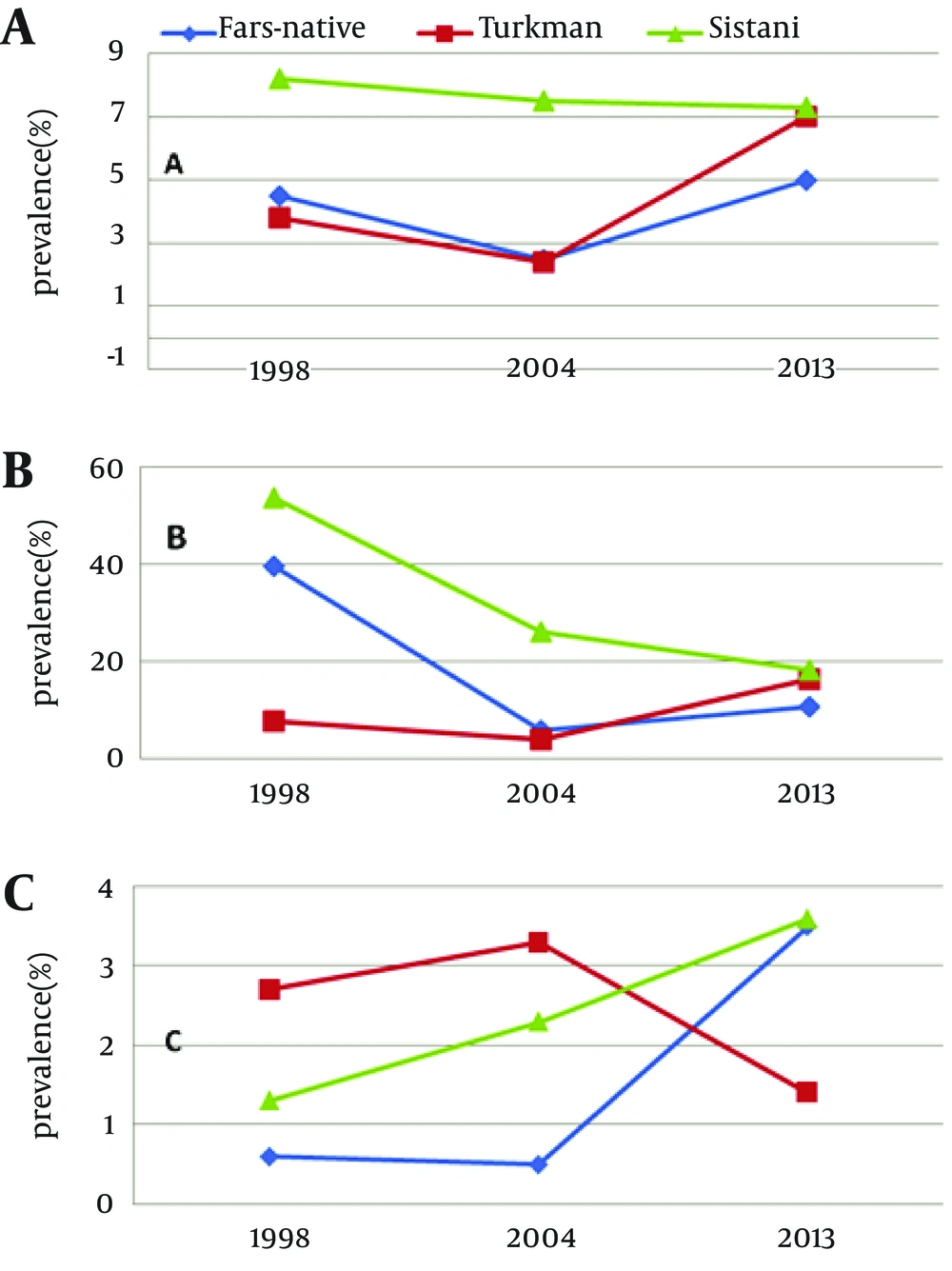
Figure 1.
A, height-for-age; B, and weight-for-height; C, in the three studies in rural area in north Iran.
5. Discussion
Underweight in 6.3%, stunting in 15.7%, and wasting in 2.7% of subjects was seen in 2013 with a higher rate in boys. According to UNICEF report, the prevalence of underweight, stunting, and wasting among Iranian five-year olds was 11%, 15%, and 5%, respectively. In Iran, several studies have found the prevalence of underweight, stunting and wasting 4.3%, 8.7%, and 7.5% in west Azarbaijan province (16) and 7.5%, 12.5%, and 4.4% in Khorasan province (17). Worldwide about 50% of preschool children are malnourished ranging from 64.0% in Bangladesh to 16.0% in China (18).
In sixty countries with data since 2006, the median prevalence of wasting is 7.1%, ranging from 0.6% in Peru to 21% in the last survey in Sudan; very high rates of wasting are also observed in Niger (15.5%), Chad (15.6%), Bangladesh (17.5%), and India (20.0%) (19).
The prevalence of underweight, stunting and wasting among under-five-children in rural areas in China was 14.6%, 7.2% and 3.1%, respectively (20). These were 4.5%, 8.5% and 3.9% in Portuguese (21), and 27%, 37%, and 6% in Kenya (22).
Compared with our findings, stunting is notable in north Iran and it is necessary to establish a control planning. Similar to other studies (22, 23), we found sex differences of under nutrition indicating higher rates in boys.
In the present study, trends of under nutrition among the three ethnic groups are not similar. Although the index has decreased in Fars-natives and Sistanis, in Turkmans it has increased. The underweight has been unchanged in Fars-natives and in Sistani but it has doubled in Turkmans during 15 years. Stunting has decreased 28.7% in Fars-natives and 35.1% in Sistanis while it has increased up to 8.5% in Turkman children. Trend studies on community nutrition of ethnic groups are scarce while studies on overall trends have been established in some countries.
Globally, childhood stunting decreased from 34% to 27% and underweight decreased from 27% to 22% between 1990 and 2000 (3). Stunting is predicted to reduce up to 22% by the next decade (6). Underweight declined significantly from 25.1% in 1993 to 15.1% in 2008 in Ghana (24). In China (15) the prevalence of underweight and stunting among under-five children lowered by 24.4% in 2002 to 30.8%, in 2006. In Peru (25) underweight dropped from 10.1% to 8.2% during 15 years and stunting decreased 19.6% in those children. In India (26), a steady decrease in stunting was seen among rural children in 1992 - 2005, while the decline in underweight was greater between 1992 and 1998 than between 1998 and 2005. Based on UNICEF report, trends in stunting among under-five children in 1990s have been decreased in China (27). In Kenya (28), child under nutrition based on underweight has declined in most socio-demographic groups during 1993 to 2009. In that study, stunting was unchanged altogether, although this trend in boys aged 0 - 35 months significantly decreased and in girls aged 12 - 23 months significantly increased.
Factors associated with under nutrition reported in some studies (20, 26, 29), are family income, provision of primary health care, low birth weight, gender, age, birth order, religion, maternal age, and maternal education. Association between socio-economic status and nutritional condition of ethnic groups has been reported differently in north Iran (30, 31). In our study, the lowering trend of under nutrition in Fars-natives and Sistani children is in line with other studies but growing trend of it in Turkmans is unexpected. The social-behaviors in Turkman society differ from other ethnic groups in north Iran; possibly there are underlying factors for different food-behavior in this group. The role of food-behaviors of ethnicities residing in north Iranian should be evaluated in further studies.
Consistent with following studies, we have shown the poor economic status as a risk factor for malnutrition. Cultural status, income level, food behavior, and less health care were known as the risk factors for malnutrition (32). Block (33) believed that low income families are less aware of their food needs. In Iran (34), socio-demographic factors influence nutritional education with improving health criteria. Thereby, more common under nutrition in Sistani children may be related to the poor economic status in this ethnic group. The socio-demography related factors as underlying causes of malnutrition in under-five-year children have been highlighted in our study.
We didn’t evaluate all of the factors that are associated with nutritional status, e.g. quality and quantity of food intake, or physical activities. Initially, ethnic groups have not been considered in sample size estimation, and age groups have not been compared among the three studies. These are our limiting study factors.
Under nutrition remains one of the health problems in under-five-year children in north Iran. Generally, under nutrition has declined from 1998 to 2004 while it has risen from 2004 to 2013. Physical growth in three studied ethnic groups is not similar. Stunting in Sistani children deeply decreased while in Turkman children slightly increased during this study. Poor economic status is a risk factor for under nutrition in this area. The changing of physical growth in Iranian northern children is remarkable. Further studies are necessary to evaluate the growth monitoring and socio-demography related factors on children of the three ethnic groups.