
1. Background
Micronutrients, including vitamins and minerals, play important roles in metabolism, gene expression, the immune system, intelligence quotient, and learning. They are, therefore, vital for protection and promotion of health and learning ability. Available information shows that micronutrient deficiencies are a major public health problem in most countries of the world, with serious undesirable social and economic consequences, causing their slow national development (1). Based on the World Bank calculations, the cost of controlling micronutrient-related malnutrition in any country is slightly less than 0.03% of gross domestic product (GDP), while this type of malnutrition causes a reduction of 5% in GDP (2).
Results of extensive provincial/regional studies in Iran reveal that micronutrient-related malnutrition is a major public health and nutritional problem. Deficiencies of vitamins A and D have been observed to various extents in recent decades in different parts of the country (3). It is certainly possible to prevent micronutrient deficiencies by sound planning and policy-making, and thus promote the national nutritional and health situation. Clearly, it is essential to first have a thorough situation analysis magnitude and distribution of deficiencies of different micronutrients, trends over time, determinants, and contributing factors. Only then, it will be possible to plan and devise policies to solve the problem (2).
Based on the estimations by the World Health Organization (WHO), the prevalence of vitamin A deficiency among pre-school children in Iran is less than 2%. However, it is much more common in pregnant women (10 - 20%) (4). A low dietary intake of this vitamin in Iran has been reported since previous decades. A national food consumption survey, conducted by National Nutrition and Food Technology Research Institute in 2000 - 2002, showed that about 65% of the households had a daily dietary intake below 80% of the recommended dietary allowance (RDA).
Vitamin D is another fat-soluble vitamin with several functions in the body. In addition to vital roles in the metabolism of calcium and phosphorus, and bone, it is also involved in the immune system. There is some evidence that a deficiency of this vitamin may increase the risk of chromic non-communicable diseases, including cancer. The main source of vitamin D is the sunlight. Rickets is common to some extent among children in Tehran and other Iranian cities (5). In a study, the prevalence of vitamin D deficiency in 1-to-6-year-old children in Tehran was 51%, while 4.51% had severe deficiency (level of vitamin D < 10 ng/m) (6).
So far, two national micronutrient surveys have been conducted in Iran. The first National Integrated Micronutrients Survey (NIMS-I) report was published in 2006, and the second (NIMS-II) report was published in 2018 (3). These two studies provided extensive valuable information about the status of vitamins A and D, disaggregated by age/gender and effective factors.
Anemia, one of the most common nutritional problems globally, is another micronutrient deficiency in Iran. Recent studies (7) in the country showed that 7.4% of children aged under six years suffered from mild anemia, 2.5% had moderate anemia, and about 1% suffer had severe anemia, which is similar to the results of the NIMS-II (3). However, anemia was most prevalent (about 40%) among 2-year-old children (8).
Zinc is also an important trace element, which has a great role in growth and development of children. Zinc deficiency was found to be another common problem in the previous study, but data from the NIMS-II study showed improved zinc status in the two age groups of children.
As a result of changes in the socio-economic situation, lifestyle, and food consumption patterns, Iran is presently undergoing a rapid nutrition transition (8).
Supplementation programs at the Ministry of Health and Medical Education (MOHME) further target these four micronutrients. On the other hand, studies conducted in different parts of the country showed deficiencies of these four micronutrients at the national and subnational levels, so these micronutrients are receiving more attention. Vitamins A and D supplementation for children under two years of age, starting iron supplementation with the start of complementary feeding, and using zinc supplements are among the programs implemented in the primary health care system (PHC) in the country. Therefore, the MOHME is undoubtedly considering the impact of these interventions and their long-term impact on reducing the deficiencies. Of course, this is not a reason why other micronutrients are not important in children’s health.
National surveys are repeated with the aim of examining the situation and comparing indicators in regular and specific periods. Comparing this information helps senior managers and planners evaluate the impact of designed intervention programs. Therefore, it was essential to repeat the national micronutrients status survey (NIMS-I) in order to determine the prevalence of deficiencies after 11 years (NIMS-II) and attempt to make recommendations for intervention strategies in different parts of the country.
It should be noted that the first two years of children’s lives are very important for their health, and intervention programs to improve micronutrient status are more focused during this period. The health status of six-year-olds who are preparing to enter primary school is also of particular importance.
2. Objectives
Accordingly, using the NIMS-I and NIMS-II data, this study aimed to determine and compare the prevalence of deficiency rates of vitamin A, vitamin D, iron, and zinc among under-2-year- and 6-year-old children in Iran.
3. Methods
This study was commissioned and supported by the MOHME to compare the deficiency status of four main micronutrients, including vitamin A, vitamin D, iron, and zinc, in children ten years after the previous study. This national survey had a steering committee consisting of 27 experts and faculty members from various and related specialties. One of the main objectives of this study was to examine the effect of interventions performed to improve the status of micronutrients in children. Examining the impact of the interventions performed can help experts and planners in designing intervention programs and even modifying existing programs.
In this national study, the country was divided into 11 study zones. Due to the high costs of the survey, it was not possible to use the results by province. To establish a balance between the costs of the study and the subsequent possible interventions and previous national studies conducted by the MOHME in Iran, including the study of ANIS (Anthropometric Nutritional Indicators Survey), based on ethnic, geographical, climatic, economic, and social characteristics and with the help of professors of demography and epidemiology, the country was divided into 11 zones.
The sampling method was one-stage cluster sampling, with equal-size samples. Considering the design effect (1.3), the sample size was determined to be 397 (for practical purpose n = 400) for each statistical group in each study zone. The cluster size was five. So, each cluster included five children aged under two years and five children aged under six years. That is to say, in each of the 11 zones n = 400. Therefore, a total of 4,400 individuals were included in the study throughout the country. To reach the under-2- and 6-year-old children, the health units, including rural and urban health houses, were selected as clusters.
To do this survey, a coordinating and implementing central committee was formed in the MOHME, and an experienced member of the scientific committee was introduced to all of the universities of medical sciences as the scientific committee representative, responsible for the university coordinating central committee, accountable to all the scientific and other questions during the implementation of the project.
Exclusion criteria were acute illness when referring to the health center and suffering from any one of the following diseases/conditions: severe mental and physical handicap, diabetes mellitus (receiving daily insulin injections), chronic renal disease (requiring the child to take medicines regularly), any type of hepatitis, human immunodeficiency virus (HIV) infection or acquired immunodeficiency syndrome (AIDS), and cancer (based on medical diagnosis and parents’ statements).
Like all national studies, this survey was conducted on all apparently healthy Iranian children. Children who referred to the centers due to illness were not included in the survey. Based on the decision of the steering committee in the MOHME, statistical framework for 6-year-old children was based on the latest household census. In urban and rural areas, where there was adequate coverage of the primary health care, the last census was used. In metropolitan cities such as Tehran, the addresses of women who had their first delivery 48 - 72 hours before the start of the study were used as the head of the cluster. For statistical framework of the children aged under two years, we used the statistical framework of health units providing basic health services and care. In each zone, the number of clusters was determined according to the population of urban and rural areas. Interviews, followed by completing the forms, and finally taking blood samples were done based on standard protocols by trained experts. Data analysis was done using SPSS version 19. The results were reported as percentages. The normal distribution of the variables was assessed using the Kolmogorov-Smirnov test and histograms. We used log transformation for non-normally distributed variables. For estimating population means, 95% confidence interval was used. As shown in Table 1, we used the WHO recommendations to describe micronutrients deficiencies. Gifts were given to all children after the interviews.
Table 1.
Nutrients Deficiency Based on the WHO Recommendations
| Nutrients | Serum Levels |
|---|---|
| Vitamin A (9); HPLC YL 9100 | A serum retinol concentration less than 0.7 mmol/l (equivalent to 20 µg/dL) |
| Vitamin D (10); Automated immunoassay method | Serum 25-hydroxy-cholecalcifecol level equal or less than 20 ng/mL |
| Serum zinc (11); Atomic absorption (Youngling AAS 8020) | Less than 70 µg/dL |
| Iron (Automated immunoassay method); children under two years; Children six years (12) | Hb under 110 g/L; Hb under 115 g/L |
3.1. Ethics
The ethics committee of Tehran University of Medical Sciences approved the study. The study design was approved by the ethical committee of the MOHME, Tehran, Iran. Participants provided a written informed consent prior to starting the interviews.
4. Results
Tables 2 and 3 show the comparison of micronutrient status in the two national surveys. The vitamin A deficiency in the second national study significantly increased compared to the first study (from 0.5% in NIMS-I to 18.3% in NIMS-II). This situation is also similar to vitamin D status. The increases in the deficiency of both vitamins A & D among both groups were statistically significant.
The anemia status showed significant reduction in under-2-year-old children based on the same criteria. The zinc deficiency rate decreased in this age group, but the difference was not significant.
Table 2.
Comparison of Micronutrients Status Among Under-2-Year-Old Children in the Two National Surveys (NIMS-I & NIMS-II)
| Micronutrients | NIMS-I % (95% CI) | NIMS-II % (95% CI) | P a |
|---|---|---|---|
| Vitamin A; Serum retinol < 0.7 µmol/L | 0.5 (0.3 - 0.7) | 18.3 (16.8 - 19.9) | 0.000 |
| Vitamin D; Serum 25-hydroxy vitamin; D3 ≤ 20 ng/mL | 3.7 (3.1 - 4.3) | 23.3 (21.7 - 24.9) | 0.000 |
| Iron; Anemia as Hb < 110 g/dL | 37.8 (36.4 - 39.2) | 17.1 (16.0 - 18.2) | 0.000 |
| Zn; Serum Zn < 70 µg/dL | 19.4 (18.2 - 20.6) | 19.1 (17.9 - 20.3) | 0.2 |
a Independent t test.
Table 3.
Comparison of Micronutrients Status Among 6-Year-Old Children in the Two National Surveys (NIMS-I & NIMS-II)
| Micronutrients | NIMS-I % (95% CI) | NIMS-II % (95% CI) | P a |
|---|---|---|---|
| Vitamin D; Serum 25-hydroxy vitamin; D3 ≤ 20 ng/mL | - | 61.8 (60.4 - 63.2) | - |
| Iron; Anemia as Hb < 115 g/dL | 18.2 (17.1 - 19.3) | 9.9 (9.0 - 10.8) | 0.000 |
| Zn; Serum Zn < 70 µg/dL | 31.0 (29.7 - 32.4) | 13.6 (12.6 - 14.6) | 0.000 |
a Independent t test.
Vitamin A deficiency among under-2-year-old boys was higher than that in girls. Also, it was higher in rural areas than in urban areas. Regarding vitamin D, the deficiency among girls was higher than boys, and in urban areas it was higher than in rural areas.
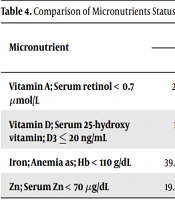
The comparison of micronutrients deficiency among the two age groups based on gender has been shown in Tables 4 and 5. It should be noted that vitamin A status was measured only among 2-year-old children.
Table 4.
Comparison of Micronutrients Status Among Under-2-Year-Old Children by Gender (NIMS-I & NIMS-II)
| Micronutrient | Boys % (95% CI) | P | Girls % (95% CI) | P | ||
|---|---|---|---|---|---|---|
| NIMS I | NIMS II | NIMS I | NIMS II | |||
| Vitamin A; Serum retinol < 0.7 µmol/L | 2.3 (1.7 - 3.0) | 19.8; (18.1 - 21.5) | < 0. 01 | 1.9 (1.3 - 2.5) | 16.7 (15.1 - 18.3) | < 0. 01 |
| Vitamin D; Serum 25-hydroxy vitamin; D3 ≤ 20 ng/mL | 1.7 (1.3 - 2.1) | 20.3; (19.1 - 21.6) | < 0. 01 | 2.9 (2.4 - 3.4) | 26.7 (25.3 - 28.1) | < 0. 01 |
| Iron; Anemia as; Hb < 110 g/dL | 39.9 (38.4 - 41.4) | 18.4; (17.2 - 19.6) | < 0. 01 | 35.3 (33.8 - 36.8) | 15.6 (14.5 - 16.7) | < 0. 01 |
| Zn; Serum Zn < 70 µg/dL | 19.4 (18.2 - 20.6) | 19.6; (18.4 - 20.8) | NS | 19.4 (18.1 - 20.5) | 18.5 (17.3 - 19.7) | < 0. 05 |
Table 5.
Comparison of Micronutrients Status Among 6-Year-Old Children by Gender (NIMS-I & NIMS-II)
| Micronutrient | Boys % (95% CI) | P | Girls % (95% CI) | P | ||
|---|---|---|---|---|---|---|
| NIMS I | NIMS II | NIMS I | NIMS II | |||
| Vitamin D; Serum 25-hydroxy vitamin; D3 ≤ 20 ng/mL | - | 54.2 (52.0 - 56.4) | - | - | 68.4 (66.4 - 70.4) | - |
| Iron; Anemia as; Hb < 115 g/dL | 18.0 (16.3 - 19.7) | 10.7 (9.4 - 12.0) | < 0. 01 | 18.5 (16.8 - 20.2) | 9.0 (7.8 - 10.2) | < 0. 01 |
| Zn; Serum Zn < 70 µg/dL | 30.7 (28.7 - 32.7) | 15.5 (13.9 - 17.1) | < 0.01 | 31.3 (29.3 - 33.3) | 11.9 (10.5 - 13.3) | < 0. 01 |
The difference in vitamin D deficiency in both age groups among boys and girls in NIMS-II was significant (P < 0.01).
The comparison of micronutrient status in two national surveys among under-2-year-old children based on the place of birth has been shown in Tables 6 and 7. As mentioned, since vitamin A deficiency was not accessible, it was not analyzed.
Table 6.
Comparison of Micronutrients Status Among Under-2-Year-Old Children in Rural and Urban Areas (NIMS-I & NIMS-II)
| Micronutrient | Urban % (95% CI) | P | Rural % (95% CI) | P | ||
|---|---|---|---|---|---|---|
| NIMS I | NIMS II | NIMS I | NIMS II | |||
| Vitamin A; Serum retinol < 0.7 µmol/L | 1.6 (1.1 - 2.1) | 16.8 (15.2 - 18.4) | < 0. 01 | 2.7 (2.0 - 3.4) | 21.8 (20.0 - 23.6) | < 0. 01 |
| Vitamin D; Serum 25-hydroxy vitamin; D3 ≤ 20 ng/mL | 3.0 (2.3 - 3.7) | 25.4 (23.5 - 27.3) | - | 1.1 (0.7 - 1.6) | 18.7 (17.0 - 20.4) | - |
| Iron; Anemia as; Hb < 110 g/dL | 38.1 (36.0 - 40.2) | 14.7 (13.2 - 16.2) | < 0. 01 | 37.5 (35.4 - 39.6) | 22.4 (20.6 - 24.2) | < 0. 01 |
| Zn; Serum Zn < 70 µg/dL | 18.2 (16.5 - 19.9) | 17.1 (15.5 - 18.7) | < 0.01 | 19.4 (17.7 - 21.1) | 2.2 (1.6 - 2.8) | < 0. 01 |
Table 7.
Comparison of Micronutrients Status Among 6-Year-Old Children in Rural and Urban Areas (NIMS-I & NIMS-II)
| Micronutrient | Urban % (95% CI) | P | Rural % (95% CI) | P | ||
|---|---|---|---|---|---|---|
| NIMS I | NIMS II | NIMS I | NIMS II | |||
| Vitamin D; Serum 25-hydroxy vitamin; D3 ≤ 20 ng/mL | - | 66.2 (64.2 - 68.3) | - | - | 52.5 (50.3 - 54.7) | - |
| Iron; Anemia as; Hb < 115 g/dL | 17.6 (16.0 - 19.3) | 8.9 (7.7 - 10.1) | < 0. 01 | 20.1 (18.4 - 21.8) | 12.0 (10.6 - 13.4) | < 0. 01 |
| Zn; Serum Zn < 70 µg/dL | 26.6 (24.7 - 28.5) | 12.9 (11.5 - 14.4) | < 0.01 | 38.7 (36.6 - 40.8) | 15.3 (13.7 - 16.9) | < 0. 01 |
The difference in vitamin D deficiency among both age groups in rural and urban areas in NIMS-II was significant (P < 0.001).
5. Discussion
Several nationwide surveys have been conducted in Iran in the last two decades, all showing that micronutrient deficiencies are prevalent throughout the country.
Vitamins A and D are fat-soluble vitamins with several functions in the body. They play roles in the prevention of infection, skin health and oral mucous tissues, digestive system, respiratory tract, eyes, immune system, bone metabolism, and growth of children (10).
A national study was performed on desirable food basket by the National Nutrition and Food Technology Research Institute (NNFTRI) in 1998. The findings showed that one of the key nutrients in Iran was vitamin A. A low dietary intake of vitamin A has been observed in several provinces, the deficiency being more severe in rural than urban areas. The average per capita daily intake in several provinces, including Kerman, Ilam, Kordestan, Lorestan, Sistan-Baluchestan, Chaharmahal-Bakhtiari, Yazd, Khokyloyeh-Boyrahmad, and Kermanshah was below the RDA. The prevalence of vitamin A deficiency ranged between 1% and 35% nationwide (13).
The worldwide prevalence of vitamin A deficiency among less than 5-year-old children was about 21%, with the greatest prevalence in Asian and African countries (9, 14). Based on a review article in 2017, the mean vitamin A deficiency among less than 5-year-old children after age standardization was 23.5%, and the trend of vitamin A deficiency for both sexes in many areas of Iran after two decades is positive, which is consistent with our results (15).
Trends of vitamin A deficiency in children in 138 low-income and middle-income countries between 1991 and 2013 showed that 39% (95% CI, 27 - 52) of children aged 6 - 59 months were vitamin A-deficient in 1991, but this rate decreased to 29% (95% CI, 17 - 42) in 2013. Although vitamin A deficiency significantly declined in most countries and regions in the world, it is still prevalent in sub-Saharan Africa (48%, 95% CI: 25 - 75) and south Asia (44% 95% CI: 13 - 79) (4).
Many studies have shown that some children in several provinces and towns in Iran suffer from vitamin D deficiency, and its clinical manifestations as follows: (1) 1-to-12-month-old children in Orumieh; (2) under-3-year-olds in Kashan (16); (3) under-5-year-olds in Astaneh-Ashrafieh and Some-e-olia in Gilan Province (17); (4) under-1-year-olds in Birjand (18); and (5) young children in other towns (19).
Vitamin D deficiency is relatively high and prevalent not only in the region, but also in all over the world. Among infants, it can be traced to maternal nutrition status (19-21). The prevalence of vitamin D deficiency (less than 20 ng/mL) in south Asia was about 70% and varied from 6 - 70% (22).
Vitamin D is naturally present in just a few foods and there is not a single good source of vitamin D among foods (23). Although exposure to the sun is a good way to provide a valuable part of our daily need, vitamin D deficiency is still prevalent among countries with a lot of sunshine. For example, in India, which is located in an area with plenty of sunshine all year round, the prevalence of vitamin D deficiency among all age and sex groups was more than 70% (24).
In a recent study in Australia, the effectiveness of current sun exposure guidelines was evaluated. The results suggested that the current guidelines were ineffective for most people in winter (25). It should be noted that vitamin D has many functions in the body and might play some roles in the prevention and treatment of some medical conditions and even mortality (26-33).
Iron deficiency and its related problems have been well-known in the world. Despite the variety of intervention programs designed, its prevalence is still high in many countries around the world, especially in the region. The prevalence of iron deficiency anemia (transferrin saturation < 10%, serum ferritin less than 12 µg/L) in children under two years old and 5-to-6-year-old children in Saudi Arabia was 14.5% and 3.3%, respectively (34). In another study in Saudi Arabia, the prevalence of iron deficiency anemia (Hb < 11 g/dL, serum ferritin less than 10 µg/L) among children aged two to six was 49% (35). The situation was different in Egypt, and the prevalence of anemia in preschool children ranged from 18% to 56.5% in different parts of the country (36, 37).
Based on the WHO estimation, 42% of children under five years old are anemic. Comparison of these numbers with the situation of anemia in Iranian children shows a relatively better situation of the prevalence of anemia in Iranian children aged under five years (17.1% in children under two and 9.9% in children aged six years old).
A study among children in five Indian states showed that zinc deficiency was 43.8% (38). The prevalence in another study in Pakistan was 37.1% (38). Zinc deficiency rates among Japanese and Chinese children were 6.7% and 4%, respectively (39, 40). Based on NIMS studies, the zinc deficiency rate among under-2 and 6-year-old children was 13.6% and 19%, respectively, which is not too high. There was no change of zinc status in two national studies among under-2-year- old children, but zinc deficiency was reduced by half among children aged under six years old; this might be due to zinc supplementation and fortification in Iran.
5.1. Conclusion
Vitamins A and D play important roles in the body. Considering the status of both vitamins in two national studies after about ten years, it is essential to develop national intervention programs such as supplementation and fortification. As there is enough evidence of vitamins A and D deficiency among this age group, it may be necessary to prescribe high-dose supplementation for a special period of time. Positive increase of both vitamins A and D deficiency in NIMS study is alarming. Due to the special roles of these two vitamins, special considerations and effective actions are needed. Data evaluation from two national studies indicated a decrease in the prevalence of iron and zinc deficiency in both age groups, which could be due to the successful implementation of nutritional intervention programs, such as nutritional education, supplementation, and iron fortification in Iran.