Innovative Journal of Pediatrics
The Scientific Journal of Growth & Development Research Center
e-ISSN 3117-5341

Image Credit:Inn J Pediatr
Outline
Assessment of Left Atrial Ejection Force in Mildly Asphyxiated Newborns
Published online:Nov 20, 2011
Article type:Research Article
Received:Jan 31, 2011
Accepted:Jan 13, 2012
Abstract
Objective: Asphyxia-induced cardiac insult is one of the major causes of mortality and morbidity in the course of perinatal asphyxia. Nowadays, a remarkable trend of interest is sensed introducing a plausible modality for early detection of cardiac insults at the beginning stages of asphyxia. In this study we aimed to evaluate diagnostic utility of transmitral Doppler–derived parameters as well as left atrial ejection force index as a marker of left atrial contractile function in these patients.
Methods: In a prospective study selected cases of 26 asphyxiated newborns with preserved systolic function underwent conventional transmitral Doppler flow echocardiographic assessment. Left atrial ejection force index was further calculated for all patients. Data was compared with normal ranges of healthy newborns in order to clarify the diagnostic utility of these parameters for determining minor cardiac insults in this age group.
Findings: We found that mildly asphyxiated newborns showed an increase in the values of left atrial ejection force index (5.44±2.12 kilodyne vs. 6.66±2.17 kilodyne, P= 0.02) and left atrial filling fraction (39%±10% vs. 45%±8%, P= 0.01). Furthermore, the acceleration and deceleration rate of early filling flow peak velocity were decreased in this group of asphyxiated newborns.
Conclusion: Assessment of left atrial ejection force in mildly asphyxiated newborns reveals that newborns with even mild asphyxia, although could not be categorized in conventional grading system, suffer to some extent from a ventricular filling abnormality. This type of latent ventricular filling abnormality could simply be unmasked by calculation of atrial ejection force index.
Highlights
How to Cite:Kiani A, Shabanian R, Rekabi M, Kocharian A, Heidari-Bateni G. Assessment of Left Atrial Ejection Force in Mildly Asphyxiated Newborns. Inn J Pediatr. 2012;22(4):. doi:
References
- 1.References are available on the PDF.
Copyright
© 2012, Author(s). This open-access article is available under the Creative Commons Attribution 4.0 (CC BY 4.0) International License (https://creativecommons.org/licenses/by/4.0/), which allows for unrestricted use, distribution, and reproduction in any medium, provided that the original work is properly cited.
Similar Articles
14
Feb
2023
Early-Stage Vasoactive-Inotropic Score and Left Ventricular Ejection Fraction Following Cardiac Surgery: A Comparison of Two Non-invasive Heart Function Monitoring Technologies in the Prognosis of Infants
Xiong Xiaoyu,
Ren Jie,
Liu Chengjun,
Xu Feng,
Li Jing
Xiaoyu X, Jie R, Chengjun L, Feng X, Jing L. Early-Stage Vasoactive-Inotropic Score and Left Ventricular Ejection Fraction Following Cardiac Surgery: A Comparison of Two Non-invasive Heart Function Monitoring Technologies in the Prognosis of Infants. Inn J Pediatr. 2023;33(1):e131666. doi: https://doi.org/10.5812/ijp-131666
30
Jun
2009
Non-Invasive Assessment of Left Ventricular End-Diastolic Pressure in Patients with Chronic Aortic Regurgitation, Comparison of the Sensitivity and Specificity of CW Doppler Echocardiography with Angiography
Maryam Esmaeilzadeh,
M Hamidzad,
M Kiavar,
H Bakhshandeh Abkenar,
F Esmaeilzadeh
Esmaeilzadeh M, Hamidzad M, Kiavar M, Bakhshandeh Abkenar H, Esmaeilzadeh F. Non-Invasive Assessment of Left Ventricular End-Diastolic Pressure in Patients with Chronic Aortic Regurgitation, Comparison of the Sensitivity and Specificity of CW Doppler Echocardiography with Angiography. Int Cardiovasc Res J. 2009;3(2):e68465. doi:
16
Dec
2019
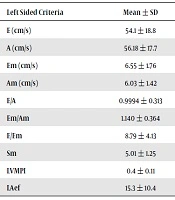
The Relationship Between Serum Levels of Troponin I and Myocardial Function in Neonates Under Mechanical Ventilation
Asadolah Tanasan,
Fatemeh Eghbalian,
Mohammad Kazem Sabzehei,
Alireza Rastgoo Haghi
Tanasan A, Eghbalian F, Sabzehei MK, Rastgoo Haghi A. The Relationship Between Serum Levels of Troponin I and Myocardial Function in Neonates Under Mechanical Ventilation. Inn J Pediatr. 2019;30(1):e93846. doi: https://doi.org/10.5812/ijp.93846
1
Jan
2009
Prevalence of Left Ventricular Diastolic Asynchrony in Patient with Systolic Heart Failure
Maryam Esmaeilzadeh,
H Saadatifar,
A Mohebbi,
F Noohi,
N Samiei,
Z Ojaghi Haghighi
,et al.Esmaeilzadeh M, Saadatifar H, Mohebbi A, Noohi F, Samiei N, et al. Prevalence of Left Ventricular Diastolic Asynchrony in Patient with Systolic Heart Failure. Int Cardiovasc Res J. 2019;13(1):e175353. doi:
1
Sep
2010
Inverted Left Atrial Appendage: A Cause of Left Ventricular Inflow Obstruction
A Molaei,
A Tabib,
M Meraji,
RHH Shemirani
Molaei A, Tabib A, Meraji M, Shemirani R. Inverted Left Atrial Appendage: A Cause of Left Ventricular Inflow Obstruction. Int Cardiovasc Res J. 2010;4(3):e62961. doi:
Cited by
- Scopus by DOI: 0
Last Update: 1 month ago
- Scopus by Title: 3
Last Update: 1 month ago
- Scopus by Title (Ref): 0
Last Update: 1 month ago
- CrossRef: 0
Last Update: 1 day ago
- OpenAlex: 0
Last Update: 2 days ago
- OpenCitations: 0
Last Update: 5 days ago
Comments
Number of Comments:0Indexed in
