
1. Background
Transcatheter patent ductus arteriosus (PDA) closure, first described in 1967, has become the standard method of treatment for children after the neonatal period (1). Coil occlusion for PDA closure, which was first introduced in 1992, has now become an established treatment as a transcatheter closure technique (2). Various types of occlusion systems have been developed. Currently, coils are the most commonly used occluders for small-sized PDA closure (3). For moderate- to large-sized PDA closure, the amplatzer duct occluders (ADO) are the most frequently used devices (4, 5). Critical complications of transcatheter PDA closure are rare. Device embolization is the most common complication, which was relatively common in early experience with coils (6). Various studies have concluded that immediate, short, and intermediate term outcomes of transcatheter PDA closure using coils or ADO are excellent (7-9).
Although the efficacy and safety of occlusion devices have been reported in many patients with PDA, there is only a limited number of studies performed on the mid- and long-term outcome of device occlusion.
2. Objectives
Therefore, the aim of this study was to determine the follow-up period of patients with PDA who underwent coil or ADO closure in Shiraz, the main referral center for pediatric cardiac intervention in southern Iran.
3. Patients and Methods
Our cohort consisted of all patients with PDA who underwent percutaneous closure using coil or ADO at Nemazee, Shahid Faghihi, and Kowsar hospitals, which are tertiary healthcare centers affiliated with Shiraz University of Medical Sciences, from November 2005 to November 2013. The parents of all patients gave their informed written consent.
The PDAs were classified based on their size as small (< 2 mm), moderate (2 - 4 mm), or large (≥ 4 mm). Appropriate occlusion devices for percutaneous closure were selected according to the size of the PDA closure. The coils were used for small-sized PDA closure and ADOs were used for moderate- and large-sized PDA closure. The coils which we used were the Nit-Occlud PDA occlusion device (pfm AG, Cologne, Germany).
Residual leakage of the PDA was evaluated by using color-coded Doppler echocardiography.
Echocardiography was performed by two-dimensional, M-mode echocardiography, pulsed wave, and Doppler with a GE vivid 3-MHz probe.
Follow-up transthoracic echocardiography was performed before and just after the procedure, at two weeks, two months, six months, and during the study period (in average 4.8 ± 3.8 years). Throughout the follow-up period, transthoracic echocardiography was used. The patients’ charts were reviewed until December 2014 and complications related to device implantation were noted. A pediatric cardiologist reevaluated all of the patients by physical examination and transthoracic echocardiography during this study for detection of any complication or residual shunt.
3.1. Data Collection
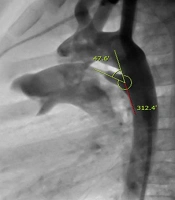
Baseline characteristics of each patient, including age, gender, type of device, and mean pulmonary artery pressure (PAP), were obtained from their medical records. Mean PAP more than 25 mmHg during catheterization was considered to be pulmonary hypertension. Long-term occlusion rate was considered to be the primary outcome. Post-treatment adverse events, mortality rate, and residual leakage as the secondary outcomes were also considered. Post-treatment adverse events were defined as follows: failure to implant the coils, coil migration, accidental detachment of the coil, deformity of the delivery cable, difficulty in retrieving the device, hemolysis, peripheral pulmonary stenosis (Doppler velocity > 2.0 m/s), coarctation associated with the coils, and recanalization. In addition, the pulmonary end of the ductus, aortic side, and length of the ductus was measured in the lateral projection. Variations in PDA configuration have been illustrated according to the classification of Krichenko et al. (10) The configurations are sketched on the left, and examples of lateral angiograms for each type are on the right: type A (“conical”) ductus, with well-defined aortic ampulla and constriction near the pulmonary artery end; type B (“window”) very large ductus, with very short length and narrowed aortic end; type C (“tubular”) ductus, which is without constrictions; type D (“complex”) ductus, which has multiple constrictions; and type E (“elongated conical”) ductus, with the constriction remote from the anterior edge of the trachea.
3.2. Statistical Analysis
All of the statistical analyses were performed using SPSS, version 20.0 (SPSS Inc., Chicago, IL, USA). Values are expressed as mean ± standard deviation (SD) for the quantitative variables and percentages for the categorical variables. Data was compared using the paired t-test for the continuous variables and the Chi-square test (or Fisher’s exact test, if required) for the categorical variables. This study was conducted with the power of 80% and P values of 0.05 or less were considered statistically significant.
4. Results
4.1. Baseline Characteristics
During the study period, 426 patients had PDA closure and 22 patients had no follow up, but their chart showed successful PDA closure. The study period included 404 patients with PDA closure by device. Their mean age was 43.2 ± 49.2 months with a median of 24 months (range: 1 - 312 months). Coil occlusion was performed in 220 patients and 184 patients underwent catheterization using ADO. The mean age in the coil group was 46.1 ± 47.9 months (range: 1 - 216 months, median: 24 months) and the mean age was 39.9 ± 50.6 months (range: 2 - 312 months, median: 15 months) in the ADO group (P = 0.21). In 352 (87%) patients, PAP was almost normal, while 52 (13%) suffered pulmonary hypertension. Table 1 summarizes the characteristics of these 404 catheterizations. A total of 366 (90.6%) patients had an isolated duct and 38 (9.4%) had other cardiac and extracardiac defects, such as aortic stenosis (n=3), mitral stenosis (n = 2), ventricular septal defect (n = 26), dilated cardiomyopathy (n = 2), coarctation of the aorta (n = 3), and pulmonary valvular stenosis (n = 2).
Table 1.
Baseline Characteristics of the Patientsa
| Characteristics | Data |
|---|---|
| 43.2 ± 49.2 (1 - 312) | |
| 0 - 12 | 14.3 (35.3) |
| > 12 | 261 (74.7) |
| 143/261 (0.5/1) | |
| 17.8 ± 14.1 | |
| 3.02 ± 2.8 | |
| 7.62 ± 3.45 | |
| 9.5 ± 2.53 | |
| 4.37 ± 4.1 | |
| 295/6/8/3/9/83 | |
| 220 (54.5) | |
| 184 (45.5) |
Abbreviations: PDA, patent ducts arteriosus; MPAP, mean pulmonary artery pressure.
aValues are expressed as mean ± SD.
4.2. Catheterization Outcomes
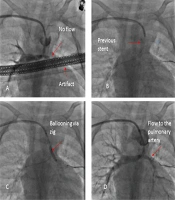
The catheterization was successful in 393 (97.2%) patients and in 11 (2.7%) cases, PDA was not closed after catheterization due to the tiny size of PDA in eight patients, severe pulmonary hypertension in two patients, and patient instability in one patient. Immediate complete occlusion was seen in 290 (73.7%) patients. Table 2 shows the rate of PDA closure. At six months, all but five patients achieved complete occlusion. Four patients in the coil group had minimal residual leakage six months after the closure. For these patients, closure of the residual leakage was performed by smaller coil one year after previous coil insertion. Residual leakage was closed completely in two patients and the other two patients had tiny residual leakage one year after the second coil. One patient in the ADO group had residual leakage after six months, which was hemodynamically not significant. This patient had a PDA with pulmonary end size of 5 mm, pulmonary hypertension, dilated left ventricle, and left atrium PDA, which was closed by ADO device 6 × 8. The patient had no pulmonary hypertension with the left atrial to aortic ratio < 1.2 and Qp/Qs = 1.1 six months after the closure.
Table 2.
Closure Rate in Successful Deployment Groupa
| Value | Immediately After Procedure | 2 Weeks | 2 Months | 6 Months | At Time of The Study |
|---|---|---|---|---|---|
| 290 (73.7) | 325 (84) | 368 (93.6) | 388 (98.7) | 390 (99.5) | |
| 161 (75.6) | 179 (85.4) | 201 (94.3) | 209 (98.1) | 211 (99.2) | |
| 141 (78.3) | 146 (81.1) | 167 (92.7) | 179 (99.4) | 179 (99.7) |
Abbreviation: ADO, amplatzer duct occluder.
aValues are expressed as No. (%).
4.3. Complications of Procedure
Complications were seen in 23 (5.8%) patients during (n = 16) or immediately after (n = 7) the catheterization. During the procedure, embolization was observed in 11 cases, accidental separation of the device in one case, and bradycardia or hypotension in four cases. Embolization happened in six coils. Of these, three were retrieved by snaring; one was embolized to the distal part of the left upper pulmonary artery, which was left in place and had no complication in follow up; and two were retrieved surgically. One of the coils removed surgically was embolized to the right femoral artery and could not be retrieved and the other coil was interrupted into the tricuspid cordas and could not be retrieved by snaring. In the ADO group, embolization occurred in five patients. Two ADOs were embolized to the aorta, one of which was retrieved by snaring and one was removed from the femoral artery surgically. Three of them were embolized to the pulmonary artery, two of which were removed by snaring and one was removed surgically. All of them had severe pulmonary hypertension and large PDA. Four coil embolizations and three ADO embolizations happened in the first year of use of these devices. Nine of the 11 patients with embolization were aged less than 12 months and their weight was less than 10 kg (Table 3).
Table 3.
Complications Among the Patients With Unsuccessful Catheterization
| Value | Age, Month | Weight | Type of Device | Time of Embolization | Retrieval |
|---|---|---|---|---|---|
| 1 | 6 | 5 | Nit-Occlud coil 6 × 5 | Just after deployment | Left in place |
| 2 | 7 | 5.5 | Nit-Occlud coil 7 × 6 | 2 weeks after | Retrieved by snaring |
| 3 | 11 | 7 | Nit-Occlud coil 7 × 6 | Just after deployment | Retrieved by snaring |
| 4 | 36 | 11 | Nit-Occlud coil 7 × 6 | Just after deployment | Retrieved by snaring |
| 5 | 8 | 6 | Nit-Occlud coil 9 × 6 | 1 day after | Surgical removal |
| 6 | 6 | 4.5 | Nit-Occlud coil 9 × 6 | Just after deployment | Surgical removal |
| 7 | 5 | 3.5 | ADO 4 × 6 | Just after deployment | Surgical removal |
| 8 | 8 | 5.8 | ADO 6 × 8 | Just after deployment | Surgical removal |
| 9 | 6 | 4.8 | ADO 6 × 8 | Just after deployment | Retrieved by snaring |
| 10 | 7 | 5 | ADO 8 × 10 | Just after deployment | Retrieved by snaring |
| 11 | 38 | 13 | ADO 12 × 14 | 2 weeks after | Retrieved by snaring |
Abbreviation: ADO, amplatzer duct occluder.
Bradycardia or hypotension happened in four ADO patients during the device insertion, which required epinephrine injection; all of these patients were less than one year old and had severe pulmonary hypertension. Three patients (six months, six months, and eight months old) had narrowing of aortic isthmus (gradient of 18, 20 and 20 mmHg) after closure of PDA; one patient’s coarctation gradient was increased to 60 two years after closure, which had no response to balloon dilation. Surgery was performed and the device was removed. Mild left pulmonary artery (LPA) stenosis with gradient 10 - 20 mmHg was detected in four patients after closure of PDA. In addition, no deaths or other serious complications occurred in the follow up. There was no relationship between the frequency of complications and type of devices (Table 4).
Table 4.
Frequency of Complicationsa
| Value | Coil, (213) | ADO, (180) |
|---|---|---|
| Embolization | 6 (2.8) | 5 (2.7) |
| Accidental separation of the devices | 1 (0.5) | 0 |
| Bradycardia or hypotension | 0 | 4 (2.2) |
| Narrowing aortic isthmus | 0 | 3 (1.6) |
| Mild LPA stenosis | 4 (1.8) | 0 |
Abbreviation: LPA, left pulmonary artery.
aValues are expressed as No. (%).
Three patients had unilateral vocal cord paralysis after PDA closure. Two of them were closed by ADO and one by coil. None of them had intubation during the procedure. Two of them improved six months after closure, but another still had hoarseness 1.5 years after PDA closure.
Two patients had dilated cardiomyopathy at the time of PDA closure, which did not improve 3 and 4.5 years after PDA closure. One six-month old patient with Down syndrome, in whom PDA was closed by ADO, had reactive pulmonary pressure and severe pulmonary hypertension lasting three years improved gradually. In two patients with severe pulmonary hypertension who were five and ten years old, PDA was closed by muscular ventricular septal defect device 12 and 14. In two 17 and 20 year old patients with very large PDA, PDA was closed by atrial septal defect device 14 and 18 successfully; one of these patients had transient hemolysis for one week, which recovered completely. Three patients (6, 8 and 14 months old) had PDA and discrete coarctation of the aorta; PDA was closed by coil in two of these patients and by ADO in one of the patients; also, balloon angioplasty of coarctation was done simultaneously with PDA closure. None of them had recoarctation or residual PDA. Two patients had pulmonary valvular stenosis and balloon valvuloplasty. PDA closure was performed simultaneously. One patient had right and left pulmonary stenosis and PDA. PDA was closed by coil and balloon angioplasty was performed. PDA was closed retrogradely in eight patients with small-sized PDA. In 16 patients, PDA was accessed retrogradely and after snaring of the wire, PDA was closed anterogradely by coil.
5. Discussion
In 1967, Porstmann for the first time carried out percutaneous closure of a PDA; since then, various devices and techniques have been developed in clinical practice (1). In recent decades, extensive efforts to improve a transcatheter PDA closure technique have been made and a number of techniques with varying degrees of popularity and success have been suggested, including the Portsmann plug, Rashkind device, and Gianturco embolization coils (11-14). Actually, transcatheter PDA closure is now a safe and effective procedure in experienced hands and is widely accepted as an attractive alternative to conventional surgery by avoiding thoracotomy scar, shorter hospital stay, minimal discomfort or pain, and avoidance of general anesthesia in older children (15, 16). All of these transcatheter techniques have been efficacious, although each has some problems. Their major drawbacks are the complex and large delivery system, the length of the procedure, and most importantly, the high incidence of residual leakage (9).
The major factors for success of transcatheter approach include vascular accessibility, morphology of the ductus, imaging modality, and, perhaps most importantly, selection of the device (17). As demonstrated in previous studies, the coils were recommended for small-sized PDAs and ADO was designed and recommended for moderate to large ones to address the aforementioned concern (3-5).
In the present study, device closure was attempted in 404 consecutive PDAs over a period of eight years with an overall implantation ratio of 97.2%. In addition, the implantation rate of the coil was 96.8% in small-sized PDAs and the ADO was successfully implanted in 97.8% of the patients with moderate- and large-sized PDA. The success rate of 97.2% in our trial as a large scale study is in accordance with the international figures. Takata et al. (18) reported 96.0% successful coil implantation in 286 out of 298 patients. In another study, Sultan et al. (19) reported that PDA was successfully implanted in 491 (98.2%) cases. Furthermore, a multicenter US ADO trial reported success in 435 out of 439 (99%) patients (9).
The overall closure rates just after procedure, at two weeks, two months, and six months after the implant were 73.7%, 84%, 93.6%, and 98.7%. Although the immediate success rate was 73.7% and lower (99%, 92.5%) than those in previous reports (19, 20), the final coil occlusion rate was 99.2%, which is in accordance with the recently reported 97.8% in coil implantation by Takata et al. (18) and 99.7% in ADO implantation by Pass et al. (9) Moreover, Bilkis et al. (8) reported that the use of the ADO achieved a closure rate of 66% at 24 hours, 97% one month, and 99% 12 months after implantation.
In our experience, the rate of complications was 5.8%, which is similar to that reported in previous studies (3% - 10%) (9, 18, 21, 22). The major complication was embolization of the devices, which was seen in 11 (2.7%) patients, all of which were retrieved by snaring or surgically with no adverse clinical or hemodynamic effects. The frequency of complications was not significantly related to the type of the devices. As noted, there was no case of cardiac perforation or tamponade. Perhaps one of the leading causes of morbidity of these devices would be LPA and aortic arch obstruction. In this study, mild LPA stenosis occurred in four patients in the coil group and narrowing aortic isthmus was seen in three patients in the ADO group; this is consistent with the findings of a previous study (9). The incidence of complication has a multi-factor issue, which is probably affected by the following circumstances: patients less than 10 kg of body weight meet more complications after the procedure and the physician’s skill is a main factor in decreasing complications (23, 24).
5.1. Conclusions
The findings of this study showed that transcatheter closure of the PDA by coil or Amplatzer is an effective and safe intervention with excellent midterm outcomes. Pulmonary hypertension, age of less than 12 months, and experience of less than one year may increase complications of device closure.