
1. Background
The survival of neonates who have been admitted to NICU, especially premature infants with few mortality and morbidity, is the most important attitude.
Due to some limitations, the Apgar score cannot be used as a useful tool for the evaluation of newborns. Different factors, especially prematurity, can have an effect on it, as a result of which it cannot anticipate mortality and morbidity definitively (1). There are many studies which have focused on evaluation of risk factors for prediction of mortality and severity of disease, especially in perinatal asphyxia (1-5), bronchopulmonary dysplasia (6), cardiovascular disorders (7), and respiratory distress syndrome (RDS) (8). There are different scoring systems for assessing neonatal mortality (9, 10). These scoring systems contain many items, and sometimes checking takes hours; as a result, they can be very time-consuming in some situations.
Increasing the activity of xanthine oxidase (XO) during the inflammatory process and neonatal sepsis has already been studied. Hypoxic ischemic events and inflammatory processes can cause renal damage, which leads to urinary uric acid excretion, which is a product of purine catabolism and free radicals due to the activation of xanthine oxidase (11-13). Previous studies have evaluated the UUA/Cr ratio as a predictor of mortality and severity of disease in perinatal asphyxia, and have established the correlation between the Apgar score and the urinary uric acid to creatinine ratio (4). Moreover, rising of serum uric acid as a predictor of mortality in critically ill children has already been reported (14)
2. Objectives
The aim of this study was to evaluate the UUA/Cr ratio and to determine whether it can serve as a simple, accessible marker of the mortality and severity of disease in NICU-admitted neonates. According to our knowledge, this is the first time the UUA/Cr ratio has been used for studying the severity of various diseases during neonatal periods, except for perinatal asphyxia.
3. Patients and Methods
A prospective cohort study was conducted during 13 months from March 2014 to April 2015 on 362 preterm infants who were admitted to the NICU of Arash Hospital in Tehran, soon after birth. The study was approved by the local ethical committee.
All preterm infants with gestational ages of 26 to 36 6/7 weeks were included in the study. Inclusion criterion: preterm infants with respiratory disorders. Exclusion criteria: 1, infants born to mothers with preeclampsia or chorioamnionitis; 2, major congenital abnormalities at birth. To avoid any confounding effects, the first urine samples were collected with a urine bag within 24 hours after birth and the urinary ratio of uric acid to creatinine (UUA/Cr) was performed using the uricase-peroxidase enzymatic method. The need for high set-up of mechanical ventilation, complications of prematurity (respiratory distress syndrome (RDS), late onset sepsis, patent ductus arteriosus (PDA), necrotizing enterocolitis (NEC), pulmonary air leak syndrome, bronchopulmonary dysplasia (BPD), and duration of stay in the NICU were defined as the severity of disease. Mortality and the severity of disease were considered to be the final unfavorable outcomes.
As an initial step, descriptive statistics for all variables were produced. The results were presented as arithmetic mean ± standard deviation for continuous variables with normal distribution. The duration of stay and the UUA/Cr ratio showed a skewed distribution in all groups, so log-transformation (Ln) was applied and the geometric mean calculated. Proportions were presented for categorical data. The relationship between the Ln urinary uric acid/creatinine ratio and the Apgar score at the 1st and 5th minute of birth and duration of stay, on the other, was analyzed by using linear regression.
Univariable logistic regression was used in order to measure the strength and direction of the association between the urinary uric acid/creatinine ratio and the Apgar score at the 1st and 5th minute of birth and outcome.
A P < 0.05 was considered to be significant. Statistical analyses were performed by using STATA version 11 (STATA Corp., TX, USA).
4. Results
Out of the 362 premature neonates who were admitted to our NICU from March 2014 to April 2015, 298 were discharged without any complication and were included in the control group, while 64 (17.6%) had a severe disease, out of whom 43 (11.8%) died. These constituted the case group. Demographic profiles of patients in each subgroup are shown in Table 1. RDS was the most frequent cause of admission.
Table 1.
Demographic Profiles and Urine Uric Acid/Creatinine Ratio of Patientsa
| Variables | Survived (n = 255) | Severe (n = 64) | Dead (n = 43) | Total (n = 362) |
|---|---|---|---|---|
| Birth weight, kg | 2.11 ± 0.75 | 1.81 ± 0.91 | 1.35 ± 0.78 | 1.97 ± 0.81 |
| Apgar score (1st minute) | 7 ± 2 | 6 ± 1 | 4 ± 2 | 7 ± 2 |
| Urinary uric acid/creatinine ratio mg uric acid/creatinine, mg | 3.14 ± 1.67 | 4.31 ± 1.60 | 3.96 ± 3.24 | 3.30 ± 1.95 |
| Mean gestational age, week | 33.3 ± 3.5 | 31.8 ± 3.07 | 29.91 ± 4.6 | 32.7 ± 3.9 |
| Gender, % | ||||
| Male | 46.0 | 38.1 | 46.4 | 45.6 |
| Female | 54.0 | 61.9 | 53.6 | 54.4 |
| Cause of Admission, % | ||||
| RDS | 67.0 | 76.2 | 85.7 | 70.4 |
| TTN | 22.5 | 4.8 | 1.8 | 18.2 |
| Prematurity | 6.7 | 4.8 | 1.8 | 5.8 |
| Pneumonia | 0.7 | 0.0 | 1.8 | 0.8 |
| Others | 3.1 | 14.2 | 9.7 | 4.8 |
aValues are expressed as mean ± SD unless otherwise indicated.
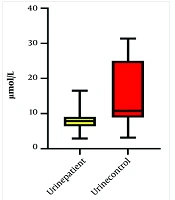
There are negative correlations between the UUA/Cr ratio and the 1st minute Apgar score (r: -0.17, P = 0.006) and the 5th minute Apgar score (r: -0.19, P = 0.003). The arithmetic means of the UUA/Cr ratio and the 1st minute Apgar score were 3.14 and 7 respectively in discharged infants without any compilation compared to 3.96 and 4 in the dead group, and 4.31 and 6 in the other group. The mean differences in both of them were statistically significant. We also compared the mean UUA/Cr ratio of NICU-admitted infants (3.30 ± 1.95) with the mean of this ratio for healthy infants who were born in our hospital (1.36 ± 0.42), and a statistically significant difference was also found (P = 0.001).
The duration of stay and the UUA/Cr ratio showed a skewed distribution in all groups, so log-transformation (Ln) was applied and the geometric means calculated. The correlation of the UUA/Cr ratio and the 1st minute Apgar score with outcome and duration of stay is presented in Table 2. The 1st minute Apgar scores were negatively correlated with the outcome (OR = 0.68; CI %95: 0.60 to 0.77, P < 0.001) and the duration of stay (β = -0.28; P < 0.001). In other words, each unit increase in the Apgar score ranging 5 and above at birth decreases the odds of a severe condition by 30%. However, the UUA/Cr ratio was positively correlated with unfavorable outcome (OR= 1.24; CI %95: 1.06 to 1.43, P = 0.006) and increased duration of stay (β = 0.17; P = 0.009).
Table 2.
Correlation of Urinary Uric Acid/Creatine Ratio and 1st Minute Apgar Score With Duration of Stay and Outcome
| Predictors | Unfavorable OutcomeaOdds Ratio (Confidence Interval 95%) | P Value | Lnb Duration of Stay Beta (SEc) | P Value |
|---|---|---|---|---|
| Ln urinary uric acid/creatinine ratio (UUA/Cr) | 1.24 (1.06 to 1.43) | 0.006 | 0.17 ± 0.06 | 0.009 |
| 1st minute Apgar Score | 0.68 (0.60 to 0.77) | < 0.001 | -0.28 ± 0.02 | <0.001 |
aUnfavorable outcome: severity of diseases and neonatal death.
bLn: log-transformation.
cSE: standard error.
5. Discussion
The prediction of mortality and morbidity for infants admitted to the NICU is the most important goal. The present study evaluates the UUA/Cr ratio as a single, simple test for this purpose and shows that it was elevated in all preterm neonates who were admitted, in comparison with healthy infants who were born in our hospital. Chen et al. reported that the urinary UA/Cr ratio was remarkably higher in hypoxic premature infants than in hypoxic term infants (15).
Bahubali et al. reported that this ratio was elevated in neonates with birth asphyxia compared with the control group, and that this ratio was correlated significantly with the clinical severity of the disease. They also reported a significant negative correlation between this ratio and the Apgar score (16), which was also indicated in studies by Banupriya (2) and Bhongir (3). In our study, there was a weekly negative correlation between this ratio and the 1st and 5th Apgar scores.
Although in other studies this ratio was evaluated as a predictor of outcome only in prenatal asphyxia (2, 3), our study shows that the urinary uric acid excretion rate depends on the severity of renal damage during any condition which leads to severe unfavorable events and death, especially in preterm neonates. The UUA/Cr ratio increases with the severity of disease and is associated with longer duration of stay and adverse outcome in all NICU-admitted neonates.
The 1st minute Apgar scores were negatively correlated with the outcome and duration of stay, but there was no significant correlation between 5th minute Apgar scores and outcome. This may be due to improper assessment of the Apgar score during resuscitation, so that the 5th minute Apgar score was higher than expected. This is why the American academy of pediatrics recommends an expanded Apgar score for assessment of infants after birth (1).
According to the results of our study, the UUA/Cr ratio has the potential to act as a simple cost-effective, noninvasive, single biochemical marker for assessing the severity of disease and mortality, not only in prenatal asphyxia, but also in all unstable newborns admitted to the NICU. The UUA/Cr ratio in combination with the Apgar score and other scoring tools can contribute to early decision-making on the level of care that infants require.
5.1. Limitation
In this study, all complications of prematurity (RDS, IVH, NEC,...) were regarded as indicators of the severity of disease. There is a need to evaluate this marker for each disease separately and define the best cut-off value for each gestational age.