Innovative Journal of Pediatrics
The Scientific Journal of Growth & Development Research Center
e-ISSN 3117-5341
Image Credit:Inn J Pediatr
Outline
Autonomy of Children and Adolescents in Consent to Treatment: Ethical, Jurisprudential and Legal Considerations
Authors
Published online:Mar 31, 2014
Article type:Review Article
Received:Jul 30, 2013
Accepted:Jan 11, 2014
How to Cite:Parsapoor A, Parsapoor M, Rezaei N, Asghari F. Autonomy of Children and Adolescents in Consent to Treatment: Ethical, Jurisprudential and Legal Considerations. Inn J Pediatr. 2014;24(3):. doi:
Abstract
Autonomy is usually considered as a main principle in making decisions about individuals’ health. Children and particularly adolescents have the capacity to take part in medical decision-making to some extent. For the most part the parent-doctor-child/adolescent triangle sides are essentially in agreement, but this may not be true in some cases, causing physicians to face problems attempting to determine their professional duties. According to Islamic jurisprudent upon reaching the age of Taklif (15 full lunar years for boys and 9 full lunar years for girls) no one can be treated as incompetent based on mental immaturity unless his or her insanity or mental immaturity is provend Moreover the Islamic Sharia, decrees that parents should lose their authority to make medical decisions for their children, if their bad faith or imprudence is proven, in which case a fit and proper person or an institution will be appointed to make decisions in this respect based on the child’s best interests.
Highlights
References
- 1.References are available on the PDF.
Copyright
© 2014, Author(s). This open-access article is available under the Creative Commons Attribution 4.0 (CC BY 4.0) International License (https://creativecommons.org/licenses/by/4.0/), which allows for unrestricted use, distribution, and reproduction in any medium, provided that the original work is properly cited.
Similar Articles
7
Aug
2021
Study of Obtaining Informed Consent in Pediatric Wards from the Viewpoint of Physicians and Children’s Parents
Soodabeh Rezvani,
Mohsen Fadavi,
Shabnam Bazmi
Rezvani S, Fadavi M, Bazmi S. Study of Obtaining Informed Consent in Pediatric Wards from the Viewpoint of Physicians and Children’s Parents. Arch Pediatr Infect Dis. 2022;10(1):e111168. doi: https://doi.org/10.5812/pedinfect.111168
10
Mar
2012
Key Ethical Issues in Pediatric Research: Islamic Perspective, Iranian Experience
Bagher Larijani,
Mina Mobasher,
Pooneh Salari
Larijani B, Mobasher M, Salari P. Key Ethical Issues in Pediatric Research: Islamic Perspective, Iranian Experience. Inn J Pediatr. 2012;22(4):. doi:
18
Sep
2013
Ethics and religious principles in Medical research
Shahrokh Iravani
Iravani S. Ethics and religious principles in Medical research. Ann Mil Health Sci Res. 2013;11(3):e66136. doi:
19
Jan
2019

The Intersection of Muslim Physician's Religious Beliefs and End-of-Life Care: Ethical Considerations
Sedigheh Ebrahimi,
Soheil Ashkani-Esfahani
Ebrahimi S, Ashkani-Esfahani S. The Intersection of Muslim Physician's Religious Beliefs and End-of-Life Care: Ethical Considerations. Thrita J Neu. 2019;7(2):e62251. doi: https://doi.org/10.5812/thrita.62251
16
Nov
2022
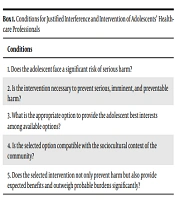
A Bioethics Framework for At-risk Child/Adolescent Access to Key Reproductive Health Services Without Parental Consent
Forouzan Akrami,
Alireza Zali,
Mahmoud Abbasi
Akrami F, Zali A, Abbasi M. A Bioethics Framework for At-risk Child/Adolescent Access to Key Reproductive Health Services Without Parental Consent. Inn J Pediatr. 2022;32(6):e120591. doi: https://doi.org/10.5812/ijp-120591
Cited by
- Scopus by DOI: 0
Last Update: 1 week ago
- Scopus by Title: 25
Last Update: 1 week ago
- Scopus by Title (Ref): 25
Last Update: 1 week ago
- CrossRef: 0
Last Update: 4 hours ago
- OpenAlex: 0
Last Update: 7 hours ago
- OpenCitations: 0
Last Update: 5 days ago
Comments
Number of Comments:0