
1. Context
Adolescence is a transition period with evolutionary, emotional, psychological, and social changes. Both policy and practical steps are needed to support the health and well-being of adolescents at this distinct stage of life (1). In recent years, in addition to developmental and psychological changes, much emphasis has been placed on the rights of adolescents (2). Regarding the challenges of development in a turbulent world, the good chances and prospects for the lives of millions of adolescents are limited by inequality. They are exposed to numerous harms, some of which, such as bullying, violence, and self-harm, are more common in adolescence than in other stages of life due to their specific characteristics (1). The Convention on the rights of the child (CRC) obliges states parties to take action to protect all children living in their judicial realm without discrimination (3).
Adolescents’ sexuality is an essential reproductive health issue due to exposure to sexually transmitted diseases (STDs) and human immunodeficiency virus (HIV) or illegitimate pregnancies (4, 5). Despite the decreasing trend of HIV infection and acquired immunodeficiency syndrome (AIDS)-related deaths, these rates are increasing in older adolescents (1). Studies in the Asia-Pacific countries show an increase in the age of marriage and a decrease in the age of sexual activity (6); nevertheless, the results of a systematic review indicate the inconsistency of sexual and reproductive health policies and laws in these countries (7).
The World Health Organization (WHO) emphasizes accountability to make a sustainable and equitable world where the health and human rights of children and adolescents to survive, thrive, and develop are respected. Therefore, providing universal health coverage and access to essential goods and services is recommended (1). However, providing key reproductive health services (KRHS) to minors is a challenging issue with potential legal burdens. The need for HIV testing and counseling (HTC) and/or taking emergency contraceptive pills are some of KRHS to protect at-risk adolescents against harm, which confronts healthcare professionals (HCPs) with moral dilemmas and legal conflicts regarding consent and confidentiality (4, 5).
Consent and confidentiality are major challenging ethical and legal issues relating to at-risk adolescents’ access to KRHS. Most studies have looked at how to obtain informed consent for a child, participate in research, or choose a treatment intervention that meets the best interests of the child; however, harm preventive measures in at-risk adolescents have often been neglected (8-10). In Islamic countries, including Iran, KRHS, especially contraceptive services for adolescents, are prohibited due to the illegality of sex outside of the marriage contract. Based on the principles of Islamic biomedical ethics, especially “no harm” and “necessity”, immediate intervention in perilous circumstances is necessary to prevent or reduce harm, even if the intervention is against the law (11). Additionally, based on article 3 of “the law on the protection of children and adolescents” of the Islamic Republic of Iran (2020), a situation that endangers a child or adolescent in terms of physical, mental, social, and moral health and/or security or educational status is considered perilous and requires immediate intervention and legal protection. However, there is no directive or regulation on the access of at-risk adolescents to KHRS without parental consent.
According to WHO report (2017) on transformative accountability for adolescents, most Muslim countries, such as Egypt, Malesia, Indonesia, Iraq, and Iran, have no laws and regulations that allow adolescents (age range: 15 - 19 years) to seek contraception services without parental or spousal consent. A few of these countries, such as Afghanistan and Indonesia, allow HTC services and harm reduction intervention for adolescents who use injectable drugs (1). The administrative regulation of authorized centers for harm reduction intervention for individuals who abuse drugs, including adolescents, was adopted and implemented in Iran in 2012; however, it does not include KRHS for at-risk adolescents. The directive of prevention and prohibition of stigma and discrimination against people living with HIV was also adopted in Iran in 2020. In paragraph 9, article 9 of the directive, HIV testing for a discerning child has been implicitly allowed without parental consent.
The protection of adolescents from diseases related to lifestyle and sexual behaviors, such as HIV and common cancers in later years of life, is an ethical consideration and a legal obligation (12). It is frequently emphasized that adolescents with unconventional or unsafe sexual behaviors should have access to KRHS; nevertheless, the issue of the age of consent is a challenging factor and barrier to receiving these services. As a result, the first question that arises is whether there is a proper age for self-consent by at-risk adolescents, and the second is what ethical and legal standards justify their reproductive health regulations. Despite emphasizing adolescents’ access to KRHS globally, these questions have not been answered clearly. Therefore, this study aimed to justify at-risk adolescents’ access to KRHS without parental consent.
2. Evidence Acquisition
In this study, first, articles and documents were searched using the age of consent laws, reproductive health, and ethical/legal standards phrases with AND/OR separators in PubMed and Web of Science databases using the Google Scholar search engine in English. After a concise review of the age of consent in child/adolescent-related laws, at-risk child/adolescent access to KRHS without parental consent was analyzed and justified using major ethical and legal principles and standards.
Ethical frameworks are concrete instruments that help professionals in reasoning and deliberating about ethical aspects of a program or policy and decision-making about its implementation using a set of principles and standards to achieve better outcomes (13). Therefore, using major ethical and legal principles and standards, the first part of this framework argues that considering the age of consent for at-risk adolescents’ access to KRHS is a limiting and inefficient factor, and the second part presents arguments to justify at-risk adolescents’ access to KRHS without parental consent.
3. Results
3.1. Adolescence and Age of Consent Laws
According to the definition of the WHO, adolescence refers to the age range of 10 - 19 years, and individuals within the age range of 10-24 years are called young. The United Nations defines youth as 15 - 24 years for statistical conformity in regions and without conflict with the definitions of other member states. About 23% of the world’s population are young individuals, and 16.4% are 10 - 19 years; nearly two-thirds of them live in Asia (14).
Based on article 1 of the CRC, individuals under 18 years are generally considered to be children unless their majority is recognized or registered in accordance with the applicable law on children. Article 1 of “the Law on the Protection of Children and Adolescents” of the Islamic Republic of Iran, which has been enacted to provide legal protection for children under the age of 18, defines an individual before reaching the age of puberty as a “child”, and those who are within the age of puberty and 18 full years of age as “adolescent” (15).
Maturation is defined by two means, namely physical maturity, and intellectual maturity. According to Islamic jurisprudence, the legal age of puberty is 9 full lunar years for females and 15 full lunar years for males, referring to their competence and assignment to religious duties (16). The minority is different in a variety of affairs and situations in such a way that the majority, for some matters, such as marriage, driving, participating in elections, and even sexuality, is different according to the law of each country. Because decision-making in various matters, in addition to physical maturity, requires a degree of mental maturity; for example, in numerous countries, the voting age is 16 years. In some Islamic countries, the movement to consider the age of 15 for legal considerations, such as voting, marriage, and property, equally for both males and females has begun (4).
In France law, a doctor can override parental wishes in exceptional situations, such as a minor’s request for contraception and pregnancy termination (17). In the United States, several governments have authorized adolescents to use contraception with their own consent. Some have considered other competency criteria, such as judgment of HCPs for harm if they did not receive care. Moreover, 35 of the 50 states in the United States have statutes that allow adolescents contraception access, and most of them allow adolescents to receive HTC, STDs, and reportable diseases care with their own consent. In all of these states, access to alcohol and substance-use care or mental health outpatient services is permitted with the adolescent’s consent, albeit with restrictions on age or type of care. In some states, courts argue that an adolescent is allowed to have access to contraception without parental consent based on privacy and confidentiality laws (18).
The age of consent for HIV testing in Sub-Saharan countries ranges from 12 to 18 years (19). A review of the laws of countries of the Asia and Asia-Pacific region, many of which are Muslim, shows that each has adopted a certain consent age to prevent and reduce harm. The existence or enactment of these laws reflects the fact that in situations where minors are at risk of imminent danger or harm, governments have enacted relevant laws to prevent or reduce harm. For example, the ages of consent for HIV testing under the laws of Vietnam, Lao, and the Philippines are 16, 14, and 15 and older, respectively; the age of consent in Cambodia is 18 years, and if it is not possible to obtain parental consent and in the case of best interests of the child, consent is obtained from the child. Nonetheless, in most of these countries (except Vietnam), there is no legal age limit for access to harm reduction services (e.g., needles and syringes and alternative opioid therapy) (20). In most Asian countries, regulations do not allow access to contraception, including emergency pills, for adolescents aged 15 - 19 years without parental or spousal consent; nevertheless, in some others, including Afghanistan, Iraq, Indonesia, and Lebanon, voluntary HCT and harm reduction services are allowed for them (1).
3.2. Framework
3.2.1. First Part
Informed consent is an ethical process and a legal issue. By law, children under 18 years are usually considered unauthorized to consent to medical procedures. The medical examination and treatment of children require the consent of parents as those who want the best for their child more than others (21). However, medical intervention based on the combination of a parent or legal guardian’s consent and patient assent is the preferred model recommended to pediatricians (22). Ensuring the child’s capacity or understanding of its inadequacy plays an essential role in deciding how he/she can exercise his/her rights. Recent studies have invoked the principle of “evolving capacities” to protect the child. According to the CRC, member states should comply with the parents’ responsibilities and duties to guide them to respect the child’s rights recognized in the convention proportionate to the principle of “child’s evolving capacities” (3).
Children have historically been defined as vulnerable and legally incompetent individuals in need of protection; however, they have been shown to be able to exercise agency and decision-making even at a young age, much earlier than the age of legal competence (23). Regarding the gradual development of their capacity, numerous children can make the right choices in some conditions before legally becoming adults (24). Therefore, some legal systems refer to adolescents’ evolving capacities for self-determination in medicine as a mature minor rule (10, 25). It is believed that if adolescents’ perceptual capacities are sufficiently developed, they will have some degree of self-determination and can give independent consent to have access to KRHS. Age-related strictness, in which younger adolescents need parental consent to receive preventive healthcare, is often ineffective because it impairs adolescents’ health and well-being by creating barriers to care access (26).
The right to self-determination in clinical and research situations requires to include disclosure of information about the process, benefits, risks, and alternative treatments to patients in health regulations, although a range of disclosure standards in clinical situations in different states are present (27). An important point is the nature and effectiveness of healthcare services based on scientific evidence. Therapeutic interventions with an aggressive nature and significant risk require written informed consent. For preventive measures, oral consent is sufficient because they do not impose a significant risk to the patient, such as HTC (28). Therefore, the type of services that can be provided to at-risk adolescents without the consent of parents or legal guardians should be specified.
Some scholars believe that traditional informed consent is a formal process; it is required for unusual, invasive, and high-risk interventions, and for routine, simple, and low-risk procedures, patient assent is sufficient. In their proposed model, consent is presented as a continuum consisting of three items, namely informed consent, assent, and dissent. Most primary health measures, such as screening and diagnostic and radiological tests, only require the patient’s dissent. Assent requires HCPs to provide specific recommendations while educating; they make available a brief list of options based on the patient’s condition. The use of each of these items depends on contextual factors, including age, gender, culture, health literacy, previous medical experience, professional expertise, and the type and duration of the relationship with the patient (29).
Adolescents aged 14 years and older can assent to treatment interventions and participate in nonprofit research (8, 9). As Diekema puts it, the purpose of adolescent assent is not to treat adolescents as adults who have full capacity for informed choice or to exclude those who already have the same decision-making capacity as adults. Therefore, adolescent assent at any age is needed for the measures in which they are directly involved (9).
In terms of the evolving capacities of the child, adolescents can be considered to have some degree of mental capacity to understand general information and self-determination for receiving preventive services (e.g., screening, diagnostic tests, and primary healthcare). Adolescents of the same age might have varying degrees of self-determination capacity. Adolescents who voluntarily engage in sexual activity and request KRHS appear to have the maturation to benefit from these services, and the maturation of those who do not seek these services despite engaging in similar high-risk behaviors is questionable. Therefore, in our view, considering a certain age of consent for KRHS that are preventive in nature is a limiting and inefficient factor and conflicts with the principle of evolving capacities.
Given the purpose of providing KRHS, which is to protect at-risk adolescents from harm, the use of health laws as a tool to maintain and promote public health, and not to consider the adolescent as the responsible person for using these services, we are not looking for the competence of these adolescents in the same way as adults. On the other hand, adolescents who put themselves at risk cannot be expected to do so. In these situations, unlike therapeutic interventions, there is no need to understand the explanations about the treatment procedure or alternative methods for choosing them or understand the purpose and the risks and benefits of research to participate. Understanding the general context and justifying the adolescent are sufficient to provide KRHS and to protect from harm. At-risk adolescents have some degree of self-determination to decide their health-related matters, and KRHS can be provided to them with their own assent. At the same time, this helps develop health-related autonomy and empowers them to make healthy choices.
Minor consent considerations for providing healthcare and confidentiality of information are intertwined, especially in the case of KRHS. When a minor is less than the legal age for consent, the confidentiality of his/her information is also morally and legally challenging. Mature minors who can make decisions about their health might request confidentiality of information; however, in cases, such as rape, due to a legal reporting obligation or the need to pay for a medical procedure or its side effects, the adolescent should be explained about the relativity or impracticality of confidentiality (10). Numerous laws, such as the Right to Privacy Act, protect the confidentiality of healthcare information. Laws that allow minor consent to healthcare include confidentiality with various terms, such as disclosure in specific cases or the expression of a general disclosure consideration. Although specific rules or other rules on parental access to minor healthcare information are silent, HCPs are responsible for judging and deciding in these cases (18).
The HTC is one major and current sample of KRHS which should be conducted voluntarily and confidentially due to HIV related-stigma and discrimination. Posttest counseling is necessary to advise avoidance of risky behaviors to those with negative test results. However, in cases where the condition persists, such as a positive HIV test result or aggressive treatment, the adolescent needs to be consulted to disclose and share his/her medical information with his/her parent or legal guardian (10).
3.2.2. Second Part
The second part of the framework addresses the issue that if we do not believe in the proper age of consent and allow adolescents’ assent in the event of serious harm due to their evolving capacities, their reproductive health regulations can be justified on which ethical and legal standards. Regarding the middle age of adolescents, most studies have recommended the use of the harm principle (HP) and the best interest standard (BIS) to make decisions about pediatric medical care (30-33). Although the HP is one of the principles of bioethics and health law, which has been applied to protect others from harm, especially children and disabled individuals (34), it has also been applied as a principle of bioethics to make decisions for children for the past two decades. Numerous scholars have suggested applying the HP instead of BIS. According to the HP, if the decisions of parents expose the child to injury, the government is obliged to protect the child from harmful decisions (32, 33, 35). Moreover, according to scientific evidence, due to the preventive nature of KRHS, they have no significant side effects, and failing to give such services can lead to irrecoverable harm. According to the HP, as long as the adolescent is at risk, providing these care services to protect him/her is necessary.
For many years, the BIS has been the dominant model for making decisions about children in bioethics. The BIS is enshrined in law as the first consideration in decision-making for children as both leading and restricting criteria of parental authority (36). It leads parents to decide and choose the best option, and the unreasonable decision of parents requires the intervention of the government (21). Therefore, decision-makers and HCPs are obliged to choose the option that provides the best interests of the child by balancing available potential healthcare actions (36). Critics of the BIS argue that it does not sufficiently limit the authority of parents and/or does not determine the threshold to intervene by the government (31, 35).
Ethically setting the minimum threshold of parental decision using the HP and ensuring the best interest of the child require intervention in parental decisions. This way is similar to Gillam’s zone of parental discretion, which arises from the HP (37). The parental discretion zone (PDZ) is an ethical measure that has been proposed by Gillam to be applied in the case of conflicts between the medical decisions of physicians and parents. Based on the HP, the parental decision below the mentioned threshold requires intervention by the government, and above that is placed in the area of parental control, where parents can do whatever they want without others’ intervention (35).
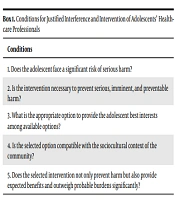
In the current suggested framework, the BIS is applied in the decision-making process for at-risk adolescents to have access to KRHS on the ground of harm standard. In Box 1, the first two questions assess only the threshold of intervention, and the next three questions are the practical steps toward preventing harm and providing the adolescents’ interests. For every option, balancing the benefits and burdens should be done to minimize the probable burdens (see Box 1).
Box 1.
Conditions for Justified Interference and Intervention of Adolescents’ Healthcare Professionals
| Conditions |
|---|
| 1. Does the adolescent face a significant risk of serious harm? |
| 2. Is the intervention necessary to prevent serious, imminent, and preventable harm? |
| 3. What is the appropriate option to provide the adolescent best interests among available options? |
| 4. Is the selected option compatible with the sociocultural context of the community? |
| 5. Does the selected intervention not only prevent harm but also provide expected benefits and outweigh probable burdens significantly? |
The HP obliges the government to protect at-risk adolescents against harm by shifting the tasks from parents to HCPs in order to promote the interests of the adolescent by balancing the expected benefits and probable burdens of each option and choosing the best among available options. The perceived risk and available options depend on the sociocultural context of the community in which the adolescent lives. Therefore, the community context was considered in assessing the seriousness of the harm and choosing the optimal option for adolescents’ well-being.
As noted, the principle of evolving capacities, the HP, and the BIS limit the power of parents to consent to provide KRHS to at-risk adolescents. Informing parents to consent to KHRS in these critical situations can lead to conflicts between the parents and the adolescent and endanger the adolescent’s mental and physical safety. In such a risky situation, where it is not possible to obtain parental consent or endanger the adolescent’s personal security, preventing harm and meeting the adolescent’s best interests require providing preventive services, such as HTC, with the adolescent’s own assent.
After assessing the seriousness of the harm and the threshold of intervention, practical steps are taken toward the provision of the health and well-being of the adolescent. Based on the BIS, HCPs should choose the option that best promotes adolescent interests by balancing the benefits and burdens and minimizing the probable risks. Maintaining sound communication between HCPs and adolescents requires that their privacy be respected, and they refrain from disclosing information to their parents except in cases of imminent harm and according to legal examples of mandatory reporting or with their assent. However, in cases where a risky condition persists, such as a positive HIV test result or illegitimate pregnancy, the adolescent should be consulted to disclose and share medical information with the parents or legal guardian.
In the proposed framework, firstly, it was argued that at-risk adolescents could receive KRHS with their own assent. This study, unlike other studies, discussed adolescents’ consent to have access to KRHS with the purpose of harm prevention instead of therapeutic intervention. According to the committee on pediatric emergency medicine and committee on bioethics, generally, the screening tests and any essential and probable medical intervention to prevent serious injury to a child with an immediate medical condition should not be postponed due to problems in obtaining consent (22). Informing and educating at-risk adolescents is the first step for the improvement of adolescents’ self-determination to choose healthy behaviors and avoid harmful ones. A preventative approach requires that the services provided to at-risk adolescents and protecting them from serious harm empower them to avoid unconventional sex and risky behaviors.
Secondly, it was argued that the BIS is applied in the ethical decision-making process for at-risk adolescents’ access to KRHS on the ground of harm standard. In this framework, it is trying to prevent harm, meanwhile maximizing the interests of the adolescent. According to the Malaysian Children’s Bioethics Symposium, both principles of best interest and no harm are equally essential and complementary in decision-making for children (38). Diekema believes that a serious risk or harm can hinder the interests of the child (33). Gillam’s PDZ model focuses on preventing potential harm, although she suggests evaluating whether the good effects outweigh the harms (35). Although the present study seeks potential benefits to ensure the optimal interests of the adolescent, the suggested framework tries to maximize the benefits of the adolescent while removing harm. Serious harm can deter several aspects of an individual’s good life other than health. Therefore, unlike Gillam, to make decisions and choose the best option for adolescents’ well-being, positive questions are asked. Because asking negative questions is a minimal approach to prevent harm and cannot meet both the adolescent’s health and well-being.
Adolescents’ lifestyles and behavioral norms are influenced by policies, laws, and the environment. Given the shortcoming of human rights to protect children, ethical frameworks are suggested to provide child protection and well-being using both child rights and moral entitlements in a socioecological context (39). The perceived risk and available options depend on the context of the community in which the adolescent lives; the context should also be considered in choosing the optimal option for the adolescent’s well-being. It is believed that although the HP is simple to apply, since the definition of harm changes based on the context, this principle cannot be used to justify choosing the best option among the potential actions (30, 37). Applying the HP causes missing the other ethical requirements in preventing harm because it pushes back other moral features of the parent-child and doctor-child relationship. The consequence is deviating from other ethical imperatives for improving a child’s well-being or prioritizing options that, in addition to removing the harms, promote the child’s benefits (40).
4. Conclusions
The results showed that KRHS could be provided for at-risk children/adolescents with their own assent. Regarding the existence of restrictive laws, the suggested framework can be applied in different communities as a bioethics policy guide for the legislation and appropriate actions of adolescents’ HCPs.
Regarding context-related limitations, including restrictive laws and customs, the implementation of the suggested framework requires that each country develops a national action plan with the participation of all responsible organizations. Commitment to protecting children/adolescents from harm and legal obligation to intervene immediately in the event of serious harm or threat to their physical or mental health requires reviewing and amending related regulations, such as the age of consent, in line with social changes. Therefore, firstly, the government should protect at-risk adolescents against harm by shifting tasks from parents to HCPs based on the Islamic maxim of no harm and obliging them to choose the option that best suits adolescents’ interests. Secondly, to maximize positive outcomes and minimize the burdens of actions, providing KHRS for at-risk adolescents should be inserted and implemented in the frame of a harm reduction program by trained HCPs.
The suggestion for further studies is setting criteria in terms of the type and frequency of KRHS based on the sociocultural context of the communities, without enacting stigma and discrimination, and preventing risky behaviors that cause harm and have a deterrent effect on the frequency and intensity of these behaviors.