
1. Background
Kidney stones, as the most common chronic kidney and urinary tract diseases in children, are among the major causes of children mortality; may be due to obstructive abnormalities or underlying metabolic predispositions (1). In industrialized societies, most stones (> 90%) are formed in the urinary tract (UT) of children and become symptomatic. The clinical symptoms and signs include renal colic, vomiting, distress, and inability to relieve pain with position changes. In younger children, classic symptoms may not be apparent; fussiness and vomiting may be the only symptoms (2).
In the etiology section, metabolic causes consist of idiopathic familial hypercalciuria (IHC), hyperoxaluria, uric acid disorders, distal renal tubular acidosis, cystinuria, hypercalcemic hypercalciuria, and primary hyperparathyroidism (3).
Anatomical abnormalities associated with kidney stones formation:
- Calyceal diverticulum
- Ureteropelvic junction (UPJ) obstruction
- Urinary tract obstruction
- Vesicoureteral reflux
- Benign prostatic hypertrophy (BPH)
- Medullary sponge kidney (tubular ectasia)
Metabolic abnormalities associated with kidney stones formation:
- Metabolic syndrome
- Hypovolemia
- Hypercalcuria
- Hypocitraturia
Proper nutrition in infancy is essential for normal growth, resistance to infections, long-term adult health, and cognitive development (4). Healthy nutrition has especially an important role in the first 6 months, an exceptional period, to accelerate growth and fulfil the high nutrient requirements relative to body weight (5). In addition, nutritional therapy, such as fluid intake, plays an important role in preventing of kidney stones formation (6). Therefore, patients should take more than 8 glasses, 8 ounces, of water per day to keep urine dilution (7), this approach in uric acid and cysteine stones is more important (8).
2. Objectives
Kidney stones, as the most common chronic kidney disease in children, may induce obstructive uropathy also nutrition influenced kidney stones formation. Therefore, the current study aimed at investigating children with nephrolithiasis or urolithiasis and their relationship with the absence of healthy eating behaviors.
3. Methods
3.1. Study Setting
The current study was conducted in the pediatric clinic of Amirkabir hospital, Arak, Iran.
3.2. Study Population
This as a case-control study was conducted on 270 children with or without kidney stones, within the age range of 2 - 12 years selected by the convenience sampling method. The case group comprised of 135 children with kidney or urinary tract stone, confirmed by sonography reports, and the control group included 135 healthy children. Inclusion criteria were the positive kidney or urinary tract stones, absence of congenital kidney disease and anomaly (detected in patient assessments), and consent to participate in the research project; the exclusion criteria were leaving the study for any reasons and no agreement to use their personal data in the study.
3.3. Measurements
All tests and sonographies were conducted and assessed by the same pediatric nephrologist on all the participants to detect kidney stones. Nutritional status was determined by a 24-hour questionnaire and according to the serving size and report recalls for each food item such as methionine, vitamin C, and sodium; the daily intake of them was expressed in gram units. In addition, the energy content of each food and beverage was calculated using the USDA (United States Department of Agriculture) food composition table embedded in the food processing software Nutritionist 4. The demographic information (gender, birth rank of child, body mass index (BMI (kg/m2, birth weight, and type of child about delivery time), growth status, and nutrient intake status in the past 24 hours were collected by the researcher.
3.4. Ethical Considerations
Ethical issues (including plagiarism, data fabrication, double publication) were completely observed by the authors. In addition, the ethical committee of Arak University of Medical Sciences approved the study protocol.
3.5. Statistical Analysis
Sample size was calculated based on the comparison of 2 diets for the prevention of recurrent stones in idiopathic hypercalciuria (9). Data analysis was conducted using the Pearson correlation coefficient, independent t test, and regression logestic analysis, central and distribution indices were reported as mean ± standard deviation (SD); solidarity quantitative indicators were assessed using the 2-tailed Pearson correlation. In addition, logistic regression analysis was also used; P < 0.05 was considerede as the level of significance.
4. Results
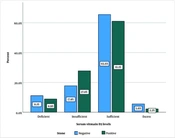
As shown in Table 1, in the demographic data section, only gestational age had statistically significant differences in the 2 groups (P = 0.016). The other variables consisting of gender, birth rank, BMI, and birth weight were matched (P = N.S). Growth status in Table 2 showed no significant difference between the case and control groups (P = N.S).
Table 1.
Demographic Information in Case and Control Groupsa
| Variable | Case | Control | Total | P Valueb |
|---|---|---|---|---|
| Gender | N.S | |||
| Male | 60 (44.4) | 63 (46.9) | 123 (45.7) | |
| Female | 75 (55.6) | 72 (53.1) | 147 (54.3) | |
| Child Birth rank | N.S | |||
| First | 71 (52.8) | 75 (55.6) | 146 (54.2) | |
| Second | 43 (32.1) | 41 (30.6) | 84 (31.3) | |
| Third and higher | 21 (15.1) | 19 (13.9) | 40 (14.5) | |
| BMI, kg/m2 | N.S | |||
| < 18.5 | 78 (57.9) | 78 (57) | 156 (57.5) | |
| 18.5 - 25 | 44 (32.7) | 45 (33.6) | 89 (33.2) | |
| 25.1 - 30 | 9 (6.5) | 10 (7.5) | 19 (7) | |
| 30.1 - 35 | 3 (1.9) | 1 (0.9) | 4 (1.4) | |
| < 35 | 1 (0.9) | 1 (0.9) | 2 (0.9) | |
| Birth weight, g | N.S | |||
| VLBW, < 1500 | 1 (0.9) | 1 (0.9) | 2 (0.9) | |
| LBW, 1500-2500 | 13 (9.3) | 10 (7.4) | 23 (8.4) | |
| NBW, 2500-4000 | 109 (80.4) | 122 (89.9) | 231 (85.1) | |
| HBW, > 4000 | 13 (9.3) | 3 (1.9) | 16 (5.6) | |
| Gestational age | 0.016 | |||
| Preterm | 23 (17) | 10 (7.4) | 33 (12.1) | |
| Term | 103 (76.4) | 122 (90.7) | 225 (83.6) | |
| Post-term | 9 (6.6) | 3 (1.9) | 12 (4.2) |
Abbreviation: N.S, not significant.
aThe values are presented as No. (%).
bP values < 0.5 were considered statistically significant.
Table 2.
Comparison of Growth Status in the Case and Control Groupsa
| Variable | Case | Control | Total | P Valueb |
|---|---|---|---|---|
| Optimal growth | N.S | |||
| Positive | 120 (88.5) | 122 (90.6) | 24 2(89.5) | |
| Negative | 15 (11.5) | 13 (9.4) | 28 (10.5) | |
| FTT | N.S | |||
| Positive | 3 (2) | 4 (3) | 7 (2.5) | |
| Negative | 132 (98) | 131 (97) | 263 (97.5) | |
| Stunted growth | N.S | |||
| Positive | 7 (5.1) | 1 (1) | 8 (3) | |
| Negative | 128 (94.9) | 134 (99) | 262 (97) | |
| Slow growth | N.S | |||
| Positive | 16 (11.9) | 14 (10.7) | 30 (11.3) | |
| Negative | 119 (88.1) | 121 (89.3) | 240 (88.7) |
Abbreviation: N.S, not significant.
aThe values are presented as No. (%).
bP values < 0.5 were considered statistically significant.
In addition, as shown in Table 3, nutrient intakes including animal protein (P = 0.0001), meals water (P = 0.023), total liquids (P = 0.011), energy (P = 0.003), protein (P=0.008), fat (P = 0.001), saturated free fatty acids (FFA) (P = 0.018), unsaturated FFA (P = 0.002), meat (P = 0.0001), caffeine (P = 0.0015), potassium (P = 0.024), and methionine (P = 0.004) was significantly higher in the case group than the control group, while sodium (P = 0.0001) intake was significantly higher in control group. There were no statistically significant differences in the intake of vitamin K, fructose, sucrose, carbohydrate, vitamin B6, folate, vitamin B12, vitamin D, magnesium, cysteine, fiber, fruit, vegetables, bread/cereals units, content of protein, carbohydrates and fat in the daily energy supply of the 2 groups (P = N.S).
Table 3.
Mean Intake of Nutrients Affecting the Kidney Stone formation in the Case and Control Groupsa
| Variable | Case | Control | Total | P Valueb |
|---|---|---|---|---|
| Animal protein, g | 12.8 ± 27.6 | 9.2 ± 20 | 11.8 ± 23.8 | 0.0001 |
| Calcium, mg | 302 ± 610 | 304 ± 562 | 58.5 ± 586 | N.S |
| Vitamin C, mg | 56.7 ± 65.3 | 60 ± 72 | 58.5 ± 68.7 | N.S |
| Oxalate, un | 1 ± 1.58 | 1.1 ± 1.4 | 1.09 ± 1.5 | N.S |
| Food liquids, mL | 369 ± 828 | 336 ± 718 | 357 ± 773 | 0.023 |
| Water with meals/during day, mL | 426 ± 1218 | 439 ± 1135 | 434 ± 1176 | N.S |
| Total Liquids, mL | 518 ± 2047 | 594 ± 1853 | 564 ± 1950 | 0.011 |
| Energy, kcal | 568 ± 1695 | 531 ± 1462 | 560 ± 1578 | 0.003 |
| Carbohydrate, g | 73 ± 218.7 | 74 ± 200 | 74 ± 209 | N.S |
| Total protein, g | 22.6 ± 52.5 | 18.3 ± 45 | 20.9 ± 48.8 | 0.008 |
| Fat, g | 29.3 ± 65.3 | 21.5 ± 53 | 26.2 ± 59 | 0.001 |
| Saturated FFA, g | 11.8 ± 18.8 | 9.2 ± 15.3 | 10.7 ± 17 | N.S |
| Unsaturated FFA with 1 - 2 double bonds, g | 10.8 ± 18.9 | 9.1 ± 15 | 10.1 ± 16.9 | 0.004 |
| Unsaturated FFA with > 2 double bonds, g | 10.3 ± 20.2 | 8 ± 16.2 | 9.4 ± 18.2 | 0.002 |
| Milk/dairy, un | 0.9 ± 0.9 | 0.8 ± 0.9 | 0.88 ± 0.94 | N.S |
| Vegetable, un | 1 ± 0.8 | 0.8 ± 0.8 | 0.9 ± 0.8 | N.S |
| Fruit, un | 1.3 ± 1.35 | 1.3 ± 1.5 | 1.3 ± 1.4 | N.S |
| Meat, un | 2.2 ± 3.2 | 1.3 ± 2.2 | 1.8 ± 2.7 | 0.0001 |
| Bread/cereals, un | 3.6 ± 8.5 | 3.3 ± 9.1 | 3.5 ± 8.8 | N.S |
| Fat, un | 3.6 ± 8.4 | 2.8 ± 6.2 | 3.4 ± 7.3 | 0.0001 |
| Energy content Protein, % | 3.3± 11.9 | 3 ± 11.9 | 3.1 ± 12 | N.S |
| Carbohydrate energy content, % | 9.4 ± 53.4 | 8.1 ± 55.2 | 8.8 ± 54.3 | N.S |
| Fat energy content, % | 7.8 ± 33.4 | 8 ± 32.7 | 7.8 ± 33 | N.S |
| Fructose, g | 5.6 ± 4.8 | 6.6 ± 5 | 6 ± 5 | N.S |
| Sucrose, g | 14 ± 18.9 | 12.4 ± 15.6 | 13.4 ± 17.3 | N.S |
| Potassium, mg | 977 ± 1921 | 803 ± 1650 | 902 ± 1785 | 0.024 |
| Magnesium, mg | 93 ± 185 | 93.5 ± 173 | 93.4 ± 179 | N.S |
| Vitamin B6, mg | 0.66 ± 0.96 | 0.74 ± 0.86 | 0.78 ± 0.92 | N.S |
| Vitamin B12, mcg | 7 ± 2.7 | 1.3 ± 1.6 | 1.8 ± 2.1 | N.S |
| Fiber, g | 6.9 ± 11.6 | 5 ± 11 | 6 ± 11.2 | N.S |
| Cysteine, mg | 374 ± 662 | 345 ± 566 | 362 ± 614 | N.S |
| Ash, g | 4.1 ± 8.7 | 8.6 ± 8.4 | 6.8 ± 8.5 | N.S |
| Sodium, mg | 634 ± 1042 | 3437 ± 22340 | 2545 ± 1689 | 0.0001 |
| Methionine, mg | 534 ± 1026 | 412 ± 835 | 485 ± 931 | 0.004 |
| Folate, mg | 141 ± 168 | 91 ± 146 | 119 ± 157 | N.S |
| Vitamin K, mcg | 122 ± 53.5 | 76 ± 45 | 101 ± 49.5 | N.S |
| Phosphorus, mg | 408 ± 783 | 344 ± 694 | 380 ± 740 | N.S |
| Caffeine, mg | 19 ± 37 | 15 ± 31 | 17 ± 34 | 0.015 |
| Major citrate dietary sources, un | 0.9 ± 0.7 | 0.8 ± 0.7 | 0.85 ± 0.7 | N.S |
| Vitamin D, mcg | 1.9 ± 1.7 | 2.8 ± 1.9 | 2.4 ± 1.8 | N.S |
Abbreviation: N.S, not significant.
aValues are presented as mean ± SD.
bP values < 0.5 were considered statistically significant.
Also, based on logistic regression analysis, Table 4, intake of sodium (P = 0.0001), methionine (P = 0.0001), animal protein (P = 0.002) and fat (P = 0.0001) units had a significant effect on kidney stones formation.
Table 4.
Logistic Regression Analysis of Variables Influencing Kidney Stones Formation
| Variable | Ex (B) | B | P Value |
|---|---|---|---|
| Sodium, mg | 1.002 | 0.002 | 0.0001 |
| Methionine, mg | 1.001 | 0.001 | 0.0001 |
| Animal protein, g | 0.923 | 0.08- | 0.002 |
| Fat, un | 0.77 | 0.261- | 0.0001 |
5. Discussion
The current study aimed at considering the nutritional factors in kidney stones formation in children. The results of the current study showed that energy, protein, fat, caffeine, methionine, and sodium intake should be considered more carefully. Recent studies show that the most important environmental factor associated with kidney stones formation is related to diet, but the role of food sources in stone formation is unknown.
The number of male and female patients with kidney stones in the groups was equal, but in other studies kidney stones formation in males was more than that of females (1, 10). According to the experimental data, high prevalence of stones in males can be attributed to the role of sex hormones in the incidence of kidney stones. In the current study, the large number of females with kidney stones might be attributed to factors such as age, lack of personal hygiene knowledge, and the risk of urinary tract infection. Manuel Ferraro et al. found that risk of kidney stones might vary by the type of consuming protein. High potassium in diets or a relative abundance of animal protein compared with potassium could represent a means of kidney stone prevention (11), but in the current study, animal protein intake and amino acids containing sulfur, cysteine, and methionine, in the case group was higher compare with those of the control group. Margaret et al. reported the areas of educational need, specifically, quantifying patients' intake of certain foods/nutrients and identified that stone risk factors were diet related (12). Ferraro et al. concluded that caffeine intake was independently associated with a lower risk of incidence of kidney stones (13). Dietary factors and the risk of kidney stones formation in males indicated that the association between calcium intake and kidney stone formation varied with age and magnesium intake decrease; and total vitamin C intake seemed to increase the risk of symptomatic nephrolithiasis. Age and body size affect the relationship between diet and kidney stones; hence, dietary recommendations for stone prevention should be tailored to the individual patient, based on the study by Taylor et al. (14). In future research, it is recommended to investigate the supplements and their effects on kidney stones, water drinking, and their relationships with kidney stones formation in children.