
1. Background
Every year, 15 million premature infants are born in the world, and this number is increasing (1, 2). Hospitalization of premature infants is inevitable most of the times, and the infant may even have a long stay in the neonatal intensive care unit (NICU). The parents constantly undergo a lot of psychological pressure during the infant’s stay in the NICU, and therefore experience feelings of incompetence, anxiety, and major depression (3). Moreover, the infant’s hospitalization in NICU is a potential stress-inducing factor, which affects the mother-infant interaction. Psychological, social, and biological stresses along with the infant’s hospitalization in NICU, concerns about its health and separation from it can cause emotional difficulties and anxiety for the mother (4).
Feelings of stress are associated with a reduction in loving and responsible maternal behaviorsand affectionate behavior and also between the mother’s anxiety and disturbed parenting behavior (5). On the other hand, the parent-child interaction is the foundation of self-confidence, security, emotional stability, learning readiness, and social development in a child. Mothers of premature infants may also show symptoms of depression, which can intervene with the development of the mother-infant attachment and the quality of care provided by the mother for the infant (6).
Parents of premature infants experience more tension than parents of full-term infants, and in this regard, mothers endure more tension and stress than fathers (3, 7). In such situations, it is essential to take measures to support the mothers during the acute phase of the infants’ hospitalization in the NICU (8, 9). The results of studies showed that some interventions had a positive effect on the mental health and anxiety of mothers of preterm infants (3, 10).
Touch is an important tool through which parents regulate their infants’ reactions. Mothers use special types of touch to control the infants’ negative and positive reactions (11).
The positive touch, which comprises different ways of touching the infant, including handling, holding, massaging, and the Kangaroo Care, is a novel approach that helps infants and parents deal with the stress they experience in an NICU. The first outcome of this intervention is the improvement in the mother-infant interaction, which improves the mother’s psychological state, increases her self-esteem, and consequently helps her adapt to stress and anxiety. The benefits of the infant massage for mothers include the decrease in the mother’s depression, increase in the mother-infant attachment, improvement of the mother-infant interaction, and the decrease in the mother’s negative emotion (12).
The existing literature is mostly focused on the effect of this method on various aspects of the infant’s health, and few studies have evaluated its effects on the mother as the infant’s primary caregiver (13). One of the interventions which has received less attention so far is the infant massage performed by the mother, which gives her the opportunity to have a pleasant interaction with her infant and establish a deep interaction with it through repeated eye-contact (14). Although recent studies have provided a better understanding of the effects of the infant massage on mothers, few studies have investigated the simultaneous effects of touch, massage, kangaroo mother care, and face-to-face verbal communication between the mother and the infant (collectively forming the positive touch) on the mothers’ mood states (15).
2. Objectives
The present study aimed to investigate the effect of positive touch on moods of mothers of premature infants hospitalized in NICU.
3. Methods
The present randomized clinical trial was conducted on 80 mothers, whose premature infants were hospitalized in the NICU of two hospitals in northern Iran in 2018. The study was registered in the Iranian Registry of Clinical Trials (IRCT) (registration number: IRCT20171205037765N1). The sampling method used in the first stage was convenience sampling, which was then shifted to random sampling by assigning even and odd numbers to the questionnaires of each of the intervention and control groups. The participants were divided into two equal groups (n = 40) of experimental and control. All participants were given a Profile of Mood States (POMS) questionnaire both at the time of admission and discharge. The experimental group received positive touch from the beginning of admission to the NICU until the time of discharge, while the control group only received the routine care. The inclusion criteria were mothers over 18 years of age, able to read and write, with no chronic mental or physical illnesses, and having an infant with no chromosomal abnormality. The exclusion criteria were a length of stay shorter than 10 days and longer than two months for the infant and the mother’s unwillingness to participate in the study. The required sample size was calculated to be 40 for each of the study groups, assuming a confidence level of 95% and power of 80%. Any mother who entered the NICU and met the inclusion criteria was informed about the research objectives and the way the study was conducted. Those who were willing to participate were asked to give an informed consent and were given a questionnaire. Then, they were consecutively assigned to one of the two study groups by computer randomization. In the experimental group, the intervention (positive touch) was performed at any time of the day, when the mother had the ability to enter the unit and visit her infant. The control group received the usual care and support. The researcher initially gave the experimental group the required training on how to perform the positive touch, i.e., touching, holding, massaging, and kangaroo care, using a soft doll. The mothers were also provided with the training contents in the form of an educational brochure. It should be noted that positive touch care is not routinely performed in the neonatal wards.
The positive touch includes the following stages:
- Preparation and observation: Providing an opportunity for the mother to express her feelings and fear, free her mind to concentrate, and see the infant.
- Mother’s presence without touching: Sitting quietly at infant’s bedside, reaching out the hand and holding it a few centimeters away from the infant’s head or feet, taking a slow, deep breath to reduce tension, and envisioning the comforting glow that can encircle the infant to help the mother relax.
- Initiating touch (permission): Conveying the intention of the forthcoming contact, deciding about infant’s readiness based on medical condition and behavioral state, waiting for signals of acceptance, preparing the environment by reducing the lighting and the noise level, and ensuring warmth and convenience by the nurse.
- Still holding/containment: Gently stroking with the fingertips, cupping the hands around the infant’s head, feet or hands, leading the infant into a quiet and relaxed state.
- Pacing: Adjusting the intensity, speed, and duration of the touch/massage to avoid overreaction of hypersensitive infants to help the infants respond and to provoke self-regulation.
- Kangaroo care: cuddling, caressing, and affectionately touching the infant, considering the NICU’s procedures, the infant’s individual needs, the daily rhythms of sleep, and the mother’s tendency to skin-to-skin touch.
- Letting go: Initiating the departure of the touch slowly, conveying the intention of forthcoming departure verbally or with silent intent, the hand rests still before the mother leaves, she gradually slows down the movement of her hand and then holds it still (16).
In implementing the positive touch, it is better to avoid predetermined time and duration and initiate the movement regularly and in a predictable way every day if circumstances allow. We begin with one slow but firm movement at a time on a part of body, where the infant appears to like (usually the head, hands or feet) and continue with a pressure deeper than a tickle stimulus, until it increases the production of behavior in response to the massage movements, which are rhythmical. If the infant trusts and tolerates the massaging, we gradually increase the number of sessions to more than one session per day up to a maximum of three times a day. The experimental group received the positive touch from the beginning of the infant’s admission to the NICU until the time of discharge.
The data collection instrument in the present study was the POMS questionnaire, which included two parts: (1) demographic characteristics (the mother’s age, level of education, and the infant’s birth order; the infant’s weight); (2) questions regarding the mood state. The POMS questionnaire contains 65 questions, measuring six different dimensions of the mood swings including tension-anxiety, anger-hostility, vigor, fatigue, depression, and confusion. We used a five-point Likert scale ranging from 0 (not at all) to 4 (extremely) to assign the scores. The range of scores for each subscale was as follows: (1) 0 - 36 for anxiety; (2) 0 - 60 for depression; (3) 0 - 48 for anger; (4) 0 - 32 for vigor; (5) 0 - 28 for fatigue; and (6) 0 - 28 for confusion. In order to calculate the total mood disturbance (TMD), we added the total scores for the five negative subscales, including anxiety, depression, anger, fatigue, and confusion and then subtracted the score for the positive subscale, which is vigor. Therefore, the TMD ranged from 0 to 168 and the lower score indicated a better mood (17). The number of items dedicated to each subscale of the mood state was nine for anxiety, 15 for depression, 12 for anger, eight for vigor, seven for fatigue, and seven for confusion. It took 3 - 7 minutes for healthy participants to complete the questionnaire and for those who were physically ill, it took longer. All the mothers in the experimental group completed the questionnaire once at the beginning of the study and once at the time of the infant’s discharge from the NICU. The mothers in the control group, who received no intervention and contacted their infants according to the routine procedures of the ward, completed the questionnaire twice like the mothers in the experimental group. The primary outcome of this study was the effect of positive touch on maternal mood states and its secondary outcome was the effect of positive touch on mother-infant interactions. The sampling process lasted for six months (Figure 1).
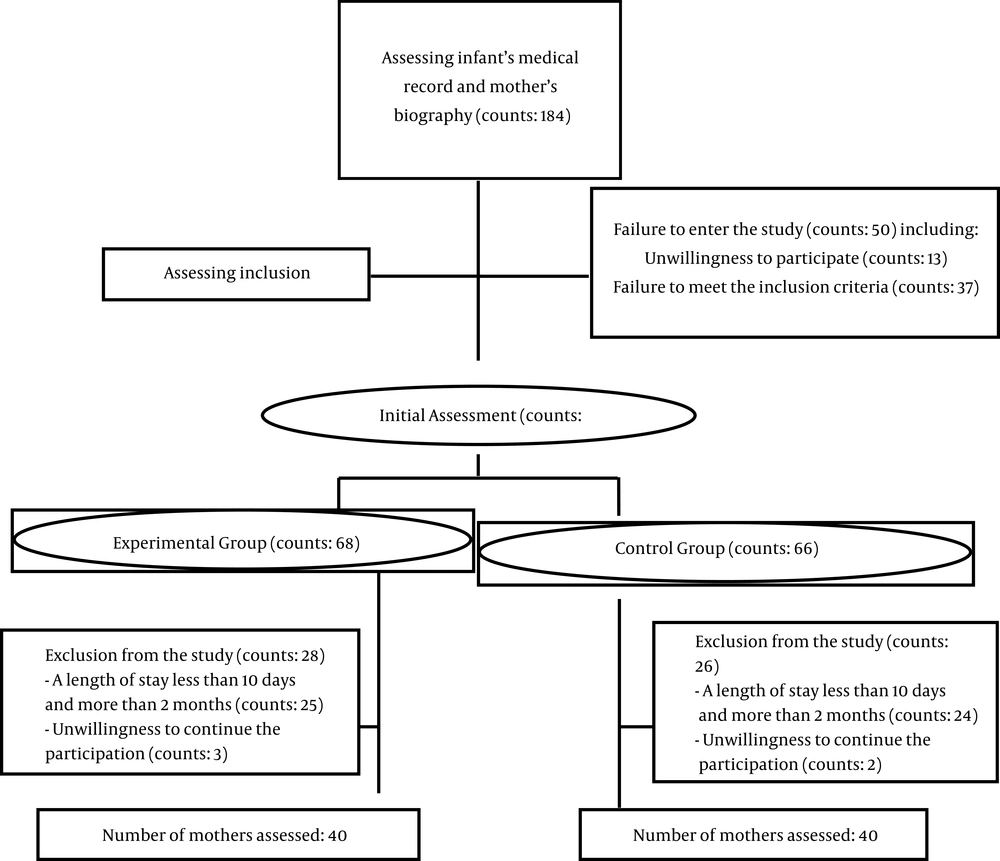
Figure 1.
The flow diagram of study design
In a study, Shafiei et al. used the content validity method to determine the validity of the POMS questionnaire. According to their findings, Cronbach’s alpha was 0.95 and Pearson correlation coefficient was 0.97 for anxiety, 0.95 for vigor, 0.98 for fatigue, and 0.98 for confusion (17). In the present study, Cronbach’s alpha for each subscale was as follows: (1) 0.733 for tension, (2) 0.924 for depression, (3) 0.868 for anger, (4) 0.855 for fatigue, (5) 0.733 for vigor, (6) 0.703 for confusion, and (7) 0.934 for the TMD. The obtained data was coded and analyzed using SPSS software version 22. Data analysis was performed using chi-square, paired t-test, and independent t-test. A P-value of less than 0.05 was considered significant.
4. Results
According to our results, both the experimental and control groups had similar demographic characteristics and there was no significant statistical difference between the two groups (Table 1). Also, according to Table 2, there was no statistically significant difference between the two groups in the mean length of stay of premature infants and the mothers’ mean age. There was no significant difference in between the two groups in terms of the total mood disturbance TMD score. There was no significant difference between the two groups in terms of the TMD score and the sub-scales of mood states before the intervention. After the intervention, except the sub-scale vigor which increased, all other sub-scales decreased, but the decrease in the experimental group was statistically significant compared to the control group (Table 3).
Table 1.
Percentage and Frequency Distribution of Demographic Characteristics of Mothers and their Premature Infants Hospitalized in NICU
| Demographic Characteristic | Experimental Group Counts (%) | Control Group Counts (%) | P-Value |
|---|---|---|---|
| Infant's gender | 0.18 | ||
| Boy | 23 (57.5) | 17 (42.5) | |
| Girl | 17 (42.5) | 23 (57.5) | |
| Mother’s level of education | 0.52 | ||
| Lower than high school diploma | 9 (45) | 11 (55) | |
| High school diploma | 19 (57.6) | 14(42.4) | |
| Higher education | 12 (44.4) | 15 (55.6) | |
| Mother's occupation | 1 | ||
| Housewife | 36 (50) | 36 (50) | |
| Employed | 4 (50) | 4 (50) | |
| Birth order | 0.08 | ||
| 1st child | 25 (51) | 24 (49) | |
| 2nd child | 11 (40.7) | 16 (59.3) | |
| 3rd child and onwards | 0 (25) | 4 (100) | |
| Type of delivery | 0.80 | ||
| Natural | 11 (47.8) | 12 (52.2) | |
| Cesarean | 29 (50.9) | 28 (49.1) | |
| Infant's weight (grams) | 0.24 | ||
| < 1000 | 1 (14.3) | 6 (85.7) | |
| 1000 - 1500 | 11 (52.4) | 10 (47.6) | |
| 1500 - 2500 | 22 (52.4) | 20 (47.6) | |
| > 2500 | 6 (60) | 4 (40) |
Table 2.
Comparison of Length of Stay and Mother’s Age in the Experimental and Control Groups a
| Variables | Experimental Group | Control Group | P-Value |
|---|---|---|---|
| Length of stay | 26.78 ± 15.07 | 23.95 ± 13.92 | 0.38 |
| Mother's age (y) | 28.73 ± 5.257 | 27.80 ± 4.895 | 0.41 |
a Values are expressed as mean ± SD.
Table 3.
Comparison of the Mean Score of Each Sub-scale of the Mothers' Mood States in the Two Groups Before and After the Educational Intervention
| Variables | Before Intervention | After Intervention | P-Value | Difference |
|---|---|---|---|---|
| Anxiety | ||||
| Experimental | 13.6 ± 7.49 | 7.45 ± 4.107 | < 0.001 | -6.15 ± 5.72 |
| Control | 13.175 ± 6.13 | 10.425 ± 5.2 | 0.004 | -2.75 ± 5.69 |
| P-value | 0.78 | 0.006 | 0.009 | |
| Depression | ||||
| Experimental | 15.725 ± 13.11 | 7.5 ± 885 | < 0.001 | -8.23 ± 10.03 |
| Control | 12.1 ± 8.622 | 9.05 ± 7.84 | 0.03 | -3.05 ± 8.93 |
| P-value | 0.14 | 0.320 | 0.017 | |
| Anger | ||||
| Experimental | 12.975 ± 9.585 | 6.075 ± 4.423 | < 0.001 | -6.9 ± 7.97 |
| Control | 11.475 ± 7.222 | 8.425 ± 5.3 | 0.002 | -3.05 ± 5.85 |
| P-value | 0.43 | 0.034 | 0.016 | |
| Vigor | ||||
| Experimental | 14.93 ± 4.599 | 16.93 ± 3.214 | 0.001 | 2 ± 3.43 |
| Control | 16.78 ± 4.47 | 17.45 ± 4.088 | 0.17 | 0.675 ± 3.09 |
| P-value | 0.07 | 0.525 | 0.074 | |
| Fatigue | ||||
| Experimental | 7.5 ± 6.47 | 3.95 ± 2.88 | < 0.001 | -3.55 ± 5.26 |
| Control | 6.68 ± 4.75 | 4.93 ± 4.475 | 0.01 | -1.75 ± 4.38 |
| P-value | 0.51 | 0.25 | 0.1 | |
| Confusion | ||||
| Experimental | 9.63 ± 4.65 | 6.73 ± 2.42 | < 0.001 | -2.9 ± 4.2 |
| Control | 8.8 ± 3.52 | 7.88 ± 3.36 | 0.09 | -0.925 ± 3.37 |
| P-value | 0.37 | 0.083 | 0.023 | |
| Total mood disturbance | ||||
| Experimental | 74.35 ± 36.47 | 48.63 ± 16.02 | < 0.001 | -25.72 ± 28.96 |
| Control | 69 ± 26.5 | 58.15 ± 24 | 0.01 | -10.85 ± 25.48 |
| P-value | 0.45 | 0.04 | 0.017 |
5. Discussion
The present research showed that the positive touch of the infant improves the mood states and its sub-scales in the mothers of premature infants hospitalized in the NICU. In line with the present study, in another similar study, massage of premature infants was effective in improving maternal mood (18).
In the present research, anxiety, which is a sub-scale of the mood state, decreased under the influence of the positive touch. The separation from the infant causes tension and anxiety for the parents, especially the mother (19). Gray et al. showed that mothers of preterm infants experience higher stress levels than mothers of full-term infants; it was suggested that the required preparations for the parents with premature infants, particularly mothers, should be provided after the childbirth to face with their infants and make appropriate interaction with them in the NICU (20).
In our study, the mother learned the first encounter with the infant through the positive touch training. By learning what she wants to do, she can better overcome her anxiety. A mother who enters the NICU can experience less anxiety if she knows how to touch, caress, hold, massage, and behave with her infant. In order to make relationship and interact with her infant, the mother needs an opportunity to make contact with the infant. The study by Jafari Mianaei et al. showed that after each stage of the program, anxiety in the mothers was lower in the experimental group compared to the control group (19). In another study, the mothers’ participation in taking care of the premature infant was effective on reducing the maternal anxiety (21). Similarly, the present study showed that the mother-infant interaction, which also exists in the positive touch, can have the same effect. However, the results of the study by Heidarzadeh et al. indicated that NICU orientation program cannot reduce the mother’s anxiety (22).
In the positive touch, the mother employs the kangaroo care. In the study by Kashaninia et al., the kangaroo care reduced the anxiety in the mothers of the premature infants (13). The study by Morelius et al. showed that an almost continuous skin-to-skin contact decreases the mothers’ postpartum stress and depression (23). In the positive touch training, too, the skin-to-skin contact is highly noted.
This study showed that massage of infants by mothers can be an effective treatment to facilitate maternal interaction and reduce postpartum depression. In other studies, such as the present study, mothers’ anxiety and depression were reduced after massage (24, 25). The study by Sohrabi et al. also showed that massaging the infant’s body by the mother affected the mother’s attachment behaviors (26).
In the present study, both groups had almost the same mean anger scores before the intervention. But after the intervention, although the mean anger scores decreased in the two groups, the difference in the mean anger scores of the two groups was still meaningful. However, in the study by Fujita et al., there was no significant difference between the groups prior to the initiation of the massage treatment and three months after the massage (15).
After the intervention, only the experimental group had a statistically significant increase in vigor compared to before the intervention. It can be said that giving birth to an infant and becoming a mother causes a pleasant feeling of vigor and capability in the mothers; hence, in both groups, the mothers obtained the highest score for vigor at the time of hospitalization of their infants. This feeling of vigor did not change significantly at the time of discharge in the control group; but in the experimental group, the mothers’ vigor and ability increased because of the positive touch training, in which the mothers were told to openly express their thoughts and fears, avoid negative thoughts, be imaginative, take deep breaths, and use the relaxation techniques. Similarly, in the study by Fujita et al., vigor increased after three months (15).
The sub-scale of fatigue had a low score in both groups before the intervention, just like the sub-scale of confusion, and there was no significant difference in the mean fatigue scores of the two groups. After the intervention, the mean fatigue score decreased in both groups. However, this decrease was more noticeable in the experimental group in which the mean fatigue score decreased by half. In a study by Lotfalipour et al., the mothers’ fatigue score decreased after the intervention (18).
In the present study, the positive touch and its training to mothers of premature infants hospitalized in NICU reduced the mothers’ confusion. Gold et al.’s study also showed that mothers’ confusion decreased after the intervention (25). In the present study, although the mothers’ confusion decreased slightly in the control group, this decrease was much greater in the intervention group partly because the positive touch care relaxes mothers and provides natural conditions for mother-infant relationship. Therefore, it is necessary for the medical staff, especially the nursing personnel, to dedicate more time to these groups of mothers and answer their questions.
The main limitation of the present study was some mothers’ unwillingness to participate in the study, which made the sampling time longer. Also, there were some difficulties in the NICU such as the light and the noises that made mothers feel uncomfortable.
5.1. Conclusions
The present study showed that training and implementation of positive touch affected the mood states of the mothers of the premature infants hospitalized in the NICU and reduced items such as tension and anxiety, depression, anger and fury, fatigue, confusion and bewilderment and increased the feeling of vigor in these mothers. Consequently, using this method can reduce a part of the mothers’ troubles and affect the infants’ treatment process. Considering the beneficial effects of the positive touch such as improving the mood states of mothers of premature infants hospitalized in NICU, promoting the mother-infant interaction and enhancing the mothers’ cooperation with the medical staff, it is highly recommended that the positive touch be introduced to the medical society and be taught to mothers so that it can be utilized at the bedside to treat the infant properly and employ the mothers’ participation.