
1. Background
A literature review reveals that psychiatric disorders are one of the most essential and significant components of the disease’s overall global burden (1). A high prevalence of psychiatric comorbidities is observed among the patients admitted to general hospitals (2).
Billings used the term “consultation-liaison psychiatry” for the first time in 1993 (3). The consultation-liaison psychiatric services (or psychosomatic medicine) range from physical to mental health and focus on caring for patients with comorbid psychiatric and general illness (4). This tool provides a comprehensive approach to patients, proving that there is no health without mental health (5).
Simultaneous exposure to physical and mental disorders without effective intervention leads to increased symptom load, higher mortality and morbidity rates, prolonged illness, prolonged hospital stays, non-response to common treatments for physical illnesses, and increased treatment costs (6, 7). Recent studies have indicated that timely consultation and transferring patients to the psychiatric ward significantly reduces the length of hospital stay and promotes patient and physician satisfaction (8, 9). Only a small proportion of hospitalized patients with psychiatric comorbidities (only 30 - 50%) are referred to psychiatric wards; therefore, other medical professionals must realize how to apply for psychiatric consultation (10).
Most Iranian studies on this topic have been conducted in the Northern part of the country. They have addressed the frequency of causes and diagnoses in psychiatric consultations over less than a year. Considering the cultural and social differences in different regions of Iran, this study aimed to determine the frequency of causes and diagnoses in psychiatric consultations regarding some parameters, such as the patient’s age, gender, marital status, and occupation, in Southeast Iran.
2. Objectives
This study aimed to determine the frequency of causes and diagnoses in psychiatric consultations offered in the Afzalipour Hospital in Kerman, Iran, to facilitate the timely identification and treatment of psychiatric disorders commonly associated with other diseases.
3. Methods
This cross-sectional, descriptive study was conducted in the Afzalipour Hospital (i.e., the most equipped and the largest hospital in Southeast Iran) affiliated with the Keman University of Medical Sciences, Kerman, Iran, with a total of 462 beds. In this study, 1106 participants received psychiatric consultations when admitted to different wards (i.e., coronary care unit [CCU], intensive care unit [ICU], pediatric, emergency, organ transplant, internal, gynecology, and surgery) from March 2018 to March 2019.
The required data were collected using a data collection form addressing the patient’s clinical records, including age, gender, marital status, occupation, level of education, counseling wards, and psychiatric diagnoses. The patient’s medical history in their consultation sheets was incomplete and unreliable; therefore, they were not extracted in this study. Psychiatric consultations were performed by third- and fourth-year psychiatry residents in the hospital, who were working under the supervision of a psychosomatic medicine fellowship specialist.
Psychiatric clinical interviews were conducted according to the fifth edition of the diagnostic criteria noted in the diagnostic and statistical manual of mental disorders (DSM-5). Psychiatric consultation for patients suffering from no psychiatric problem or having no particular diagnosis, according to the opinion of the psychiatric service, was titled “other diagnoses.” Patients who underwent psychiatric consultation in the Afzalipour Hospital between March 2018 and March 2019 were included in the study, and records with > 15% incompletion were excluded. The patients’ information remained anonymous and confidential.
3.1. Statistical Analysis
After importing the data into SPSS software (version 22), bivariate and multivariate tests were used to compare qualitative variables. Frequency, relative frequency, and central mean index were used for descriptive statistics, and the chi-squared test was used for the analytical test. SPSS software (version 22) was used to produce the results. In this study, P < 0.05 was considered to be statistically significant.
4. Results
4.1. Demographic Characteristics
The present study was performed to investigate the frequency of the causes of psychiatric consultations in the Afzalipour Hospital for all patients consulted between March 2018 and March 2019. The study encompassed 36472 patients, of whom 1106 (3%) subjects underwent psychiatric consultation. Out of 1106 patients, 54.2%, 34.4%, 9%, and 0.5% were married, single, unanswered, and widows/widowers, respectively. Moreover, a majority (54.7%) of the subjects were female. Most of the patients were admitted to the internal ward (68.06%), 14.02% to the ICU, 10% to the emergency department, and others to other wards. Regarding the level of education, the highest consultation rate (61%) was observed for patients holding high school and diploma degrees. Regarding the age range, the highest and lowest percentages of consultation were observed in the age ranges of 21 - 30 (30.3%) and 31 - 40 (18.7%) years, respectively. The patients’ employment status showed that the majority were housewives (26.9%) and students (23.4%).
4.2. Reasons for Consultation
Regarding the reasons for referring to a psychiatrist, the results indicated that 56% of the patients committed suicide, and 13.9% had psychiatric signs and symptoms. Other reasons were agitation (6%), drug abuse (5.9%), delusion/hallucination (3.9%), physical pain (3.2%), alcohol addiction (3.1%), aggression (3%), medical history of psychiatric illness (2.9%), and drug dose adjustment (2.3%), respectively. According to the chi-square test results, a significant relationship was noticed between the marital status (P = 0.007), referral ward (P = 0.004), and patient’s age (P = 0.001) with reasons for referral to a psychiatrist. Psychiatric consultation was prevalent in the married subjects, the internal ward cases, and the age group of 21 - 30 years. No significant relationship was observed between gender (P = 0.202) and occupation (P = 0.479) with reasons for referral to a psychiatrist (Table 1).
Table 1.
Relationship Between Reasons for Referring to a Consultant and Different Parameters
| Variables | Reasons for Referral; No (%) | P-Value | |||||||||
|---|---|---|---|---|---|---|---|---|---|---|---|
| Suicide | Medical History of Psychiatric Illness | Drug Abuse | Alcohol Addiction | Delusion and Hallucination | Agitation | Aggression | Drugs Dose Adjustment | Physical Pain | Psychiatric Signs and Symptoms | ||
| Marital status | 0.007 | ||||||||||
| Single | 242 (39.1) | 13 (46.6) | 20 (30.8) | 14 (14.2) | 9 (20.9) | 18 (27.3) | 7 (21.2) | 4 (16) | 11 (31.4) | 43 (27.9) | |
| Married | 311 (50.2) | 16 (50) | 38 (58.5) | 18 (52.9) | 31 (72.1) | 42 (36.6) | 18 (54.5) | 15 (60) | 19 (54.3) | 91 (59.1) | |
| Divorced | 14 (2.3) | 0 (0) | 0 (0) | 0 (0) | 0 (0) | 0 (0) | 1 (3) | 1 (4) | 0 (0) | 6 (3.9) | |
| Widows and widowers | 0 (0) | 0 (0) | 1 (1.5) | 0 (0) | 1 (2.3) | 2 (3) | 0 (0) | 0 (0) | 0 (0) | 1 (0.6) | |
| Unanswered | 52 (8.4) | 3 (9.4) | 6 (9.2) | 2 (5.9) | 2 (4.7) | 4 (6.1) | 7 (12.2) | 5 (20) | 5 (14.3) | 13 8.4) | |
| Ward | 0.004 | ||||||||||
| CCU | 4 (0.6) | 1 (3.1) | 2 (3.1) | 0 (0) | 0 (0) | 0 (0) | 0 (0) | 1 (4) | 0 (0) | 2 (1.3) | |
| ICU | 99 (16) | 6 (18.8) | 7 (10.8) | 7 (20.6) | 7 (16.3) | 6 (9.1) | 1 (3) | 4 (16) | 6 (17.1) | 14 (9.1) | |
| Pediatric | 7 (1.1) | 1 (3.1) | 1 (1.5) | 2 (5.9) | 1 (2.3) | 1 (1.5) | 0 (0) | 0 (0) | 0 (0) | 1 (0.6) | |
| Emergency | 68 (11) | 2 (6.3) | 8 (13.3) | 4 (11.8) | 3 (7) | 7 (10.6) | 2 (6.1) | 1 (4) | 2 (5.7) | 14 (9.1) | |
| Organ transplant | 6 (1) | 0 (0) | 2 (3.1) | 0 (0) | 0 (0) | 0 (0) | 0 (0) | 0 (0) | 0 (0) | 2 (1.3) | |
| Internal | 414 (66.9) | 22 (68.8) | 41 (63.1) | 20 (58.8) | 31 (72.1) | 50 (75.8) | 28 (84.8) | 17 (68) | 26 (74.3) | 110 (17.4) | |
| Gynecology | 10 (1.6) | 0 (0) | 4 (6.2) | 0 (0) | 1 (2.3) | 1 (1.5) | 1 (3) | 1 (4) | 1 (2.9) | 5 (3.2) | |
| Surgery | 11 (1.8) | 0 (0) | 0 (0) | 1 (2.9) | 0 (0) | 1 (1.5) | 1 (3) | 1 (4) | 0 (0) | 6 (3.9) | |
| Age (y) | 0.001 | ||||||||||
| ≤ 20 | 192 (31) | 8 (25) | 16 (24.6) | 11 (32.4) | 5 (11.6) | 13 (19.7) | 5 (15.2) | 3 (12) | 12 (34.3) | 27 (17.5) | |
| 21 - 30 | 212 (34.2) | 8 (25) | 17 (26.2) | 5 (14.7) | 14 (32.6) | 14 (21.2) | 9 (27.3) | 7 (28) | 7 (20) | 42 (27.3) | |
| 31 - 40 | 110 (17.8) | 8 (25) | 12 (18.5) | 10 (29.4) | 7 (16.3) | 5 (15.2) | 4 (16) | 9 (25.7) | 9 (25.7) | 31 (20.1) | |
| 41 ≤ | 105 (17) | 8 (25) | 20 (30.8) | 8 (23.5) | 17 (39.5) | 28 (42.4) | 14 (42.4) | 11 (44) | 7 (20) | 54 (35.1) | |
Abbreviations: CCU, coronary care unit; ICU, intensive care unit.
4.3. Psychiatric Disorders
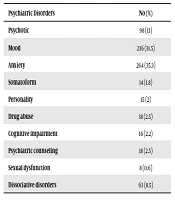
Regarding the type of disorder, most patients (27.8%) suffer from major depressive disorder (Table 2). According to the chi-square test results, a significant relationship was observed between marital status (P = 0.024) and patients’ level of education (P = 0.019) with the type of disorder. The incidence of psychiatric disorders was higher among married subjects and those holding high school and diploma degrees. No significant relationship was observed between gender (P = 0.888), ward (P = 0.452), occupation (P = 0.317), and age (P = 0.352) with reasons for referral to a consultant (P = 0.476) in patients and the type of disorder (Table 2).
Table 2.
Relationship Between Types of Psychiatric Disorders and Different Parameters and Frequency and Percentage of Patients According to Them
| Variables | Types of Disorders, No (%) | P-Value | ||||||||
|---|---|---|---|---|---|---|---|---|---|---|
| Adjustment Disorders | Bipolar Disorder | Personality Disorders | Major Depression Disorder | Delirium | Anxiety Disorder | Substance Use Disorder | Mild Depression Disorder | Other Disorders | ||
| Marital status | 0.024 | |||||||||
| Single | 57 (15) | 15 (3.9) | 85 (22.3) | 102 (26.8) | 12 (3.1) | 16 (4.2) | 12 (3.1) | 26 (6.8) | 56 (14.7) | |
| Married | 75 (12.5) | 36 (6) | 105 (17.5) | 177 (29.5) | 42 (7) | 24 (4) | 24 (4) | 34 (5.7) | 82 (13.7) | |
| Divorced | 4 (18.2) | 0 (0) | 5 (22.7) | 2 (9.1) | 3 (13.6) | 4 (18.2) | 0 (0) | 0 (0) | 4 (18.2) | |
| Widows and widowers | 0 (0) | 0 (0) | 0 (0) | 1 (20) | 1 (20) | 0 (0) | 0 (0) | 1 (20) | 2 (40) | |
| Unanswered | 20 (20.2) | 3 (3) | 22 (22.2) | 26 (26.3) | 2 (2) | 5 (5.1) | 5 (5.1) | 6 (6.1) | 10 (10.1) | |
| Education | 0.019 | |||||||||
| Illiterate | 19 (14.4) | 13 (9.8) | 24 (18.2) | 40 (30.3) | 4 (3) | 8 (6.1) | 5 (3.8) | 2 (1.5) | 17 (12.9) | |
| High school and diploma | 99 (14.7) | 30 (4.4) | 143 (21.2) | 191 (28.3) | 37 (5.5) | 24 (3.6) | 21 (3.1) | 37 (5.5) | 93 (13.8) | |
| University | 23 (13.3) | 6 (3.5) | 36 (20.8) | 47 (27.2) | 11 (6.4) | 7 (4) | 6 (3.5) | 13 (7.5) | 24 (13.9) | |
| Unknown | 15 (11.9) | 5 (4) | 14 (11.1) | 30 (23.8) | 8 (6.3) | 10 (7.9) | 9 (7.1) | 15 (11.9) | 20 (15.9) | |
| Total frequency | 156 (14.1) | 54 (4.9) | 217 (19.6) | 308 (27.8) | 60 (5.4) | 49 (4.4) | 41 (3.7) | 67 (6.1) | 154 (13.9) | |
5. Discussion
In this study, 1106 hospitalized patients (3%) received psychiatric consultation, which is higher than some other similar studies (e.g., Beyraghi et al. in 2004 in the Taleghani hospital, Tehran. Iran [1.6%] (11)) and lower than some studies (e.g., Turkmanipour and Palahang in 1999 in the Kashani hospital in Shahrekord, Iran [30.7%] (12)). The significant difference in the request for psychiatry consultation in this study could be due to unawareness of psychiatric issues and problems by other physicians, in addition to the one-dimensional approach to the disease of individuals. Furthermore, since psychiatric problems are considered a social stigma in most societies, hospitalized patients refrain from cooperating with psychiatrists.
The data showed a significant relationship between the patient’s age (P = 0.001) and reasons for referral to a psychiatrist. Most psychiatric disorders were in the age group of 21 - 30 years (30.3%), which is consistent with the findings reported by Zarghami et al. (35.2%) and Hosseini and Mortazavi (31.5%) since suicide and depression are more common at this age group (13, 14).
The other finding was that psychiatric disorders were more common among female subjects (54.7%), which is consistent with the findings reported by Shokrgozar et al. (51.1%) and Turkmanipour and Palahang (35%), who concluded that it was related to the limitations of women in social activities, environmental stress, and family problems (12, 15).
This study observed a significant relationship between the referral ward (P = 0.004) and reasons for referral to a psychiatrist. The highest referrals were from the internal medicine department (68%), which is consistent with most previous studies, which might be due to the illness variation of these patients, the large patient population in this ward, and the higher awareness of more internal medicine specialists of psychiatric disorders. This finding shows that the hospitalized patients’ mental health in the internal medicine department should be further examined (11, 14, 15). In a scoping review by Hosseini et al., most requests were from internal, surgical, and emergency departments, respectively (16).
The highest frequency of psychiatric consultations was among married individuals (54.2%). This finding is inconsistent with Mohammadi et al.’s study, which reported the highest number of consultations for the widow/widower group (26.9%). This inconsistency could result from cultural differences among families living in the North and Southeast of Iran. This issue implies that a spouse’s death is a stressor causing and predisposing to psychiatric disorders (17).
Furthermore, housewives (26.9%) had the highest number of psychiatric consultations, which is consistent with the findings of previous studies. It is therefore concluded that homemakers are among the vulnerable groups suffering from various psychological pressures. As a result, there should be some policies on their participation in social activities to provide them with a sense of worth (12, 13, 17).
Similar to previous findings, the most common diagnosis for patients was major depression (27.8%), confirming the high prevalence of depression in general hospitals and the importance of its diagnosis and treatment (11, 13, 17). In contrast, many studies have reported mood disorders as the most common type (8, 18-20).
This study reported a significant relationship between patients’ level of education (P = 0.019) and the type of disorder. Most patients (61%) receiving psychiatric consultation had high school and diploma education, indicating that social and cultural constraints and individuals’ failure to use effective methods to deal with stressors could be the reason for the higher prevalence of disorders at this level of education and promote the awareness of the educated.
This study had several limitations. Since not all checklist items were observed in all consultations, statistical evaluation was performed only on the recorded cases. Since secondary data were used in this study, files with > 15% incomplete data were excluded from the study. Furthermore, other physicians should have considered the importance of psychiatric consultation since there is no guideline for psychiatric consultation.
Future studies are suggested to evaluate the effect of consultation results on patients’ recovery processes. Given that the prevalence of psychiatric disorders is high in general medicine and since the demand for psychiatric consultation and referrals is minimal, there might not be enough training or attention to the field of psychiatric disorders; therefore, it is necessary to pay further attention to psychiatric disorders in general medicine training and retraining courses.
5.1. Conclusions
According to this study, the most common cause of psychiatric consultation was suicide, and most patients had a major depressive disorder. Married, young, and undergraduate women were more likely to be at risk of psychiatric disorders than others. Attention to psychiatric issues and problems in married, young, and undergraduate women admitted to general hospitals seems more necessary as psychiatric disorders in these patients are often diagnosed late or sometimes not diagnosed. The existence of these disorders poses problems in diagnosing their physical diseases, resistance to treatment, lack of cooperation with the medical staff, and finally, non-responsiveness to treatment.