
1. Background
Stigma encompasses a broad spectrum of experiences and extends beyond mental disorders. It involves attaching negative judgments to the person's moral character marked with the stigma. The World Health Organization defines stigma as a social mark of shame that leads to rejection, discrimination, and exclusion from society (1).
Social stigma, or public stigma, is the process where major social groups foster and sustain stereotypes about marginalized individuals or groups, triggering discrimination. This public stigma can reduce self-esteem and self-efficacy when internalized, termed as self-stigma. It's characterized by devaluation, secrecy, shame, and isolation, stemming from absorbing negative self-stereotypes (2).
Studies show that highly stigmatized individuals fearing discrimination often encounter issues like higher unemployment, lower income, and struggle with treatment adherence (3). They tend to have low self-esteem (4), underuse mental health services, and experience a poorer quality of life (5, 6). They might also employ avoidant coping strategies. Internalized stigma, especially in schizophrenia patients, can hinder treatment adherence, possibly causing treatment delays and resistance and fostering a belief that treatment signifies weakness (5, 6).
Treatment adherence is how well a patient follows a healthcare professional's medical advice, including medication, lifestyle changes, diet, exercise, and appointments. Various techniques are used to assess adherence, such as self-reporting, although it can be biased due to memory issues, disease severity, denial, or pretense of compliance (7).
2. Objectives
This study seeks to understand how treatment adherence in outpatient individuals with mental illnesses is linked to self-stigma. Insights from this may help clinicians enhance medication adherence in stable psychiatric outpatients.
3. Methods
3.1. Participants and Design
This cross-sectional study involved 200 mental health patients from Amirkabir Hospital's outpatient clinics in Arak, Iran. Eligible participants were adults with a psychiatrist-confirmed diagnosis of schizophrenia, bipolar disorder, major depressive disorder, or anxiety disorders at least six months prior and stable mental conditions. Exclusions included cognitive dysfunction, acute suicidality, or unwillingness to participate. Recruitment was managed by certified psychiatrists.
Before participating, all provided written consent. We collected demographics via a questionnaire. The study protocol was approved by the Arak University of Medical Sciences Research Ethics Committees. Recruitment was conducted from May 2022 to October 2022 after Institutional Review Board approval in May 2022.
A random sampling method was employed to ensure equitable representation of the entire population in the study. This approach aimed to offer each member an equal opportunity to be included, with data collected from participants at a specific moment, thus ensuring a representative sample.
3.2. Sample Size
To determine the sample size for this study, we referred to Richter et al.'s study, “Internalized Stigma in Mental Patients: Psychometric Applications of a New Scale," (8) and utilized Cochran's formula for sample size calculation. Assuming an unknown population size, the formula was applied as follows:
Additionally, Cohen's d was computed using the formula:
At a 95% confidence level and a 5% probability of error, the calculated Z value was 1.96, resulting in a determined sample size of 200 individuals for the study.
3.3. Measures
Self-Stigma: We used the Internalized Stigma of Mental Illness (ISMI) scale to assess internalized stigma. It has five domains and employs a 4-point Likert scale for its 29 items. Its average internal consistency coefficient is estimated at α = 0.85, but the “resistance to stigma" domain may lack consistency (8). The Persian version of the ISMI scale demonstrates acceptable reliability with internal consistency scores ranging from 0.74 to 0.94 for all subscales. Test-retest reliability varies but generally indicates stability. Validity data, though limited, support convergent and discriminant validity. Factorial validity is moderately supported, with some variability across studies (9).
3.4. Adherence to Treatment
The Drug Attitude Inventory (DAI-10) is a ten-item self-rating scale used to assess patients' attitudes toward medication and measure current treatment adherence (10). The Persian DAI-10 shows robust psychometrics: High test-retest reliability (0.805) and internal consistency (Cronbach's α 0.787). It moderately aligns with Medication Possession Ratio (MPR) at 0.676, predicts future medication adherence reasonably (around 0.663), and correlates strongly (0.822) with another test. Overall, it's a reliable tool for assessing medication attitudes in bipolar I disorder patients (11).
3.5. Statistical Analysis
Descriptive statistics summarized participant characteristics, with chi-square and t-tests comparing variables. Correlation and regression analyzed variable relationships. Significance was a P-value below 0.05. Data analysis used SPSS Statistics 22.
4. Results
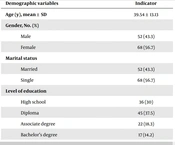
The study included 200 mental illness patients (73 men, 127 women). Most were females (63.5%), averaging 35.1 ± 12.07 years and 6.3 ± 6.90 years since illness onset. Most were university graduates (63%), single (51%), and had a stable income.
The average total internalized stigma score was 62.8 ± 16.27. Mean ISMI scores for all items and subscales were calculated, and results were categorized into minimal, low, moderate, and vigorous categories (see Table 1). The Cronbach's alpha for reliability was α = 0.93, indicating good consistency. A cut-off of 2.5 was used, with scores above it indicating moderate to high stigma and below showing minimal to low stigma.
Table 1.
The Mean Scores of ISMI and its Subscales a
| Mean ISMI Score | Mean ± SD | Minimal (1 - 2) | Low (2 - 2.5) | Moderate (2.5 - 3) | High (3 - 4) |
|---|---|---|---|---|---|
| Total 29 Items | 2.13 ± 0.56 | 79 (39.5) | 70 (35.0) | 36 (18.0) | 15 (7.5) |
| Alienation | 2.27 ± 0.74 | 75 (37.5) | 59 (29.5) | 39 (19.5) | 27 (13.5) |
| Stereotype endorsement | 2.07 ± 0.61 | 101 (50.5) | 55 (27.5) | 33 (16.5) | 11 (5.5) |
| Discrimination experience | 1.91 ± 0.68 | 126 (63.0) | 30 (15.0) | 36 (18.0) | 8 (4.0) |
| Social withdrawal | 1.59 ± 0.57 | 156 (78.0) | 36 (18.0) | 7 (3.5) | 1 (0.5) |
| Stigma resistance | 2.30 ± 0.44 | 61 (30.5) | 77 (38.5) | 54 (27.0) | 8 (4.0) |
Abbreviation: ISMI, internalized stigma of mental illness.
a Values are expressed as No. (%).
The average DAI-10 score for adherence was 4.8 ± 5.01, with 86% of participants showing a positive attitude towards medication. The Cronbach's alpha for DAI-10 was α = 0.78.
Current adherence and self-stigma means were compared across gender, alcohol abuse, smoking, marital status, and diagnosis, with results tabulated in Table 2. Correlations with age and diagnosis duration are demonstrated in Table 3.
Table 2.
Adherence and Self-stigma Correlations with Gender, Alcohol Abuse, Smoking, Marital Status, and Diagnosis
| Variables | ISMI | DAI-10 | ||
|---|---|---|---|---|
| Mean ± SD | Statistics-comparison Significance | Mean ± SD | Statistics-comparison Significance | |
| Gender | t-test, P = 0.349 | t-test, P = 0.134 | ||
| Male | 63.3 ± 18.08 | 4.1 ± 5.47 | ||
| Female | 61.0 ± 15.15 | 5.2 ± 4.70 | ||
| Alcohol abuse | t-test, P = 0.978 | t-test, P = 0.024 | ||
| No | 61.9 ± 16.83 | 5.3 ± 4.81 | ||
| Yes | 61.8 ± 14.94 | 3.5 ± 5.31 | ||
| Smoker | t-test, P = 0.633 | t-test, P = 0.000 | ||
| No | 61.4 ± 16.33 | 6.0 ± 4.33 | ||
| Yes | 62.5 ± 16.27 | 2.8 ± 5.39 | ||
| Marital status | 60.9 ± 15.28 | ANOVA, P = 0.565 | ANOVA, P = 0.078 | |
| Never married | 4.7 ± 4.54 | |||
| Married | 62.5 ± 17.91 | 4.9 ± 5.37 | ||
| Divorced | 70.0 ± 8.83 | 1.3 ± 7.12 | ||
| Widowed | 59.4 ± 12.50 | 9.2 ± 1.79 | ||
| Diagnosis | ANOVA, P = 0.005 | ANOVA, P = 0.509 | ||
| MDD | 64.1 ± 15.29 | 4.4 ± 5.45 | ||
| BID | 67.1 ± 17.81 | 4.7 ± 5.17 | ||
| Schizophrenia | 64.3 ± 6.81 | 6.6 ± 3.06 | ||
| GAD | 53.6 ± 14.11 | 5.8 ± 4.12 | ||
| OCD | 60.4 ± 15.59 | 6.0 ± 3.83 | ||
| Etc. | 57.7 ± 17.97 | 3.6 ± 5.05 | ||
Abbreviations: ISMI, internalized stigma of mental illness; DAI, Drug Attitude Inventory; MDD, major depressive disorder; BID, bipolar disorder; OCD, obsessive compulsive disorder; GAD, generalized anxiety disorder.
Table 3.
Adherence and Self-stigma Correlations with Age and Diagnosis Duration
| Variables | ISMI | DAI-10 |
|---|---|---|
| Age | r = -0.036, P = 0.615 | r = 0.144, P = 0.041 |
| Diagnosis duration | r = 0.125, P = 0.077 | r = -0.100, P = 0.159 |
| DAI-10 | r = -0.295, P = 0.000 | Not applicable |
Abbreviations: ISMI, Internalized Stigma of Mental Illness; DAI, Drug Attitude Inventory.
Table 3 shows that smokers and alcohol consumers had significantly lower treatment adherence (P < 0.001, P = 0.024). A one-way ANOVA indicated mental disorder diagnosis significantly affects self-stigma (P = 0.005). There was a weak negative correlation between self-stigma and adherence (r = -0.295, P < 0.001) and a weak positive one with age (r = 0.144, P = 0.041).
5. Discussion
Our findings, similar to others, demonstrated a weak link between age and treatment adherence, with older participants showing higher adherence (12), possibly due to more social support and less depression and anxiety. However, some research shows no significant age-adherence relationship, potentially due to socioeconomic factors.
Smoking and alcohol consumption correlated with lower treatment adherence in our study. However, no significant links were found between gender, marital status, diagnosis, duration, and adherence. This contradicts Matas et al., who found lower adherence among singles (13) but aligns with other studies showing no adherence-marital status link (12, 14).
We used a 2.5 cutoff to classify patients' internalized stigma, with most (74.5%) having minimal to low levels. However, there's no empirical evidence to validate this cutoff's effectiveness in differentiating minimal to low and moderate to high stigma levels (15).
Our results found no significant effect of factors like gender, marital status, alcohol abuse, smoking, age, and diagnosis duration on self-stigma. These findings are inconsistent with some other studies, such as Girma et al., who found that women tend to have significantly higher self-stigma than men, and Mosanya et al., who found that income status and education level are associated with self-stigma (16, 17). However, our findings align with those of other authors who failed to find a relationship between gender, age, and self-stigma (14). Such contradictions may arise from differences in diagnostic criteria, self-stigma assessment tools, and socio-economic and cultural variations in sample populations.
Furthermore, we observed a statistically significant main effect of mental disorder diagnosis on self-stigma (P = 0.005). Participants diagnosed with bipolar disorder demonstrated the highest internalized stigma scores (67.1 ± 17.81), whereas those diagnosed with GAD had the lowest internalized stigma scores (53.6 ± 14.11). This finding contrasts with the study by Picco et al. (15), which suggests no clinical correlates were linked to internalized stigma.
Importantly, our study revealed a significant correlation between treatment adherence and self-stigma. Increased self-stigma was associated with lower levels of treatment adherence. This is consistent with the results published by Vrbova et al., who examined self-stigma and adherence to treatment in patients with psychotic disorders (14). Sirey et al. also found that better adherence may be predicted by lower levels of stigma among outpatients with depression (3).
5.1. Conclusions
Therapeutic success hinges on treatment adherence. Our study showed that younger age, smoking, alcohol use, and high self-stigma correlate with low adherence, while factors like gender, marital status, disorder diagnosis, and diagnosis duration seem unrelated. This suggests the potential for improving adherence through self-stigma reduction strategies, meriting further research.