
1. Background
Mental health during adolescence is a critical determinant of psychological and social well-being and significantly influences quality of life and long-term developmental outcomes (1). The World Health Organization reports that approximately 10% of children and adolescents worldwide experience mental disorders (2), with half of these conditions emerging by age 14 (3). These statistics underscore the urgent need for early intervention and the development of appropriate support and treatment infrastructure. From an Islamic perspective, spiritual health is an important component of psychological well-being, underscoring cultural factors that should be incorporated into mental health assessments to promote holistic health among Iranian adolescents (4).
Mental health plays a vital role in shaping personality, academic achievement, stress management, the development of healthy social relationships, and positive decision-making. Regular, scientifically grounded assessments using validated screening tools are essential for the early identification of at-risk adolescents (5). However, standardized and validated screening instruments for mental disorders among Iranian adolescents remain limited (6, 7). Several studies have examined the psychometric properties of this measure or closely related DSM-5 self-report instruments. In the original DSM-5 field-trial study, Narrow et al. reported generally good test–retest reliability for the child and adolescent version across most domains; however, stability was less consistent for certain child-reported items, and convergent, discriminant, and concurrent validity were not formally established (8, 9). Although its utility has been established in Western populations (8), the validity and reliability of the Persian version have not been examined among Iranian adolescents.
Previous studies have successfully adapted psychometric instruments for Persian-speaking contexts through rigorous translation procedures, expert validation using CVI and FVI, factor analyses using EFA and CFA, and reliability testing, demonstrating the feasibility of this approach. For example, the Persian version of the Structured Clinical Interview for DSM-5 disorders has shown adequate diagnostic accuracy and reliability in Iranian samples (10). Similarly rigorous cross-cultural validation procedures have been reported for cognitive complaint measures in Iranian patients with bipolar disorder (11), short-form perfectionism scales among Iranian adults (12), and resilience measures among Iranian adolescents with suicidal ideation (13), collectively demonstrating the feasibility and methodological consistency of psychometric adaptation in Iranian populations across diverse age groups and clinical contexts.
2. Objectives
This study aimed to evaluate the validity and reliability of the Persian version of the DSM-5 Self-Rated Level 1 Cross-Cutting Symptom Measure among Iranian high school students using a methodological framework comprising forward–backward translation with American Psychiatric Association (APA) permission; assessments of content and face validity (CVI/FVI); internal consistency (Cronbach's α); test–retest reliability (ICC); EFA; and first- and second-order CFA. The findings will contribute to improving mental health screening tools in Iran and facilitating evidence-based early interventions in school settings.
3. Methods
3.1. Study Design and Participants
This cross-sectional study was conducted in 2024 among 350 high school students in Ilam, Iran. A multistage cluster random sampling approach was used. In the first stage, 10 public high schools (five girls’ and five boys’) were randomly selected from the 28 public high schools in Ilam. In the second stage, two classrooms (one 10th-grade class and one 11th-grade class) were randomly selected from each school, and all students present (approximately 17 - 18 per class) were invited to participate. The inclusion criteria were age 11 - 17 years, enrollment in a high school in Ilam, and oral informed consent from both students and their parents/guardians. The exclusion criteria were a clinical diagnosis of a severe psychiatric disorder in the past 6 months, current use of psychotropic medication, or absence on the day of data collection. Screening information was verified using a brief parent-report checklist.
3.2. Missing Data Handling
Missing values were handled using complete-case analysis. Before deletion, Little’s MCAR test was performed to assess whether data were missing completely at random: χ2(28) = 24.31, P = 0.65. The results supported MCAR status, suggesting that listwise deletion of fewer than 5% of all data was unlikely to introduce substantial bias or meaningfully reduce statistical power. To assess robustness, a sensitivity analysis compared CFA models estimated using all available data with missing-data maximum likelihood and the complete-case dataset. Differences in fit indices were trivial (ΔCFI < 0.01), supporting the stability of the findings.
3.3. Permission and Translation Process
The DSM-5-TR Self-Rated Level 1 Cross-Cutting Symptom Measure—Child Age 11 - 17 is copyrighted by the APA. According to the permission terms published with the measure, it may be reproduced without separate permission by researchers and clinicians for use with their patients. Therefore, no additional written authorization from the APA was required for the present study, and no formal permission beyond this standing license was obtained or claimed. The authors did not intend any commercial use or inclusion in a for-sale product.
A pilot test was conducted with 20 students who were not included in the main sample; these students participated in cognitive debriefing interviews to assess the clarity, comprehensibility, and cultural relevance of each item. Based on their feedback, three items (Items 8, 14, and 22) were revised to improve cultural appropriateness.
3.4. Data Collection Tool
The DSM-5 Cross-Cutting Symptom Measure—Level 1 (25-item self-report, youth version) was used to assess mental health symptoms in adolescents aged 11 - 17 years. The questionnaire evaluates 12 psychiatric domains, including somatic symptoms, sleep disturbance, attention problems, depression, irritability, anger, mania/impulsivity, psychosis, anxiety, obsessive–compulsive symptoms, substance use, and suicidal thoughts. Items related to substance use and suicidal ideation are dichotomous (yes/no). In the original DSM-5 field-trial study, the child and adolescent version showed generally good test–retest reliability across domains, although reliability was less consistent for some child-reported items. Subsequent validation studies in the US and non-US adolescent and adult samples have supported internal consistency and construct validity, with reported CFA model fit ranging from acceptable to good; however, prior studies have not consistently examined convergent, discriminant, or concurrent validity (8).
3.5. Validity and Reliability Assessment
3.5.1. Content Validity
Content validity was assessed using Lawshe’s method. A panel of 10 experts rated each item for relevance, clarity, and comprehensiveness. Content validity ratio (CVR) and CVI indices were calculated after dichotomizing the ratings. The overall scale-level CVI was 0.92, and item-level CVIs ranged from 0.83 to 1.00, exceeding the acceptable threshold for 10 experts. No items were eliminated.
3.5.2. Face Validity
Face validity was assessed among 15 adolescents (8 girls and 7 boys; mean age = 14.2 years) who were not part of the main study. Participants rated the clarity and interpretability of each item on a 4-point scale analogous to the CVI scoring method. The overall FVI was 0.91, with all items above 0.80 except Item 14, which was slightly revised following this pilot study (8).
3.5.3. Reliability
3.5.3.1. Internal Consistency
To evaluate internal consistency, Cronbach’s alpha coefficients were calculated for each subscale. The questionnaire was administered to a sample of 50 high school students in Ilam. After data collection, Cronbach’s alpha values for each domain were computed using Stata software. A threshold of 0.70 or higher was considered acceptable for internal consistency (14).
3.5.3.2. Test–Retest Reliability
Test–retest reliability was assessed by administering the final translated version of the questionnaire to the same group of 50 students, who completed the test twice with a 15-day interval. To determine the stability of the instrument over time, ICCs were calculated for each domain and each item (15). ICC values ≥ 0.70 indicated satisfactory reliability. The sample size of 50 participants was considered appropriate based on previous validation studies and methodological recommendations for reliability testing.
Convergent, discriminant, and concurrent validity were not assessed in this study because no external criterion measure (e.g., a clinician-administered diagnostic interview or an established comparator instrument) was administered alongside the Cross-Cutting Symptom Measure. This limitation is addressed further in the Study Limitations section.
3.6. Exploratory and Confirmatory Factor Analysis
EFA was conducted on the first half of the sample (n = 175) using principal axis factoring with Varimax rotation to explore the underlying structure and guide subsequent CFA.
CFA was performed using AMOS version 18.0 on the second half of the sample (n = 175), following EFA on the first half. A first-order model with 12 correlated latent factors was initially tested, followed by a second-order model with a higher-order “general psychopathology” factor. Model fit was evaluated using χ2/df ≤ 5.0, CFI ≥ 0.90, TLI ≥ 0.90, RMSEA ≤ 0.08, and SRMR ≤ 0.08. Items with factor loadings < 0.40 were considered for removal based on theoretical justification. Maximum likelihood estimation was used with robust standard errors.
3.7. Data Analysis
Data were analyzed using Stata version 12. Descriptive statistics (means, standard deviations, and frequencies) and inferential statistics, including chi-square tests and inter-rater agreement indices, were used. The EFA and CFA procedures and their respective software, as described above, were used to examine the underlying factor structure of the questionnaire; results are reported by sample half (EFA: n = 175; CFA: n = 175) in the Results section and in Table 1.
Table 1.
Final Second-Order CFA Model After Item Removal a
| Mental Health Domain | Domain Factor Loading | Associated Items | Item Factor Loadings |
|---|---|---|---|
| Somatic | 0.78 | q1, q2 | 0.65, 0.68 |
| Sleep | 0.76 | q3 | 0.76 |
| Inattention | 0.75 | q5, q6 | 0.67, 0.70 |
| Depression | 0.85 | q8 | 0.82 |
| Anger | 0.74 | q9, q10 | 0.71, 0.73 |
| Irritability | 0.74 | q11, q12 | 0.72, 0.74 |
| Mania/Impulsivity | 0.73 | q13, q14 | 0.68, 0.70 |
| Anxiety | 0.72 | q15, q16 | 0.67, 0.69 |
| Psychosis | 0.71 | q17, q18 | 0.69, 0.71 |
| Substance Use | 0.70 | q20 | 0.70 |
| Behavioral Issues | 0.69 | q21, q22 | 0.65, 0.67 |
| Suicidality | 0.63 | q23–q26 | 0.63 - 0.66 |
| General Psychopathology | — | 12 domains | 0.68 - 0.85 |
a Q7 and Q19 were removed from the initial CFA solution because their standardized loadings were below 0.40. All loadings shown here are from the final post-removal model.
3.8. Ethical Considerations
Participants and their guardians were fully informed about the study objectives and provided oral informed consent. Confidentiality and voluntary participation were assured. The study protocol was approved by the Ethics Committee of Ilam University of Medical Sciences, with approval code IR.MEDILAM.REC.1402.260.
4. Results
4.1. Demographic Characteristics of Participants
A total of 350 high school students participated in the study, including 254 females (72.6%) and 96 males (27.4%). The mean age was 14.23 years (SD = 0.75; range, 11 - 17 years). Most participants (91.4%) resided in urban areas, whereas 8.6% lived in rural areas. Regarding school type, 64.3% attended public schools, and 35.7% were enrolled in special or gifted schools. Detailed demographic data are presented in Table 2.
Table 2.
Demographic Characteristics of the Study Participants (N = 350)
| Variables | No. (%) |
|---|---|
| Gender | |
| Female | 254 (72.6) |
| Male | 96 (27.4) |
| School Type | |
| Public | 225 (64.3) |
| Special | 125 (35.7) |
| Residence | |
| Urban | 320 (91.4) |
| Rural | 30 (8.6) |
4.2. Handling of Missing Data
Data were examined for missing values before analysis. Across all items, less than 5% of responses were missing (range, 0.6%–4.2%). Little's MCAR test was performed to assess the missing-data mechanism: χ2(28) = 24.31, P = 0.65, confirming that data were missing completely at random. Complete-case analysis (CCA) was used as the primary approach, justified by the low rate of missingness (< 5%) and MCAR status. Sensitivity analyses compared CFA models estimated using full-information maximum likelihood (FIML) on the original dataset with those estimated using CCA. Fit indices showed negligible differences (ΔCFI < 0.01, ΔRMSEA < 0.005), confirming the stability of the results across missing-data handling methods.
4.3. Content and Face Validity Findings
Content validity was assessed by a panel of 10 experts using Lawshe's method. Item-level CVIs ranged from 0.83 to 1.00, and the scale-level CVI was 0.92, exceeding acceptable thresholds (CVR > 0.62). Agreement rates for item relevance, clarity, and comprehensiveness ranged from 87.5% to 100%. ICCs for expert ratings ranged from 0.86 to 0.98, indicating excellent inter-rater reliability (Table 3; Table S1 in the Supplementary File for item-level details).
Table 3.
Content Validity Index (CVI) Results from Expert Panel
| Index | Value | Interpretation |
|---|---|---|
| Scale-level CVI | 0.92 | Excellent |
| Item-level CVI Range | 0.83 - 1.00 | Excellent |
| Comprehensiveness (%) | 99.2 | Excellent |
| Appropriateness (%) | 96.6 | Excellent |
| Clarity (%) | 94.4 | Excellent |
| Inter-rater ICC | 0.86 - 0.98 | Excellent |
Face validity was assessed separately among 15 adolescents (8 girls and 7 boys; mean age = 14.2 years) from the target population who were not included in the main study. Participants rated item clarity, simplicity, and fluency on a 4-point scale. The overall FVI was 0.91, with all items scoring above 0.80 except Item 14 (FVI = 0.78), which was subsequently revised based on adolescent feedback (Table 4).
Table 4.
Face Validity Index (FVI)
| Index | Value | Interpretation |
|---|---|---|
| Overall FVI | 0.91 | Excellent |
| Item-level FVI Range | 0.78 - 1.00 | Good-Excellent |
| Clarity (%) | 94.4 | Excellent |
| Simplicity & Fluency (%) | 96.6 | Excellent |
4.4. Internal Consistency and Test–Retest Reliability
Internal consistency was assessed using Cronbach's α across multi-item domains, yielding coefficients ranging from 0.76 (anxiety, suicidal ideation) to 0.94 (depression), indicating good to excellent reliability. Single-item domains (Sleep Problems and Inattention) were not applicable for α estimation (Table 5).
Table 5.
Internal Consistency (Cronbach's Alpha) and Test–Retest Reliability (ICC With 95% CI) for Each Domain of the Persian DSM-5 Level 1 Self-Rated Measure a
| Domain | Number of Items | Cronbach's Alpha | ICC (95% Confidence Interval) |
|---|---|---|---|
| Somatic Symptoms | 2 | 0.89 | 0.84 (0.72 - 0.91) |
| Sleep Problems | 1 | Not applicable (single-item) | 0.85 (0.73 - 0.91) |
| Inattention | 1 | Not applicable (single-item) | 0.91 (0.84 - 0.95) |
| Depression | 2 | 0.94 | 0.93 (0.87 - 0.96) |
| Anger | 2 | 0.87 | 0.80 (0.62 - 0.88) |
| Irritability | 2 | 0.89 | 0.84 (0.72 - 0.91) |
| Mania | 2 | 0.81 | 0.93 (0.87 - 0.96) |
| Anxiety | 3 | 0.76 | 0.83 (0.70 - 0.90) |
| Psychosis | 2 | 0.81 | 0.93 (0.87 - 0.96) |
| Repetitive Thoughts & Behaviors | 4 | 0.87 | 0.80 (0.62 - 0.88) |
| Substance Use | 4 | 0.82 | 0.82 (0.59 - 0.87) |
| Suicidal Ideation | 3 | 0.76 | 0.80 (0.74 - 0.87) |
a Cronbach's alpha is not applicable for single-item domains. Abbreviations: ICC, intraclass correlation coefficient; CI, confidence interval.
Test–retest reliability was evaluated in a subsample of 50 students who were retested after 15 days using ICCs. ICC values ranged from 0.80 to 0.93 across all domains, with the highest stability observed for Depression, Mania, and Psychosis (ICC = 0.93). Single-item domains showed ICCs of 0.85 (Sleep Problems) and 0.91 (Inattention). All 95% confidence intervals excluded zero, confirming precise stability estimates (Table 5).
These reliability indices indicate that the measure performs consistently across items and over time; however, reliability alone does not establish that the instrument measures the constructs it is intended to measure. Evidence addressing this issue is presented separately below.
4.5. Exploratory and Confirmatory Factor Analysis
EFA using principal axis factoring with Varimax rotation was conducted on the first randomly selected half of the sample (n = 175). The Kaiser–Meyer–Olkin measure indicated sampling adequacy (KMO = 0.88), and Bartlett's test of sphericity was significant (χ2 = 1,245.37, P < 0.001). Based on eigenvalues greater than 1 and the theoretical structure of the instrument, a 12-factor solution was retained, explaining 62.4% of the total variance. EFA results are presented in Table 1. The EFA solution is reported separately from the confirmatory model; Figure 1 presents the final second-order confirmatory factor model after item removal.
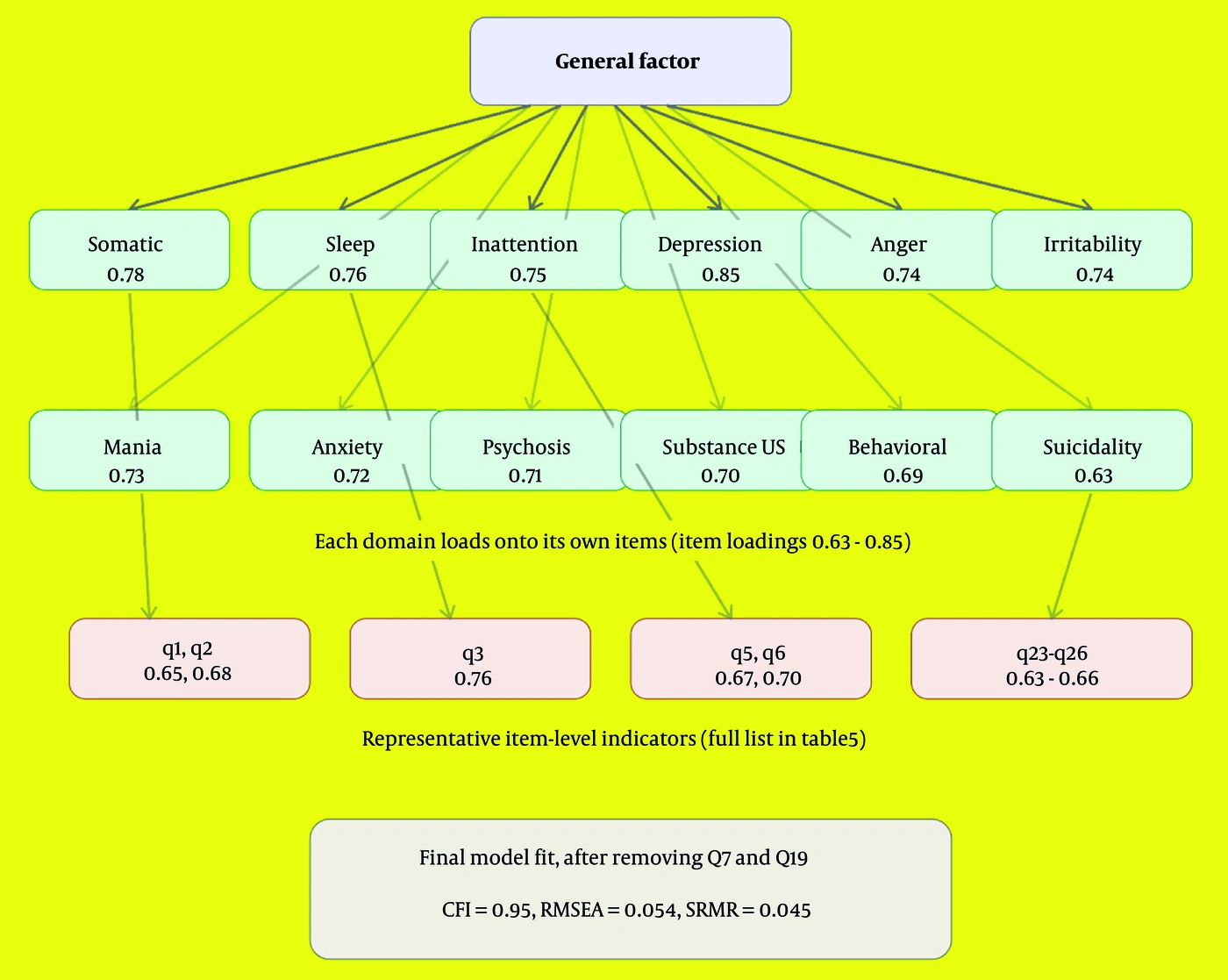
Figure 1.
Final second-order confirmatory factor model of the Persian DSM-5 Self-Rated Level 1 Cross-Cutting Symptom Measure after removing Q7 and Q19
CFA was performed on the second half of the sample (n = 175) using AMOS version 18.0. The first-order model (12 correlated factors) showed acceptable fit (χ2/df = 3.12, CFI = 0.89, TLI = 0.87, RMSEA = 0.078 [90% CI: 0.071 - 0.085], SRMR = 0.062). The second-order model, including a higher-order general psychopathology factor, demonstrated improved fit (χ2/df = 2.87, CFI = 0.93, TLI = 0.91, RMSEA = 0.062 [90% CI: 0.054 - 0.071], SRMR = 0.048).
Model comparison supported the superiority of the second-order model (Δχ2 = 32.18, Δdf = 11, P < 0.001; ΔCFI = 0.04), favoring the second-order structure. In the initial CFA model before item removal, standardized factor loadings ranged from 0.42 to 0.80; however, items Q7 and Q19 showed loadings below 0.40 and were removed based on recommended thresholds. The model was then re-estimated, and in the final model (11 retained items), standardized loadings ranged from 0.63 to 0.85. The final second-order model demonstrated improved fit (CFI = 0.95, RMSEA = 0.054 [90% CI: 0.046 - 0.062], SRMR = 0.045). Table 5 and Figure 1 present the final model after item removal.
4.6. Scope of Validity Evidence
These analyses provide evidence of internal consistency, test–retest reliability, and structural validity for the Persian DSM-5 Level 1 Self-Rated Measure. Convergent, discriminant, and concurrent validity were not assessed because of the absence of external comparator instruments. These findings therefore support the reliability and internal factor structure of the instrument rather than its overall validity.
5. Discussion
The findings of the present study indicate that the Persian version of the DSM-5 Self-Rated Level 1 Cross-Cutting Symptom Measure demonstrated acceptable content validity, face validity, internal consistency, and test–retest reliability among Iranian high school students. Indices assessing item clarity, simplicity, and relevance exceeded 90%, and the instrument also showed satisfactory content coverage. Convergent, discriminant, and concurrent validity were not assessed in this study and therefore cannot be claimed.
These results are consistent with findings reported for other language versions of the same instrument. In the original DSM-5 field trials, Narrow et al. reported generally good test–retest reliability for both the adult and child/adolescent self-rated forms of the measure across most symptom domains (8). In a community sample of adults, Doss and Lowmaster demonstrated that the domains of the Cross-Cutting Symptom Measure (CCSM) were internally consistent and showed strong convergent validity with established measures of psychopathology (16), whereas Mahoney et al. reported comparable evidence of criterion-related utility in a sample of healthy research volunteers screened with the same instrument (17). In adolescent and young-adult populations more directly comparable to the present sample, a large population-based birth-cohort study in Brazil examined the screening properties of the measure for detecting internalizing and externalizing disorders and found that the anxiety, suicidal ideation, and repetitive-thoughts domains showed the most meaningful screening performance (18). Although none of these studies involved a Persian-speaking sample, they support the broader cross-cultural and cross-developmental applicability of the instrument's underlying domain structure.
With respect to internal consistency, the present findings parallel those obtained with other translated versions of the measure. The Turkish adult form demonstrated satisfactory reliability and validity in a mixed sample of psychiatric patients, their relatives, and healthy controls, and an exploratory factor analysis of the same dataset supported a three-factor solution corresponding to neurotic, psychotic, and substance-use dimensions (19). Similarly, the Urdu child/adolescent form (ages 11 - 17 years) showed good internal consistency, and confirmatory factor analysis supported its construct validity in a sample of Pakistani adolescents; in that study, the CCSM subscales correlated positively with the difficulty subscales and negatively with the prosocial subscale of the Strengths and Difficulties Questionnaire, providing direct evidence of convergent and divergent validity (20). A separate confirmatory factor analysis of the Urdu adult form in a sample of Pakistani prisoners likewise supported an adequate fit for the instrument's multidomain structure (21). The Hindi translation of the adult form similarly demonstrated cross-language equivalence, test–retest reliability, internal consistency, and split-half reliability (22). The convergence of these cross-cultural findings with the internal-consistency results obtained here supports the broader cross-cultural robustness of the instrument; however, it should be noted that, as in the present study, most of this international literature has emphasized content validity, internal consistency, and factor structure rather than convergent, discriminant, or concurrent validity, leaving this an open methodological gap across the broader cross-cultural adaptation literature on this measure, including the current study.
The CFA conducted here further supported the conceptual structure of the questionnaire. Most items loaded acceptably on their hypothesized domains; however, two items (Q7 and Q19) showed loadings below the conventional 0.40 cutoff and were removed before final model estimation. This structural evidence supports the conceptual organization of the measure but does not, by itself, establish criterion-related (convergent, discriminant, or concurrent) validity. These results are broadly consistent with international factor-analytic work on the same instrument: using both EFA and CFA in an online English-speaking sample, Lace and Merz reported that a two-factor structure—comprising an externalizing/serious-mental-illness dimension and an internalizing/affective dimension—best fit the data (23), whereas Gibbons et al., using CFA in a large psychiatric outpatient sample, found that the originally proposed 13-domain structure provided an adequate, though imperfect, fit (24). The authors of these international studies noted that each was constrained by sample characteristics, such as incarcerated populations, online convenience samples, or single-site clinical populations, underscoring the need for continued replication of the factor structure across diverse populations, including adolescents.
It is also worth noting that, according to the American Psychiatric Association's published guidance, this measure may be reproduced and used by researchers and clinicians without separate permission, a provision that has facilitated its translation and cultural adaptation across the diverse languages and populations reviewed above, including the Persian version evaluated here.
5.1. Study Limitations
Notwithstanding this supportive evidence, several limitations must be acknowledged. Most importantly, convergent, discriminant, and concurrent validity were not assessed in the present study because it did not include a clinician-administered diagnostic interview or another validated comparator instrument. Consequently, the present findings establish content validity, face validity, internal consistency, test–retest reliability, and factor structure but do not demonstrate that the measure accurately identifies clinical caseness or distinguishes between related and unrelated constructs. The self-report nature of the instrument may also introduce biases, such as social desirability or individual differences in the interpretation of psychological constructs. Moreover, conducting the study solely in Ilam limits the generalizability of the findings to other regions and more diverse populations within Iran. Future research should employ larger, more heterogeneous samples, incorporate cross-cultural comparative analyses, and formally assess convergent, discriminant, and concurrent validity against established diagnostic or screening criteria to clarify the instrument's broader applicability.
5.2. Conclusions
The findings suggest that the Persian version of the DSM-5 Self-Rated Level 1 Cross-Cutting Symptom Measure has acceptable content validity, face validity, internal consistency, and test–retest reliability, with a factor structure broadly consistent with the proposed 12-domain organization. These findings support its potential utility as a brief, culturally adapted cross-cutting screening tool for Iranian adolescents, in line with the measure's intended role as an aid to clinical decision-making rather than a replacement for it. However, because convergent, discriminant, and concurrent validity were not assessed in this study, conclusions regarding diagnostic accuracy or readiness for large-scale implementation, including national screening programs, cannot yet be drawn. Future studies should therefore include criterion-related validity testing against clinician-administered diagnostic interviews before such applications are recommended.