Cover image of the article: The Relationship Between Perfectionism, Depression, Anxiety, and Quality of Life in Medical Students: A Cross-sectional Study

Image Credit:Iran J Psychiatry Behav Sci

The Relationship Between Perfectionism, Depression, Anxiety, and Quality of Life in Medical Students: A Cross-sectional Study

Authors

Zanireh SalimiZanireh Salimi ORCID1, Amirreza Ghanami2, Saeed AkhlaghiSaeed Akhlaghi ORCID3, 4, Seyedeh Narges Nejatifard1,*
1Psychiatry and Behavioral Sciences Research Center, Mashhad University of Medical Sciences, Mashhad, Iran
2Faculty of Medicine, Mashhad University of Medical Sciences, Mashhad, Iran
3Department of Biostatistics, School of Health, Mashhad University of Medical Sciences, Mashhad, Iran
4Social Determinants of Health Research Center, Mashhad University of Medical Sciences, Mashhad, Iran
*Corresponding Author: Psychiatry and Behavioral Sciences Research Center, Mashhad University of Medical Sciences, Mashhad, Iran. Email: nargesnejati1992@gmail.com

IJ Psychiatry and Behavioral Sciences:Vol. 20, issue 3; e166054
Published online:Aug 31, 2026
Article type:Research Article
Received:Sep 27, 2025
Accepted:Aug 22, 2026
How to Cite:Salimi Z, Ghanami A, Akhlaghi S, Nejatifard SN. The Relationship Between Perfectionism, Depression, Anxiety, and Quality of Life in Medical Students: A Cross-sectional Study. Iran J Psychiatry Behav Sci. 2026;20(3):e166054. doi: https://doi.org/10.5812/ijpbs-166054

Abstract

Background:

Medical students face substantial academic and emotional pressures, placing them at high risk for psychological distress. Perfectionism, a common trait in this population, is often associated with mental health outcomes.

Objectives:

This study aimed to investigate associations between perfectionism and levels of depression, anxiety, and quality of life among medical students in Iran.

Methods:

This cross-sectional study was conducted in 2023 at Mashhad University of Medical Sciences. A total of 306 medical students from all academic years (basic sciences, physiopathology, externship, and internship) were selected using stratified random sampling. The response rate was approximately 70%. Participants completed an online survey consisting of a demographic questionnaire and four validated instruments: the Frost Multidimensional Perfectionism Scale (FMPS), Beck Depression Inventory-II (BDI-II), Beck Anxiety Inventory (BAI), and the World Health Organization Quality of Life-BREF (WHOQOL-BREF). Previously validated Persian versions of these instruments were used. Data were analyzed using descriptive statistics and Pearson correlation coefficients.

Results:

The study included 306 students (52.9% male, 80.4% single, 57.8% in the internship year, 59.2% living with parents, and 71.9% with a family income > 100 million Iranian rials), with a mean age of 24.30 ± 1.94 years. The mean scores were 115.13 ± 14.85 for the FMPS, 46.19 ± 10.94 for the BDI-II, and 39.51 ± 8.28 for the BAI. Statistically significant, albeit weak, negative correlations were observed between the total perfectionism score (FMPS) and depression (BDI-II: r = -0.162, P = 0.005) and anxiety (BAI: r = -0.196, P = 0.001). A significant negative correlation was also observed between the FMPS and quality of life (WHOQOL-BREF: r = -0.118, P = 0.039).

Conclusions:

Higher overall perfectionism was associated with lower self-reported symptoms of depression and anxiety but also with lower quality of life, underscoring its nuanced role. Limitations include the cross-sectional design, which precludes causal inference; the single-center setting, which limits generalizability; and reliance on self-reported measures, which may introduce bias. These findings highlight the multidimensional nature of perfectionism and suggest that its adaptive and maladaptive components may have different implications for student well-being. Universities should consider implementing support programs that foster healthy striving while mitigating the detrimental aspects of perfectionism to improve student well-being.

1. Background

Medical schools are tasked with cultivating competent and compassionate physicians to serve patients and advance public health (1). However, the educational pathway is exceptionally demanding, requiring substantial academic and emotional commitment from students (2). This sustained pressure can adversely affect psychological well-being, potentially triggering or exacerbating mental health conditions such as depression and anxiety (3). The risk of psychological disorders is significantly higher among medical students and professionals than in the general population (4, 5).
A substantial body of literature has shown that medical students experience psychological distress at higher rates than the general population (5). Meta-analytic evidence has reported a considerable prevalence of depressive symptoms among medical students worldwide (6). Anxiety is also frequently reported in this population, although prevalence estimates vary across studies and settings, partly because of differences in instruments, cutoff points, and sociocultural context (7, 8). In Iran, available studies have likewise documented notable levels of depression, anxiety, and stress among students of medical sciences. Nevertheless, evidence regarding the role of personality-related factors that may contribute to these outcomes among Iranian medical students remains limited (9).
Among the personality traits implicated in student mental health, perfectionism has received considerable attention. Defined as a multidimensional construct characterized by exceedingly high personal standards and overly critical self-evaluation (10, 11), perfectionism has a dual nature. Although striving for excellence can be adaptive, maladaptive forms are consistently associated with adverse psychological consequences, including increased depression, anxiety, and stress (12). Studies have identified perfectionism as a strong predictor of psychological distress in medical students (13). However, the existing literature presents a complex picture, and the precise nature of this relationship, particularly within the Iranian context, remains underexplored.

2. Objectives

This study was conducted to address this research gap by examining the associations between perfectionism and levels of depression, anxiety, and quality of life among medical students at a major university in Iran. It aimed to provide evidence-based insights to inform mental health support in Iranian medical education, where cultural and academic pressures may uniquely influence these associations. A total of 437 students were invited to participate, and 306 completed the survey, yielding a response rate of approximately 70%.

3. Methods

3.1. Study Design and Participants

Eligible participants were medical students who 1) were enrolled at the School of Medicine during the study period, 2) were Iranian citizens, and 3) were willing and able to complete an online questionnaire. Students who had taken a major examination during the month preceding participation were excluded because recent major examinations could act as an acute situational stressor and confound the assessment of general levels of perfectionism, depression, anxiety, and quality of life. Questionnaires with substantial missing data were excluded from the final analysis.

3.2. Sampling Procedure

A stratified random sampling technique was used to ensure representation across academic years. First, the student population was stratified into four academic levels: basic sciences, physiopathology, externship, and internship. The number of students required from each stratum was calculated based on its proportional size within the entire medical student body. Subsequently, the required number of participants was selected from the official list of students in each stratum using a simple random sampling method with a random number generator.

3.3. Instruments

The online survey comprised a demographic questionnaire and four standardized instruments.
The demographic questionnaire collected information on age, sex, marital status, parity, place of residence, monthly family income, academic stage, native/non-native student status, tuition payment status, history of failure in final examinations, grade point average, substance use, history of psychiatric disorders, and use of psychiatric medication.
Perfectionism was assessed using the Persian-validated version of the Frost Multidimensional Perfectionism Scale (FMPS), a 35-item self-report instrument comprising six subscales: personal standards, concern over mistakes, parental expectations, parental criticism, doubts about actions, and organization. Items were rated on a 5-point Likert scale, and selected items were reverse-scored before summation according to the standard scoring protocol (14). A total perfectionism score was calculated by summing all item scores, with higher scores indicating greater overall perfectionistic tendencies. The Persian version of the FMPS used in this study has demonstrated acceptable internal consistency and validity in previous Iranian research (15).
Depressive symptoms were assessed using the Persian-validated version of the Beck Depression Inventory-II (BDI-II), a 21-item self-report instrument in which each item was rated on a 4-point scale (0 - 3), yielding a total score ranging from 0 to 63. Higher total scores indicate greater severity of depressive symptoms (16). The Persian version of the BDI-II has shown good reliability and validity in Iranian samples.
Anxiety symptoms were assessed using the Persian-validated version of the Beck Anxiety Inventory (BAI), a 21-item self-report instrument assessing the severity of somatic and cognitive symptoms of anxiety over the preceding week, with each item rated on a 4-point scale (0 - 3). Total scores range from 0 to 63, with higher scores indicating greater anxiety severity (17). The Persian version of the BAI has demonstrated acceptable psychometric properties in previous studies conducted in Iran.
Quality of life was assessed using the Persian-validated version of the World Health Organization Quality of Life-BREF (WHOQOL-BREF), a 26-item self-report instrument comprising four domains: physical health (7 items), psychological health (6 items), social relationships (3 items), and environmental health (8 items), in addition to two general items on overall quality of life and general health that were not included in domain scoring. Raw domain scores were calculated by summing the relevant items and then transformed to a standardized 0 - 100 scale using the following formula: (raw domain score × 100) divided by the maximum possible raw score for that domain. The overall quality-of-life score was calculated as the mean of the four transformed domain scores, with higher scores indicating better perceived quality of life (18). The Persian version of the WHOQOL-BREF has been validated and widely used in Iranian populations (19).

3.4. Statistical Analysis

Data were analyzed using SPSS version 22.0. Descriptive statistics, including means, standard deviations, frequencies, percentages, minimum values, and maximum values, were used to summarize participant characteristics and study variables. The normality of the main study variables was assessed using the Kolmogorov-Smirnov test and visual inspection of histograms. Pearson correlation coefficients were used to examine the relationships between total perfectionism scores and depression, anxiety, and quality-of-life scores. Scatterplots were also generated to visually assess the direction and strength of the observed associations. A 2-tailed P value < 0.05 was considered statistically significant.

3.5. Ethical Considerations

The study protocol was approved by the Ethics Committee of Mashhad University of Medical Sciences (Code: IR.MUMS.MEDICAL.REC.1401.597). An information sheet outlining the study purpose and ensuring anonymity was provided on the first page of the online survey. Participants provided digital informed consent before proceeding. The study was funded by Mashhad University of Medical Sciences (Grant code: 4011520).

4. Results

4.1. Participant Characteristics

A total of 306 medical students completed the survey. The mean age of the participants was 24.30 ± 1.94 years. Demographic characteristics are presented in Table 1. The sample comprised 52.9% males; most students were single (80.4%) and in their internship year (57.8%).
Table 1.
Demographic Characteristics of the Participants
VariablesNo. (%)
Gender
Male162 (52.9)
Female144 (47.1)
Marital status
Single246 (80.4)
Married60 (19.6)
Having children16 (5.2)
Place of residence
Dormitory125 (40.8)
With parents181 (59.2)
Family income/month (RLS) a
30 - 5013 (4.2)
50 - 10073 (23.9)
> 100220 (71.9)
Education period
Basic sciences25 (8.2)
Physiopathology36 (11.8)
Extern68 (22.2)
Intern177 (57.8)
Local student138 (45.1)
Paid enrollment79 (25.8)
History of failure in final examination41 (13.4)
Grade point average (maximum, 20 points)
< 1427 (8.8)
14 - 17178 (58.2)
17 - 20101 (33.0)
a RLS: Iranian rials (values reflect the local currency scale; equivalent to approximately 0.00002 USD per rial at the time of the study).
The mean scores of the FMPS, BDI-II, BAI, and WHOQOL-BREF were 115.13 ± 14.85, 46.19 ± 10.94, 39.51 ± 8.28, and 65.49 ± 10.51, respectively.

4.2. Correlation Analysis

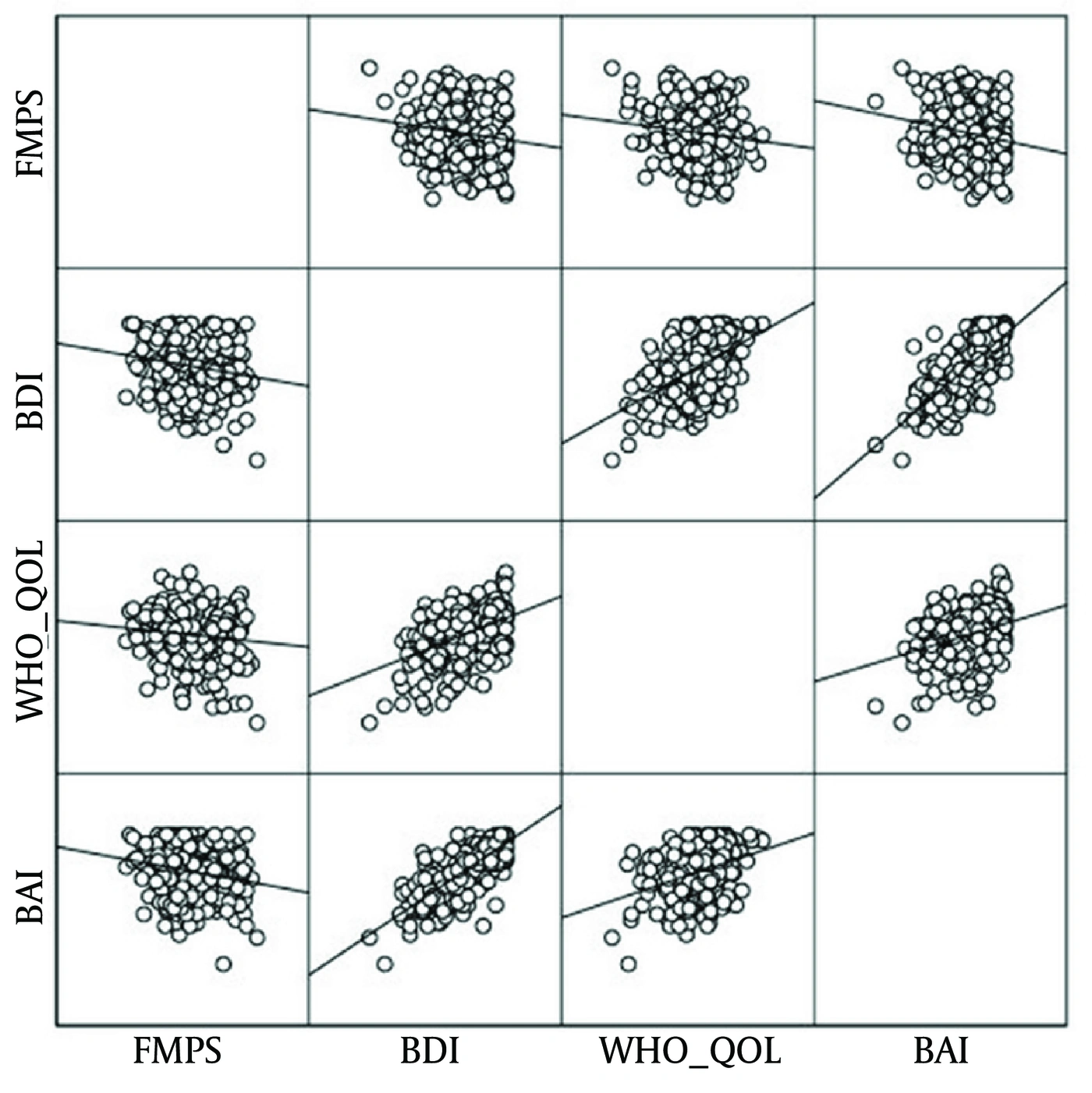
The results of the Pearson correlation analysis are presented in Table 2. A statistically significant, although weak, negative correlation was observed between the total FMPS score and BDI-II scores (r = -0.162, P = 0.005), as well as BAI scores (r = -0.196, P = 0.001). Accordingly, as total perfectionism scores increased, self-reported levels of depression and anxiety tended to decrease. A significant negative correlation was also found between the total FMPS score and WHOQOL-BREF scores (r = -0.118, P = 0.039), suggesting that higher perfectionism was associated with lower quality of life (Figure 1).
Table 2.
Pearson Correlation Between Perfectionism (FMPS) and Other Study Variables
Variable Correlated with FMPSPearson rP-Value
BDI-II score (depression)-0.1620.005
BAI score (anxiety)-0.1960.001
WHOQOL-BREF score (quality of life)-0.1180.039
Correlation between FMPS scores and the scores of the BDI-II, BAI, and WHOQOL-BREF questionnaires. Abbreviations: FMPS, Frost Multidimensional Perfectionism Scale; BDI-II, Beck Depression Inventory-II; BAI, Beck Anxiety Inventory; WHOQOL-BREF, World Health Organization Quality of Life-BREF.
Figure 1.
Correlation between FMPS scores and the scores of the BDI-II, BAI, and WHOQOL-BREF questionnaires. Abbreviations: FMPS, Frost Multidimensional Perfectionism Scale; BDI-II, Beck Depression Inventory-II; BAI, Beck Anxiety Inventory; WHOQOL-BREF, World Health Organization Quality of Life-BREF.
The dispersion of the data points suggests that the observed associations are weak.

5. Discussion

This study explored the relationship between perfectionism and mental health outcomes in a sample of Iranian medical students. The principal finding was nuanced: higher overall perfectionism was associated with lower self-reported symptoms of depression and anxiety, while also being associated with lower quality of life.
At first glance, the inverse associations between perfectionism and depression or anxiety may appear inconsistent with studies linking perfectionism to psychological distress (9, 12). However, this apparent discrepancy may be explained by the multidimensional nature of perfectionism. Perfectionism includes dimensions that may reflect relatively adaptive striving, such as high personal standards and orderliness, as well as dimensions that are more clearly maladaptive, such as excessive concern over mistakes and chronic self-criticism (20). In a high-achieving academic environment such as medical school, adaptive aspects of perfectionism may be more prominent in some students and may be associated with fewer self-reported emotional symptoms. At the same time, perfectionistic tendencies may still undermine broader well-being, which may help explain the negative association observed with quality of life (6, 18).
These findings should therefore be interpreted cautiously. Because only the total perfectionism score was analyzed in the present study, it was not possible to distinguish the effects of adaptive and maladaptive dimensions of perfectionism. This limitation may partly explain why our findings differ from studies reporting positive associations between maladaptive perfectionism and depression, anxiety, or stress. Differences in the study setting, culture, student population, and measurement strategies may also contribute to variability across findings.
Another important finding was the high mean scores for depression and anxiety in this sample. Based on commonly used interpretations of the BDI-II and BAI, the mean scores observed in this study fall within the severe range of symptomatology. This finding indicates a substantial burden of psychological distress among the surveyed students and is broadly consistent with prior reports highlighting the mental health vulnerability of medical students (17, 9, 5).

5.1. Strengths and Limitations

A primary strength of this study is the use of a stratified random sampling method, which enhances the representativeness of the sample compared with convenience sampling. The use of well-validated instruments is another strength.
However, several limitations must be acknowledged. First, the cross-sectional design precludes any inference of causality. Second, reliance on self-report questionnaires may introduce reporting bias. Third, because we did not perform a subscale analysis of the FMPS, we were unable to differentiate adaptive and maladaptive perfectionism. Finally, because this was a single-center study, the findings may not be generalizable to all medical students in Iran, and the single-center design may also have affected the representativeness of the sample.

5.2. Future Directions

Future research should prioritize longitudinal designs to track these variables over time and explore directional relationships. A detailed analysis of perfectionism subscales is crucial. Interventional studies could assess programs designed to reduce maladaptive perfectionism (21-23).

5.3. Conclusions

In this sample of Iranian medical students, overall perfectionism demonstrated a paradoxical relationship with mental health, being associated with fewer symptoms of depression and anxiety but also with lower quality of life. This finding underscores the nuanced and multidimensional nature of perfectionism. Regardless of this complexity, the severe levels of psychological distress reported by students indicate an urgent need for universities to implement comprehensive mental health and stress management programs. Such initiatives are vital to support students' well-being throughout their demanding educational journey.
Footnotes

  • AI Use Disclosure:The authors declare that no generative AI tools were used in the creation of this article.

  • Authors' Contribution:Study concept and design: Z. S. and A. G.; Acquisition of data: S. A.; Analysis and interpretation of data: S. N. N.; Drafting of the manuscript: S. N. N.; Critical revision of the manuscript for important intellectual content: Z. S. and A. G.; Statistical analysis: S. A.; Administrative, technical, and material support: S. N. N.; Study supervision: Z. S. and S. N. N.

  • Conflict of Interests Statement:The authors have no conflict of interest.

  • Data Availability:The datasets generated and analysed during the current study are not publicly available but are available from the corresponding author at reasonable request.

  • Ethical Approval:This study is approved under the ethical approval code of IR.MUMS.MEDICAL.REC.1401.597.Webpage of ethical approval code is: https://ethics.research.ac.ir/EthicsProposalView.php?id=309316

  • Funding/Support:This study was supported by the Mashhad University of Medical Sciences (grant No: 4011520).

  • Informed Consent:Informed consent was obtained from all subjects.

References

  • 1.
    Mirza AA, Baig M, Beyari GM, Halawani MA, Mirza AA. Depression and anxiety among medical students: a brief overview. Advances in Medical Education and Practice. 2021;12:393-398. [PubMed ID: 33911913]. [PubMed Central ID: PMC8071692]. https://doi.org/10.2147/AMEP.S302897.
  • 2.
    Melaku L, Bulcha G. Evaluation and comparison of medical students stressors and coping strategies among undergraduate preclinical and clinical year students enrolled in Medical School of Arsi University, Southeast Ethiopia. Education Research International. 2021;2021(1):9202156-12. https://doi.org/10.1155/2021/9202156.
  • 3.
    Baldassin S, Zilbermann ML, de Toledo Ferraz Alves TC, Martins-da-Silva AS, Castaldelli-Maia JM, Nogueira-Martins LA. Coping skills, depression, and anxiety in medical students. medRxiv. 2023. [PubMed Central ID: PMC9860056]. https://doi.org/10.1101/2023.09.24.23295999.
  • 4.
    Mata DA, Ramos MA, Bansal N, Khan R, Guille C, Di Angelantonio E, et al. Prevalence of depression and depressive symptoms among resident physicians: a systematic review and meta-analysis. Survey of Anesthesiology. 2016;60(4):146. https://doi.org/10.1097/SA.0000000000000237.
  • 5.
    Rotenstein LS, Ramos MA, Torre M, Segal JB, Peluso MJ, Guille C, et al. Prevalence of depression, depressive symptoms, and suicidal ideation among medical students: a systematic review and meta-analysis. Jama. 2016;316(21):2214-36. [PubMed ID: 27923088]. [PubMed Central ID: PMC5613659]. https://doi.org/10.1001/jama.2016.17324.
  • 6.
    Sargazi M, Hamzehpour R, Shirafkan H, Moudi S. Depression, Anxiety and Stress in Students of Various Fields of Medical Sciences: A survey at Babol University of Medical Sciences, North of Iran. Shiraz E-Medical Journal. 2025;26(26). e159484. https://doi.org/10.5812/semj-159484.
  • 7.
    Naidoo T, Tomita A, Paruk S. Burnout, anxiety and depression risk in medical doctors working in KwaZulu-Natal Province, South Africa: Evidence from a multi-site study of resource-constrained government hospitals in a generalised HIV epidemic setting. PLoS one. 2020;15(10). e0239753. [PubMed ID: 33052921]. [PubMed Central ID: PMC7556533]. https://doi.org/10.1371/journal.pone.0239753.
  • 8.
    Kaushik A, Ravikiran SR, Suprasanna K, Nayak MG, Baliga K, Acharya SD. Depression, anxiety, stress and workplace stressors among nurses in tertiary health care settings. Indian Journal of Occupational and Environmental Medicine. 2021;25(1):27-32. [PubMed ID: 34295059]. [PubMed Central ID: PMC8259589]. https://doi.org/10.4103/ijoem.IJOEM_123_20.
  • 9.
    Khoozan M, Falahnezhad AR, Shirafkan H, Mirtabar SM, Faramarzi M. Quality of Professional Life in Medical Students: The Roles of Psychological Self-care, Anxiety, and Depression. Shiraz E-Medical Journal. 2024;25(25). https://doi.org/10.5812/semj-146018.
  • 10.
    Smith MM, Sherry SB, Rnic K, Saklofske DH, Enns M, Gralnick T. Are perfectionism dimensions vulnerability factors for depressive symptoms after controlling for neuroticism? A meta-analysis of 10 longitudinal studies. European Journal of Personality. 2016;30(2):201-12. https://doi.org/10.1002/per.2053.
  • 11.
    Thomas M, Bigatti S. Perfectionism, impostor phenomenon, and mental health in medicine: a literature review. International journal of medical education. 2020;11:201-213. [PubMed ID: 32996466]. [PubMed Central ID: PMC7882132]. https://doi.org/10.5116/ijme.5f54.c8f8.
  • 12.
    Bieling PJ, Israeli AL, Antony MM. Is perfectionism good, bad, or both? Examining models of the perfectionism construct. Personality and individual differences. 2004;36(6):1373-85. https://doi.org/10.1016/S0191-8869(03)00235-6.
  • 13.
    Eley DS, Bansal V, Leung J. Perfectionism as a mediator of psychological distress: Implications for addressing underlying vulnerabilities to the mental health of medical students. Medical Teacher. 2020;42(11):1301-7. [PubMed ID: 32805157]. https://doi.org/10.1080/0142159X.2020.1805101.
  • 14.
    Stöber J. The Frost Multidimensional Perfectionism Scale revisited: More perfect with four (instead of six) dimensions. Personality and individual differences. 1998;24(4):481-91. https://doi.org/10.1016/S0191-8869(97)00207-9.
  • 15.
    Seif MH, Rastgar A, Ershaddi R. The relationship between perfectionism with burnout through academic engagement. Research in Medical Education. 2017;9(2):33-43. https://doi.org/10.29252/rme.9.2.43.
  • 16.
    Zubair R, Dar U. Correlates of psychiatric morbidity among Pakistani medical students: A cross-sectional survey. Majmaah Journal of Health Sciences. 2020;8(2):1. https://doi.org/10.5455/mjhs.2020.02.002.
  • 17.
    Puthran R, Zhang MWB, Tam WW, Ho RC. Prevalence of depression amongst medical students: A meta-analysis. Medical education. 2016;50(4):456-68. [PubMed ID: 26995484]. https://doi.org/10.1111/medu.12962.
  • 18.
    Smith MM, Sherry SB, Ray C, Hewitt PL, Flett GL. Is perfectionism a vulnerability factor for depressive symptoms, a complication of depressive symptoms, or both? A meta-analytic test of 67 longitudinal studies. Clinical psychology review. 2021;84. 101982. [PubMed ID: 33556805]. https://doi.org/10.1016/j.cpr.2021.101982.
  • 19.
    Vahedi S. World Health Organization Quality-of-Life Scale (WHOQOL-BREF): analyses of their item response theory properties based on the graded responses model. Iran J Psychiatry. 2010;5(4):140-153. [PubMed ID: 22952508]. [PubMed Central ID: PMC3395923].
  • 20.
    Hu KS, Chibnall JT, Slavin SJ. Maladaptive perfectionism, impostorism, and cognitive distortions: threats to the mental health of pre-clinical medical students. Academic Psychiatry. 2019;43(4):381-5. [PubMed ID: 30725427]. https://doi.org/10.1007/s40596-019-01031-z.
  • 21.
    Ferrari M, Yap K, Scott N, Einstein DA, Ciarrochi J. Self-compassion moderates the perfectionism and depression link in both adolescence and adulthood. PloS one. 2018;13(2). e0192022. [PubMed ID: 29466452]. [PubMed Central ID: PMC5821438]. https://doi.org/10.1371/journal.pone.0192022.
  • 22.
    Bamuhair SS, Al Farhan AI, Althubaiti A, Agha S, Rahman SU, Ibrahim NO. Sources of Stress and Coping Strategies among Undergraduate Medical Students Enrolled in a Problem-Based Learning Curriculum. Journal of Biomedical Education. 2015;2015(1):575139-8. https://doi.org/10.1155/2015/575139.
  • 23.
    Atwa H, Aboueisha H, Abdelmohsen S, Abdelnasser A. Perfectionism Among Undergraduate Medical Students: Prevalence and Relationship to Academic Achievement, Gender, and Study Year. Health Professions Education. 2024;10(1):6. https://doi.org/10.55890/2452-3011.1066.

Copyright

Copyright © 2026, Salimi et al. This open-access article is available under the Creative Commons Attribution 4.0 (CC BY 4.0) International License (https://creativecommons.org/licenses/by/4.0/), which allows for unrestricted use, distribution, and reproduction in any medium, provided that the original work is properly cited.

Similar Articles

31
Dec
2010
The Relationship between Perfectionism and Academic Achievement, Depression and Anxiety

The Relationship between Perfectionism and Academic Achievement, Depression and Anxiety

Dr. Mahtab Rahbar,
Dr. Ali Asghar Keshavarz,
Dr. Shahla Jahanbin

Rahbar DM, Keshavarz DAA, Jahanbin DS. The Relationship between Perfectionism and Academic Achievement, Depression and Anxiety. J Kermanshah Univ Med Sci. 2007;11(1):e81879. doi:

31
Dec
2010
The Relationship between Perfectionism and Academic Achievement, Depression and Anxiety

The Relationship between Perfectionism and Academic Achievement, Depression and Anxiety

Hamidreza Roohafza,
Hamid Afshar,
Masoumeh Sadeghi,
Bahram Soleymani,
Alireza Saadaty,
Mohammad Matinpour
,et al.

Roohafza H, Afshar H, Sadeghi M, Soleymani B, Saadaty A, et al. The Relationship between Perfectionism and Academic Achievement, Depression and Anxiety. Iran J Psychiatry Behav Sci. 2010;4(2):e2905. doi:

15
Oct
2014
The Role of Attachment Styles and Perfectionism in Predicting of  Students' Mental Health

The Role of Attachment Styles and Perfectionism in Predicting of Students' Mental Health

Parastoo Abaspour,
Sara Ahmadi,
Seyed Mojtaba Ahmadi,
Seyed Teymur Seyedi Asl‎

Abaspour P, Ahmadi S, Ahmadi SM, Seyedi Asl‎ ST. The Role of Attachment Styles and Perfectionism in Predicting of Students' Mental Health. J Clin Res Paramed Sci. 2014;3(3):e82117. doi:

14
Dec
2015
The Relationship Between Positive and Negative Perfectionism and Depressive Symptoms: The Role of Academic Rumination

The Relationship Between Positive and Negative Perfectionism and Depressive Symptoms: The Role of Academic Rumination

Omid Soliemanifar,
Zahra Rezaei,
Ali Asghar Rasuli,
Mehdi Rasuli

Soliemanifar O, Rezaei Z, Rasuli AA, Rasuli M. The Relationship Between Positive and Negative Perfectionism and Depressive Symptoms: The Role of Academic Rumination. Jentashapir J Cell Mol Biol. 2015;6(6):e28709. doi: https://doi.org/10.17795/jjhr-28709

1
Jun
2024
Quality of Professional Life in Medical Students: The Roles of Psychological Self-care, Anxiety, and Depression

Quality of Professional Life in Medical Students: The Roles of Psychological Self-care, Anxiety, and Depression

Mahboobeh Khoozan,
Amir Reza Falahnezhad,
Hoda Shirafkan,
Seyyedeh Mahboobeh Mirtabar,
Mahbobeh Faramarzi

Khoozan M, Falahnezhad AR, Shirafkan H, Mirtabar SM, Faramarzi M. Quality of Professional Life in Medical Students: The Roles of Psychological Self-care, Anxiety, and Depression. Shiraz E-Med J. 2024;25(7):e146018. doi: https://doi.org/10.5812/semj-146018

More by these authors

Zanireh SalimiPubMedScholar
Amirreza GhanamiPubMedScholar
Saeed AkhlaghiPubMedScholar
Seyedeh Narges NejatifardPubMedScholar
Share
Cited by
Metrics