
1. Context
This narrative review synthesizes current evidence on the association between emotional stress, immune dysregulation, and autoimmune thyroid disease. The primary aim is to examine the relationship between emotional stress and autoimmune thyroid disease, particularly Graves’ disease and Hashimoto thyroiditis, with emphasis on psychoneuroendocrine and immune mechanisms that may contribute to disease onset, progression, and clinical manifestations. Evidence from other autoimmune and inflammatory disorders is also discussed to provide supportive mechanistic context.
2. Evidence Acquisition
This narrative review was based on literature searches of PubMed, Google Scholar, and Web of Science. The initial search was conducted during manuscript preparation in 2023 - 2024, and an updated search was performed during revision in 2026 to identify newly published relevant studies. Representative search terms included “emotional stress,” “psychological stress,” “stressful life events,” “autoimmune thyroid disease,” “Graves’ disease,” “Hashimoto thyroiditis,” “thyroid dysfunction,” “thyroid autoimmunity,” and “immune system.”
Relevant English-language studies were selected based on their relevance to emotional stress and autoimmune thyroid disease, particularly Graves’ disease and Hashimoto thyroiditis. Original studies, observational studies, clinical trials, reviews, and mechanistic studies addressing stress-related immunological, neuroendocrine, or thyroid-related mechanisms were considered. Articles lacking relevance to stress or autoimmune thyroid disease were excluded.
Records were assessed for relevance based on titles, abstracts, and, when necessary, full texts. Studies relevant to the review objectives were included in the narrative synthesis. Owing to heterogeneity in study designs, populations, and outcomes, findings were synthesized narratively; no formal systematic-review methodology or quantitative synthesis was applied.
3. Results
3.1. Role of Emotional Stress in the Pathophysiology of Hashimoto Thyroiditis and Graves’ Disease
Stress may influence immune function by promoting a shift from Th1- to Th2-mediated responses. This shift has been identified as a factor that may contribute to the development of Graves’ disease (1). Reports published before 2011 indicated that 65% of young patients with hyperthyroidism had experienced stressful life events (2). Stress and anxiety may also affect the course of Graves’ disease and other thyroid disorders. Reductions in anxiety and depression among patients with Graves’ disease have been associated with lower disease severity (3). Occupational stress has been proposed as a potential risk factor for Graves’ disease, although this association remains uncertain (4). Patients with overt hypothyroidism or hyperthyroidism report higher levels of stress and anxiety than healthy individuals, although treatment outcomes tend to be more favorable than those in patients with subclinical thyroid dysfunction (5). More recent evidence suggests that emotional neglect and emotional abuse may be associated with autoimmune thyroid disorders, although prospective studies are needed to confirm these findings (6).
Stress-management interventions have been reported to reduce anxiety and symptoms in women with Hashimoto thyroiditis, with increases in HLPCQ scores and slight decreases in thyroid-stimulating hormone (TSH) and anti-thyroid peroxidase (anti-TPO) levels (7). Yoshiuchi et al. reported that women with Graves’ disease tended to experience higher levels of stress, which may increase susceptibility to the disease. The risk of Graves’ disease was also reported to be approximately five times higher among women who smoked (8).
3.2. Autoimmune Thyroid Disease and Stress
3.2.1. Stress and Graves’ Disease
Stress affects the immune system both directly and indirectly via neural and endocrine pathways. The development of autoimmune thyroid disease (AITD) is influenced by the balance between Th1 and Th2 immune responses (1). During stress, activation of the sympathoadrenal system and the hypothalamic-pituitary-adrenal (HPA) axis increases the secretion of catecholamines and glucocorticoids. These mediators selectively suppress Th1 responses while promoting Th2-mediated humoral immunity, a mechanism that may contribute to Graves’ disease, which is considered a Th2-predominant condition (9).
Although some prospective evidence suggests that stress may not play a major role in the pathogenesis of AITD overall (10), several studies have reported associations between psychological stress and the onset and progression of Graves’ disease (11). Individuals with Graves’ disease have been shown to experience a higher incidence of stressful life events before the onset or diagnosis of Graves’ thyrotoxicosis compared with control subjects. In this context, stress is mainly discussed as a potential triggering or predisposing factor for Graves’ disease onset. Stressful events have also been associated with a poorer prognosis in Graves’ disease. In addition, studies evaluating the clinical course of Graves’ disease suggest that significant life events, personality traits, and daily stressors may influence disease progression. Here, stress is discussed in relation to disease progression and treatment response rather than disease initiation.
Altered HPA-axis activity, glucocorticoid signaling, cytokine modulation, and stress-related immune dysregulation may contribute not only to disease onset but also to symptom exacerbation and treatment response in Graves’ disease.
The association between stress and Graves’ disease may result from stress-induced immunological dysregulation. Malfunction of the stress response system may alter immune responses to the thyroid-stimulating hormone receptor through modulation of hormones, neurotransmitters, and cytokines in genetically susceptible individuals. The HPA axis appears to play an important role in the relationship between stress and autoimmune disorders.
Clinical evidence has indicated a correlation between stress and Graves’ disease. Compared with controls, patients with Graves’ disease reported a greater number of negative life events and perceived these events as more severe. They also experienced more daily stressors and had higher distress scores, although coping abilities were similar between groups. Assessment of daily hassles in addition to major life events may provide a more comprehensive understanding of stress exposure. Individuals with Graves’ disease experienced greater psychological stress and adverse life events before disease onset, suggesting that stress may contribute to disease triggering in predisposed individuals (12).
Heritable factors contribute approximately 70%–80% and environmental factors approximately 20%–30% to the pathogenesis of AITD. Stress has been proposed as one of the environmental triggers involved in Graves’ disease development. Several case-control studies have reported a higher frequency of stressful life events preceding the diagnosis of Graves’ hyperthyroidism compared with controls (13). Selected studies investigating stress and AITD have shown that patients with Graves’ disease reported significantly greater numbers of negative and positive stressful life events, higher negative life event scores during the year preceding diagnosis, and associations between stressful life events and Graves’ disease in women (14). A 2023 systematic review and meta-analysis found a significant association between stressful life events and the onset of Graves’ disease, whereas no significant effect was observed on antithyroid drug treatment outcomes (15).
3.2.2. Stress and Hashimoto Thyroiditis
In contrast to Graves’ disease, the relationship between stress and Hashimoto thyroiditis has been less extensively investigated. Decreased HPA-axis activity may promote Th1-mediated immune activity, potentially leading to thyroid-cell destruction and the development of Hashimoto thyroiditis through apoptotic pathways affecting thyroid follicular cells. In contrast to Graves’ disease, Hashimoto thyroiditis has mainly been discussed in relation to Th1-mediated immune activity and thyroid-cell destruction (9, 10, 11).
However, prospective findings regarding stress and Hashimoto thyroiditis remain inconsistent. One study found no significant difference in stress exposure between individuals who developed thyroid peroxidase antibodies (anti-TPO) and those who did not. Stress questionnaires also showed no differences between hypothyroid cases and controls at any time point, although hypothyroid cases reported fewer negative emotions at diagnosis. These findings suggested that stress may not play a major role in the pathogenesis of AITD overall (10). Available data indicate that evidence linking emotional stress to Hashimoto thyroiditis remains limited (11). Similarly, a recent cross-sectional study in women of reproductive age found no significant association between perceived stress scores and thyroid function, despite a nonsignificant positive correlation between perceived stress and TSH levels (16).
In Hashimoto thyroiditis, stress has mainly been explored as a possible modifier of immune activity rather than a clearly established triggering factor. The gradual onset and chronic inflammatory course of Hashimoto thyroiditis may make the potential effects of stress more difficult to detect. In the Amsterdam AITD cohort, recent life events and daily hassles were assessed annually during a 5-year follow-up. Two nested case-control studies did not identify any association between stress exposure and either de novo thyroid peroxidase antibody positivity or progression to overt autoimmune hypothyroidism (13). Stress has nevertheless been associated with impaired immune function and immunological disturbances, which may contribute to autoimmune disease susceptibility in some individuals. Chronic post-traumatic stress disorder has also been linked to common autoimmune diseases, including Graves’ disease and Hashimoto thyroiditis (14). A summary of key studies evaluating the relationship between psychological stress and autoimmune thyroid disease is presented in Table 1.
Table 1.
AITD Denotes Autoimmune Thyroid Disease a
| Study | Disease/Population | Study type | Main finding related to stress |
|---|---|---|---|
| Wang et al. (15) | Graves' disease | Systematic review and meta-analysis | Stressful life events were significantly associated with Graves' disease onset but not with antithyroid drug treatment outcomes. |
| Corso et al. (6) | Autoimmune thyroid disease | Case-control study | Emotional neglect and emotional abuse were reported more frequently in women with autoimmune thyroid disease than in controls. |
| Vita et al. (17) | Hashimoto thyroiditis | Case report | Described stress-induced hashitoxicosis in a patient with autoimmune thyroid disease. |
| Markomanolaki et al. (7) | Hashimoto thyroiditis | Randomized controlled trial | Stress-management intervention was associated with improvements in psychological well-being; effects on thyroid-specific outcomes remain uncertain. |
| Effraimidis et al. (10) | Individuals at risk for autoimmune thyroid disease | Prospective cohort study | No significant association was observed between stress exposure and development of thyroid autoimmunity or autoimmune hypothyroidism. |
| Stewart et al. (18) | Graves' disease | Observational study | Psychological stress was associated with outcomes following radioiodine treatment for Graves' disease. |
| Winsa and Adami (19) | Graves' disease | Case-control study | Stressful life events were more common before the onset of Graves' disease compared with controls. |
| Kung (12) | Graves' disease | Case-control study | Patients with Graves' disease reported more negative life events, daily stressors, and psychological distress than controls. |
| Yoshiuchi et al. (8) | Graves' disease | Case-control study | Stressful life events and smoking were associated with Graves' disease in women but not in men. |
a Evidence regarding Graves’ disease is generally more consistent than evidence regarding Hashimoto thyroiditis. Most available studies support an association between psychological stress and Graves’ disease onset, whereas findings for Hashimoto thyroiditis remain limited and inconsistent.
3.3. Effects of Emotional Stress and Acute and Chronic Psychosocial Stress on Thyroid Function and the Hypothalamic-Pituitary-Thyroid Axis
Psychological stress can activate the HPA axis through increased release of corticotropin-releasing hormone (CRH) from the hypothalamus, leading to adrenocorticotropic hormone (ACTH) secretion and subsequent cortisol release. Abnormal cortisol secretion may be associated with conditions such as Cushing syndrome or Addison disease. Psychological stress has also been associated with reduced thyroid hormone levels through the effects of glucocorticoids (GCs), whereas adrenal hormones and catecholamines tend to increase (2, 9). Inflammatory mediators may also influence HPA-axis activity.
These neuroendocrine and inflammatory pathways may contribute to stress-related alterations in immune regulation and thyroid function in susceptible individuals. Interleukin-1, interleukin-2, and TNF-α can synergistically stimulate hypothalamic CRH secretion, although the precise mechanisms remain unclear. Inflammatory cytokines may also activate pituitary secretion and stimulate adrenal cortisol synthesis, particularly at higher cytokine concentrations (9, 10). Similar interactions between the hypothalamic-pituitary-adrenal and hypothalamic-pituitary-thyroid axes have been proposed in broader thyroid research, further supporting the potential role of stress-related neuroendocrine dysregulation in thyroid disorders, although direct evidence in autoimmune thyroid disease remains limited (20).
3.4. Stress and the Immune System: Leukocyte Subset Distribution
Stress alters the distribution of circulating mononuclear cells and has been associated with increased neutrophils and CD19 B cells (21-23). Acute psychosocial stress changes circulating leukocyte subsets and cell adhesion in a pattern comparable to exercise-induced redistribution (24). In a 1992 study, mild psychosocial stress caused a significant increase in natural killer (NK) cells in 50 men, with levels returning to baseline after 15 minutes (25). In another study, neutrophils increased 1.5-fold during landing after short-term spaceflight compared with preflight levels, and neutrophil adhesion increased both before and after flight. Lymphocytes decreased slightly, and monocyte responses were altered (26).
Catecholamines mediate stress-related leukocyte redistribution through adrenergic mechanisms (27). Adrenaline increases circulating neutrophils and decreases blood lymphocytes, whereas noradrenaline increases both neutrophils and B cells (28). However, adrenalectomy did not prevent increases in NK cells, neutrophil agranulocytosis, and monocytosis (27). In the spaceflight study, plasma immunoglobulin, cortisol, and ACTH levels did not change significantly (26), whereas urinary epinephrine, norepinephrine, and cortisol increased significantly. At peak endogenous concentrations, glucocorticoids redistribute T cells from the bloodstream to organs. Trauma may also alter glucocorticoid receptor binding, as shown by lower receptor density in traumatized veterans than in controls. Resistance of T-cell proliferation to dexamethasone has been observed only in severe post-traumatic stress disorder (PTSD) (29).
Stress is also associated with elevated CD19 B-cell and neutrophil levels, with a more pronounced response in individuals using oral contraceptive pills (OCPs) (21). Adler et al. found that stress significantly decreased L-selectin without changing CD4 levels, whereas circulating CD8 levels increased (24, 25), reducing the CD4/CD8 ratio (21, 30). Minor stressful life events increased circulating B cells and decreased circulating T cells, whereas major stressful events decreased the CD4/CD8 ratio. Neuroendocrine alterations may shift cytokine responses to pathogens and autoantigens toward Th2 activity (31). Chronic corticosteroid use can increase Th2 activity and decrease Th1 activity by limiting interleukin-12 production; therefore, although these drugs are used to treat allergies, long-term use may worsen allergic responses (32). Collectively, these findings suggest that stress-related neuroendocrine and immune alterations may influence thyroid autoimmunity through interconnected HPA-axis, immune, and endocrine pathways. The proposed interactions between psychological stress, neuroendocrine activation, immune modulation, and thyroid autoimmunity are summarized in Figure 1.
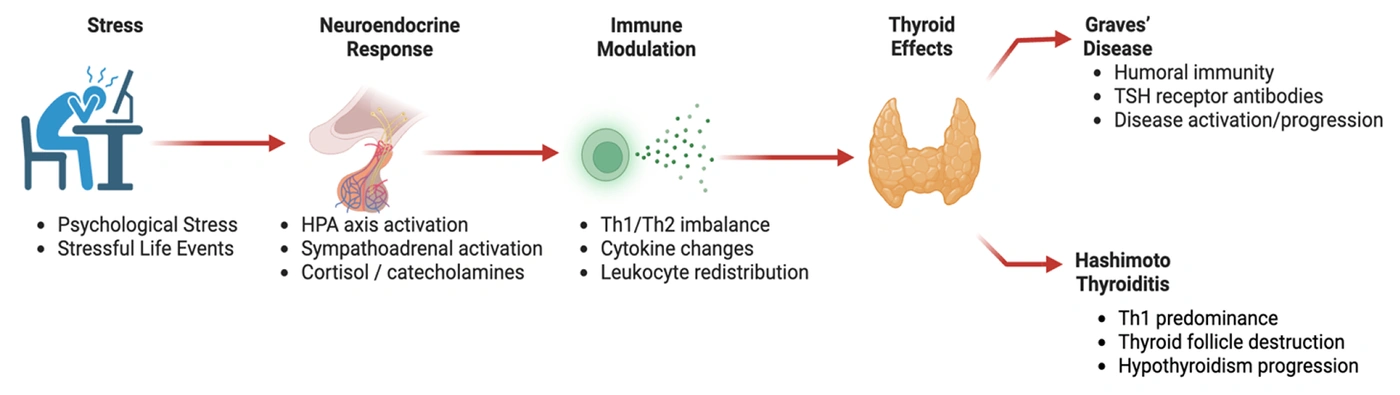
Figure 1.
Proposed relationship between psychological stress, neuroendocrine activation, immune modulation, and autoimmune thyroid disease outcomes, illustrating differential pathways in Graves’ disease and Hashimoto thyroiditis.
3.5. Stress Disorders and Other Autoimmune Diseases
Evidence from other autoimmune and inflammatory disorders has been used to explore stress-related immune mechanisms that may also be relevant to autoimmune thyroid disease; however, these findings cannot be directly extrapolated to thyroid autoimmunity. Individuals with multiple sclerosis have been reported to experience more life difficulties than those without the disease (33). No significant between-group differences were observed in childhood experiences, personality traits, or access to psychological support. However, individuals with multiple sclerosis reported significantly higher levels of abnormal stress and extreme events during the 2 years preceding diagnosis, such as the loss of a child (34-36). Patients with exacerbations also reported higher levels of psychological stress than those in remission (37).
Childhood psychosocial stressors have been associated with earlier adult-onset rheumatoid arthritis, and the risk appears higher among individuals with a history of PTSD (38- 40). Long-term stress may affect the severity of inflammatory bowel disease, whereas short-term stress has been associated with relapse. PTSD and trauma exposure have been associated with an increased risk of systemic lupus erythematosus (41-43). Among patients with Graves’ disease, those reporting more negative events may develop hypothyroidism earlier after radiation treatment than less-stressed patients (12, 18). Stress has also been linked to the onset and exacerbation of psoriasis (44, 45) and autoimmune bullous disease and may have a triggering role in latent autoimmune diabetes in adults (46, 47). Although these studies support a broader relationship between stress and immune dysregulation, their applicability to autoimmune thyroid disease remains indirect.
3.6. Stress, Inflammation, and the Endocrine System
A substantial body of evidence has examined the relationship between chronic stress and pain; however, stress is rarely addressed in pain management. The physiological stress response can induce the secretion of sympathetic catecholamines, including epinephrine and norepinephrine, and neuroendocrine hormones such as cortisol. Cortisol is a potent anti-inflammatory hormone that mobilizes glucose reserves and regulates inflammation. Under normal conditions, cortisol binds to the glucocorticoid receptor (GR) and exerts anti-inflammatory effects. Prolonged or excessive cortisol secretion, however, may lead to compensatory GR downregulation or resistance, analogous to mechanisms proposed in insulin resistance. Extreme cortisol elevations may also increase affinity for the mineralocorticoid receptor (MR), through which cortisol may exert proinflammatory effects. Elevated inflammatory mediators may further impair GR function and disrupt the negative-feedback loop through which cortisol inhibits continued CRH release (40). Environmental factors associated with chronic stress may contribute to glucocorticoid resistance. Chronic psychosocial stress has been shown to induce glucocorticoid resistance in human and mouse immune cells, whereas stress-related disorders, including depression and metabolic disease, have been associated with HPA-axis dysregulation, hypercortisolism, and altered cortisol secretion patterns (48). Similar mechanisms have been discussed in stress-related inflammatory and metabolic disorders, although their direct role in autoimmune thyroid disease remains incompletely understood.
3.7. Emotional Stress and Thyrotoxic Periodic Paralysis
Thyrotoxic periodic paralysis (TPP) is characterized by hypokalemia associated with hyperthyroidism. It is more prevalent among Asian men and less common in other populations (49-51), although its occurrence is increasing in other ethnic groups. Most patients have subtle clinical manifestations, and only a minority have clearly identifiable precipitating factors (52). Although hyperthyroidism is more common in women, TPP predominantly affects men (51, 52). The effect of emotional stress on serum catecholamine levels has been proposed as one explanation for this sex difference. Emotional stress may precipitate TPP attacks, as may high-carbohydrate intake, vigorous exercise, acute upper respiratory tract infection, a high-salt diet, cold exposure, alcohol consumption, menstruation, and medications such as corticosteroids, epinephrine, acetazolamide, and nonsteroidal anti-inflammatory drugs (50, 52, 53).
3.8. Thyroid Hormonal Activity and Stress
The effects of chronic psychological stress on hormonal secretion were investigated in 84 psychiatric patients who had recently immigrated to West Berlin from East Germany. These patients had experienced prolonged stress before relocation, which continued afterward. Serum thyroid-stimulating hormone and thyroid hormone levels were measured and compared with those of 20 healthy controls. TSH and all thyroid hormone concentrations were significantly lower in the patient group. Although 62% of patients had biochemical hypothyroidism, they had no clinical symptoms. The investigators concluded that the hormonal changes were not associated with psychiatric illness or the severity of acute or chronic stress (54).
Compared with euthyroid controls and thyroid hormone-supplemented animals, hypothyroid mice showed moderate anxiety in the open-field and light-dark transition tests. This response may be related to reduced levels of proteins such as neuroserpin in neuronal dendritic spines in the hippocampus and decreased brain-derived neurotrophic factor (BDNF) signaling, which is important for maturation of CA1 hippocampal dendritic spines (55). A clinical cohort study published in 1960 reported an association between thyroid disorders and depression, and subsequent clinical trials indicated that antidepressant treatment may be more effective when supplemented with triiodothyronine. A population-based study investigated the association of serum TSH and anti-thyroid peroxidase antibodies with depression and anxiety. Multivariable regression showed no significant association between diagnosed thyroid disorders at SHIP-1 and lifetime major depressive disorder (MDD) at LEGEND (56); however, untreated diagnosed hyperthyroidism was positively associated with MDD during the 12 months before LEGEND. Kikuchi et al. assessed free triiodothyronine (T3), free thyroxine (T4), and TSH in 66 patients with panic disorder and found a positive correlation between current panic-attack severity and TSH levels in nonmedicated patients (57). Anxiety severity was negatively associated with free T4 levels. Sturges et al. studied 38 adults with post-treatment hyperthyroidism (n = 13), low euthyroidism (n = 12), or high euthyroidism (n = 13). Serum T3 concentrations ranged from 56 to 398 ng/dL, with no significant differences among groups (58).
3.9. Depression and Thyroid Diseases
This section primarily addresses psychiatric comorbidity and symptom associations rather than causal mechanisms of autoimmune thyroid disease. Women who test positive for anti-TPO antibodies have been reported to have a fivefold higher risk of postpartum depression than women without these antibodies. These patients may also be more likely to experience thyroid dysfunction, as reflected by elevated anti-thyroglobulin and anti-TPO antibodies. Studies using the Edinburgh Postnatal Depression Scale (EPDS) have supported an association between positive autoantibodies and postpartum depression. Research Diagnostic Criteria have also indicated that women with elevated microsomal antibodies during pregnancy are at increased risk of postpartum thyroid dysfunction, although not all develop depression. The mechanisms by which thyroid dysfunction may contribute to postpartum depression remain unclear (59). An unhealthy and stressful lifestyle may also increase the likelihood of thyroid disorders, and adverse life events have been identified as a contributing factor. Kung reported that individuals with Graves’ disease experienced more negative life events, which were considered a risk factor for thyroid disorders (12, 19). Studies have also reported that patients with major depressive disorder and suicidal tendencies are more likely to have overt thyroid dysfunction than those without suicidal tendencies, with differences in hormone measures including higher TSH and BS levels. Accordingly, thyroid hormone assessment has been proposed as a potential screening or preventive measure in this population (60).
3.10. Stress-Induced Hashitoxicosis
These reports discuss stress as a possible precipitating or exacerbating factor. Vita et al. described a 28-year-old woman with Hashimoto thyroiditis who presented with fatigue and palpitations after remaining euthyroid for 12 years. Thyroid testing showed thyrotoxicosis, negative TSH receptor antibodies, and elevated inflammatory markers. She had experienced a stressful event during the previous 3 months, suggesting a possible relationship between stress and hashitoxicosis (17). In an 8-week study comparing a standard control group with a stress-management group, investigators assessed anti-thyroid peroxidase and anti-thyroglobulin antibodies, TSH, lifestyle factors, body mass index, depression, anxiety, and stress. After 8 weeks, the stress-management group showed reduced anti-thyroglobulin antibody titers and lower reported stress, depression, and anxiety scores (7). Although stress-management interventions may improve psychological well-being and quality of life, current evidence is insufficient to conclude that they directly modify thyroid autoimmunity or disease progression.
Although these findings are of interest, further studies are needed before stress-management interventions can be considered evidence-based therapeutic strategies for autoimmune thyroid disease. Another study investigated the relationship between stress and thyroid disease in 50 patients with thyrotoxicosis and 50 patients with nontoxic goiter. Twelve patients in the thyrotoxic group and 18 in the control group reported no significant life events during the preceding 6 months. Among 16 thyrotoxic patients whose symptoms had begun within 3 months before interview, 8 had experienced life events during the preceding 3 months and 6 had experienced such events 4 - 6 months before interview. More stressful events occurred after symptom onset than before it (61).
3.11. Emotional Stress and Anxiety in Graves’ Ophthalmopathy
In Graves’ ophthalmopathy, stress and anxiety are primarily considered comorbidity-related and symptom-modifying factors. Depression and anxiety disorders are prevalent among affected individuals. Identifying predictors of psychiatric morbidity may help clinicians recognize patients at risk and refer them for appropriate treatment. The Hospital Anxiety and Depression Scale (HADS) may be useful for screening psychiatric morbidity in patients with Graves’ ophthalmopathy (62).
Approximately 30 - 40% of individuals with Graves’ ophthalmopathy exhibit symptoms such as anxiety, agitation, apprehension, dread, depression, restlessness, decreased attention, forced thinking, emotional lability, and hyperkinesia. Nervousness in hyperthyroidism is characterized by restlessness and a short attention span and differs from primary anxiety neurosis. Anxiety, phobia, and depression scores have been linked to serum TSH receptor antibody (TRAb) activity, suggesting interactions among cerebral changes, autoimmune abnormalities, endocrinopathies, and psychoneuropathies. Graves’ ophthalmopathy is a debilitating condition associated with substantial cerebral and endocrine burdens, particularly when impairing symptoms predominate. Psychiatric aspects should be evaluated during routine follow-up and considered in treatment decisions (63). Stress before the clinical manifestation of Graves’ disease has been associated with earlier hypothyroidism after a standard dose of radioiodine, possibly through an augmented autoimmune response acting synergistically with radiation. A lower radioiodine dose has therefore been proposed as a possible way to reduce early hypothyroidism in these patients (18). Thyroid autoimmunity in Graves’ disease is influenced by genetic and nongenetic factors, including infections, smoking, and stress. Recent studies have also suggested potential effects of COVID-19 and mental stress on the onset of Graves’ hyperthyroidism (GH) and Graves’ orbitopathy (GO) (64).
3.12. Lifestyle Modification and Stress Management in Thyroid Disease Treatment
Current evidence regarding lifestyle modification and stress management in autoimmune thyroid disease remains limited and largely observational. One historical study assessed the likelihood that Count Ivan VIII Drašković had Graves’ orbitopathy based on two portraits showing proptosis and eyelid swelling; tobacco and iodine exposure and a stressful lifestyle were among the factors considered (65). A population-based study of 5,154 individuals in China examined associations between lifestyle factors and thyroid disorders. Higher educational levels were associated with a lower likelihood of hypothyroidism, whereas alcohol consumption was associated with a higher risk of hypothyroidism (66).
3.13. Limitations
This review has several limitations. First, it is a narrative review and did not use a formal systematic-review methodology, which may increase the risk of selection bias. Second, the available literature is heterogeneous in study design, stress assessment, and thyroid outcomes, and differences in study populations, outcome definitions, assessment methods, and follow-up periods limit direct comparisons. Third, because many included studies were observational or retrospective, definitive causal relationships between stress and autoimmune thyroid disease cannot be established. Finally, several older studies were included because of their historical importance in the field.
4. Conclusions
Overall, stress may contribute to disease onset, progression, and symptom burden in susceptible individuals. The evidence is more consistent for Graves’ disease than for Hashimoto thyroiditis, for which findings remain limited and inconsistent. Stress-management interventions are currently best regarded as adjunctive supportive measures rather than disease-modifying treatments for autoimmune thyroid disease. Reported outcomes primarily involve psychological well-being, stress-related symptoms, and selected antibody measurements rather than definitive changes in disease progression or long-term thyroid outcomes. Further research is needed to clarify the role of stress in the pathogenesis and exacerbation of autoimmune thyroid disease and to determine the clinical value of stress-management and lifestyle interventions.