
1. Introduction
Individuals with physical disabilities, like those without disabilities, show substantial diversity in personality, experiences, and functioning. The effects of disability are highly individualized. Specific aspects of disability influence an individual’s perception and internalized meaning of the condition, which, in turn, shape subsequent reactions. The prevalence of mental disorders among children and adolescents is estimated to be approximately 10% to 20% (1). However, this rate may be higher among adolescents with physical disabilities. Moreover, the number of individuals who do not have a specific mental disorder but experience poor well-being may be considerably greater.
Young people with physical disabilities or long-term health conditions may be at greater risk of adverse health outcomes (2, 3). Public health and school health programs, guided by healthcare providers, should collaborate with these adolescents and their families to develop and implement appropriate interventions, with particular emphasis on promoting mental health (2). Adolescents with physical disabilities who are undergoing developmental transitions face additional challenges. Their psychological profiles may be characterized by low self-esteem, social withdrawal, and limited social interaction (4). Furthermore, adolescence is a period during which individuals become increasingly aware of personal differences, which may contribute to rejection and stigmatization of people with disabilities (5). As a result, individuals with disabilities may feel isolated and worthless and may internalize societal misconceptions and prejudices, leading to self-stigmatization (6). Stigma may also be reinforced by negative language in everyday life, thereby undermining self-acceptance. Studies indicate that people with physical disabilities often experience poor mental health and well-being (5). They may experience subclinical symptoms of depression and anxiety (7). The psychological challenges faced by adolescents with physical disabilities highlight the need for focused attention and counseling services (8). Psychologists and counselors should therefore consider the various factors that influence the experience of disability across developmental stages (9).
Well-being is a multidimensional construct encompassing cognitive and emotional components and reflecting desirable individual functioning (10). Individuals with greater well-being tend to experience more positive emotions and to evaluate events more favorably. In contrast, individuals with low psychological well-being predominantly experience negative emotions such as depression, anxiety, and anger (11). Ryff defined psychological well-being as an effort to actualize one’s full potential (12). People with physical disabilities may perceive themselves as different from others and as more vulnerable or less capable. Consequently, they may have less control over negative emotional responses, thereby reducing psychological well-being.
Various counseling approaches can be used to assist individuals with physical disabilities. The effectiveness of different counseling methods for people with disabilities remains a subject of debate, reflecting broader discussions regarding the efficacy of psychological models. Nevertheless, further research is needed. Personal construct therapy, originally developed by George Kelly and subsequently expanded by later generations of clinical psychologists (13), forms the basis of one such approach. Fransella and Dalton proposed a personal construct counseling model in which counselors identify clients’ constructs, formulate hypotheses about the causes of their problems, and help modify these constructs accordingly (14).
Neimeyer and Winter described the principles and applications of personal construct therapy for a wide range of problems. Personal construct therapy has been applied to depression, anxiety, obsessive-compulsive disorder, phobias, post-traumatic stress disorder, stuttering, and grief. It has also been used in educational and interpersonal contexts, including academic underachievement, interpersonal relationships, family therapy, and couples therapy (13). Personal construct counselors assist clients in reinterpreting their problems and exploring new identities (15).
The goal of personal construct counseling is not to achieve a predetermined end state through specific techniques but to enhance an individual’s capacity to develop a more practical perspective for understanding and engaging with the world (16). This approach may be particularly useful for adolescents with physical disabilities. Personal construct counseling is also well suited to adolescent counseling because assessment and change processes are integrated (17), facilitating a deeper understanding of adolescents’ interpretations of reality. However, many psychological interventions focus primarily on children or adults and may overlook the specific needs and interests of adolescents. This gap may restrict opportunities for adolescents to develop skills and prepare for social participation (9).
Accordingly, this study examined the effectiveness of personal construct counseling in improving psychological well-being and general health among adolescents with mild physical disabilities using a single-case multiple-baseline design.
2. Case Presentation
2.1. Participants and Design
This study included adolescents with mild physical disabilities residing in Qom, Iran. Participants were selected from individuals identified by the Rehabilitation Committee of the Welfare Organization of Qom Province as having mild disabilities. Their functioning was evaluated according to the World Health Organization’s International Classification of Functioning, Disability, and Health (ICF). Mild physical disability corresponded to ICF functioning scores ranging from 5 to 24 (18, 19).
The inclusion criteria were as follows: 1) age 12 - 18 years, corresponding to adolescence as defined by the World Health Organization; 2) confirmation of mild physical disability by the Rehabilitation Committee of the Welfare Organization of Qom Province, with a valid identification card based on the ICF and a functioning score of 5 - 24; 3) scores below the cutoff points on both Ryff’s Psychological Well-Being Scale (PWBS; cutoff = 72) and the 28-item General Health Questionnaire (GHQ-28; cutoff = 83), indicating low psychological well-being and poor general health; 4) willingness of the adolescent to participate and provision of written informed consent by a parent or legal guardian; 5) ability to communicate verbally and attend individual counseling sessions lasting 45 - 60 minutes in Persian; and 6) no concurrent psychological or counseling intervention during the study period.
The exclusion criteria were as follows: 1) noncooperation or absence from more than two consecutive intervention sessions; 2) development of an acute mental disorder, such as psychosis, suicidal risk, or substance abuse, requiring immediate intervention; 3) occurrence of a sudden severe stressor, such as the death of a first-degree relative, an accident, or prolonged hospitalization, that could influence outcomes independently of the counseling intervention; and 4) withdrawal of consent by the participant or parent at any stage of the study. The demographic characteristics of the participants are presented in Table 1.
Table 1.
Participant Demographics
| Participant | Gender | Age (y) | Disability | Etiology |
|---|---|---|---|---|
| 1 | Male | 15 | Mild spinal misalignment | Congenital |
| 2 | Male | 17 | Defect in the right leg | Congenital |
| 3 | Male | 16 | Absence of fingers on the right hand | Acquired |
| 4 | Male | 17 | Defect in the spine | Congenital |
| 5 | Female | 15 | Absence of the middle fingers and middle toes | Congenital |
| 6 | Female | 17 | Short left arm | Congenital |
Convenience sampling was used, and eight individuals who met the inclusion criteria were selected. Of these, six participants—three boys and three girls—were randomly selected to participate in the study. Two additional participants, one boy and one girl, served as substitutes in the event of dropout. For ethical reasons, the same intervention was subsequently provided to the substitutes.
Before enrollment, the procedures were explained to the adolescents and their parents in a joint session. After informed consent was obtained from the participants and their parents, the participants were enrolled. Participants and their parents were free to withdraw at any time.
2.2. Measures
The PWBS consists of 84 items and assesses six components of psychological well-being: self-acceptance, positive relations with others, autonomy, environmental mastery, purpose in life, and personal growth. Each subscale contains 14 statements (12). Ryff administered the scale to 321 participants and reported internal consistency coefficients of 0.76 for Autonomy, 0.90 for Environmental Mastery, 0.87 for Personal Growth, 0.91 for Positive Relations With Others, 0.90 for Purpose in Life, and 0.93 for Self-Acceptance. The psychometric properties of the Persian version have also been evaluated, with a Cronbach alpha of 0.90 for the total scale and values ranging from 0.72 to 0.86 for the subscales (20). Higher scores indicate greater psychological well-being. A cutoff score of 72 was used to identify low psychological well-being based on the Persian adaptation.
The GHQ-28 is a self-report instrument commonly used in clinical settings to screen for mental health problems. It includes four subscales: somatic symptoms, anxiety and insomnia, social dysfunction, and depression. The overall score is obtained by summing the subscale scores, with higher scores indicating poorer general health (21). The psychometric properties of the Persian version of the GHQ-28 have been evaluated. Cronbach alpha coefficients were 0.89 for somatic symptoms, 0.86 for anxiety and insomnia, 0.84 for social dysfunction, and 0.70 for depression. The overall reliability coefficient was 0.82 (22). A cutoff score of 83 was used to identify poor general health based on the Persian validation study.
2.3. Counseling Procedure
Before the intervention, two pretests were administered to the first sample, three to the second, and four to the third, in accordance with the single-case multiple-baseline design. Each sample included one girl and one boy, and all participants were randomly selected. The dependent variables were measured during these baseline periods.
The intervention was then delivered individually over eight sessions. Counseling was based on personal construct therapy. Session content was designed specifically for adolescents, approved by three experts, and administered by the corresponding author. A summary of the content of the eight counseling sessions is presented in Table 2.
Table 2.
Summary of Personal Construct Therapy-Based Rehabilitative Counseling Sessions
| Session | Content |
|---|---|
| 1 | Drawing the ideal self, drawing the person the client would not want to resemble, drawing the person the client would want to resemble, and determining one's position. |
| 2 | Examining and identifying different characteristics of one's position, including positive and negative aspects. |
| 3 | Extracting personal constructs and organizing them according to organization, dichotomy, and choice corollaries. |
| 4 | Familiarizing the client with the implicit pole, examining it, and exploring constructs related to the ability pole that are often overlooked in people with disabilities. |
| 5 | Using the laddering technique to identify the meaning of constructs and understand their position within the client's construct system. |
| 6 | Examining similarities and differences among the extracted constructs and exploring construct change through quantitative change and changes in perspective. |
| 7 | Further verifying constructs through experience and testing and examining the cycle of experience. |
| 8 | Following up on the change process and examining new meanings achieved through discovery and the client's increased self-awareness. |
2.4. Analysis and Findings
The Tau-U nonoverlap index was used to quantify intervention effects for each participant and to calculate a weighted mean effect size across participants. Tau-U is a nonparametric statistic developed specifically for single-case designs and combines nonoverlap between baseline and intervention phases with correction for undesirable baseline trends (23). Tau-U values range from -1 to +1, with +1 indicating that all intervention data points exceed all baseline data points after trend correction.
The index is calculated from pairwise comparisons between baseline and intervention observations. For each pair, a positive comparison is recorded when the intervention point exceeds the baseline point, and a tie receives a score of 0.5. The raw sum of the comparisons is then adjusted by subtracting the trend score when the baseline trend is in an undesirable direction. When no baseline trend is present or the trend is in the therapeutic direction, no correction is applied.
Effect-size benchmarks were interpreted as follows: ≤ 0.65 = weak or questionable effect, 0.66 - 0.92 = strong effect, 0.93 - 0.99 = very strong effect, and 1.00 = complete effect. A 95% confidence interval (CI) was calculated for each Tau-U value using Kendall’s τ sampling distribution. All calculations were performed using the Tau-U online calculator (23). The weighted mean Tau-U across participants was computed by weighting each participant’s Tau-U value by the inverse of its variance, thereby giving greater weight to estimates with smaller standard errors.
Multiple-baseline diagrams and Tau-U effect sizes were used to interpret the findings. Visual inspection of Figure 1 showed an increasing trend in psychological well-being scores and a decreasing trend in general health scores during the intervention phase for all participants. Baseline stability across participants before the introduction of the intervention supported the internal validity of the design.
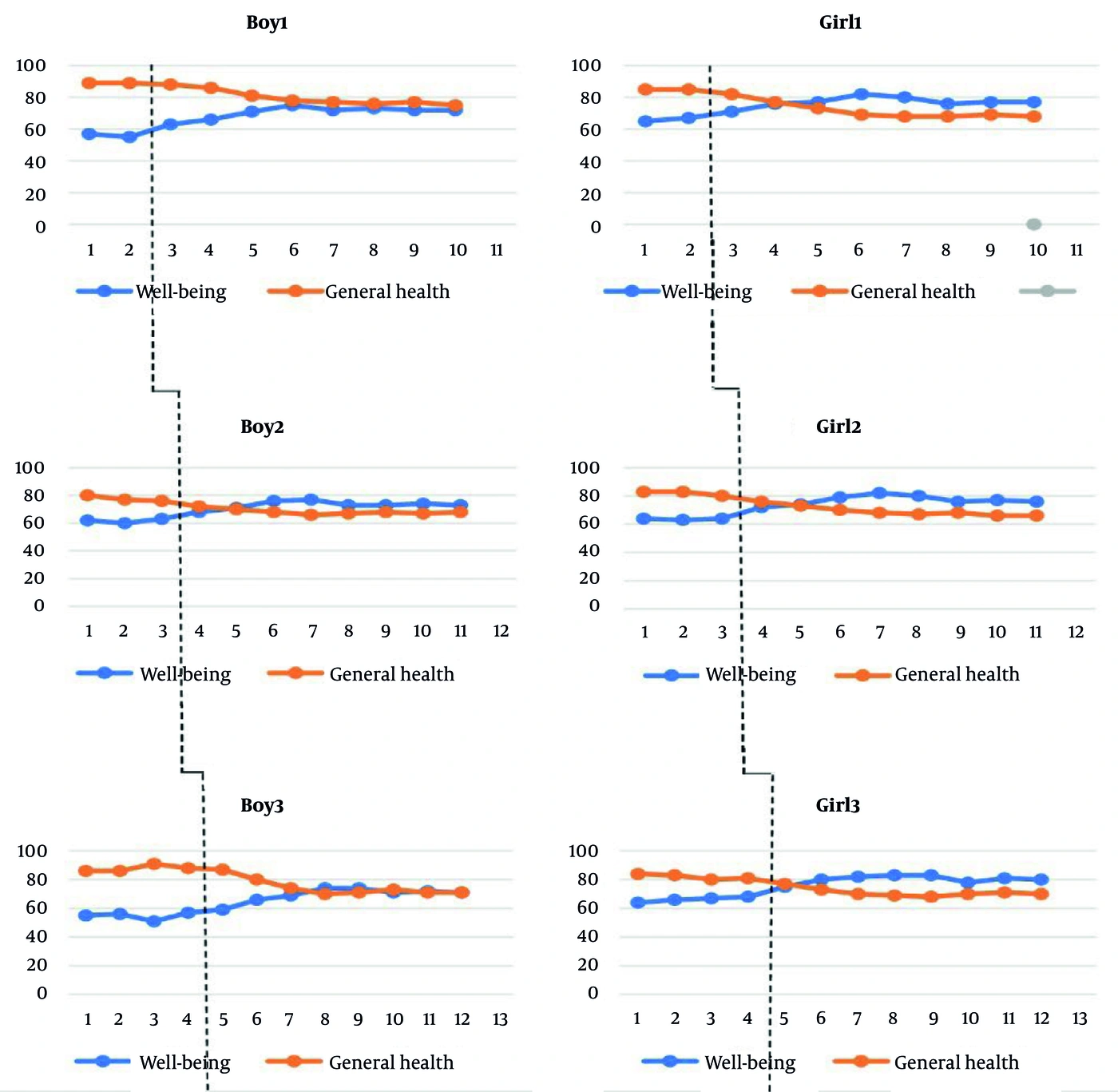
Figure 1.
Average psychological well-being and general health scores for the samples at baseline and intervention stages. Vertical dotted lines separate the nonintervention and intervention baselines.
Tau-U analyses supported the visual findings and provided quantitative estimates of effect magnitude. Tables 3 and 4 present the Tau-U values, 95% CIs, and effect-level interpretations for psychological well-being and general health, respectively.
Table 3.
Tau-U Effect Sizes, 95% Confidence Intervals, and Effect Levels for Psychological Well-Being a
| Participants | Baseline Sessions | Intervention Sessions | SBetween | SWithin Pairs | Tau-U | 95% CI | Effect Level |
|---|---|---|---|---|---|---|---|
| 1 | 2 | 8 | 16 | 0 | 1.000 | 0.83 - 1.00 | Complete |
| 2 | 3 | 8 | 24 | 1 | 0.958 | 0.82 - 1.00 | Very strong |
| 3 | 3 | 8 | 32 | 2 | 0.938 | 0.79 - 1.00 | Very strong |
| 1 | 2 | 8 | 16 | 1 | 0.938 | 0.79 - 1.00 | Very strong |
| 2 | 3 | 8 | 24 | 1 | 0.958 | 0.82 - 1.00 | Very strong |
| 3 | 3 | 8 | 32 | 6 | 0.813 | 0.66 - 0.92 | Strong |
| Weighted mean | - | - | - | - | 0.924 | 0.867 - 0.953 | Very strong |
a Effect-level thresholds were ≤ 0.65 = weak/questionable, 0.66 - 0.92 = strong, 0.93 - 0.99 = very strong, and 1.00 = complete (23). Abbreviations: Sbetween, nonoverlapping pairs between phases; Swithin, nonoverlapping pairs within a phase; CI, confidence interval.
Table 4.
Tau-U Effect Sizes, 95% Confidence Intervals, and Effect Levels for General Health a
| Participants | Baseline Sessions | Intervention Sessions | SBetween | SWithin Pairs | Tau-U | 95% CI | Effect Level |
|---|---|---|---|---|---|---|---|
| 1 | 2 | 8 | 16 | 0 | 1.000 | 0.85 - 1.00 | Complete |
| 2 | 3 | 8 | 24 | 3 | 0.875 | 0.72 - 0.99 | Very strong |
| 3 | 4 | 8 | 29 | 1 | 0.875 | 0.72 - 0.99 | Very strong |
| 1 | 2 | 8 | 16 | 0 | 1.000 | 0.85 - 1.00 | Complete |
| 2 | 3 | 8 | 24 | 2 | 0.917 | 0.76 - 0.99 | Very strong |
| 3 | 4 | 8 | 32 | 5 | 0.814 | 0.69 - 0.96 | Strong |
| Weighted mean | - | - | - | - | 0.903 | 0.854 - 0.953 | Very strong |
a Effect-level thresholds were ≤ 0.65 = weak/questionable, 0.66 - 0.92 = strong, 0.93 - 0.99 = very strong, and 1.00 = complete (23). Abbreviations: Sbetween, nonoverlapping pairs between phases; Swithin, nonoverlapping pairs within a phase; CI, confidence interval.
As shown in Table 3, the weighted mean Tau-U for psychological well-being was 0.924 (95% CI, 0.867 - 0.953), representing a very strong overall effect. One male participant (Boy 1) demonstrated a complete effect (Tau-U = 1.000), whereas the other participants demonstrated strong to very strong improvements. For general health (Table 4), the weighted mean Tau-U was 0.903 (95% CI, 0.854 - 0.953), also indicating a very strong overall effect. Two participants (Boy 1 and Girl 1) achieved complete effects, and the remaining participants showed strong to very strong reductions in GHQ-28 scores. Collectively, these findings indicate that personal construct counseling produced statistically and practically significant improvements in psychological well-being and general health, with effects that were largely consistent across participants.
3. Discussion
This pilot study investigated the effectiveness of a counseling model based on personal construct therapy in improving psychological well-being among adolescents with mild physical disabilities. The findings indicated that the intervention significantly improved psychological well-being and general health, as evidenced by large Tau-U effect sizes and clear visual trends in the multiple-baseline graphs. Personal construct therapy has been applied across various clinical and educational fields; however, to our knowledge, no previous study has specifically examined personal construct counseling among individuals with physical disabilities. Direct comparisons with the existing literature are therefore limited.
Evidence from both single-case and group designs supports the therapeutic benefits of personal construct therapy (13). Reviews of personal construct psychotherapy have suggested that its effects may be comparable to those of other established psychotherapies, although estimates vary across studies (24, 25). The large and consistent effects observed in the present study, with weighted mean Tau-U values of 0.924 for psychological well-being and 0.903 for general health, suggest that personal construct counseling may be beneficial when tailored to the developmental and psychological needs of adolescents with physical disabilities.
A core principle of personal construct counseling is transforming the individual's meaning-making process rather than merely eliminating negative thoughts. The client's construct system is first clarified and then reconsidered so that it can better serve the client's needs. Human systems have self-organizing dynamics and internal logic; therefore, the therapeutic focus is on modifying the broader construct system rather than isolated cognitions. This creative, nonremedial orientation may be particularly suitable for adolescents, who are developmentally receptive to exploring alternative perspectives (26). Adolescents may value being heard and understood, making a constructivist approach a potentially engaging framework.
The present findings are consistent with emerging evidence on cognitive and emotional interventions for improving psychosocial outcomes in vulnerable populations. Afshari and Shirinbek reported that broadening-thinking-skills training based on de Bono's six-thinking-hats approach improved cognitive flexibility, moral development, and altruism while reducing problematic sexual attitudes among high-risk adolescents (27). Their intervention was associated with an increase in cognitive flexibility from 43.92 ± 2.69 to 51.15 ± 1.62. This objective parallels that of personal construct counseling, which aims to increase cognitive flexibility by helping adolescents revise rigid and maladaptive constructs. Both approaches emphasize expansion of the individual's cognitive repertoire and the development of more adaptive interpretations of personal and social challenges. The cognitive-flexibility gains reported by Afshari and Shirinbek (27) parallel the construct revisions addressed through laddering and experiential testing in Sessions 5 and 7 of the present intervention.
The present study's emphasis on psychological well-being also aligns with research examining factors associated with stress and anxiety. Marzban et al. (28) investigated psychological well-being among participants in mass gatherings and reported that younger individuals aged 18 - 30 years and first-time attendees experienced greater distress, whereas women reported greater anxiety and stress than men. They also reported a strong correlation between crowd density and psychological distress (r = 0.72, P < 0.001) (28). Adolescents with physical disabilities may encounter analogous stressors in social and educational environments, including perceived scrutiny, stigmatization, and environmental barriers. The improvement in general health observed in the present sample (weighted mean Tau-U = 0.903; 95% CI, 0.854 - 0.953) suggests that personal construct counseling may provide cognitive and emotional resources that help adolescents manage such stressors.
Some authors have used the term "cognitive personal construct psychotherapy," although proponents of Kelly's original theory do not universally endorse this description. Nevertheless, personal construct therapy shares conceptual ground with some cognitive-behavioral approaches (25). Interventions targeting cognitive and emotional processes have also been investigated in individuals with physical disabilities. For example, Mohammad Aminzadeh et al. (26) found that emotion-regulation training improved psychological well-being in students with physical disabilities. Similarly, solution-focused therapy (29) has been associated with improvements in psychosocial outcomes among students with physical disabilities.
Support for the relevance of schema-focused interventions is further provided by Ansari Asl et al. (30), who evaluated emotion-focused therapy (EFT) and schema therapy (ST) for reducing physical appearance perfectionism among women with obesity. Their randomized controlled trial showed that both EFT and ST significantly reduced perfectionism, with improvements maintained at the two-month follow-up. Schema therapy targets early maladaptive schemas, which are deeply ingrained dysfunctional patterns associated with unmet childhood emotional needs, and shares conceptual similarities with personal construct therapy (13, 25). Both approaches recognize that individuals develop core beliefs or constructs that shape the interpretation of experiences and guide emotional and behavioral responses. Among adolescents with physical disabilities, maladaptive constructs related to ability, appearance, and social acceptance may parallel schemas involving defectiveness, shame, or unrelenting standards. The reported effectiveness of schema therapy in addressing appearance-related concerns (30) provides indirect support for interventions that similarly seek to revise deeply held beliefs through cognitive and experiential techniques.
Taken together, these findings suggest that interventions targeting cognitive and emotional processes, including broadening-thinking-skills training, schema therapy, emotion-focused therapy, solution-focused interventions, and personal construct counseling, may improve psychosocial outcomes in diverse populations. The present study extends this literature by examining personal construct counseling in adolescents with mild physical disabilities. The large and consistent effect sizes observed in this pilot study (weighted Tau-U = 0.924 for psychological well-being and 0.903 for general health) support further investigation of this approach.
Several limitations should be considered. First, the small sample size (N = 6) is inherent to the single-case experimental design. Although this approach provides experimental control and enables detailed individual analysis, it limits generalizability and precludes examination of potential moderators such as gender, disability type, or age. Second, convenience sampling from a single geographic region (Qom, Iran) and inclusion of individuals already identified by the Welfare Organization may introduce selection bias and restrict external validity. Future studies should use more systematic multisite sampling strategies.
Third, the baseline period was relatively short, extending to four sessions for the third tier. Although this was ethically justified, it limits the strength of evidence regarding baseline stability. The multiple-baseline design partially mitigates this limitation, but longer baseline periods would strengthen causal inference. Fourth, the intervention was adapted from existing personal construct therapy approaches and, although validated by experts, lacked a standardized treatment manual and a fidelity checklist, thereby reducing replicability. Future research should develop and implement comprehensive fidelity protocols.
Fifth, the therapist and researcher were the same individual, potentially introducing observer bias. Although repeated outcome measurements provided some consistency checks, the absence of independent, blinded outcome assessors remains a methodological limitation. Sixth, the absence of a control or comparison condition limits the extent to which improvements can be attributed exclusively to the intervention rather than to nonspecific factors such as attention or therapeutic alliance. Seventh, reliance on self-report measures, including the PWBS and GHQ-28, raises the possibility of response bias, social desirability effects, and common-method variance. Future studies should incorporate clinician-rated, observational, or informant-based assessments.
In conclusion, this study provides preliminary evidence that personal construct counseling may improve psychological well-being and general health among adolescents with mild physical disabilities. The large and consistent effect sizes, together with the single-case experimental design and nonparametric statistical analyses, support further investigation in larger randomized controlled trials with diverse samples, longer follow-up periods, standardized intervention protocols, and independent outcome assessment. The convergence of the present findings with those of Afshari and Shirinbek (27), Marzban et al. (28), and Ansari Asl et al. (30) further supports continued investigation of cognitive and emotional interventions for vulnerable populations.