1. Background
Worldwide, breast cancer remains the most common malignancy in women and the leading contributor to cancer-related mortality. Data from the GLOBOCAN 2022 project show that approximately 2.3 million women worldwide received a breast cancer diagnosis in 2022, and nearly 670,000 died from the disease. The likelihood of developing breast cancer increases steadily with age, although it can occur at any time after puberty. Moreover, the burden of breast cancer varies widely among countries, primarily according to the level of human development. For example, in countries with a very high Human Development Index (HDI), 1 in every 13 women will develop breast cancer during her lifetime, whereas the corresponding mortality estimate is 1 death per 71 women. In low-HDI countries, by contrast, the lifetime incidence is lower, at 1 in 27 women, but the mortality rate is markedly higher, at 1 in 48 women (1).
Data from the American Cancer Society indicate that breast cancer accounts for nearly 30% of all newly diagnosed cancers among women each year. In the United States, the lifetime probability of developing this malignancy is approximately 13%, whereas the probability of dying from it is approximately 1 in 43. The disease predominantly affects middle-aged and older women, with a mean age at diagnosis of 62 years; thus, half of affected women are 62 years or younger at diagnosis. Only a small minority of breast cancer cases occur in women younger than 45 years.
Cancer registry data from Iran indicate an increasing trend in breast cancer incidence. According to the most recent national registry report from 2018, breast cancer incidence among all registered cancers was 44.24 per 100,000. The highest incidence rates occurred in the age groups 65 - 69 years (128.33 per 100,000 women) and 60 - 64 years (127.71 per 100,000 women). The provinces with the highest breast cancer rates included Tehran, Isfahan, Yazd, Gilan, and Alborz (2). A cancer diagnosis itself can be a stressful event that threatens various aspects of a patient's life (3).
Chronic illnesses, which are responsible for 59% of annual global mortality, pose substantial challenges for contemporary health care systems. Cancer, as one of these chronic conditions, is a multifaceted group comprising more than 100 distinct diseases (4). Individuals with cancer experience considerable psychological stress. Owing to disease-specific problems, patients with cancer develop particular psychological vulnerabilities that affect their mental health (5, 6). Among psychological disturbances, emotional disorders such as alexithymia are prominent. Alexithymia, defined as difficulty recognizing and articulating emotions, occurs in a substantial proportion of patients with cancer, with prevalence ranging from 1% to 58%. Clinically, this condition is associated with disruptions in emotional processing, including difficulty verbalizing emotions and distinguishing them from somatic sensations (4).
These characteristics lead to deficiencies in the cognitive processing and organization of emotional states (7). Alexithymia is associated with difficulties in emotion regulation, information processing at a global cognitive level, and managing emotional responses (8).
Alexithymia leads individuals to focus on neutral or ordinary feelings, whereas the undifferentiated arousal associated with alexithymia produces physical sensations. In both situations, individuals focus on or amplify these sensations; the intensified feelings are reinforced through the autonomic feedback loop and experienced as symptoms of helplessness. As a result, patients with cancer with higher levels of alexithymia experience the adverse consequences of their illness more intensely, feel stronger negative emotions about it, and ultimately develop higher levels of anxiety and depression (9, 10).
In this context, receiving a diagnosis of illness can impose substantial physical and psychological stress on the patient. Psychological factors can influence immune function measures because the brain controls immune responses through the hypothalamic-pituitary-adrenal (HPA) axis (6).
Anxiety and the stressful process of cancer reduce the body's resistance to infections and stimulate the thyroid, pancreas, and pituitary glands, leading to an increased incidence of physical and psychological disorders. In addition, chemotherapy lowers blood cell counts and impairs bone marrow function, leading to problems such as anemia, thrombocytopenia, and reduced WBC counts. WBCs normally defend the body against infections and are essential for immune functions, including antibody production, movement, and distribution. When the immune system is weakened, the body is less able to fight long-term illnesses such as cancer, which in turn increases vulnerability to psychological distress. Today, scientific advances and recognition of 4 dimensions of human factors--physical, psychological, social, and spiritual--have marked a milestone in psychoneuroimmunology by confirming the relationship between psychological parameters and immune system variables (11-13).
In general, several investigations have examined the effects of psychotherapeutic interventions in patients with cancer and the influence of different therapeutic approaches on alexithymia (14) and WBC counts (11, 15, 16).
Acceptance and Commitment Therapy (ACT) is widely recognized as one of the most effective treatments among third-wave psychotherapeutic approaches (17). The main goal of ACT is to enhance cognitive flexibility by combining acceptance and present-moment awareness with value-based action and behavioral modification. A key advantage of this approach over other therapeutic modalities is its attention to both motivational and cognitive components, thereby enhancing the efficacy and durability of patient recovery (18).
Acceptance and commitment therapy does not seek to produce indirect changes in the individual. Instead, it encourages individuals to interact with experiences in diverse ways and to move through life effectively along a path that is meaningful and consistent with their personal values (19).
Because of its comprehensive and integrative nature, ACT has been successfully used to treat many psychological problems, such as social anxiety (18), existential concerns (19), chronic headache (20), fibromyalgia management (21), traumatic brain injury (22), Huntington disease (23), insomnia (24), a broad range of mental health conditions (25), and body dysmorphic disorder.
Acceptance and commitment therapy encourages individuals to engage wholeheartedly with the full range of life experiences, including experiences that patients with cancer tend to avoid, because such avoidance hinders their pursuit of a meaningful and purposeful life. This therapeutic approach includes 6 fundamental components: Learning to observe thoughts without fusion (cognitive defusion), willingly embracing inner experiences (acceptance), staying aware of the present moment (present-moment contact), seeing oneself as the observer rather than the content of experience (self-as-context), clarifying personal values, and taking effective steps guided by those values (committed action). Through this approach, patients learn to accept their emotions and feelings without attempting to eliminate, modify, or suppress them, thereby attaining a degree of calmness that was either absent or only minimally present before (24).
Several therapeutic strategies have been used to alleviate the physical and psychological deficits associated with alexithymia, each with some degree of efficacy. Notable examples include intensive short-term dynamic psychotherapy, which has been shown to reduce alexithymia in individuals with irritable bowel syndrome (26), and stress inoculation training, which has demonstrated beneficial effects on alexithymia in patients with coronary artery disease (27). Although these therapeutic approaches have achieved their intended outcomes, expanding research on psychological interventions and their effectiveness in patients with cancer remains a critical global priority. Given the importance of ACT and a review of the available Iranian literature, in which no previous investigation has examined the effects of ACT on alexithymia and WBC counts among women diagnosed with breast cancer, the present study was conducted to evaluate the effectiveness of this intervention for these specific outcomes in this population.
2. Objectives
The primary aim of this study was to evaluate the effectiveness of ACT in reducing alexithymia and increasing WBC counts in women with breast cancer and to examine how these effects changed over time. We hypothesized that ACT would significantly reduce alexithymia, improve WBC counts, and maintain these effects during follow-up.
3. Methods
This randomized controlled trial included a pretest, posttest, and 1-month follow-up, along with a control group. Purposive sampling was used to recruit participants among women with breast cancer referred to Baqaei Super-Specialty Hospital and a private cancer treatment center in Ahvaz from December 11, 2025, to January 10, 2026. A sample of 42 participants was determined through sample size calculation using G*Power software (28), based on mixed analysis of variance and an alpha level of 0.05. Randomization was performed using simple random allocation. The random sequence was generated by one author who was not involved in participant recruitment, using Random Allocation Generator software. To conceal allocation, opaque sealed envelopes were sequentially numbered. The same author prepared the envelopes and assigned each participant to either the ACT group (n = 21) or the control group, which received no psychological support (n = 21). Research assistants, who were center nurses, administered the questionnaires at baseline, after the intervention, and 1 month later and were unaware of group allocation. However, the therapist, who was also one of the authors, and the authors who performed the statistical analyses were aware of group assignment because of the inherent characteristics of the psychological intervention.
Women with breast cancer were eligible if they were 18 years or older, were currently receiving chemotherapy, were at clinical stage I or II, were free of other physical or mental health conditions, were able to read and write, had no previous substance misuse, and had no acute infection at study entry. Exclusion criteria were withdrawal from the research before completion, missing more than 2 treatment sessions, and the use of any form of complementary or alternative medicine.
The intervention consisted of 8 individual sessions. All ethical guidelines were strictly followed during therapy administration. The aims of the research were clearly explained, participant information was kept confidential, and written informed consent was obtained from all participants. Data were analyzed using mixed-design analysis of variance (mixed ANOVA) in SPSS version 25. To verify the assumptions for repeated-measures ANOVA, the Shapiro-Wilk test was used to assess normality, and Mauchly's test was used to assess sphericity.
The statistical model was a mixed-design ANOVA. In this model, the within-subject factor was measurement time (baseline, immediately after the intervention, and 1 month later), and the between-subject factor was treatment condition (ACT vs control). The analysis evaluated the main effects of time and group and their interaction. Because Mauchly's test indicated that the sphericity assumption had been violated (P < 0.05), the within-subject degrees of freedom were corrected using the Greenhouse-Geisser procedure. SPSS version 25 was used for all statistical analyses.
3.1. Tools
3.1.1. Toronto Alexithymia Scale
The Toronto Alexithymia Scale (TAS-20) was first introduced by Bagby and colleagues in 1994. This scale includes 20 items, each rated on a 5-point Likert scale, with 1 indicating strongly disagree and 5 indicating strongly agree. Total scores range from 20 to 100. Numerous studies have established that this instrument has satisfactory psychometric properties. For the Persian adaptation of the TAS-20, internal consistency was assessed using Cronbach's alpha. The alpha value for the total alexithymia score was 0.85. For the 3 subscales-difficulty identifying feelings, difficulty describing feelings, and externally oriented thinking-Cronbach's alpha coefficients were 0.83, 0.75, and 0.72, respectively, indicating high internal consistency. In addition, test-retest reliability was evaluated over 4 weeks in a group of 67 people. The correlation coefficients for the total scale and its subscales ranged from 0.80 to 0.87, confirming good stability over time (29). In the present study, internal consistency was re-evaluated by calculating Cronbach's alpha for the overall score, which was 0.79, indicating high reliability.
3.1.2. White Blood Cell Count
Blood samples were collected from each participant at 3 time points: pretest, posttest, and 1-month follow-up. All samples were obtained 1 day after a chemotherapy session. Participants received chemotherapy every 2 weeks. At enrollment, all patients were in the early stages of their chemotherapy course, ensuring homogeneity. Patients with acute infection were excluded from the study. Participants received WBC-boosting medication as part of their routine medical care. The authors were aware of this and aimed to test whether ACT could influence WBC counts despite this routine medication. All blood samples were analyzed using a complete blood count in a single laboratory with the same automated analyzer under identical conditions throughout the study.
3.1.3. Acceptance and Commitment Therapy
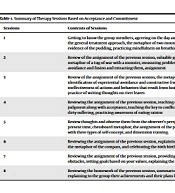
Acceptance and Commitment Therapy was introduced by Steven Hayes in 1986. The goal of ACT is to help patients achieve a more meaningful life by increasing psychological flexibility. In this therapeutic approach, the focus is on enhancing the individual's psychological relationship with thoughts and emotions rather than changing cognitions. In the present study, the intervention program was adapted from the protocol by Eifert et al. (30, 31). The intervention comprised 8 sessions, and a summary of its content is provided in Table 1.
Table 1.
Outline of the Acceptance and Commitment Therapy Protocol
| Session | Summary |
|---|---|
| Session 1 | Establishing a therapeutic relationship, familiarizing participants with the research topic, and administering the questionnaire. |
| Session 2 | Exploring patients' personal experiences and their perceptions of breast cancer and its associated treatments, while introducing creative hopelessness to help them establish new goals aligned with their current situation. |
| Session 3 | Promoting acceptance of the illness instead of denial and resistance to breast cancer and engaging in purposeful actions alongside adherence to treatment. |
| Session 4 | Applying the diffusion technique to distance oneself from discouraging thoughts about the illness, using metaphoric language to destabilize thoughts and conditions such as pain and suffering, and weakening fusion with thoughts and emotions to recognize that thoughts are merely thoughts, not external reality. |
| Session 5 | Observing the self as context, perceiving the illness as part of life rather than its entirety, diminishing the conceptualized self, and expressing the self as an observer to notice one's illness and conditions without merging with them. |
| Session 6 | Applying mindfulness techniques to enhance present-moment awareness, support emotional regulation, cultivate nonjudgmental thinking regarding body image, and learning to view illness-related experiences as a process. |
| Session 7 | Introducing the concept of values, highlighting the risks of focusing on illness outcomes, encouraging attention to the present moment as it exists, and exploring practical life values. |
| Session 8 | Understanding the nature of acceptance and commitment and determining patterns of action aligned with personal values. |
According to the standards of the Iranian Psychological Organization, each ACT session lasted 45 minutes and was conducted once weekly. The therapist who delivered the intervention, the first author, held a doctoral degree in health psychology from the University of Tehran. The therapist also completed a specialized ACT training course at the Moddat Institute of Higher Education and had several years of clinical experience in this area. To ensure treatment fidelity and protocol adherence, the third author, who served as the supervisor and professor of the first author in this research and held a postdoctoral degree in cancer psychology from the University of Tehran, supervised the sessions. The intervention protocol was delivered uniformly to all participants in the experimental group.
4. Results
Figure 1 presents the CONSORT flow diagram. Of the 104 patients interviewed, 53 were eligible. Based on G*Power, 42 participants were randomized to the ACT group (n = 21) and the control group (n = 21). No dropout occurred, and all participants completed the 3 assessments.
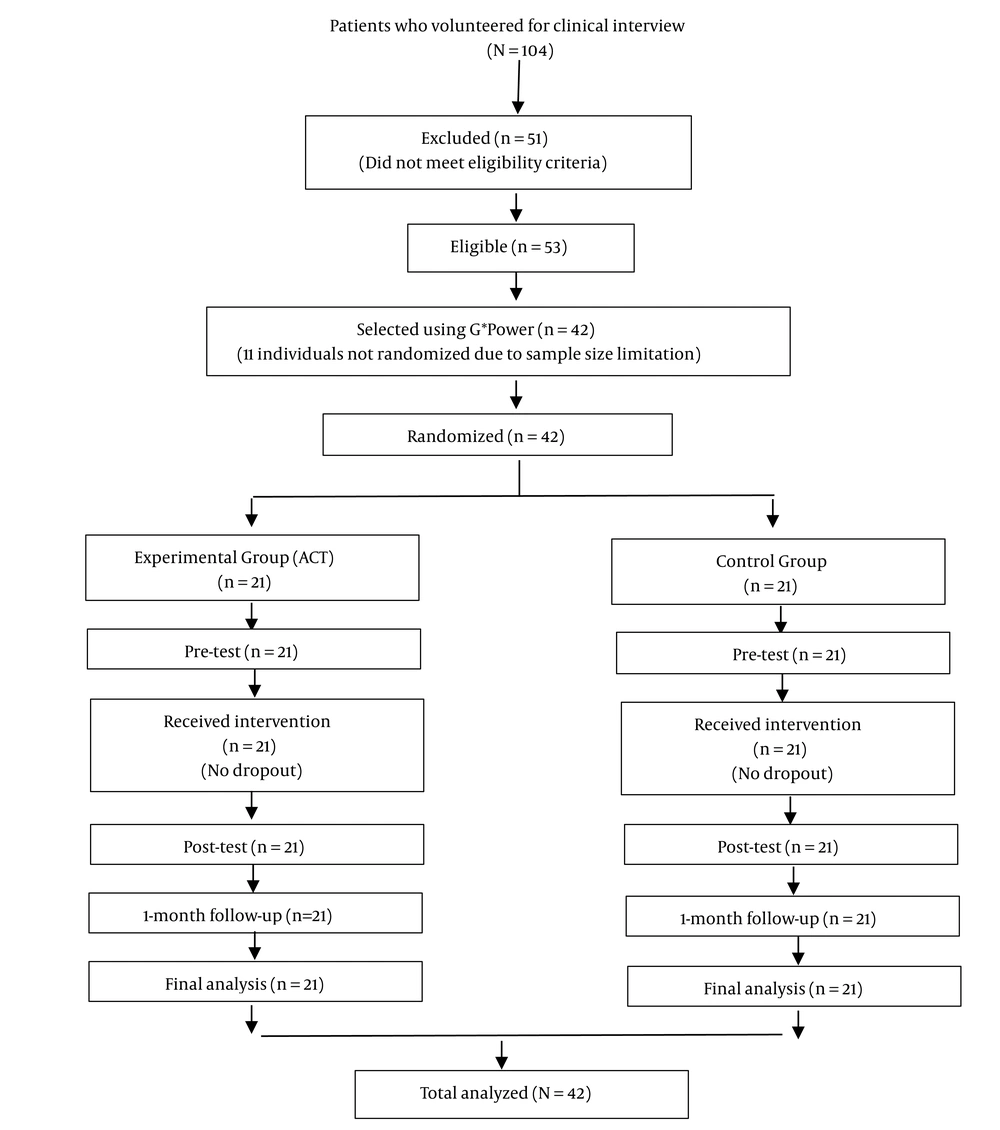
Figure 1.
CONSORT-based flowchart illustrating the study participant flow
Descriptive demographic variables are shown in Table 2.
Table 2.
Comparison of Baseline Characteristics Between the 2 Groups a
| Variables | Experimental (n = 21) | Control (n = 21) | P-Value |
|---|---|---|---|
| Marital status | 1.00 b | ||
| Married | 19 (90.47) | 17 (80.95) | |
| Single | 2 (9.52) | 4 (19.04) | |
| Level of education | 0.619 b | ||
| Under diploma | 4 (19.04) | 8 (30.09) | |
| Diploma | 11 (52.38) | 12 (57.14) | |
| Bachelor | 5 (23.8) | 2 (9.52) | |
| Master | 1 (4.76) | 0.00 | |
| Ethnicity | 0.697 b | ||
| Fars | 14 (66.66) | 13 (61.90) | |
| Bakhtiyari | 2 (9.52) | 4 (19.04) | |
| Lor | 2 (9.52) | 2 (9.52) | |
| Arab | 3 (14.28) | 2 (9.52) | |
| Job | 1.00 b | ||
| Employed | 3 (14.28) | 2 (9.52) | |
| Housewife | 18 (85.71) | 19 (90.47) | |
| Duration of cancer | 22.7746 ± 13.6174 | 18.5663 ± 10.8853 | 0.107 c |
| Age | 41.72 ± 12.19 | 40.81 ± 11.47 | 0.426 c |
a Values are expressed as No. (%) or mean ± SD.
b The chi-square test
c The independent t-test.
Table 2 shows that the 2 groups were homogeneous across all demographic variables.
4.1. Descriptive Findings of the Research Variables
The descriptive statistics for the study variables are presented in Table 3 at the 3 assessment points (pre-test, post-test, and follow-up), separately for the ACT and control groups.
Table 3.
Descriptive Statistics of Alexithymia and White Blood Cell Count Across Pre-Test, Post-Test, and Follow-Up Stages a
| Variables and Time | ACT | Control |
|---|---|---|
| Alexithymia | ||
| Pre-test | 76.76 ± 8.71 | 77.11 ± 7.71 |
| Post-test | 47.50 ± 8.85 | 78.03 ± 7.63 |
| Follow-up | 46.04 ± 8.94 | 77.84 ± 7.60 |
| White blood cell count | ||
| Pre-test | 3921 ± 276.13 | 3893 ± 298.38 |
| Post-test | 4007 ± 198.76 | 3961 ± 243.97 |
| Follow-up | 4008 ± 200.32 | 3960 ± 272.50 |
a Values are expressed as mean ± SD. Abbreviations: ACT, acceptance and commitment therapy; SD, standard deviation.
As shown in Table 3, after the therapeutic intervention, the mean alexithymia level decreased significantly, and this reduction remained stable at the 1-month follow-up. In contrast, the mean WBC count showed no statistically significant change at Post-test compared with Pre-test.
Before reporting the mixed ANOVA findings, all required parametric assumptions were examined. The Shapiro-Wilk test was used to assess normality at the 3 time points: Pre-test, Post-test, and follow-up. Levene's test was used to evaluate the homogeneity of variance between the experimental and control groups. The F statistic for variance comparisons across both groups at all 3 time points was nonsignificant (P > 0.05), indicating no notable variance differences and supporting the assumption of homogeneity of variance. As shown in Table 4, Mauchly's test was statistically significant for alexithymia (P = 0.001) and WBC count (P = 0.003), indicating that the sphericity assumption was not met. Therefore, the degrees of freedom for the within-subject factors in the repeated-measures ANOVA were adjusted using the Greenhouse-Geisser correction. Table 5 presents the adjusted results.
Table 4.
Outcomes of Mauchly's Test for the Sphericity Assumption Concerning Alexithymia and White Blood Cell Count
| Dependent Variable | Mauchly's W | Chi-Square Approximation | df | P-Value | Greenhouse-Geisser Epsilon | Huynh-Feldt Epsilon |
|---|---|---|---|---|---|---|
| Alexithymia | 0.55 | 19.20 | 3 | 0.001 | 0.53 | 0.75 |
| White blood cell count | 0.73 | 11.69 | 3 | 0.003 | 0.71 | 0.73 |
Table 5.
Outcomes of the Repeated-Measures ANOVA Examining the Within-Group and Between-Group Effects of Time and Intervention Type on Alexithymia and White Blood Cell Count
| Characteristic and Source of Statistical Changes | Sum of Squares | df | Mean Squares | F | P-Value | Effect Size |
|---|---|---|---|---|---|---|
| Alexithymia | ||||||
| Time | 142 | 1.07 | 132.7 | 40.92 | 0.001 | 0.76 |
| Group | 1214 | 1 | 1214 | 38.82 | 0.001 | 0.75 |
| Time × group | 361 | 1.07 | 337.4 | 84.29 | 0.001 | 0.81 |
| White blood cell count | ||||||
| Time | 2103426.61 | 1.42 | 1481286 | 0.52 | 0.61 | 0.01 |
| Group | 2197416.45 | 2 | 1098708 | 0.38 | 0.53 | 0.01 |
| Time × group | 1413119.76 | 2 | 706559 | 0.64 | 0.54 | 0.02 |
The results of the within-group and between-group effect analyses are reported in Table 5.
According to Table 5, the effects of time, group, and their interaction on alexithymia were all statistically significant (P = 0.001). In contrast, for WBC count, neither the main effects of time and group nor their interaction were significant (all P > 0.05), consistent with the descriptive data in Table 3. Thus, alexithymia scores differed significantly across the 3 assessment points.
Pairwise comparisons for within-group and between-group differences were conducted using the Bonferroni test.
Table 6 presents the pairwise comparisons obtained using the Bonferroni post hoc test. In the experimental group, alexithymia scores decreased significantly from baseline to postintervention (mean difference = 29.26; 95% CI, 23.50 - 35.02; P < 0.001) and remained substantially lower at follow-up than at pre-test (mean difference = 30.72; 95% CI, 24.85 - 36.59; P < 0.001). However, the change between post-test and follow-up did not reach statistical significance (mean difference = 1.46; 95% CI, -0.95 to 3.87; P = 0.32), indicating that the improvement was maintained without further meaningful change. In the control group, none of the comparisons across the 3 time points was significant (all P > 0.05). For WBC count, neither group showed a meaningful change at any measurement time (all P > 0.05), further indicating that the intervention had no statistically significant effect on this biological measure.
Table 6.
Results of the Bonferroni Post Hoc Test for Within-Group Pairwise Comparisons of Alexithymia and White Blood Cell Count
| Variables and Comparison | Experimental | Control | ||||
|---|---|---|---|---|---|---|
| Mean Difference | P-Value | 95% CI | Mean Difference | P-Value | 95% CI | |
| Alexithymia | ||||||
| Pre-test and post-test | 29.26 | 0.001 | 23.50, 35.02 | -0.92 | 0.65 | -4.15, 2.31 |
| Pre-test and follow-up | 30.72 | 0.001 | 24.85, 36.59 | -0.73 | 0.65 | -3.95, 2.49 |
| Post-test and follow-up | 1.46 | 0.32 | -0.95, 3.87 | 0.19 | 0.32 | -2.10, 2.48 |
| White blood cell count | ||||||
| Pre-test and post-test | 86 | 0.61 | -124.5, 296.5 | -68 | 0.82 | -278.5, 142.5 |
| Pre-test and follow-up | 87 | 0.63 | -123.8, 297.8 | -67 | 0.72 | -277.5, 143.5 |
| Post-test and follow-up | 1 | 0.53 | -22.4, 24.4 | 1 | 0.59 | -22.4, 24.4 |
5. Discussion
In the ACT group, the mean alexithymia score decreased from 76.76 at baseline to 47.50 after the intervention and further decreased to 46.04 at the 1-month follow-up. Given the total possible range of the TAS-20 (20 - 100), this reduction of approximately 30 points, or about 38% of the full range, represents a clinically meaningful improvement, shifting participants from a high level of alexithymia to a low-to-moderate range.
Despite advances in cancer survival and treatment, patients with cancer frequently experience substantial psychological strain, including alexithymia. The term alexithymia, derived from the Greek roots alexis, meaning absence of words, and thymus, meaning emotions, refers to difficulty recognizing and articulating feelings, resulting in various adverse consequences that impair physical health and mental well-being (4). Acceptance and Commitment Therapy is a relatively recent psychotherapeutic approach that focuses on translating personal goals into concrete actions while helping individuals modify thought patterns to better manage and resolve psychological difficulties. Moreover, this approach enables individuals to voluntarily engage with and regulate their emotional states and to articulate and communicate their feelings accurately (18).
This study was primarily designed to examine the effectiveness of ACT in reducing alexithymic features and enhancing WBC counts among women with a definite diagnosis of breast cancer. The findings indicated that, given the large effect size and considerable improvement, ACT was highly successful in reducing alexithymia, and these beneficial effects were largely maintained over time. For WBC counts, no statistically significant change was observed after the intervention.
Our findings are consistent with earlier work showing that ACT is effective for a broad range of psychological and medical problems, such as insomnia (24), traumatic brain injury (22), Huntington disease (23), chronic headache (20), and a broad range of mental health conditions (25).
Existing research on the effects of psychotherapeutic interventions on WBC counts has yielded mixed findings, and the present results are consistent with this variability. One review examined whether psychological treatments can alter immune indicators in patients with cancer. According to this review, psychotherapy influenced the activity of natural killer cells, a subtype of WBCs that targets infected and abnormal cells, including cancerous cells, whereas its effects on other immune cells were absent or inconsistent (11). A recent systematic review and meta-analysis examined how psychological interventions developed mainly to reduce stress affect different biological markers in individuals with cancer, including inflammatory markers and cortisol concentrations. The findings indicated that although these interventions had a beneficial effect on patients' perceived cognitive abilities, their influence on biological measures, such as tumor necrosis factor alpha, morning cortisol, interleukin levels, and C-reactive protein, remained uncertain or statistically nonsignificant. The present results align with these observations because ACT did not produce a statistically significant shift in WBC levels (16). In another study, psychotherapeutic interventions were found to influence anti-inflammatory cytokine levels, antibody concentrations, immune cell counts, and natural killer cell activity (15).
Steven Hayes first introduced the ACT framework in 1982. This approach is based on the premise that the primary source of life problems is experiential avoidance. Experiential avoidance refers to a person's attempt to evade specific events, thoughts, sensations, and emotions. However, avoidance of thoughts and emotions often paradoxically intensifies them. When an individual attempts to avoid emotional experiences, the likelihood of amplifying that experience and developing more substantial problems increases.
The acronym ACT reflects the essential components of this therapeutic approach. The letter A represents acceptance of thoughts and emotions, with a focus on living in the present moment. The letter C denotes choosing a valued life direction, and T refers to taking action to implement goals. In essence, ACT aims to help individuals experience emotions as they are, enabling them to explore emotional experiences, accurately recognize and understand them, and express them in a healthy manner.
The central aim of ACT is to cultivate cognitive flexibility. This therapeutic objective promotes present-moment engagement, reduces experiential avoidance, and encourages committed action consistent with personal values, primarily through acceptance and defusion techniques. With increased psychological flexibility, individuals can remain focused on the present moment, free from the weight of past events or anxieties about the future. At the same time, they become more aware of their values, objectives, and feelings and ultimately behave in a manner consistent with their fundamental life values (4, 14, 20).
Individuals undergoing cancer treatment often experience trauma and pronounced emotional rigidity, a condition commonly referred to as alexithymia or emotional inexpressiveness. These observations underscore the substantial emotional challenges that arise when coping with cancer-related stressors.
Although the present study did not directly measure neurobiological or endocrine variables, ACT may plausibly influence brain regions such as the limbic system, amygdala, and hippocampus, as well as dopaminergic reward pathways and oxytocinergic activity, which are involved in emotional regulation and stress processing. However, these potential mechanisms remain speculative and should be systematically investigated in future research using appropriate neuroimaging or neuroendocrine methods.
The complex nature of human physiology, including the immune system, bone marrow function (particularly WBCs), and individual genetic variations, is well recognized by hematology and oncology specialists, given that numerous factors can influence increases or decreases in these cells during chemotherapy. The present findings did not reveal any statistically meaningful effect of the intervention on WBC count. This observation further underscores the complexity of these physiological mechanisms and indicates the need for additional research in this field.
Several limitations should be considered when generalizing the present findings to other cancer types, age groups, or male populations. Future studies should apply this therapeutic approach across a broader range of cultural settings and age groups. From a practical standpoint, psychological interventions should be incorporated into standard oncology care in medical centers, and clinical health psychologists should be available in these facilities. Because patients with cancer often experience significant psychological distress, adding these interventions to usual treatment, with support from the Ministry of Health, could reduce psychological strain and improve overall quality of life.
5.1. Conclusions
The present findings suggest that ACT can reduce alexithymia in women with breast cancer, and this improvement may remain stable at 1-month follow-up. However, ACT did not produce a statistically significant change in WBC count. These results support the clinical value of psychological interventions in oncology care while highlighting the need for further research on biological outcomes.