1. Background
The breast cancer is the second leading cause of death in women (1). It is estimated that by 2020, 70 percent of new cases of breast cancer will be observed in developing countries (2). The International Association for the Study of Pain (IASP) reported that the prevalent of pain in breast cancer is between 40% to 89% (3) and 17 million people complain of cancer pain.
Cancer pain or cancer treatment side effects impact on 50 to 90 percent of the patients (4). This leads to emotional disturbance and consequently decrease quality of life in patients (5). Cancer pain is affected by the neuropathic, psychological, social and spiritual variables and ends to social dysfunction (6). Pain is a multidimensional phenomenon. According to the International Association of Pain, pain is defined as an unpleasant emotional experience associated with actual or potential tissue damage and has sensory and emotional dimension. Sensory aspects of pain refers to severity of pain and emotional dimension refers to amount of an unpleasant emotional experience (7). In other words, pain is what a patient expresses as long as he experiences it. This definition emphasizes psychological concept of pain and its control (8). Pain is a breakdown situation so that not only confronts the patient with pain distressing experience but also is related to many stressful factors which impact other different parts of patient’s life. Therefore, living with chronic pain requires tolerating emotional stress. Also, pain reduces the person’s emotional and emotional abilities. The persistent desire of the individual to escape from the pain is often unattainable. This ultimately leads to frustration and depression, which weakens the patient’s morale (9).
On the other hand, Cancerous crises have a negative effect on the patient’s response to pain and even her healing (10). Several drug therapies have been used to reduce cancer pain such as non-steroidal analgesics, opiate painkillers (11), and antidepressants (12, 13). However, these drug agents often do not completely resolve all signs of mental stress or pain. Since these drugs are mostly consumed in the long term produce a range of side effects (14). Hence, non-pharmacological strategies which are widely used in pain management and emotional distress management are applied (15). One of the most famous interventions is mind meditation which is rooted in Buddhism teaching (16). From acceptance and commitment therapy perspective which is the integration of consciousness and the principles of cognitive behavioral therapy, human suffering is rooted in mental flexibility which is made through cognitive defusion and experiential avoidance. What is considered harmful is the tendency to absorb experiences and combat them by experiential avoidance (17). Acceptance and commitment therapy is a special treatment process “psychological flexibility” which focuses on behavioral changes not reducing the symptoms (18). The main purpose of this approach seeks to undermine excessive struggle with anxiety and experiential avoidance attempts to down-regulate and control unwanted private events (thoughts, images, bodily sensations). The goal is to enhance more flexible and mindful ways of relating to anxiety so individuals can pursue life goals important to them (19). In this approach as soon as thoughts, feelings, memories, etc. were labels as signs and symptoms a struggle arouse among them. This is because these symptoms are defined as a traumatic and ailmental phenomenon. Acceptance and commitment change the relationship between emotions and problematic thoughts so that people do not perceive them as symptoms and even learn to understand them harmlessly (20). In fact, there is less focus on symptoms and more focuses on improving quality of life (21). In a randomized trial, the results showed that an acceptance-based approach was effective on the mood and quality of life of breast cancer patients (22). In a meta-analysis evidence-base evaluation with 60 randomized controlled trials on psychiatric disorders, somatic disorders, and stress at work the results revealed that the success of this approach for chronic pain is more effective than anxiety and depression. That is to say ACT is not yet well-established for any disorder (23). In another study the effectiveness of applied relaxation and acceptance and commitment therapy in a randomized, controlled clinical trial with a sample size of 60 chronic pain patients was compared. The results showed that the ACT approach with regard to its role as psychological flexibility as a mediating factor to reduce severity of pain is more effective than applied relaxation (24). The recent researches on acceptance and commitment therapy show that this treatment can be an appropriate treatment for chronic pain (25, 26). On the other hand, since acceptance and commitment interventions have shown significant advances in psychological components such as quality of life and mental flexibility, as well as reduction of symptoms in distress, emotional disturbances, and physical pain in cancer patients (27).
2. Objectives
The purpose of this research was to determine the effectiveness of acceptance and commitment therapy (ACT) on reducing the severity of perceived pain in women with breast cancer.
3. Methods
The design of this study is semi experimental with pre-test-posttest design with control group. The statistical population included all women with breast cancer who referred to Ilam health centers in 2012. An appropriate sample according to research criteria was selected using available sampling method. The patients’ criteria for entry and exit were as follow: Entrance-obtaining at least 60 scores from West Haven-Yale Multidimensional Pain Inventory (WHYMPI), minimum guidance school education, age range between 30 to 45 years, informed consent, and not undergoing psychotherapy. The exit criteria were: Having mental disorders according to clinical interview DSM-5, the presence of underlying illness such as migraine headaches and arthritis causing pain, absent more than two sessions. After the selection of patients, they were randomly assigned in groups (15 in the experimental group and 15 in the control group). WHYMPI was performed before the intervention for the experimental and control group. WHYMPI is used to identify the biological, psychological and social factors of pain (multiple dimensions of chronic pain). This inventory is used for pain management to examine the course of changes during the treatment period and estimate the treatment outcomes. The WHYMPI is a 48-item, 12-scale inventory that is divided into three parts. A 20- minute is allocated for patients’ response. Patient’s responses to WHYMPI items are made on a 6-point scale from 0 to 6. The inventory is divided into three parts: Important dimensions of the chronic pain experience, patients’ perceptions of spouses and patients’ report of the frequency with which they engage in four categories of common everyday activities. These parts include: Support, pain severity, perceived life control, affective distress, assesses or significant others display solicitous, patients’ perception of his disability in household chores, outdoor work, and social activities. In this study only the first part (important dimensions of chronic pain experience) was used.
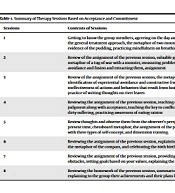
For this study, the Cronbach’s alpha for first part of the inventory was 0.86, or the second part was 0.78 and for the third part was 0.75. On the other hand, the reliability of pain interference with daily activities scale was reported 0.91 based on Cronbach’s alpha. The reliability coefficient of the inventory was equivalent to 0.95 according to re-test method (28). After presenting WHYMPI, acceptance and commitment therapy were performed in 8 sessions for 90 minutes once a week for the experimental group. After the intervention, the above mention inventory were taken as posttest from both groups. To analyze the data SPSS version 21 was used. Descriptive statistics (mean, standard deviation ...) and inferential statistics of covariance analysis were used to analyze the data. A summary of the content of the meetings is listed in Table 1.
Table 1.
Summary of ACT Sessions
| Sessions | Therapeutic Intervention |
|---|---|
| First session | Creating a collaborative relationship, reviewing treatment and goals, completing the questionnaire |
| Second session | Teaching the “if after” mentality and control methods, describes the relationship between “pain, creativity and function” |
| Third session | Description of acceptance concepts, cognitive faults, values, conceptualization of control as a problem of performance measurement |
| Fourth session | Discuss values, barriers to values, discover practical values of life |
| Fifth session | Addressing the concept of cognitive fault, reviewing more mental frameworks and practicing exercises |
| Sixth session | Review prior session’s experience Self-observation as a background, self-conceptual weakening and self-expression as observer, performance measurement, showing separation between oneself, internal experiences |
| Seventh session | Review prior session’s experience Understanding tendency, commitment to barriers, application of the techniques of mindfulness, observation of internal experiences as a process |
| Eight session | Review prior session’s experience, commitments issues, prevent recurrence |
4. Results
As it can be observed in Table 2, Mean of pain severity pretest in experimental group were 76.66 and 74/98 in control group. However, after intervention the mean of pain severity posttest in experimental group were 70.08 and 74.06 in control group.
Table 2.
Means and Standard Deviation of Severity of Pain in Control and Experimental Group in Pretest and Posttest
| Group | Variable | Number | Pretest | Posttest |
|---|---|---|---|---|
| Experimental | Severity of pain | 15 | 76.66 ± 6.11 | 70.08 ± 5.47 |
| Control | Severity of pain | 15 | 74.98 ± 5.37 | 74.06 ± 5.06 |
As shown in Table 3, there was a significant difference between adjusted means of participants pain scores in posttest (F = 48.41) based on group membership (experimental and control group) (P = 0.01). Therefore, acceptance and commitment therapy was effective in reducing the severity of pain in experimental group (R squared = 0.54).
Table 3.
The Results of Analysis of Covariance of the Severity of Pain in the Experimental and Control Group
| Sources of Changes | Sum of Squares | Degree of Freedom | Means of Squares | F | Level of Significance | Eta Coefficient |
|---|---|---|---|---|---|---|
| Pretest | 1295.339 | 1 | 1295.339 | |||
| Group | 200.789 | 1 | 200.784 | 48.41 | 0.01 | 0.54 |
| Error | 111.995 | 27 | 4.15 | |||
| Total | 158885 | 30 |
5. Discussion
The purpose of this study was to investigate the effect of acceptance and commitment therapy on pain reduction in women with breast cancer. The results of Table 3 showed that the difference between the two groups was significant in the pain intensity variable (F = 48.41; P = 0.001). This finding is in line with Ost (23) research, Kemani et al. (24), Johnston et al. (25), and Scott and McCracken (26). Mosher et al. (29) in an attempt to assess the effectiveness of acceptance therapy and commitment to psychological symptoms in breast cancer patients came to this conclusion that acceptance and commitment therapy was effective in reducing pain and improving the quality of sleep in patients with breast cancer. It seems that the acceptance and commitment therapy has reduced the participants ‘intensity of perceived pain through factors such as adoption without judgment, being in the moment, coping with the inner experiences without avoiding, suppressing or attempting to change negative emotions. In fact, cancer patients need strategies to maintain their power of adaptability and coping ability. Similarly, acceptance and commitment therapy helped these people fail to conceive themselves as failures, injuries, or hopelessness, and life has meaning and value for them. All of these items can be a factor in improving the psychological well-being of individuals. Acceptance and commitment therapy with its impacts on changes in emotional regulation and individual behavioral changes was able to change individual’s life style and attitudes. On the other hand, the acceptance of breast cancer which was painful according to the researches (3, 4, 30) helped the participants to be familiar with the techniques of mindfulness, self as background and experience psychological flexibility instead of experiential avoidance and describing themselves as process and content “I am suffering from cancer and feeling pain”. Moreover the patients change their attitudes toward the situations. Other dimensions of this type of therapy include faults, relationship with the present with the strengthening of self-observer, identifying values and commitment to value. They allow patients the opportunity to adjust their feelings and change their perception of pain. Thus, the results revealed that the main framework of the acceptance and commitment therapy indicate an intervention model for reducing the perception of severity of pain in patients with breast cancer. These patients can accept the pains and release themselves from emotional exasperation trap. This approach with introducing a six-process model led to awareness of weakened self-awareness and their uncertain values. Consequently, they learn which components of their problem need to be accepted and which one needs change the basis of this approach is that difficult thoughts and emotions are inevitable aspects of human life, not the problems that must get rid of them. Because life involves painful events, and efforts to avoid pain make it more widespread. One of the limitations of this research is the lack of follow-up courses and the limited statistical community in Ilam city.