
1. Background
Substance abuse in adolescents and its outcomes including addiction, physical, psychological and social problems is one of the important public health concerns (1, 2). The use of addictive and illicit drugs causes aggressive sexual behaviors, unwanted pregnancy, suicide, aggression and crime, accident, and personality disorders. There has been a substantial increase in drug abuse since the 1970s (3, 4).
The center on addiction and substance abuse (CASA) in the United States announced that 75.6 % of high school students have used one or more addictive substances, 72.5% have drunk alcohol, 46.3% have smoked cigarettes, 36.8% have used marijuana, and 6.4% have used cocaine (5).
Religious and cultural reasons have affected the consumption pattern of addictive substances in Iran (6). Currently, our country has the highest consumption level of narcotics in the world (7). According to dispersed studies in Iran, different results have been found. In recent studies Prevalence of Smoking which is the reason for 20% of preventable deaths in developed countries was reported 22.5% and 23.5% among adolescents in Isfahan and Yazd respectively (8, 9). The results of one study, which was conducted on 10th grade students, showed that 16.9% of students were experimenters, and 2.5% were regular smokers. Furthermore, the results of a recent study showed that 32% of students had experienced alcohol consumption and 2.1% had lifetime drug abuse (10). A study In Shiraz in 9 to 15 year- olds revealed 4.8% occasional smoking, 2% opiates use, 3.8% addiction to cigarette, and 0.1% drug addiction (11). The results of one study, which was conducted on nearly 5000 students in Tabriz, showed that prevalence of substance abuse was 1.4%. Among all substances used, 17 (25.4%), 28 (41.8%), 21 (31.3%), 10 (14.9), and 12 (17.9%) were reported for cannabis, opium, ecstasy, methamphetamines, (called Shisheh in Iran), and other drugs, respectively (12). Throughout another study in Kerman, The experience of smoking cigarettes was seen in 34.6% of the students, 51.5% used hookah, 37.7% drank alcohol, 40.7% used nonprescribed tranquilizers, 10.2% used high-dosage painkillers, 6.6% used ecstasy, 6.7% hashish, 4.9% heroin, 8.7% opium, and 9.7% used pam or chewable tobacco (2).
2. Objectives
Considering the importance of drug abuse prevention and the description of the current condition, the present study aimed at estimating the prevalence of substance abuse in adolescent’s of Yazd province as a helpful document for health decision- makers in adopting preventive measures.
3. Materials and Methods
This was a cross sectional study; and the sample size was 730 individuals out of about 3773, 12th grade students in Yazd according to the previous researches, and P = 0.18, d = 0.03, z = 1.96, and design effect = 2. The sampling was done in a two-stage cluster manner, through which the schools were considered as clusters, and the selection of schools was based on the school population.
Our research instrument was adapted from the United nation office on drugs and crime substance abuse questionnaire, which was designed to be used in schools; and its validity has been established (13, 14).
Permission was obtained from the education and training organization and school officials, followed by introducing the research objectives to students and emphasizing the confidentiality of information. Then, the researchers distributed the questioners among the students and requested them to place it inside the box in the middle of the class after its anonymous completion so that the confidentiality of information would be warranted.
The questionnaire consisted of 2 parts: background information and questions about the use of 40 different substances or drugs, in which the item of “never consumed” was coded as 0, “having at least one time experience” as 1, and “more than once” as 2. In addition, for every substance or drug, bidder and the age of the first experience were also asked. Logistic regression model and Chi-square, or Fisher exact test were used for statistical analysis using SPSS, and P < 0.05 was considered statistically significant.
4. Results
After analyzing 704 completed questionnaires, the following results were achieved: of the students, 505 (71.7%) were from public schools and 199 (28.3%) were studying in private schools. The mean age of the students was 17.6 ± 0.61 years (min. 16, max. 22) and 256 (36.4%) of them were female.
The highest frequency of one time and more than one time drug usage among students pertained to hookah 41.1% and 31.1%, cigarette 17.5% and 8.1%, and alcohol 10.8% and 7.5%, respectively (Figure 1). Other substance abuse frequencies are presented separately for male and female students in Table 1.
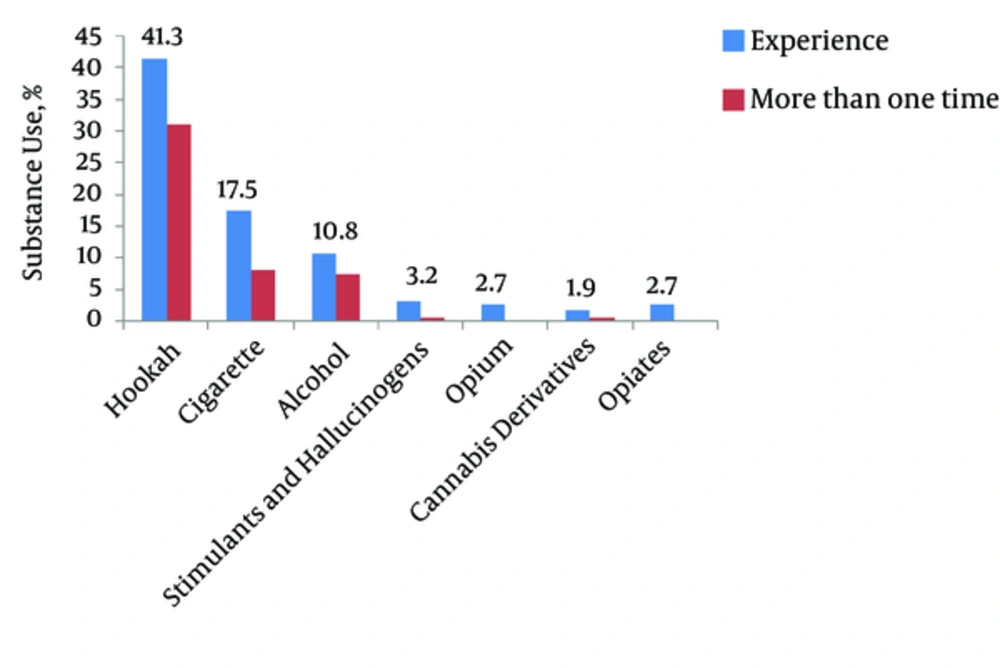
Figure 1.
The Percent of Experience (One Time) and More Than One Time Substance Use in Iranian Adolescents
Table 1.
Frequency of One Time (Experience) and More Than One Time Substance Abuse in Iranian Adolescents: 448 Males and 256 Femalesa
| Substance | Experience | More Than One Time | ||||||
|---|---|---|---|---|---|---|---|---|
| Male | Female | Total | P Value | Male | Female | Total | P Value | |
| Hookah | 219 (48.9) | 72 (28.1) | 291 (41.3) | < 0.001 | 171 (38.2) | 48 (18.8) | 219 (31.1) | < 0.001 |
| Cigarette | 98 (21.9) | 25 (9.8) | 123 (17.4) | < 0.001 | 48 (10.7) | 9 (3.5) | 57 (8.09) | < 0.001 |
| Alcohol | 65 (14.5) | 11 (4.3) | 76 (10.7) | < 0.001 | 47 (10.5) | 6 (2.3) | 53 (7.5) | < 0.001 |
| Opiates | ||||||||
| Opium | 11 (2.5) | 8 (3.1) | 19 (2.6) | 0.59 | 2 (0.4) | 0 | 2 (0.2) | 0.2 |
| Opium juice | 4 (0.9) | 3 (1.2) | 7 (0.99) | 0.7 | 3 (0.7) | 0 | 3 (0.4) | 0.1 |
| Opium residue | 2 (0.4) | 1 (0.4) | 3 (0.4) | 0.9 | 1 (0.2) | 0 | 1 (0.1) | 0.4 |
| Norgesic or Temgesic | 2 (0.4) | 0 | 0.2 | 0 | 0 | - | ||
| Heroin, Heroin Kerack | 0 | 0 | - | 0 | 0 | - | ||
| Cannabis derivatives | ||||||||
| Hashish, Bang or Marijuana | 14 (3.1) | 0 | 14 (1.98) | 0.003 | 5 (1.1) | 0 | 5 (0.7) | 0.1 |
| stimulants and hallucinogens | ||||||||
| Cocaine | 1 (0.2) | 2 (0.8) | 3 (0.4) | 0.2 | 0 | 1 (0.4) | 1 (0.1) | 0.1 |
| Ecstasy | 2 (0.4) | 1 (0.4) | 3 (0.4) | 0.9 | 0 | 0 | - | |
| Glass (Crystal) | 1 (0.2) | 0 | 1 (0.1) | 0.4 | 0 | 0 | - | |
| LSD | 0 | 3 (0.7) | 3 (0.4) | 0.1 | 1 (0.2) | 0 | 1 (0.1) | 0.4 |
| Phencyclidine (PCP) | 0 | 1 (0.2) | 1 (0.1) | 0.4 | 0 | 0 | - | |
| Pan, Pamprak, Nass (Chewable Tobacco) | 12 (2.6) | 1 (0.4) | 13 (1.8) | 0.03 | 4 (0.9) | 0 | 4 (0.5) | 0.3 |
| Glue | 2 (0.4) | 1 (0.4) | 3 (0.4) | 0.1 | 2 (0.4) | 1 (0.4) | 3 (0.4) | 0.9 |
| Lighter gas | 3 (0.7) | 0 | 3 (0.4) | 0.1 | 2 (0.4) | 0 | 2 (0.2) | 0.2 |
aValues are expressed as No. (%).
Overall, 264 (37.8%) students responded to questions about bidder of substance abuse. Among them, 102 (36.8%), 37(14%), 59 (22.3%), and 66 (25%) mentioned them to friends, first-degree family members, themselves, and others, respectively. More details about suggesting persons for every addictive drug are displayed in Table 2.
Table 2.
Bidder’s Frequency of Substances in Iranian Adolescentsa
| Bidder | ||||||||
|---|---|---|---|---|---|---|---|---|
| Substance | Female | Male | ||||||
| Friends | First-Degree Family Members | Myself | Others | Friends | First-Degree Family Members | Myself | Others | |
| Cigarette | 7 (36.8) | - | 7 (36.8) | 5 (26.3) | 43 (53.1) | 2 (2.5) | 25 (30.9) | 11 (13.6) |
| Hookah | 4(8) | 9 (18) | 20 (40) | - | 95 (53.1) | 10 (5.6) | 42 (23.5) | 32 (17.9) |
| Alcohol | - | 3 (60) | 1 (20) | 1(20) | 30 (57.7) | 2 (3.8) | 14 (26.9) | 6 (11.5) |
| Opium and opiates | 2 (33.3) | 1 (16.6) | 3 (50) | - | 4 (44.4) | - | - | 5 (55.5) |
| Hashish, Bang or Marijuana | - | - | - | - | 7 (87.5) | - | 1 (12.5) | - |
| Cocaine, Ecstasy, Glass | - | 1 (100) | - | - | 4 (66.6) | - | 2 (33.3) | - |
| Pan, Pamprak, Nass (ChewableTobacco) | 1 (100) | - | - | - | 6 (75) | 1 (12.5) | 1 (12.5) | - |
| Glue | - | - | 1 (100) | - | - | - | 1 (100) | - |
| Lighter gas | - | - | - | - | - | - | 1 (100) | - |
aValues are expressed as No. (%).
The mean age of the first experience of cigarette was 14.6 ± 3.1 years (5 - 18), hookah 14.7 ± 3 years (5 - 18), and alcohol 15.7 ± 2.8 years (7 - 21). Among all substances, the minimum and maximum substance experience onset age was 7.5 ± 0.7 for glue and 17 ± 0.9 for marijuana, respectively.
Among all adolescents, regardless of use, 407 (57.8%) had a desire to consume at least one type of substances. High or very high tendency for cigarette, hookah, and alcohol were reported in 50 (7.1%), 151 (21.4%), and 69 (9.8%) of all 704 students.
Based on the results of simple logistic regression, significantly related risk variables for regular smoking , ever use of alcohol, and ever use of illicit drugs were entered into the multivariate analysis in 3 models. Based on the results, male gender, mathematics course studying, lower past year GPA (Grade Point Average), hookah and alcohol experience for regular smoking in Model 1; male gender, cigarette and alcohol experience for ever use of alcohol in Model 2, and male, mathematics course studying, poor educational situation, last born, high level of father education, and tranquilizer experience for ever use of illicit drugs in Model 3 were considered as predicting factors (Table 3).
Table 3.
Logistic Regression Analysis of the Relationship Between Regular Smoking , Ever Use of Alcohol, and Ever Use of Illicit Drugs and Risk Variables Based on Forward Conditional Procedures
| Model. 1a | Model. 2b | Model. 3c | |||||
|---|---|---|---|---|---|---|---|
| Risk Variables | Regular Smoking | Ever Use of Alcohol | Ever Use of Illicit Drugs | ||||
| OR (CI95%) | P Value | OR (CI95%) | P Value | OR (CI95%) | P Value | ||
| Sex | Male | 3.02 (1.4 - 6.3) | 0.004 | 2.7 (1.3 - 5.4) | 0.008 | 2.5 (1.77 - 3.59) | < 0.001 |
| Female | Referent | - | Referent | - | Referent | - | |
| Field of study | Mathematics | 1.8 (1.1 - 2.8) | 0.01 | - | - | 1.6 (1.11 - 2.21) | 0.01 |
| Other | Referent | - | - | - | Referent | - | |
| Educational situation | Poor | - | - | - | - | 1.7 (1.06 - 2.58) | 0.027 |
| Good | Referent | - | - | - | Referent | - | |
| Higher GPA of past year | 0.84 (0.75 - 0.94) | 0.002 | - | - | - | - | |
| Birth order | Last born | - | - | - | - | 1.6 (1.1 - 2.2) | 0.008 |
| Others | Referent | - | - | - | Referent | ||
| Father education | High level | - | - | - | - | 3.9 (1.72 - 8.83) | 0.001 |
| Others | Referent | - | - | - | referent | - | |
| Tranquilizer experience | Yes | - | - | - | - | 5.8 (2.7 - 12.2) | < 0.001 |
| No | Referent | - | - | - | Referent | - | |
| Cigarette experience | Yes | - | - | 3.2 (1.8 - 5.6) | < 0.001 | - | - |
| No | Referent | - | Referent | - | - | - | |
| Hookah experience | Yes | 14.4 (7.5 - 27.2) | < 0.001 | 7.6 (3.4 - 16.9) | < 0.001 | - | - |
| No | Referent | Referent | - | - | |||
| Alcohol experience | Yes | 3.4 (1.9 - 6.02) | < 0.001 | - | - | - | - |
| No | Referent | - | - | - | - | - | |
Abbreviation: GPA: grade point average.
aModel. 1: Hosmer and Lemeshow Test: (Chi-square (8) = 4.04, P Value = 0.8. A total of 84.8% of participants were correctly classified.).
bModel. 2: Hosmer and Lemeshow Test showed an acceptable of model fit (Chi-square (5) = 1.6, P Value = 0.8. A total of 89.2% of participants were correctly classified).
cModel .3: Hosmer and Lemeshow Test showed an acceptable of model fit (Chi-square (7) = 2.9, P Value = 0.8. A total of 65.3% of participants were correctly classified.).
5. Discussion
The main goal of this study was to estimate the prevalence of drug abuse among the pre university students of Yazd in the academic year of 2012 - 2013. The results of this study revealed that the second and third most commonly used substances were cigarette and alcohol, after hookah as the most frequent substance among adolescents.
Our findings also indicated that the one time and more than one time experience frequency was 4.4% and 0.8% for opiates(eg, opium, opium juice, and residue),1.9% and 0.7% for cannabis derivatives (eg, hashish, marijuana), and 4% and 1.5% for stimulants and hallucinogens (eg, ecstasy, glass, LSD). The present study, similar to others in different parts of Iran, reported the amicability of hookah smoking among teenagers (15-17), moreover, cigarette smoking and alcohol use were mentioned as the top of the list of the most frequent substance abuse in many other studies in Iran and other parts of the world (14, 16). Results of the adolescent’s survey in 10 provinces of Iran showed that 14.7%, 9.8%, 1.4%, and 2.5% of the adolescents had experienced cigarettes, alcohol, opiates, and other substances once in their lifetime, respectively (18). Other studies have revealed that the experience of alcohol use in Iranian adolescents is as frequent as 12.6% to 32% (10, 19, 20). A study in Hong Kong reported that 30% of adolescents used illicit substances frequently (21). A study on American students showed that 38.7% had experienced alcohol and 23.1% marijuana 30 days before the survey (22).
It seems that our findings about the frequency of alcohol experience have been replaced at the lower parts of the mentioned spectrum. Moreover, the prevalence of substance abuse was not very high in our study compared to other studies in different parts of the world (23, 24). However, the frequency of opiates experience was higher than mentioned studies. The heterogeneity in the prevalence and pattern of substance use among adolescents of different countries or different regions of our country reflects the difference in age of target population and other sample characteristics such as gender, traditional and cultural backgrounds, religious and legal restrictions, social and family values, and socioeconomic status.
The present study also demonstrated the important role of friends and first- degree family members in offering various type of substance use to the adolescents. Similarly, most studies have indicated the effect of friends on smoking (9, 25-27). On the other hand, the results of some studies indicated that drug abuser or smoker parents could expose their children to a higher risk of substance use by teaching this behavior indirectly and transferring their incorrect attitude to adolescents at home (28, 29).
In the present study, the onset mean age of substance use was low (before 15 for cigarette and hookah). Other studies revealed that the onset age of substance abuse has been decreased in the recent years. In the United States, the onset age of cannabis use reduced from 18 in 1960 to younger than 15 in 1990 (30); the downward slope in age onset trend has been a concern in Iran as well as other parts of the world (9, 31). In our results, the age onset of opium use was lower than other provinces in Iran (2, 15), and the reason could be the more accessibility of opium and a different attitude to its use in this Eastern province of Iran.
The multivariable logistic regression models showed that being a male increased the odds of regular smoking, ever use of alcohol, and illicit drug abuse by more than 3 and 2.5 times, respectively. The relationship between sex and substance, involving more males than females, points out that this is almost admissible for males in Iranian culture. In other parts of the world, gender difference becomes more impressive in adults than in adolescents, with males being only 1.3 times more likely to have a substance use disorder than females (32). While substance abuse in general is more common among males than females (33), females have greater rates of abuse of some specific substances. For example, data from the most recent NSDUH indicated that females had greater rates of dependence on cocaine and psychotherapeutic drugs (33).
Based on the results, similar to other studies, the experience of other substances was considered as an important predicting factor for regular smoking, alcohol, and illicit drugs use (12, 34). Perhaps, the mentioned synchrony is due to the common underlying risk factors.
Another notable point was that this was similar to other studies (35, 36). Substance abuse in students was as an obstacle to successful academic performance.
We found that academic level educated fathers had adolescents with experience of illicit drug near 4 times more than the others. In contrast, some studies have suggested that higher level of parents’ education was a protective factor for their adolescents’ substance abuse (2, 37). Perhaps our finding was due to less observation from busy parents and adolescents having more accessibility to drugs in those families.
This study presents data on the prevalence of common substance use among adolescents in Iran (Yazd). The results of this study showed that the second and third most commonly used substances were cigarette and alcohol, after hookah. Based on the results, gender, poor academic performance, and the experience of cigarette or alcohol use were considered as predicting factors for substance abuse. These findings point to the need for prevention and control programs for substance use in adolescents.
5.1. Suggestion for Future Studies
Considering the importance of drug abuse in adolescents, it is recommended to determine its trend among this group in the future.
Due to the limitation of the present study, research in other educational levels and other provinces of the country is also necessary for more generalization.
Performing a project in the field of addiction and dependency in adolescents is required.
Finally, it seems that conducting more research about other risk factors of substance abuse such as psychological ones in adolescents is necessary.