
1. Background
Today, substance abuse or drug addiction is considered a social disease that affects all aspects of people's lives. Geographically, Iran's position in the region is such that it is located at the center of drug producers and consumers. It is estimated that approximately 50% of the drug production is transported from the borders of Iran. In addition to several personal and social damages, drug abuse has serious economic consequences for the family and the country. In this regard, the United Nations Office on Drugs and Crime (UNODC) has estimated the global cost of drug use to be 0.3 - 4.0% of gross domestic product (GDP) (1). A significant percentage of the Iranian population includes young people. According to studies, for many adolescents in Iran, the age of drug use onset is under age 18. Substance abuse can be associated with some complications. For instance, alcohol increases the risk of a situation escalating into physical violence by nearly two-fold (2). Moreover, substance abuse increases the risk of suicide, homicide (3), cardiovascular diseases (4), and cancer in adolescents (3-6).
Lower academic achievement is also associated with substance abuse (7). According to researchers, the explanation for substance use and addiction among individuals is based on several biological models, which are not separate, but interdependent (8).
The reward system refers to a group of brain structures that are activated against stimulants or pleasurable stimuli such as drugs and addictive drugs. When people are exposed to pleasurable stimuli, the brain begins to increase dopamine release, and the activity of dopamine-related brain areas increases. The mesolimbic dopamine pathway is the most important brain region associated with pleasure and reward. This pathway connects the abdominal tegmentum to the nuclei of the accumbens. The brain reward system is responsible for stimulation, participatory learning, and positive emotion, especially for states that recognize pleasure as a key component (9, 10). Various social factors such as rapid changes, modernity, changes in lifestyle patterns, and changes in the etiological value of addiction, social factors, and beliefs can be effective in the formation of dependence on addictive substances (11). Reducing social ties, generation gaps, reducing family relationships and job problems, and similar issues can all lead to drug addiction. Addiction affects social life, groups, families and causes social harm, it also affects them and thus creates a terrible cycle in society (12). Increasing social harms themselves provide a more conducive environment for substance abuse and consumption, and have a profound effect on the prevalence and spread of drugs. Thus, the use of addictive substances, on the one hand, is a product of social conditions and, on the other hand, is a factor for the formation of other social harms. In addition to the family, peer group as a social factor has a great impact on the formation of substance use behaviors. Substance use usually begins with a peer group. Drug users try to force their friends to accompany them to confirm their behaviors (13-15).
Substance abuse is rising in developing countries that have less equipment to deal with the issue (1, 16). Studies in Iran also show an increase in drug abuse. In a study by Nakhaee et al. in Kerman city (Iran), most of the students had information about opium (70.7% of boys and 79.8% of girls), and then alcohol (55.9% of boys and 53.9% of girls). Most offered substance to the students was alcohol (25% in boys and 12.4% in girls) (17). Also, Ramezani et al. in Kerman city (Iran) showed that 52.8% of students experienced cigarette smoking and 12.1% were permanent smokers, and 54.4% initiated cigarette smoking at under 20 age (18).
Moreover, according to Mohammad Khani’s study, 29.8% of males and 7.5% of females had at-least-once experience of substance use during their lifetime. In the aforementioned study, alcoholic beverages (9.8%) were the most commonly abused substance (19). Other studies in this area reported at least one experience of substance use. In Zahedan city (Iran), the use of water pipe smoking (hookah), chewing tobacco (Nas), tramadol, drugs, and alcohol were 21.5, 6.1, 4.7, 4.2, and 7.2%, respectively (20). In Yazd (Iran), 18.1% of the students had at least one history of drug use (21). In Shahrod city (Iran), the prevalence of cigarette smoking, alcohol drinking, and substance abuse among students was 20, 33, and 7%, respectively (22).
The highest risk of drug abuse is observed in the period of adolescence due to its specific characteristics and experience of different situations during this time. The age range of 10 - 20 years has an important role in creating high-risk and threatening health behaviors, and the foundation of these modifications are based on biological, cognitive, social, and emotional factors. On the other hand, adolescents spend more time outdoors in this age range, which increases the possibility of drug abuse in these individuals (1). Also, according to a study, factors such as being in high-risk situations, taking tramadol, having a smoker friend, and peer pressure are directly related to smoking in students (23). Therefore, evaluation of this age group is of paramount importance (1). Moreover, substance use can affect the academic achievement of students. As such, it seems crucial to identify the problems caused by drug use, understand its related factors, recognize its symptoms, and use educational interventions to identify and prevent drug dependence (7). Several epidemiological studies on drug abuse in adolescents show the prevalence and patterns of drug use in these individuals (15, 24-28). On the other hand, due to the increasing trend of substance abuse among adolescents, there is an increasing need for epidemiological studies to identify changes in this regard. Recently, the World Health Organization (WHO) has developed the alcohol, smoking, and substance involvement screening test (ASSIST), which is designed for application at primary care level, where the use of harmful substances may not be detected and the opportunity to intervene may be lost (14, 29-31).
2. Objectives
With this background in mind, this study was conducted for the first time to assess the prevalence of drug abuse among adolescents in Kerman, Iran, using ASSIST.
3. Methods
This descriptive and cross-sectional study was approved by the Ethics Committee of Kerman University of Medical Sciences (code: IR.KMU.REC.1397.305) and was conducted from October 2017 to May 2018. Statistical population included all adolescents of Kerman. In addition, sample size was estimated at 2,000 subjects who were selected by random cluster sampling. First, 30 schools (15 male and 15 female schools) were selected from the education districts, followed by selecting 70 students from each school randomly. Subjects were ensured of the confidentiality terms regarding their personal information since the checklists and questionnaires were completed anonymously. The questionnaires completed were collected on the next day. Inclusion criteria were being a 10th - 12th-grade student and being present in the school at the time of questionnaire distribution.
Data collection tools were a demographic characteristics questionnaire and ASSIST. The ASSIST was developed under the auspices of WHO by an international group of addiction researchers and clinicians in response to the overwhelming public health burden associated with psychoactive substance use worldwide. It was designed to be used in primary healthcare settings where hazardous and harmful substance use among clients might go undetected, or became worse. This questionnaire does not have a total score. Therefore, the average cannot be calculated (32). Generally, this questionnaire is employed to identify high-risk substance abusers so that short-term interventions can be carried out for these individuals. This questionnaire collects information about long-term substance abuse and its problems over the past three months. The importance of this study is that the mentioned questionnaire can be exploited to identify high-risk substance abusers who still have no drug dependence at the primary care level. There is a higher possibility of responding to interventions in these individuals. Compared to other questionnaires, some of the advantages of this questionnaire include its short form, applicability in all cultures, and the ability to recognize high-risk drug use in non-dependent users (33).
This questionnaire is culturally neutral and can be used for a variety of cultures. In addition, it has eight items, and each response has a numerical score, validity, and reliability of which have been previously assessed. In case of drug abuse and a positive response to the first item, the numerical scores of other questions are summed up to obtain the ASSIST risk score for each item separately. According to this questionnaire, individuals with a score of < 3 (10 for alcohol), in terms of abusing a specific drug, are at a low risk of problems related to drug abuse, while those obtaining a score in the range of 4 - 26 (11 - 26 for alcohol) are at a moderate risk of issues associated with drug abuse, and may be experiencing some of these problems. In addition, a score of ≥ 27 for any type of drug is indicative of a high risk of substance dependence (2, 32, 33). In the end, data were analyzed with SPSS version 21 using chi-square test.
4. Results
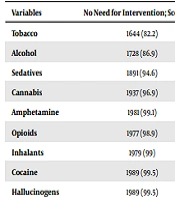
Of 2,000 students, 1,000 (50%) were male. In addition, the mean age of the participants was 16.0 ± 43.89 (15 - 18 years). In total, 667 subjects (33.4%) were 10th-grade students, whereas 667 and 666 participants were 11th-grade (33.3%) and 12th-grade (33.3%) students, respectively. Moreover, 182 subjects (9.1%) had a family history of drug abuse (Table 1). Of 2,000 students who participated in this research, 95% completed the ASSIST. The frequency and type of intervention required are shown in Table 2. The highest prevalence of substance abuse among students was tobacco, alcohol, and sedatives, respectively. According to the results, 1.5% of the students (N = 29) received an ASSIST score above 26, which demonstrated a need for serious smoking intervention. Moreover, 0.8% of alcohol users (N = 15), 0.4% of sedative users (N = 7) and 0.3% of opiate users (N = 6) required extreme intervention.
Table 1.
Demographic Characteristics of the Participants
| Demographics Characteristics | No. (%) |
|---|---|
| Gender | |
| Male | 1000 (50) |
| Female | 1000 (50) |
| School grade | |
| 10th | 667 (33.35) |
| 11th | 666 (33.33) |
| 12th | 666 (33.33) |
| Family history of substance abuse | |
| Yes | 182 (9.1) |
| No | 1818 (90.9) |
Table 2.
| Variables | No Need for Intervention; Score: 0 - 3 | Low Need for Intervention ; Score: 4 - 26 | High Need for Intervention ; Score > 26 |
|---|---|---|---|
| Tobacco | 1644 (82.2) | 327 (16.4) | 29 (1.5) |
| Alcohol | 1728 (86.9) | 257 (12.9) | 15 (0.8) |
| Sedatives | 1891 (94.6) | 102 (5.1) | 7 (0.4) |
| Cannabis | 1937 (96.9) | 63 (3.2) | _ |
| Amphetamine | 1981 (99.1) | 19 (1) | _ |
| Opioids | 1977 (98.9) | 17 (0.9) | 6 (0.3) |
| Inhalants | 1979 (99) | 16 (0.8) | 5 (0.3) |
| Cocaine | 1989 (99.5) | 11 (0.6) | _ |
| Hallucinogens | 1989 (99.5) | 11 (0.6) | _ |
a Fisher's exact test.
b Variables are expressed as No. (%).
Furthermore, drug abuse was evaluated in terms of the gender of students. As shown in Table 3, smoking and use of sedatives were significantly higher in male students compared to female subjects (P < 0.001). Moreover, the use of sedatives was significantly higher in male participants compared to female subjects (P < 0.001). Nonetheless, no significant difference was observed between the male and female subjects in terms of opioid abuse (P = 0.2).
Table 3.
Frequency Distribution of Drug Abuse Considering the Need for Drug Abuse Interventions in Each Recommendation of WHO Based on Gender a
| Type of Intervention | Male, No. (%) | Female, No. (%) | P-Value |
|---|---|---|---|
| Tobacco | 0.001 ≥ | ||
| MI | 210 (21) | 117 (11.7) | |
| II | 26 (2.6) | 3 (0.3) | |
| Sedatives | 0.07 | ||
| MI | 57 (57) | 45 (4.5) | |
| II | 6 (0.6) | 1 (0.1) | |
| Alcohol | 0.001 ≥ | ||
| MI | 182 (18.2) | 75 (7.5) | |
| II | 13 (1.3) | 2 (0.2) | |
| Cannabis | 0.01 a | ||
| MI | 42 (4.2) | 21 (2.1) | |
| II | - | - | |
| Amphetamine | 0.02 a | ||
| MI | 15 (1.5) | 4 (0.4) | |
| II | - | - | |
| Opioids | 0.2 | ||
| MI | 1 (1) | 7 (0.7) | |
| II | 5 (0.5) | 1 (0.1) | |
| Inhalants | 0.9 | ||
| MI | 8 (0.8) | 8 (0.8) | |
| II | 3 (0.3) | 2 (0.2) | |
| Hallucinogens | 0.1 a | ||
| MI | 8 (0.8) | 3 (0.3) | |
| II | - | - | |
| Cocaine | 0.1 a | ||
| MI | 8 (0.8%) | 3 (0.3) | |
| II | - | - |
Abbreviations: MI, minor intervention; II, intensive intervention.
a Fisher's exact test.
5. Discussion
According to the results of the current research, abuse of tobacco, sedatives, cannabis, and amphetamine was significantly higher in male subjects compared to female students, which is in line with the results of previous studies (19, 34, 35). In addition, other studies have reported that the abuse rate was significantly higher in male subjects compared to female participants, which may be due to lack of acceptance of this issue by girls (19, 35). However, the tendency of girls to use different types of drugs has increased significantly in recent years (19).
In 2017, Pirdehghan et al. reported that the highest frequency of one time and more than one-time drug usage among students pertained to hookah 41.1 and 31.1%, cigarette 17.5 and 8.1%, alcohol 10.8 and 7.5%, opiates 4.1 and 0.8%, hashish, bang, or marijuana 1.9 and 0.7%, stimulants and hallucinogens 3.4 and 0.8%, and glue and lighter gas 0.8 and 0.7%, respectively (27). Comparison of our findings with the results of previous studies indicated an increase in alcohol consumption of male individuals and a decrease in use of sedatives by these people. On the other hand, although alcohol consumption and use of sedatives had no specific pattern in female subjects, there was a slight increase in the abuse of these substances by female individuals. In the majority of studies, the consumption of all three types of substances in was higher male subjects compared to female participants.
According to the results of the present study, the highest prevalence of substance abuse among students was related to tobacco, alcohol, and sedatives, respectively. In a research in Kerman city, the experience of smoking cigarettes was seen in 34.6% of the students, 51.5% used hookah, 37.7% drank alcohol, 40.7% used nonprescribed tranquilizers, 10.2% used high-dosage painkillers, 6.6% used ecstasy, 6.7% hashish, 4.9% heroin, 8.7% opium and 9.7% used pam or chewable tobacco (26). Mohammadkhani realized that most commonly used substance among students in 10 provinces were cigarettes, alcoholic beverages, and opium (19). On the other hand, Bidel et al. reported that the most common substance used by high school students was alcohol (23).
A review study showed that the highest drug use prevalence pertained to cigarette and hookah, followed by alcohol, opium, ecstasy, hashish, and heroin. Opium and heroin use in Kerman city (Iran) were about 4 and 5 times their use in other studied cities, respectively (24). In a meta-analysis by Ansari Moghaddam, the most commonly used substances among Iranian adolescents were hallucinogens, sedatives, hookah, opiates, and nervous system stimulants (1). According to a study by Narimani et al. in Semnan city (Iran), the prevalence of drug use among high school students was 7.8% (36). Typically, adolescents are not special consumers and just test the substance. Therefore, prevention of abuse should be initiated at the beginning of adolescence (36).
In general, since cigarettes and alcoholic beverages are light substances and drug abuse starts with light substances, it is obvious that these materials are among the most commonly used substances among Iranian students (19). One of the major drawbacks of this study was its conducting in Kerman, which limited the generalizability of results. In addition, the results cannot be generalized to people who have dropped out of school.
5.1. Conclusion
According to the results of the study, there was higher drug abuse prevalence in male students, compared to female students. As such, it seems that consumption of alcohol, tobacco, and narcotics in adolescents requires serious intervention. It is suggested that a similar study should be conducted with a questionnaire in other cities of Kerman province to determine the status of drug use among students. This view will assist officials in planning to reduce drug and stimulant use.