
1. Background
It is estimated that about 15.9 million people inject drugs worldwide (1) and three out of four of them live in the developing and transitional countries (2). An international report indicates that the number of people who inject drugs (PWID) is approximately 180,000 in Iran (1). A rapid situation assessment (RSA) study conducted by drug control headquarter (DCHQ) showed that 18.1% out of 1.2 million drug users reported injection as their main route of drug administration; 26.5% of them had at least one injection during last year and 6.7% of them reported using needles, syringes and injecting equipment used by other drug users (3). People who inject drugs are the most HIV-infected population in Iran and contribute to approximately 67% of all identified cases of HIV infection in the country (4). Different studies on PWID in different settings in Iran show that HIV prevalence in this population reached a noticeable level among this population (5-10). A systematic review showed that the pooled HIV prevalence of studies after 2005 was 18.4%, which was significantly higher than the prevalence before the date (7).
In a study on knowledge, attitudes and behaviours concerning HIV among three high-risk groups (201 truck drivers, 50 female sex workers and 754 youths) in four cities in Iran, researchers found that knowledge on HIV was low especially among individuals with high-risk behaviours. Truck drivers and female sex workers in this study reported a higher knowledge about sexually transmitted infections compared with the youths, but their knowledge was related to their individual experience rather than education programs. Condom use was low in all groups (11).
In response to high rate of HIV infection among PWID, needle and syringe programs (NSP) was launched through DICs and outreach teams in Iran since 2002. DICs provide a range of harm reduction services including syringe and condom distribution, low-threshold methadone maintenance treatment, outreach, HIV prevention educations, HIV counselling and testing and referrals (4). Although several recent review articles showed the effectiveness of NSPs in reducing HIV risk behaviours and seroconversion (12-14), differential effectiveness of each component of needle and syringe programs was not completely examined (15).
Skill-based HIV prevention psychoeducation is the psychosocial component of NSPs which contributes to reducing or stopping high risk injection and sexual behaviours. These interventions contribute to increasing harm reduction-related knowledge and skills, empathy, avoiding confrontation with resistance, providing feedback and decreasing ambivalence (15), but there is a paucity of research on this issue in Iran. The current study aimed to preliminarily examine the effectiveness of adding-on a brief skill-based HIV prevention psychoeducation to routine NSPs at two DICs in Tehran, Iran.
2. Objectives
The current study aimed to investigate the effectiveness of adding-on a brief skill-based HIV prevention psychoeducation on HIV-related high-risk behaviours among clients of two DICs in Tehran, Iran.
3. Materials and Methods
3.1. Study Setting
The study sites were two DICs including Pardis-e-Mehr and Azadi located in South and South-West of Tehran. Pardis-e-Mehr DIC was a female-specific center providing the female participants of the study.
3.2. Participants
The study was marketed on the streets by outreach workers and at DICs by staff among newly admitted clients who reported opioids as their main drug of use.
A group of 120 consecutive clients who met diagnostic and statistical manual of mental disorders, 4th edition, text revision (DSM-IV-TR) criteria for opioid dependence within the past twelve months prior to intake were recruited. Inclusion criteria included age 18 - 65 years, lack of severe withdrawals and/or intoxication signs and severe psychiatric disorders. Clients who reported receiving treatment and harm-reduction services in the past 30 days were excluded.
3.3. Study Procedure
Clients who met eligibility criteria were randomly assigned into intervention or control groups after signing written informed consent. The intervention group received routine NSP provided at the DICs plus two brief sessions of skill-based HIV prevention psychoeducation; while the control group received only the routine NSP. Routine NSP included routine psychoeducation services that were didactic education within groups on occasional basis. The psychoeducation received by intervention group consisted of two manual-based, individual sessions delivered by trained bachelor level clinical psychologists. The psychoeducation manual included knowledge regarding harms associated with high-risk behaviors, skills to reduce drug and sex-related harms and an introduction to HIV counseling and testing (HCT). In the first session, skills to prevent high-risk drug use and sexual behaviors were taught and in the second session, the educational items taught in the first session were reviewed. Subjects were also given an opportunity to ask questions at the end of both sessions.
The content of the psychoeducation was developed by authors through extensive review of international HIV prevention psychoeducation packages developed for PWID. Content of each session was reviewed by two experts who were specialized in the field of behavioral interventions for HIV prevention (one psychiatrist and one infectious disease specialist). They were asked to give their comments on each session and the educational material was revised based on their feedback. Two clinical psychologists, each from one of the study’s DICs, were trained to deliver the package for the study participants. Each psychologist piloted implementing the intervention for five clients. Fidelity to the intervention manual in carrying out the educational intervention was rated with a 10-item checklist by the two researchers of this study. The results revealed that fidelity to the intervention manual was relatively high and the reliability among the raters was also satisfactory (Kappa = 0.55).
High risk drug injecting and sexual behaviours were assessed with a researcher-made questionnaire at baseline, and one and three months follow-ups. Assessments were conducted using interviews by research assistants who were blind to which study arm the client belonged to. Participants were advised that they would be reimbursed about 8 USD after completion of the second briefing intervention session and about 4 USD after completion of each follow-up interview in months one and three. The questions on the researcher-made questionnaire were selected by reviewing similar international studies and its face validity was approved by two HIV prevention experts. The reliability of this checklist was examined on 30 subjects within a three day test-retest and the result was satisfactory (Alpha = 0.78).
The study protocol including psychoeducational intervention, assessments and consent form was approved by the institutional review board (IRB) of mental health research centre, Tehran University of Medical Sciences (TUMS). The study was also registered in clinical trials database of ClinicalTrial.gov under the code: NCT00935103. Details of study protocol are explained somewhere else (16).
3.4. Data Analysis
Data analysis was conducted by performing a series of analyses using SPSS ver. 18.0. The results of the control and intervention groups at baseline were compared by performing independent samples T-test and the Chi-square test. Statistical significance of change in the means of within group study outcomes at each follow-up assessment was assessed with paired T-test. Between groups comparisons of group assignment regarding study outcomes were analysed by performing ANOVA.
4. Results
4.1. Baseline Characteristics
The intervention and control groups showed no significant statistical differences (P > 0.05) regarding demographics, drug abuse, injection and sexual behavior variables at baseline;
69.2% were male and 30.8% female. The mean age of the sample was 34.5 ± 7.2 years. The mean years of education was 7.18 ± 3.1 years reflecting that the sample was a relatively young group with low level of education. The majority of the clients were divorced (39.5%), single (25.2%), had no job (75.3%) and were homeless (70.8%) at the time of the study (Table 1).
Table 1.
Baseline Characteristics of the Participantsa
| Baseline Characteristics/Demographics | Total Sample (n = 120) | Control (n = 60) | Intervention (n = 60) | P Value |
|---|---|---|---|---|
| Gender | ||||
| Female | 30.8 | 33.3 | 28.3 | |
| Male | 69.2 | 66.7 | 71.7 | |
| Age, y | 34.5 (± 7.2) | 34.5 (± 7.7) | 34.4 (± 6.6) | |
| Mean years of education | 7.18 (± 3.1) | 6.9 (± 3.3) | 7.3 (± 3.02) | |
| Marital status | ||||
| Married | 16.8 | 20.0 | 13.6 | |
| Separated | 16.8 | 16.7 | 16.9 | |
| Widow | 1.7 | 3.3 | 0 | |
| Divorced | 39.5 | 35.0 | 44.0 | |
| Never married | 25.2 | 25.0 | 25.4 | |
| Employment status | ||||
| Full-time | 0.8 | 1.7 | 0 | > 0.05 |
| Part-time | 5 | 5 | 5 | |
| Housewife | 13.3 | 15 | 11.7 | |
| Unemployed | 75.3 | 76.7 | 75.0 | |
| Other | 6.7 | 3.3 | 8.3 | |
| Living conditions | ||||
| Owner | 5 | 3.3 | 6.7 | |
| Rented home | 11.6 | 13.3 | 10 | |
| Rented room | 9 | 11.7 | 8.3 | |
| Homeless | 70.8 | 70 | 71.7 | |
| Other status | 2.5 | 1.7 | 3.3 | |
| Living status | ||||
| With family | 20.5 | 23 | 18 | |
| With friends | 1.5 | 0 | 3 | |
| Alone | 75 | 75 | 75 | |
| Other | 2.5 | 2 | 3 | |
| History of incarceration (lifetime) | ||||
| Yes | 77.3 | 70 | 84.7 | |
| No | 20.2 | 26.7 | 13.6 | |
| No response | 2.5 | 3.3 | 1.7 | |
| History of incarceration (last year) | ||||
| Yes | 12.6 | 5.1 | 20 | |
| No | 84.9 | 93.6 | 74.7 | |
| No response | 2.5 | 1.7 | 3.3 |
aValues are expressed as percent (mean) or %.
4.2. History of Drug Use
Clients initiated drug use with opium and heroin and then gradually transitioned to crack heroin (a more purified form of heroin) and methamphetamine use. Age of the first drug injection was 21 ± 12.1 years and the number of drug injections in the last month before entry into study was 40.6. More details regarding history of drug use are provided in Table 2.
Average number of sex partners in the last month before study entry was 1.8 and average number of having new sex partners in the last month before study entry was 1.4, respectively. Clients also reported a range of risky sexual behaviors in the last month before entry into the study including number of partners whom participants had unprotected sex with them (1.4, P > 0.05), exchanging sex for money or drugs (0.98, P > 0.05), and having sex after using drug (0.76, P > 0.05) (Table 2).
Table 2.
Drug, Injection and Sexual Behaviors of Study Subjects at Baselinea
| Baseline Characteristics | Total Sample (n = 120) | Control (n = 60) | Intervention (n = 6 0) | P Value |
|---|---|---|---|---|
| Drug and injection behavior | > 0.05 | |||
| Age at first opium use | 17.3 (± 5.4) | 17.6 (± 6.6) | 17.1 (± 4.0) | |
| Age at first heroin use | 22.5 (± 6.6) | 23.1 (± 6.4) | 22 (± 6.8) | |
| Age at first crack heroin useb | 27.6 (± 8.1) | 27.4 (± 9.0) | 27.9 (± 7.0) | |
| Age at first MA use | 27.9 (± 9.0) | 29.7 (± 9.8) | 25.7 (± 7.7) | |
| Age at first injection | 21.0 (± 12.1) | 20.3 (± 12.2) | 21.9 (± 12.0) | |
| Number of crack heroin use days /last monthb | 28.2 (± 10.8) | 29.1 (± 13.0) | 27.2 (± 10.8) | |
| Number of MA use days/last month | 17.7 (± 16.2) | 16 (± 13.6) | 19.4 (± 16.7) | |
| Number of sedative or hypnotic prescriptions use days/last month | 18.2 (± 14.5) | 20 (± 15.5) | 16.4 (± 13.4) | |
| Proportion of participants with concurrent MA use | 17.5 | 18.3 | 16.7 | |
| Proportion of injecting to total number of daily drug use (%) | 70.6 | 71.2 | 70.0 | |
| Number of drug injection/last month | 40.6 | 37.6 | 43.6 | |
| Number of injecting drug with syringe used by another person/last month | 5.14 | 5.07 | 5.19 | |
| High risk sexual behavior | ||||
| Number of sex partners/last month | 1.8 | 2.0 | 1.7 | |
| Number of new sex partners/last month | 1.4 | 1.6 | 1.3 | |
| Number of partners with unprotected sex/last month | 1.4 | 1.5 | 1.3 | |
| Number of sex exchange for money or drugs/last month | 0.98 | 1.02 | 0.95 | |
| Number of sex after using drug/last month | 0.76 | 0.82 | 0.73 |
Abbreviation: MA, methamphetamine.
aValues are expressed as percent (mean) or %.
bCrack heroin was the most prevalent type of opioid used among drug users in Iran. Crack heroin is a semi-synthetic opioid which is more purified than heroin. Crack heroin is available in Iran’s illegal drug market since 2002 (17).
4.3. Retention
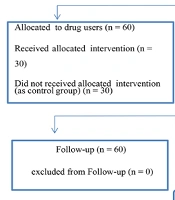
Attrition rates were 15% and 39% in the control group and 13.4% and 23.4% in the intervention group in one month and three month follow-ups, respectively. Although attrition rates were lower in the intervention group in one-month and three-month follow-ups, the observed difference was not statistically significant (P > 0.05). Figure 1 presents the study flow diagram.

Figure 1.
The Study Flow Diagram
4.4. Analysis of High Risk Behaviors
The study results indicated that after receiving the briefing intervention, the proportion of injecting drug use to total number of daily drug use (F = 4.32, P < 0.05), number of injecting drug use (F = 11.45, P < 0.05), and number of using a shared syringe during last month (F = 4.27, P < 0.05) significantly reduced in the intervention group compared to the control group.
The injecting high risk behaviors at one and three months follow-ups showed significant decrease compared to baseline assessment in the intervention group, but the only high risk injecting behavior which significantly reduced at one and three months follow-ups in the control group was the number of shared syringes used during last month.
Data analysis related to high risk sexual behaviors showed that the brief intervention was effective in reducing the number of sex partners during last month (F = 4.43, P < 0.05), the number of sex partners whom the subject had unprotected sex with during last month (F = 3.20, P < 0.05) and the number of new sex partners (F = 3.28, P < 0.05) compared with the control group.
The number of sex exchange for drug or money (F = 0.59, P > 0.05) and sexual contacts after drug use in the intervention group during last month (F = 0.77, P > 0.05) did not show significant change compared to those of the control group. Comparison of baseline values with one and three months follow-ups revealed that the number of sex exchange for drug or money did not significantly reduce in any of the groups, while sexual contacts after drug use during last month significantly reduced in both intervention and control groups (Table 3).
Table 3.
Group Means at Baseline, One and Three Months Follow-Upsa
| Variable | Control | Intervention | P Value | ||||
|---|---|---|---|---|---|---|---|
| Baseline (n = 60) | One Months (n = 51) | Three Months (n = 37) | Baseline (n = 60) | One Month (n = 52) | Three Months (n = 46) | ||
| High risk drug use behavior | |||||||
| Proportion of injecting to total number of daily drug use (%) | 71.28 (± 41.8) | 71.53 (± 36.9) | 69 (± 37.8) | 70.09 (± 40.8) | 55.32 (± 41.8) | 44.70 (± 41.7) | < 0.05 |
| Number of drug injection/last month | 37.6 (± 27.05) | 37.1 (± 23.2) | 36.6 (± 23.2) | 43.6 (± 39.3) | 30.5 (± 23.5) | 26.3 (± 24.5) | < 0.05 |
| Number of injecting drug with a syringe used by another person/last month | 5.07 (± 4.98) | 3.2 (± 2.82) | 3.11 (± 2.54) | 5.19 (± 5.73) | 1.98 (± 2.75) | 0.79 (± 1.52) | < 0.05 |
| High risk sexual behavior | |||||||
| Number of sexual partners/last month | 2.03 (± 3.53) | 2.53 (± 6.22) | 1.29 (± 1.48) | 1.73 (± 3.54) | 0.88 (± 1.13) | 0.48 (± 0.66) | < 0.05 |
| Number of new sexual partners/last month | 1.63 (± 3.24) | 1.43 (± 2.27) | 1.08 (± 1.31) | 1.32 (± 2.41) | 0.73 (± 1.07) | 0.39 (± 0.59) | < 0.05 |
| Number of partners with unprotected sex/last month | 1.55 (± 3.18) | 1.42 (± 2.11) | 1.22 (± 1.67) | 1.30 (± 3.40) | 0.7 (± 1.45) | 0.36 (± 0.55) | < 0.05 |
| Number of sex exchange for money or drugs/last month | 1.02 (± 3.00) | 0.73 (± 1.65) | 0.59 (± 1.25) | 0.95 (± 3.81) | 0.48 (± 1.09) | 0.23 (±0.53) | > 0.05 |
| Number of sex after using drug/last month | 0.82 (± 1.95) | 0.41 (± 1.20) | 0.35 (± 0.77) | 0.73 (± 2.22) | 0.36 (± 1.04) | 0.06 (0.41) | > 0.05 |
aValues are expressed as percent (mean) or %.
5. Discussion
The current study investigated effectiveness of implementing a brief skill-based HIV prevention psychoeducation added on NSPs among a group of male and female drug users at two DICs in Tehran, Iran. The study findings indicated that a brief skill-based, HIV prevention psychoeducation delivered through two individual sessions could be effective in reducing high risk sex and injecting behaviors among the people, who use opioids, referring to harm reduction facilities in Tehran.
The lower trend of attrition rate observed in the intervention group in one month and three months follow-ups suggested that the brief skill-based HIV prevention psychoeducation adding-on to routine NSPs might contribute to increasing the compliance and potentially enhanced the effectiveness of routine harm reduction services implemented for the clients; however, observed differences were not statistically significant.
Although, only a part of the brief skill-based HIV prevention psychoeducation provided in the study focused on encouraging injecting drug users to change their routes of drug administration to safer ones, the study findings revealed that the intervention applied in this study can be considered as a reverse route transition intervention (18).
The study findings also showed that the brief skill-based HIV prevention psychoeducation can reduce using needles and syringes previously used by another person significantly compared that of routine NSP. Although comparing the number of using injecting equipment used by another person before and after the intervention, revealed that this variable also reduced in the control group. This finding was consistent with that of other studies in Iran that reported lack of access to sterile syringes was the most important reason to use shared syringes (3). This finding was also consistent with the findings of many other studies which indicated that NSPs can reduce high-risk injecting behaviors, such as sharing syringe and needle among PWID (13, 14).
The comparison of findings in one- and three-month follow-ups between the intervention and the control group also showed that adding-on a brief counseling intervention enhanced the effectiveness of NSPs to reduce sharing syringes. It was consistent with the results of a meta-analysis conducted by Copenhaver et al. (19). They showed that educational interventions significantly reduced high-risk injecting behaviors particularly when they were skill-based, and focused on high-risk injecting and sexual behaviors (19). In the current study, both of these factors were applied to design the brief psychoeducational intervention. Although a recent meta-analysis did not show any differences between multisession psychosocial interventions (generally more than three sessions), standard educations and minimal intervention in reducing injecting high risk behaviors (20). These study findings may be partly explained by this issue that such studies were conducted in the developed countries, where the harm reduction messages spread through wide range of media and their findings might not be generalizable to harm reduction programs in Iran or other developing countries. The participants in those studies might receive basic information on HIV prevention through other sources, and multi-session counseling programs could not make a difference in their HIV-related high-risk behaviors.
The study findings were also consistent with the results of two meta-analyses which showed that psychoeducation was effective in reducing high-risk sexual behaviors in HIV cases (19, 20). The intervention was significantly more effective than routine services to reduce some of the high-risk sexual behavior outcomes, except the number of sex for exchanging money or drugs during last month and number of sex after using drug during last month. However, comparison of these variables at baseline assessment with one- and three-month follow-ups showed a significant decrease in both intervention and control groups.
The study findings suggested that participation in routine NSPs reduced some high-risk sexual behaviors in both groups, but more extensive educational interventions were needed to observe a significant difference after implementing psychoeducational interventions. Des Jarlais et al. showed that people who used drugs usually shared knowledge on drug dealing places, helped each other in providing drug, and used drug together. As a result, they shared new information about HIV together and these group discussions may lead to reduction in risk among the subjects in the intervention and control groups, similarly (21). It may be partly related to receiving knowledge and skills on HIV prevention from other information resources such as mass-media.
The current study findings indicated that adding-on a brief skill-based HIV prevention psychoeducation to routine NSPs can reduce HIV-related high-risk behaviors. Further studies to explore the effectiveness of this reduction on incidence of blood borne viral infections and sexually transmitted diseases among PWID are suggested.
5.1. Limitations
The study sample was limited to two DICs in Tehran. Extensive studies with more representative samples and multiple study sites are suggested. The outcomes evaluated in this study were behavioural. Further studies to explore the link observed behavioural changes with HIV incidence are suggested.