1. Background
Substance abuse and risky sexual behaviors are the most important risky behaviors that put individuals and the society at risk of serious infectious diseases such as AIDS (acquired immunodeficiency syndrome) and viral hepatitis (1, 2). It is clear that lack of information or misinformation about sexuality can lead to increased risky behaviors and sexually transmitted diseases (1, 2). Lack of information or misinformation about sexual issues lead to increased sexual risky behaviors and sexually transmitted diseases (3).
Alcohol and drug use are the most common associated behaviors with sexual risky behaviors. Numerous studies have demonstrated a positive association between substance use and risky sexual behaviors (4, 5). In this regard, the result of a study on 1765 arrested injection drug users in King county demonstrated, 13% of sexually active individuals in the past six months had always used condoms, 22% sometimes and 65% never (6). In a recent study on substance users covered by Substance Abuse Treatment Centers (SATC) in Hamadan, 55.2% reported that they have had multiple sexual partners, 55.33% of those, who have had multiple sexual partners had not used condoms in their last sexual intercourse (7). Another study on injecting drug users in Shiraz showed, 88.2% of those who had main and multiple sexual partners had not used a condom during their last sexual intercourse (8).
Sexual risk taking can lead to a number of negative consequences, including damage to romantic relationships, family conflicts, financial concerns, damage to social reputations, legal disputes, and health problems such as Sexually Transmitted Infections (STIs). Sexual risky behaviors and injection drug use are the main factors contributing to the increase in HIV infections in Iran. These data underscore the importance of understanding and addressing sexual behaviors in substance users (9-11). Therefore, to reduce negative consequences of sexual risk taking, risky sexual behaviors should be reduced, to achieve what has been defined as safe sex. Therefore safe sex consists of abstinence from sex if necessary, monogamous relationship, reducing (correct and continuous) sexual partners and condom use (12).
In this regard, the theory of planned behavior (13, 14) has been shown to be effective in predicting sexual risk behavior as well as a range of other behaviors (15, 16).
As an extension of the theory of reasoned action (17), TPB (the theory of planned behavior) was proposed by Ajzen in 1991 and has been used by researchers over the past twenty years and shown to be able to predict a variety of intentions and behaviors. According to Ajzen (14), a person’s action is determined by behavioral intentions, which in turn are influenced by an attitude towards the behavior and Subjective Norms (SN). In addition to attitude towards behavior and the subjective norm in the theory of planned behavior, perceived behavioral control can influence intention as well. Perceived behavioral control influences the individual’s decision through behavioral intention.
In the TPB, behavioral intention is the most influential predictor of behavior. Behavioral intentions are factors that describe how hard people are willing to try to perform a behavior (14). In view of the foregoing discussion, this study aimed to determine the effectiveness of an educational program based on the theory of planned behavior for improving SSBI (Safe Sexual Behaviors Intention) among male substance users in Hamadan.
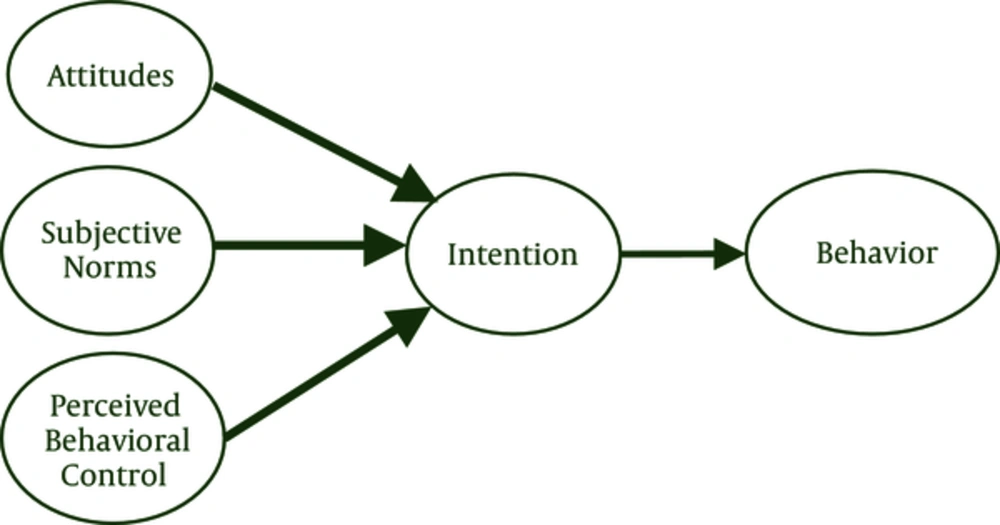
Figure 1.
Theory of Planned Behavior 14
2. Patients and Methods
2.1. Participants and Data Collection
This quasi-experimental study was conducted among young male substance users in Hamadan city during 2013 - 2014. Two substance abuse treatment centers were randomly selected within all male SATC in Hamadan city of Iran. Of the 400 substance users covered by two SATC, 104 (26%) males participated in this study. However, eight participants in the intervention and six patients in the control group were omitted from the study because of their irregular attendance of classes. Finally forty-four participants as intervention and 46 as control groups were remained at the baseline survey, all of which were followed up after the two month intervention. This study was conducted with approval from the Hamadan University of Medical Sciences 'institutional review board.
Data collecting tool was a questionnaire. Prior to administering the surveys, informed consent forms were obtained from the participants. Prior to conducting the main project, a pilot study was carried out. Initially relevant questionnaires were administered to 30 substance users, who were similar to participants in the main study, to obtain feedback about the clarity, length comprehensiveness, time of completion and internal reliability of the measures. Moreover, participants were instructed about how to fill questionnaires before gathering information. On average, each participant took less than 20 minutes to complete the questionnaire.
The questionnaire was formed in two parts: the first part of the questionnaire was demographic information and the second part included theory of planned behavior construct variables that was modified from scales of sexual risk behaviors 15. In this survey, participants provided their demographic information and responded to 30 items that were part of four major constructs, 1) attitude towards SSB; 2) subjective norms toward SSB; 3) perceived behavioral control; 4) behavior intention. Ten items were designed to measure attitude towards SSB (e.g., “the use of condoms can protect me from sexually transmitted diseases”). Ten items were designed to measure subjective norms toward SSB (e.g., “If I use condom my sexual partner will confirm”). Eight items were designed to determine behavioral control, regarding not having USSB (e.g., “If my casual partners have insisted on sexual intercourse without condoms, I believe that I can refuse”). Two items were designed to evaluate behavior intention to SSB (safe sexual behaviors) (e.g., “I intend to use a condom to prevent sexually transmitted diseases, when I have sexual intercourse with casual partners in the next six months”). In order to facilitate respondents’ responses to the items, all items were standardized to a five-point Likert scale, ranging from one (strongly disagree) to five (strongly agree). Construct reliability was measured using Cronbach’s alpha, with a value of 0.70 or higher (18). Estimated reliability coefficients for each TPB construct were as follows: attitude (α = 0.77); subjective norms (α = 0.721); perceived behavior control (α = 0.74); and behavioral intention (α = 0.78). These results demonstrated that questionnaires were internally consistent.
2.2. Intervention and Analysis
The educational program based on the theory of planned behavior using life skills with strategies to change the variables (attitudes, social norms, and perceived behavioral control) was conducted (19). For example, to change attitudes giving information about negative consequence, unhealthy effects and complications and using persuasive messages, to improve SN, we used education about life skills and social influence strategies such as educating refusal skills against risky sexual behavior. To improve perceived behavioral control, life skills education (diagnosis skills of high-risk situations and problem solving skills) was conducted. For achieving an effective preventative program, four 45 minute-sessions were tailored using group discussions and audio-visual CDs. Prior to the intervention four participants, who were commitment to mediate safe sexual behaviors intention program’s message to substances abusers in the intervention group, were selected as the mediator; consequently, four subgroups were formed as intervention groups that were coordinated by one responsible mediator. One-month after the last training session, as a reminder, educational booklets were given to participants in the intervention group. Effect of educational intervention on behavioral intention was assessed two months after the last training session.
2.3. Statistical Analysis
Data were analyzed by SPSS-16 software using appropriate statistical tests including paired t-test, independent t-tests, McNemar and multivariate logistic regression analysis.
3. Results
Table 1 illustrates the demographic characteristics of the participants. As indicated in Table 1, independent t-test showed there were no statistically significant differences in terms of age between the intervention and control groups (P value = 0.782). Also, the result of the Man Whitney test demonstrated no significant differences (P value = 0.101) between the intervention and control groups in terms of educational level. Also, according to the Fisher test there were no significant differences regarding marital status of participants in both intervention and control groups (P value = 0.101). Overall, 57.68% of the participants in the intervention group and 55.76% of the participants in the control group had a history of alcohol consumption and the chi-square test showed no significant difference between the intervention and control groups (P value = 0.96).
Table 1.
Demographic Variables of the Participants in Both Intervention (N = 52) and Control Groups (N = 52)
| Variables | Control Group, No. (%) | Intervention Group, No. (%) | Significance Level |
|---|---|---|---|
| Age, y | P value = 0.782, t = 0.278 | ||
| 20 - 25 | 8 (15.38) | 14 (26.9) | |
| 26 - 30 | 11( 21.15) | 6 (11.53) | |
| 31 - 35 | 17 (32.69) | 12 (23.07) | |
| 36-40 | 9 (17.30) | 6 (11.53) | |
| 41 - 45 | 7 (13.466) | 14 (26.9) | |
| Education level | P value = 0.101, Z = -1.64 | ||
| Illiterate | 3 (5.76) | 0 | |
| Elementary | 12 (23.07) | 13 (25) | |
| Guidance | 20 (38.46) | 14 (26.9) | |
| high school | 16 (30.76) | 19 (36.53) | |
| College | 1 (1.92) | 6 (11.53) | |
| Marital status | P value = 0.991, χ2 = 0.11 | ||
| Single | 12 (23.07) | 15 (21.15) | |
| Married | 31 (59.61) | 31 (59.61) | |
| Divorced | 7 (13.46) | 8 (15.38) | |
| Dead wife | 2 (3.84) | 2 (3.84) | |
| Alcohol Consumption | 29 (55.76) | 30 (57.68) | P value=0.96, χ2 = 0.15 |
Table 2 indicates the comparison of TPB variables (attitudes, subjective norms and perceived behavioral control) pre and post educational intervention between participants in the intervention and control group. According to the results, the mean score of attitude toward SSB in the intervention group was improved from 33.47 to 36.29 after implementing an educational program and this increase, according to the results of the paired t-test, was statistically significant (P value = 0.004) yet the mean score in the control group was decreased from 34.13 to 33.71, and this reduction was not statistically significant (P value = 0.398).
Table 2.
Mean and Standard Deviation for TPB Variables before and After the Intervention in Both Control and Intervention Groupsa
| Variables | Group | Stage | P Value, Paired t- test | t | |
|---|---|---|---|---|---|
| Before Intervention | After Intervention | ||||
| Attitude | Intervention | 33.47 ± 5.06 | 36.29 ± 4.56 | 0.004 | -3.06 |
| Control | 34.13 ± 5.39 | 33.71 ± 5.33 | 0.398 | 0.853 | |
| Independent t-tests | t = 0.442, P value = 0. 6 | t = 2.452, P value = 0.01 6 | |||
| SN | Intervention | 38.68 ± 6.06 | 41.13 ± 4.64 | 0/005 | -2.938 |
| Control | 37.91 ± 6.13 | 38.00 ± 5.64 | 0/866 | -0.17 | |
| Independent t-tests | t = 0.098, P value = 0. 922 | t = 2.857, P value = 0. 005 | |||
| PBC | Intervention | 30.13 ± 6.61 | 35.86 ± 3.19 | 0.014 | -2.56 |
| Control | 29.04 ± 4.88 | 29.55 ± 3.55 | 0.384 | -0.879 | |
| Independent t-tests | t = 1.121, P value = 0.265 | t = 4.554, P value = 0. 001 | |||
aData are presented as Mean ± SD.
The mean score of the subjective norms toward SSB in the intervention group was increased from 38.68 to 41.13 and this improving according to result of the paired t-test was statistically significant (P value = 0.005) but the mean score of subjective norms in the control group increased from 37.91 to 38.00, this changing was not statistically significant (P value = 0.866). On the other hand The mean score of perceived behavioral control in avoiding from SSB (safe sexual behavior) in the intervention group, increased from 30.13 to 35.86 and this increasing according result of the paired t-test was statistically significant (P value = 0.014) but the mentioned change in the control group was lower (29.04 to 29.55), this changes was not statistically significant (P value = 0.384).
Table 3 indicates that there are significant (P value = 0.001) improvements in the intention toward safe sexual behaviors among participant who were under intervention (percent of who have intention toward safe sexual behaviors was increased from 60% to 90.9%). However, in the control percent of intention toward safe sexual behaviors was decreased from 82% to 77% but difference was not statistically significant (P value = 0.125).
Table 3.
Comparison of Behavioral Intention Toward SSB Before and After Training in the Two Groups
| Stage | Before Intervention | After Intervention | McNemar | ||
|---|---|---|---|---|---|
| Group | Intends Toward SSB (%) | Does not Intend Toward SSB (%) | Intends Toward SSB (%) | Does not Intend Toward SSB (%) | |
| Intervention | 60 | 40 | 90.9 | 9.1 | P value = 0.001 |
| Control | 82.7 | 17.3 | 77 | 23 | P value = 0.125 |
| Test | χ2 = 6.746, P value = 0.009 | OR = 1.49, P value = 0.006 | |||
4. Discussion
The aim of this study was to assess the effectiveness of educational programs to improve safe sexual behaviors intention among male substance users covered by SATC. The results indicated a significant increase in behavioral change requirements based on the theory of planned behavior (attitudes, subjective norms, perceived behavioral control and intention) in the intervention group.
As indicated by Table 1, the intervention and control groups in demographic and background characteristics (age, education level, marital status, and history of alcohol consumption) were similar, which means the groups selected for the study were homogeneous.
A significant change in attitude scores toward safe sexual behaviors intention in the educational group in comparison with the control group after intervention with regards to the implementation of life skills training method using strategies to change attitude include: giving information about consequence and adverse effects of unsafe sexual behavior, it was expected and this result is consistent with other similar studies (20-23). Appropriate attitude toward a health problem; safe sexual behaviors can be accompanied with emphasis on giving information about the negative consequence, unhealthy effects and complications and impact on perceived susceptibility or severity of expected and on the other hand, using the persuasive messages. This attitude is a crucial factor to encourage and motivate people to adopt preventive behaviors that need to be addressed in codification of training programs. In order to motivate toward healthy changes, we need educational interventions with emphasis on fundamental changes in people’s attitude using effective methods (17, 24).
The significant increase in subjective norms toward safe sexual behaviors among the participants in the intervention group was similar with the findings of other studies (20, 21, 25-28) because subjective norms are determinants of early sexual initiation and sexual behaviors. Furthermore, due to some common aspects of substance users, motivation to comply will be at high level (29), therefore, in this study to improve SN, we used education about life skills and social influence strategies such as educating refusal skills against risky sexual behavior.
Another variable of this study was perceived behavioral control in avoiding USSB: the results indicated the positive impact of the training program on improving skills for behavior control in the intervention group and these results are consistent with those of other studies (20, 21, 25, 30, 31).
In this regard, studies in social psychology have proven that people react in different ways against social pressures while individuals' characteristics are determinants (32). For example, those whose sense of personal control is poor are most affected by the advertising. Thus, by training life skills to enhance individual's capacity in order to promote strong response against social pressures, degree of susceptibility to social influence will be reduced. In this study, it seems life skills education (skills diagnosis of high-risk situations and problem solving skills) has a positive effect on change in perceived behavioral control (33).
As the results indicated intention towards safe sexual behaviors in the intervention group significantly increased. In justify the behavioral intention, with respect to the model, due to the increasing score of: attitude, subjective norms, and perceived behavioral control, therefore increasing in behavioral intention toward safe sex can be expected. To explain the aim of the study regarding rate of effectiveness of the conducted training programs, the overall estimates of the results indicated the positive impact of theory-based educational intervention toward safe sexual behaviors intention among substance users covered by A and the results obtained in this study were consisted with other similar studies (23, 25, 34-36).
Therefore, when people gain the correct knowledge and positive attitudes toward safe sexual behaviors and understand that risky sexual behavior is controllable and receive other social support and encouragement from important people (peers, employees of substance abuse treatment centers such as psychologists, trainers) regarding safe sexual behaviors and feel that safe sexual behaviors, in terms of environmental factors (facilities and barriers), is provided for them, they intend toward safe sexual behaviors (37).
4.1. Conclusions
Overall, the findings of the current study supported that implementing an educational program based on TPB among addicted males would be effective in improving safe sexual behaviors intention among substance abusers that prevent sexually transmitted diseases. Although the present study has several strengths, such as being theory driven and interventional, the study was limited due to the homogenous sample and self-reported questionnaires. Finding to suggested more studies in this context.