
1. Background
Polygamy is a complex phenomenon and a product of power relations, with deep cultural, social, economic, and political roots. Despite being banned in many countries, the practice persists and has been associated with women’s mental health (1). Polygamy has been defined as a marital relationship involving multiple wives (2). The most common form is polygyny, where a man marries more than one woman (3). A man may take a second wife if the first wife is not fertile, if she is physically or mentally ill, or if she cannot meet the husband’s sexual needs. To enhance the status of his family and himself, the husband may select a new wife (or wives) to increase the number of his sons (4). Taking wives is always positively associated with man’s status, wealth or nobility and power, even among highly egalitarian foraging societies. Such a situation is expected to influence the family members’ behaviors and relationships (3).
Increasingly, researchers have examined the mental health of family members in polygamous and monogamous families. Daoud et al. (1), Al-Krenawi and Graham (5), Al-Krenawi et al. (6), and Ozkan et al. (4) argue that the presence of a second wife leads to changes in family members’ interactional patterns, roles and expectations, and reduces emotional ties and sincerity. The formation of triangular relationships is an important variable in reducing marital contentment and satisfaction (4, 5).
Elbedour et al. stated the life experience of wives in polygamous marriages is often influenced by wife-order, the husband’s performance and supportiveness, maternal employment, and the age of the husband (7). Al-Krenawi in another research in an outpatient psychiatric clinic concluded that woman in polygamous marriages are less happy, have a lower self-image, and feel greater loneliness (8). According to Sanderson, husbands’ unequal distribution of emotion and finance for the wives is a very significant reason for family strives and stress (9). Cherian’s study also indicated that polygamous families are prone to emotional challenges, stress, anxiety, and insecurity (10).
Polygamy is not the dominant familial system in Iran. There is no exact rate of polygamy in Iran, however, as estimated through a national survey by National Organization for Civil Registration and Ministry of Health, polygamy forms only 2.8% (11) of the families in Iran. Statistics shows that polygamy is greater in Zahedan, the center of Sistan and Baluchestan province, than in other regions of Iran (12). Some researches have shown that polygamy have led to mental problems and high stress for women and their children in this region (11, 12). Therefore, the importance of examining family structure and polygamy as it occurs in diverse cultural settings is underscored since these contexts are significant mediators of women and children’s experiences of stress in families.
2. Objectives
The purpose of the present research was to compare polygamous and monogamous families in the variable of senior wife’s stress and to determine the extent of relationships between father’s power, performance, and wife’s stress.
3. Materials and Methods
3.1. Participants and Procedures
A survey was used to reach the aims of the research. The data were collected through a questionnaire to be completed by the wives in polygamous and monogamous families in Zahedan. For inclusion criteria in the study, the wives had to be married at least for three years and be the first wife. The exclusion criteria were wives, who refused to participate and incomplete questionnaires.
The population consists of 168480 that all of them are Muslim. There were no statistics of polygamy families. Sample size of 400 were selected by Cochran formula with P = 0.50, q = 0.50, t = 1.96, d = 0.05. The sample consisted of 250 wives from monogamous families and 150 senior wives from polygamous families. They were chosen through cluster sampling. First, three areas from six areas of Zahedan were selected as three major clusters. In the next step, the main streets of each district of the municipality were considered as blocks for clusters. In the final step, women of monogamous families by a randomized sample was selected from consecutive residential women of monogamous families were selected randomly from consecutive residential units. The monogamous families were requested to introduce polygamous families. The questionnaires were distributed among the households and were collected them after three days. Women were assured that their personal information remains anonymous. Confidentiality was kept by putting no name or other personal information in the questionnaires. Women received guidance on how to fill out the questionnaires. The questionnaires were collected for two consecutive months.
3.2. Questionnaires
Father’s family performance refers to the roles and functions he should fulfill as expected by the wife and children. To assess father’s performance, McMaster’s functioning scale and Olson’s marital satisfaction scale were used with some modification to suit the community in Zahedan. The family functioning scale is a 60-item questionnaire drawn upon MacMaster’s scale, which is used to assess family performance (13). More specifically, it assesses seven dimensions of family problem solving, marital relations, roles, emotional relations, emotional responding, behavioral control, and general performance. The translation of the questionnaire, its validity and reliability with the proper amount was first performed by Yusefi. Marital satisfaction scale was developed by David. H. Olson. It is a questionnaire with 47 items on 12 scales to assess mutual understanding, marital satisfaction, personal matters, marital relations, dispute settlement, financial monitoring, leisure activities, sexual relations, marriage and children, relatives’ and friends’ fairness, and ideological orientations.
Father’s performance was assessed through combined McMasre’s scale and Olson’s scale with 33 items on seven dimensions, including emotional performance, financial performance, interactional performance, behavioral performance, sexual performance, role performance, and child-rearing performance. To determine the validity of the questionnaire, Survey form and questionnaire was sent to 12 experts in the family domain. Three questions were asked about each item in the questionnaire for formal validity (items clarity), content validity (accuracy of the items in the subject measurement), and construct validation (coordination of items). With the agreement of 75% of the experts, some items were corrected, some were deleted, and the questionnaire was adjusted. The Cronbach alpha was calculated between 0.79 and 0.95 values for the seven dimensions of performance scale. Factor analysis method was used to evaluate construct validity. The results of factor analysis with the values of AGFI = 0.95, GFI = 0.97, RMSE = 0.33, and χ2 = 89/43 showed a good fitness for the model.
In order to measure the male’s power in the family, Mahdavi and Sabouri 2003 power scale was used. The questionnaire consists of 36 items, including three subscales of power relations, (12 items), power territory (14 items), and power use (10 items). The reliability of the questionnaire was established through Cronbach alpha (over 0.79) and test-retest method after an interval of one month (0.70) (14). In order to modify the questionnaire, 18 other items on three dimensions of decision making, power exertion, and distribution of resources were added. The Cronbach alpha in present research for power scale was measured to be over 0.80. The result of factor analysis with the value of AGFI = 0.91, GFI = 0.92, RMSE = 0.28, χ2=83/33 showed a good fitness for the model.
The perceived stress scale questionnaire was constructed by Cohen et al. (15). It is available in three versions of four, ten and fourteen items, and is used to measure general perceived stress during the last month. This scale measures thoughts and feelings about stressful situations and control and handling of experienced irritation. Version 14 of the questionnaire was used to serve the purposes of this survey. This test was translated and validated in 2014 by Safaei and Shokri in Iran. They piloted it on 155 Cancer patients. According to them, the translated version is valid and had acceptable reliability and construct validity. The Cronbach’s alpha coefficient for this measure was found to be satisfactory (α = 0.76).
3.3. Data Analyses
To analyze data, Kolmogorov-Smirnov test were conducted to indicate that the data were sampled from a population with a normal distribution. A P value more than 0.05 in variables was considered statistically significant. In order to describe the demographic characteristics, the researchers used descriptive statistical analysis. The t-test was used to compare father’s power and performance and stress of women in monogamous and polygamous families, and Pearson correlation coefficient were used to find the correlation among variables. Statistical analyses were conducted using SPSS statistical software, version 22.
3.4. Ethical Consideration
This research was ethically approved by the Ethical Committee of the Faculty of Humanities and Social Sciences at Yazd University, Yazd, Iran. Written informed consent was obtained from all study participants prior to the study.
4. Results
The data in Table 1 shows that 398 mothers with an average age of 33.8 in monogamous families and 39.47 in polygamous families took part in the survey. The youngest mothers were 16, 17 and the oldest mothers were 60, 68 in the monogamous and polygamous families, respectively. The married time was 13.03 in the monogamous families and 19.32 for the polygamous families. The average family income for the polygamous families were more than in monogamous families. Mothers in the monogamous families were more educative than the woman in polygamous families.
Table 1.
Distribution of the Population in the Two Groups (N = 398)
| Variable | Monogamy (150)a | Polygamy (248)a | Results |
|---|---|---|---|
| Age | t = 8.551*** b, r = 0.164*** c | ||
| 16 - 25 | 26.3 | 11.6 | |
| 26 - 35 | 39.0 | 23.1 | |
| 36 - 45 | 17.5 | 10.9 | |
| 46 - 55 | 10.4 | 35.43 | |
| 55 to up | 6.8 | 19/0 | |
| Education levels of wife | |||
| Under the diploma | 22.0 | 71.0 | Z = -1.06*** d |
| Diploma | 29.9 | 21.8 | |
| Bachelor | 43.8 | 5.4 | |
| M.A. | 4.4 | 0.7 | |
| Wife’s vocation | |||
| Free job | 6.0 | 6.8 | |
| Employee | 16.3 | 5.4 | |
| House wife | 64.5 | 82.3 | |
| Etc. | 13.1 | 5.4 | |
| Cause of husband marriage in polygamye | |||
| Childbirth | 44 | 11.1 | |
| Religious factor | 24 | 6.5 | |
| Disagreement | 38 | 9.5 | |
| High income | 12 | 3.0 | |
| Temptation | 20 | 5.0 | |
| Term of marriage | t = 8.551*** b, r = 0.148** c | ||
| Under 5 | 37.5 | 22.4 | |
| 6 - 15 | 17.9 | 8.2 | |
| 16 - 25 | 12.7 | 10.9 | |
| 26 to up | 32.0 | 58.7 | |
| Education levels of husband | Z = -9.06*** d | ||
| Under the diploma | 18.8 | 57.1 | |
| Diploma | 31.1 | 32.7 | |
| Bachelor | 39.4 | 8.8 | |
| MA | 10.8 | 1.4 | |
| Husband’s vocation | |||
| Free Job | 39.8 | 46.3 | |
| Employee | 34.3 | 17.0 | |
| Etc. | 0.8 | 36.6 | |
| Self-evaluation of economic status | Z = 1.06*** d | ||
| Bad | 22.7 | 6.8 | |
| Moderate | 71.7 | 56.2 | |
| Good | 5.6 | 11.6 |
aConsisted of variables frequency percent.
bIndependent sample t-test.
cPearson correlation.
dMann-Whitney U test.
eConsisted of variable the cause of marriage in polygamy group.
*, P < 0.05; **, P < 0.01; ***, P < 0.001.
Table 2 indicated that women in polygamous marriages showed significantly more stress mean than their counterparts in monogamous marriages (P < 0:001). In addition, women from polygamous families than their woman from monogamous families reported significantly more problems in father’s performance (P < 0.001). The data, as shown, confirms that fathers in polygamous families are more powerful than fathers in monogamous families (P < 0.001).
Table 2.
The t-Test Results of Father’s Performance and Power and the Stress of First Wives in Monogamous and Polygamous Families (N = 398)
| Variable, Sample | No. | Mean ± SD | t | df | P Value |
|---|---|---|---|---|---|
| Emotional performance | 12.853 | 237.844 | 0.000 | ||
| Monogamy | 248 | 15.4 ± 3.215 | |||
| Polygamy | 150 | 10.05 ± 4.40 | |||
| Financial performance | 5.295 | 277.780 | 0.000 | ||
| Monogamy | 248 | 16.45 ± 4.28 | |||
| Polygamy | 150 | 13.91 ± 4.81 | |||
| Interactive performance | 15.29 | 272.930 | 0.000 | ||
| Monogamy | 248 | 22.92 ± 5.21 | |||
| Polygamy | 150 | 13.88 ± 5.99 | |||
| Behavioral performance | 15.211 | 283.855 | 0.000 | ||
| Monogamy | 248 | 18.88 ± 4.38 | |||
| Polygamy | 150 | 11.53 ± 4.80 | |||
| Sexual performance | 11.091 | 251.332 | 0.000 | ||
| Monogamy | 248 | 16.24 ± 3.74 | |||
| Polygamy | 150 | 11.14 ± 4.77 | |||
| Role performance | 10.73 | 272.526 | 0.000 | ||
| Monogamy | 248 | 20.06 ± 3.56 | |||
| Polygamy | 150 | 15.70 ± 4.10 | |||
| Upbringing performance | 8.201 | 232.319 | 0.000 | ||
| Monogamy | 248 | 15.83 ± 3.14 | |||
| Polygamy | 150 | 12.41 ± 4.45 | |||
| Father performancea | 14.044 | 248.527 | 0.000 | ||
| Monogamy | 248 | 125.8 ± 21.36 | |||
| Polygamy | 150 | 88.63 ± 27.61 | |||
| Decision making structure | -14.658 | 301.328 | 0.000 | ||
| Monogamy | 248 | 14.43 ± 6.01 | |||
| Polygamy | 150 | 23.69 ± 6.11 | |||
| Power structure | -16.035 | 362.584 | 0.000 | ||
| Monogamy | 248 | 15.07 ± 6.15 | |||
| Polygamy | 150 | 24.01 ± 4.85 | |||
| Distribution of resources | -8.087 | 384.188 | 0.000 | ||
| Monogamy | 248 | 18.19 ± 6.11 | |||
| Polygamy | 150 | 22.82 ± 5.14 | |||
| Father powera | -15.054 | 342.776 | 0.000 | ||
| Monogamy | 248 | 47.69 ± 15.96 | |||
| Polygamy | 150 | 70.52 ± 13.74 | |||
| Wife’s stressa | 10.05 | 375.659 | 0.000 | ||
| Monogamy | 248 | 38.49 ± 10.12 | |||
| Polygamy | 150 | 48.81 ± 9.47 |
aThe significance level of comparison between the two groups of monogamous and polygamous families.
Table 3 results showed that there was a positive and significant relationship between father’s power and mental stress of wives (P < 0.001). The correlation coefficient between the performance of the father and the level of stress in the wives indicated a significant negative correlation (P < 0.001). Figure 1 illustrates that increasing the father’s power in the family has positive effects on the wife’s stress and this relationship in polygamous families than monogamous ones is higher. The stress in women with appropriate performance of men is decreased and as men lose their desired performance, women’s stress increases.
Table 3.
The Relationship Among Father’s Power and Performance and the Stress of First Wives in Monogamous (248) and Polygamous Families (150)
| Variable | Monogamous Families | Polygamous Families | All the Sample |
|---|---|---|---|
| Emotional performance | -0.458a | -0.538a | -0.612a |
| Financial performance | -0.412a | -0.319a | -0.442a |
| Interactive performance | -0.435a | -0.539a | -0.538a |
| Behavioral performance | -0.405a | -0.542a | -0.524a |
| Role performance | -0.365a | -0.567a | -0.563a |
| Upbringing performance | -0.328a | -0.532a | -0.517a |
| Sexual performance | -0.375a | -0.516a | -0.590a |
| Father performance | -0.416a | -0.568a | -0.579a |
| Father power | 0.324a | 0.517a | 0.567a |
aP < 0.001.
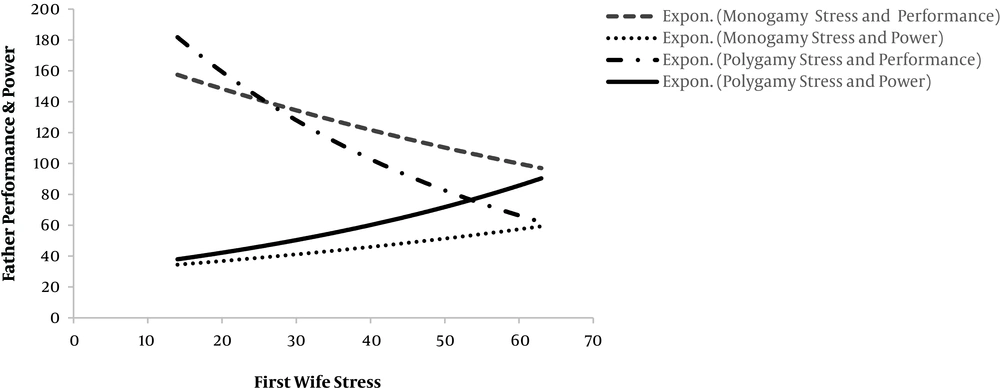
Figure 1.
Relationship between first wife stress and father’s power and performance
5. Discussion
The purpose of the present research was to compare father’s power, father’s performance, and wife’s stress in polygamous and monogamous families, and study the relationship between father’s power, performance, and wife’s stress. At first, it should be noted that the findings of this paper merely refer to the correlation between existing variables, not their causal relationships.
The results indicate that the mean power of fathers in polygamous families is more than in monogamous families in all dimensions (P ≤ 0.99). Polygamy was found more often in the families where men are more dominant, make decisions, own family resources, and determine interactional and behavioral patterns in the family. The results of the present study confirms the findings of Gray-Little et al. (16), who reported great emotional and power challenges as experienced by mothers in polygamous families. In a traditional community like Zahedan where men exercise more power, and women are denied decision making and are looked down. Polygamy is in fact the reflection of power and resource control by men in the family where they can sustain it regardless of weakened beliefs and attitudes about polygamy. Men’s power appears to be a one-sided decision that women do not have jobs and face income constraints.
A further result of the study was that the mean performance of fathers in all dimensions in monogamous families was higher than that in polygamous families. Fathers in monogamous families proved to have to better functioning in responding to family needs, emotional and affective relations, financial support, sense of responsibility and monitoring children. Such results are in line with studies by Freistadt and Strohschein (17) in Canada, Al-Krenawi et al. (18) in Jordan, and Elbedour et al. (7) in Saudi Arabia, who also reported low performance in polygamous families. Their studies indicated less marital, sexual intimacy, and low satisfaction for the polygamous mothers. Families with weak performance prove to have less marital cooperation and lower marital stability. Polygamous families do not enjoy a proper performance due to less interaction among members, family detachment, and financial inadequacy between wives, leading to marital dissatisfaction.
In the present research, mothers in the polygamous families, in comparison with their counterparts in the monogamous families were found to be irritated, aggressive, incompatible with life affairs, more concerned and unable to settle down disputes and control situations. The hypotheses was confirmed through t-test with 99 Confidence level. The results were in line with those obtained by Al-Krenawi (19), Al-Krenawi and Graham (5), Mojahed and Birashk (12), and Ozkan et al. (4). Their results showed that the structure of the family (monogamy versus polygamy) leaves psychological and social effects on mothers’ and children’s behavior.
The present study showed that men, who exercise more power and have a weak performance in the family create more stress in their wives. The results of correlation with 99% confidence level confirm the relationship between father’s power and performance and wife’s stress. Powerful polygamous men, who make the decisions and own financial resources show less emotional, affective, and sexual interaction, and weaker financial support for their first wife due to multiple emotional ties and roles. It seems that the interactional triangle formed by polygamy shatters the man’s feeling towards his first wife, decreases his responsibility towards the family, creates negative anxiety and stress for the wife, and deteriorates the familial emotional environment. The results of the studies by Al-Krenawi et al. (18), Al-Krenawi et al. (6), Daoud et al. (1), and Wusten et al. (20), indicated that the family members who encourage intimacy among themselves and exercise mutual understanding are relatively more immune against life pressures. On the other hand, lack of intimacy and severity among family members result in familial dissatisfaction and incongruity, leading to strives and emotional problems. According to Sanderson (9), husbands’ unequal distribution of emotion and finance for the wives is a very significant reason for family strives and stress. Cherian’s (10) study also indicated that polygamous families are prone to emotional challenges, stress, anxiety, and insecurity.
There are several reasons why polygamous wives, especially senior wives, have a more intense psychological distress. To describe this phenomenon, Al Sherbiny used the term first wife syndrome. The transition to a polygamous marriage structure is a life crisis for the first wife. In this syndrome, she experiences outbursts of anger and emotional problems in response to her husband’s second marriage. She may show hostility against the second wife and negative attitudes towards her husband (3). The first marriage in Zahedan for men often occurs early in life, and the first wife is selected by the man’s parents while the second marriage is arranged by the man’s contention after he has obtained more income, resources, and power in the family (16); the second and third marriages will take place out of social and religious endorsement (10).
In the second marriage, however, romantic relationships and individual choice are in effect, the husband spends time with his new wife reduces his attentiveness for the other wives and children, leading to economic and social constraints for the latter and may lead to jealousy, competition, and hostility between wives (3).
Finally, it was mentioned that the external generalizability of the findings was limited by correlation research. This method only examines the relationships between the variables, not their causal relations. Therefore, this suggests that researchers should continue to explore the family structure in forms of polygamous and monogamous so as to identify the mechanisms that cause family problems in different ways. It is highly recommended for future studies to conduct a qualitative research method to find more evidence on the effect of polygamy on the family’s father, women, and children.