


1. Background
Alzheimer’s disease (AD) is the most common cause of dementia and is recognized as one of the most important health problems in the world (1). Nowadays, the potential effects of this disease consist of loss of ability to perform daily activities, severe dependence, cognitive impairments in thinking and behavioral deficits such as fear and anxiety and ultimately death (1-3). Studies have shown that this disease progressively disrupts neuronal network communication and finally, the destruction of sensory and motor neurons (3, 4). On the other hand, today it seems that exercise and physical activity are an indispensable necessity for health and well-being. The relationship between mental health and physical well-being has long been recognized because mental health is one of the factors affecting the maximum aerobic capacity as a factor in the physical fitness of individuals related to their quality of life.
Studies have been done on the effects of exercise on anxiety, depression, and physical well-being (5-8). One of the pathologic factors that affect AD is the increased free radicals that can seriously damage brain cells. Considering the side effects of synthetic drugs and some individuals’ unwillingness to use such drugs, the attention of researchers has been drawn to herbal medicines. Saffron (with the scientific name crocus satious L.) is known to have anti-oxidant and anti-inflammatory properties, which most researchers attribute to the active ingredients and components of it such as crocin (9). Crocin is known to be an antioxidant, which boosts the cholinergic system (10). Owing to the limited applicability of some studies and the inability to control interfering interventions in human specimens, the use of animal models of this disease also has features that can provide more accurate information on therapeutic interventions in AD. Therefore, the use of trimethyltin chloride (TMT) as one of AD modeling methods has provoked interest in researchers today. This neurotoxin specifically targets and provides the apoptosis of neurons in different regions of the hippocampus and the cortex, resulting in changes in the behavior of lab animals (11). On the other hand, owing to the limited information about the effect of exercise on anxiety and physical fitness factors such as aerobic capacity in patients with AD, and also the antioxidant and enhancing effects of saffron and its active ingredients on anxiety and metabolism, conducting new studies may be effective in improving these two factors.
2. Objectives
Owing to the psychological and physical effects of AD and physical inability in individuals with AD, no study has been found to investigate the relationship between these two factors following AD and exercise. Thus the aim of this study was to investigate the effect of endurance training and crocin consumption on anxiety-like behaviors and aerobic power in rats with AD.
3. Methods
In this experimental study, 48 male Sprague Dawley rats with a mean age of eight weeks and the mean weight of 250 ± 30.65 grams were purchased and transferred to the sports physiology lab. After one week adaption to new environment; on the eighth day, 40 rats were injected intra-peritoneally with 8 mg/kg TMT (12). After 24 hours, when their complete effect on the hippocampus was assured, the rats were randomly divided into 5 groups of 8 rats, including (1) Alzheimer’s control (C), (2) endurance training (ET), (3) endurance training and crocin (ETCR), (4) crocin (CR), and (5) sham (Sh). It is worth noting that in order to investigate the effects of TMT injection on research variables, eight healthy rats were selected as the control group. During eight weeks, rats in the groups 2 and 3 ran on treadmill for three sessions per week, each session for 15 - 30 minutes with speeds of 15 - 20 m/min (13) and the groups 3 and 4 received 25 mg/kg of crocin peritoneally (14). Anxiety test was performed by elevated plus-maze (15) and aerobic power test using rats’ treadmill test. In the present study the, inclusion criteria were male sex of rats as well as age of eight weeks and the exclusion criterion was the inability to perfume endurance training for eight weeks.
3.1. Measurement of Aerobic Power
In order to determine the aerobic power or the maximum speed in rats, first, rats ran at a speed of 8 m/min for 5 minutes. In the next step, they ran at a speed of 10-15 m/min for 8 minutes; in the third step, they ran at a speed of 20 m/min for 5 minutes; and at the fourth step, at a speed of 25 m/min for 10 minutes, and afterward they ran at a speed of 30 m/min for 20 minutes. At the final step, the speed of 35 m/min was regarded as exhaustive until the rats were perpetually exposed to the end of the treadmill three times per one minute (15).
3.2. Elevated Plus-Maze
To measure anxiety, the elevated plus-maze behavioral model was used. The rats were placed inside the center of the maze, facing the open corridor. Within 5 minutes, when the animal moved freely in different parts of the maze, the number of times the animal entered the open corridor, the number of times the animal entered the closed corridor, the length of time when the animal was in the open corridor, and finally, the length of time the animal remained in the closed corridor were measured. Entering an open or closed corridor meant that all four feet of the animal were in the corridor. The time spent in each corridor was calculated accordingly (15).
3.3. Statistical Analysis
To evaluate the normal distribution of the data and weight changes in pre- and post-test, Shapiro- Wilk and paired sample t-test were used, respectively. In addition, the effect of AD induction and crocin solvent on research variables was determined by one-way ANOVA with Tukey’s post hoc test. Moreover, two-way ANOVA was used to investigate the effect of endurance training and crocin consumption on research variables. Statistical significance was set at 0.05.
3.4. Ethical Considerations
The study was approved by Larestan Branch of Islamic Azad University with code 15521423961003.
4. Results
The mean and standard deviation of the pre- and post-test of weight levels of rats are presented in Figure 1, and the mean and standard deviation of the research variables are presented in Table 1, respectively.
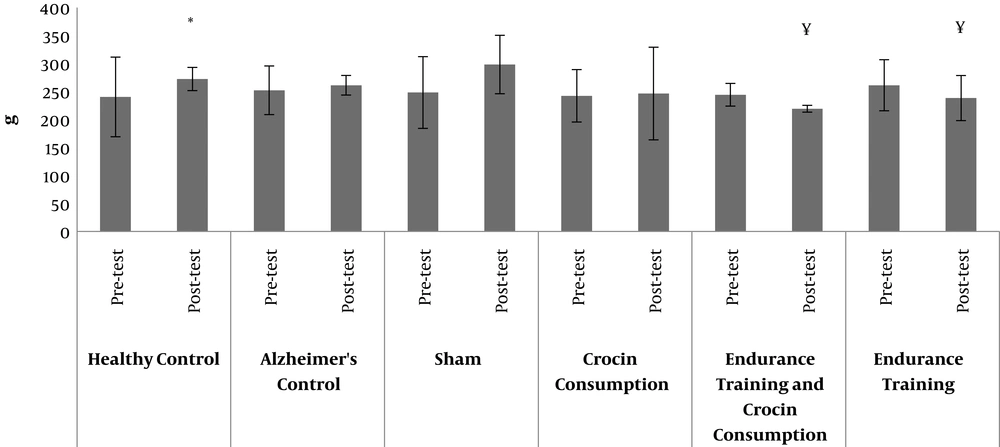
Figure 1.
Rats’ weight levels in pre-test and post-test are shown. *Significant increase compared to pre-test. ¥Significant decrease compared to pre-test
Table 1.Mean and Standard Deviation of the Research Variables in the Six Groups of the Research
| Percentage of Open Arm Entry | Percentage of Elapsed Time in the Open Arm | Aerobic Power (m/min) | |
|---|---|---|---|
| Healthy control | 41.3 ± 11.59 | 30.2 ± 13.85 | 22.3 ± 12.69 |
| Alzheimer’s control | 18.2 ± 89.97 | 14.2 ± 63.64 | 20.1 ± 83.72 |
| Sham | 20.2 ± 68.81 | 14.2 ± 38.31 | 21.2 ± 83.05 |
| Crocin consumption | 29.2 ± 17.88 | 18.2 ± 11.73 | 24.3 ± 52.29 |
| Endurance training and Crocin consumption | 38.2 ± 94.71 | 27.2 ± 60.65 | 29.1 ± 84.72 |
| Endurance training | 32.2 ± 09.50 | 32.3 ± 51.18 | 27.3 ± 35.68 |
4.1. Weight Changes
The results showed a significant increase in the weight levels of rats in the healthy control group in the post-test compared to the pre-test (P = 0.006). The weight levels of rats in the AD control (P = 0.11), sham (P = 0.85) and crocin consumption (P = 0.11) had no significant difference in the pre- and post-test. However, the weight levels of rats in the endurance training with crocin consumption (P = 0.001) and endurance training group (P = 0.001) in the post-test decreased significantly compared to the pre-test (Figure 1).
4.2. Effects of AD Induction and Crocin Solvent
To investigate the effects of induction of AD and crocin solvent between the healthy control, control of AD, and sham the results showed a significant difference in the percentage of open arm entry (P = 0.001), and the percentage of elapsed time in the open arm (P = 0.001). However, there was no significant difference in the aerobic power levels (P = 0.60) in these three groups. The results showed that induction of AD had a significant effect on decreasing the percentage of open arm entry of rats (P = 0.001). Also, there was no significant difference in the percentage of open arm entry in the control of AD and the sham (crocin solvent) (P = 0.50). The induction of AD had a significant effect on reducing the percentage of the time spent on the open arm in rats (P = 0.001), and there was no significant difference in the percentage of time elapsed in the open arm of rats in the AD control and sham (P = 0.73).
4.3. Effects of Endurance Training and Crocin Consumption
The results showed that endurance training had a significant effect on weight loss in the rats with AD (P = 0.01), but crocin consumption had no significant effect on weight loss in the rats with AD (P = 0.79). Also, endurance training and crocin consumption did not have interactive effects on weight loss in the rats with AD (P = 0.92). Endurance training (P = 0.001) and crocin consumption (P = 0.001) had a significant effect on increasing the percentage of open arm entry in the rats with AD, but endurance training and crocin consumption did not have an interactive effect on increasing the percentage of the number of open arm in the rats with AD (P = 0.09). Endurance training (P = 0.001) and crocin consumption (P = 0.001) had a significant effect on the increase in percentage of the time elapsed in the open arm in the rats with AD, but endurance training and crocin consumption had no interactive effect on increasing the percentage of time elapsed in the open arm of the rats with AD (P = 0.76). Endurance training (P = 0.001) and crocin consumption (P = 0.004) had a significant effect on increasing aerobic power in the rats with AD, but endurance training and crocin consumption had no interactive effect on increasing the aerobic power of the rats with AD (P = 0.54).
5. Discussion
The results of this study showed that endurance training had a significant effect on weight loss, increased percentage of the number of open arms, percentage of the time elapsed in the open arm, and increased aerobic power in rats with AD. Sports activities can reduce neurological stress, anxiety and depression. It seems that increased levels of serotonin and norepinephrine during exercise can reduce depression and alleviate anxiety. In other words, exercises can affect the human spirit in two ways: increasing the release of endorphins and lowering cortisol levels that are secreted in the bloodstream following neurological stress (5). In line with the present study, eight weeks of aerobic training with 60% - 70% of maximum oxygen consumption significantly reduced anxiety and improved mental health in patients with type 2 diabetes (16). In addition, 12 weeks of training with 60% - 70% of heart rate decreased the anxiety and depression of patients with metabolic syndrome (17). Also, eight weeks three sessions per week exercise had a significant effect on anxiety and stress in elderly men (18). Regarding the research conducted, the results of most studies were consistent with the present study. Therefore, it seems that various types of long-term sports activities with different intensities reduce anxiety.
The results of this study showed that consumption of crocin had a significant effect on increasing the percentage of the number of open arm entry, percentage of elapsed time in the open arm as well as aerobic power in the rats with AD. However, consumption of crocin did not significantly affect the weight-loss in the rats with AD. Noted findings show that anti-oxidant effects of crocin appear to be able to moderate the oxidative stress caused by TMT (19) in this model of AD. In line with the present study, researchers reported the anti-anxiety effects of crocin at doses of 50, 56 and 80 mg/kg (20), as well as sedative properties of crocin at a dose of 560 mg/kg. The researchers also showed anti-anxiety effects of 0.35 and 0.15 mg/kg crocin (21). On the other hand, the results of this study showed that the consumption of crocin had a significant effect on the increase of aerobic power in rats with AD. The mechanism of the effects of crocin on increasing aerobic power has not yet been completely determined, but one of the possible mechanisms of the crocin effect is an increase in metabolizing lipids (22). Studies on the effects of crocin on weight loss and fat mass are limited; however, 40 and 80 mg/kg of saffron and crocin had a significant effect on serum triglyceride levels in rats (23); as a result, crocin may reduce the oxidative stress by improving metabolism, which will have the beneficial effects on anxiety reduction in the rats with AD along with increased aerobic capacity. On the other hand, it seems that the insignificance of weight loss following crocin consumption in the present study depends on the dose of crocin because the studies above-mentioned examined doses higher than the dose of the present study.
The results of this study showed that eight weeks of endurance training simultaneously with crocin consumption had interactive effects on weight loss, increase in the number of open arm entry, percentage of the time elapsed in the open arm and aerobic power in the rats with AD. It has been reported that sport activity with increasing aerobic capacity seems to be an indicator of health-related fitness (24), increased levels of serotonin, norepinephrine, increased levels of endorphin release and decreased levels of cortisol (5) and increased parasympathetic activity (25) leads to reduction of anti-anxiety behaviors in the rats with AD. Also, it appears that crocin decreases anxiety with an oxidative stress reduction mechanism, an increase in antioxidants (26), as well as an effect on the dopaminergic system and norepinephrine reuptake inhibition (26). Furthermore, improving the metabolism of fat and metabolism of substrates (22, 26, 27) is effective in increasing the aerobic power of the rats with AD.
However, owing to inadequate studies, the mechanisms of interactive effect of training simultaneously with consumption of crocin are not known, and there is a need for extensive research in this regard. Considering the effect of calorie intake on physical health and different dimensions of mental health, a lack of measuring daily caloric intake of rats is one of the limitations of this research. Therefore, it is suggested that in future studies, caloric intake should be considered along with these factors. Considering the fact that in previous studies, the effects of crocin consumption and training on anxiety-like behaviors and aerobic power were investigated separately; therefore, the strengths of this study can be the comparison of the effect of crocin consumption and training anxiety-like behaviors and aerobic power on the rats with AD; however, the lack of consideration of different doses of crocin as well as different intensity of endurance training were the weaknesses of the present study.
5.1. Conclusions
It seems that endurance training and crocin consumption are separately effective in reducing anxiety and increasing aerobic power in the rats with AD through different pathways.




