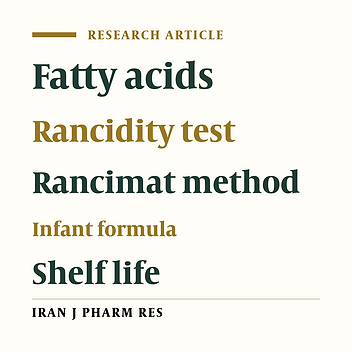
Shelf Life Prediction of Infant Formula by Using Rancidity Test
Authors
Abstract
Infant formula has a fatty acid composition that meets the needs of the neonates for unsaturated fatty acids.These fatty acids are of major importance during this period of life in which the brain and retina are developing, and will therefore have an influence upon visual acuity and learning abilities.
Oxygen reacts readily with unsaturated fatty acids, so that every time these compounds are handled there is a danger of contaminated with oxidative products. Oxidative stability is an important parameter in characterization of fats and oils.
The purpose of this study was to predict the shelf life of an infant formula using accelerated stability test (rancimat), to save time. The Rancimat method is based on conductometric determination of volatile degradation products and features automatic plotting of the conductivity against time. The evaluation was performed graphically after completion of the experiments.
The stability of a commercially available infant formula in Tehran, Iran was measured using rancimat method at temperatures of 60, 80, 90, 100, 110, 120 and 130 °C.
Equations have been derived by which the shelf life can be predicted on the basis of the Rancimat method, thus avoiding the time-consuming long-term studies. The shelf life of the commercial infant formula studied was estimated as 534 days (approximately 18 months).
Highlights
Copyright
© 2022, Author(s). This open-access article is available under the Creative Commons Attribution 4.0 (CC BY 4.0) International License (https://creativecommons.org/licenses/by/4.0/), which allows for unrestricted use, distribution, and reproduction in any medium, provided that the original work is properly cited.
Similar Articles
Detection of Oxytetracycline Residuein Infant Formulaby High-Performance Liquid Chromatography)HPLC(
Khosrokhavar R, Hosseini M, Shoeibi S, Jannat B. Detection of Oxytetracycline Residuein Infant Formulaby High-Performance Liquid Chromatography)HPLC(. Iran J Pharm Res. 2011;10(2):e125971. doi: https://doi.org/10.22037/ijpr.2011.960
Determinations of Melamine Residue in Infant Formula Brands Available in Iran Market Using by HPLC Method
Maleki J, Nazari F, Yousefi J, Khosrokhavar R, Hosseini M. Determinations of Melamine Residue in Infant Formula Brands Available in Iran Market Using by HPLC Method. Iran J Pharm Res. 2018;17(2):e124836. doi: https://doi.org/10.22037/ijpr.2018.2231
Human Breast Milk Provides Better Antioxidant Capacity than Infant Formula
Oveisi MR, Sadeghi N, Jannat B, Hajimahmoodi M, Behfar A, et al. Human Breast Milk Provides Better Antioxidant Capacity than Infant Formula. Iran J Pharm Res. 2010;9(4):e126081. doi: https://doi.org/10.22037/ijpr.2010.912
Evaluation of the stability of fatty acid content of natural lipid and frying oils available on the Iranian market during frying
Sisakhtnezhad S, Sheikhol-Islami A, Kiani A, Mohammadi B, Darzi-Ramandi M, et al. Evaluation of the stability of fatty acid content of natural lipid and frying oils available on the Iranian market during frying. J Kermanshah Univ Med Sci. 2009;12(4):e79907. doi:
Study of Cronobacter sakazakii Strains Isolated from Powdered Milk Infant Formula by Phenotypic and Molecular Methods in Iran
Mardaneh J, Soltan Dallal MM. Study of Cronobacter sakazakii Strains Isolated from Powdered Milk Infant Formula by Phenotypic and Molecular Methods in Iran. Arch Pediatr Infect Dis. 2017;5(1):e38867. doi: https://doi.org/10.5812/pedinfect.38867
- Scopus by DOI: 0
Last Update: 3 weeks ago
- Scopus by Title: 9
Last Update: 3 weeks ago
- Scopus by Title (Ref): 0
Last Update: 3 weeks ago
- CrossRef: 0
Last Update: 6 days ago
- OpenAlex: 0
Last Update: 8 hours ago
- OpenCitations: 0
Last Update: 4 days ago